ABC Family Arquivos Brasileiros de Cardiologia International Journal of Cardiovascular Sciences ABC Heart Failure & Cardiomyopathy ABC Imagem Cardiovascular
Português English
ABC Family
Português English
  • About
    • About ABC Family
    • Internal Regulation
    • Editorial Board
    • Brazilian Society of Cardiology (SBC)
  • Issues
  • SBC Guidelines
  • Content
    • Videos
    • Podcasts
    • News
  • About
    • About ABC Family
    • Internal Regulation
    • Editorial Board
    • Brazilian Society of Cardiology (SBC)
  • Issues
  • SBC Guidelines
  • Content
    • Videos
    • Podcasts
    • News

ABC Family

  • ABC Family
  • Arquivos Brasileiros de Cardiologia
  • International Journal of Cardiovascular Sciences
  • ABC Heart Failure & Cardiomyopathy
  • ABC Imagem Cardiovascular
Search in

No content found.

Journals
Ordering
Article types
Others

  1. Home
  2. Keyword: rheumatic diseases
ABC
Editorial

Beyond Remission: The Cardiometabolic Burden of ANCA-Associated Vasculitis

Manuela Fiuza

The intersection between systemic inflammation and cardiometabolic disease has emerged as a defining paradigm in contemporary medicine. Antineutrophil cytoplasmic antibody (ANCA)-associated vasculitides (AAV)—including granulomatosis with polyangiitis (GPA), microscopic polyangiitis (MPA), and eosinophilic granulomatosis with polyangiitis (EGPA)—represent a particularly compelling model where immune-mediated vascular injury coexists with a substantial and often underrecognized metabolic burden. In this issue, Bezerra et al. provide important data regarding the prevalence and predictors of metabolic syndrome (MetS) within this population.

Using the NCEP ATP III criteria, the authors report a MetS prevalence of 43.5% in a cohort of 62 consecutive AAV patients followed at a Brazilian tertiary referral center, compared with only 13.2% in age- and sex-matched controls (p=0.001). In multivariable analysis restricted to AAV patients, male sex (OR=11.43; 95%CI=2.81–46.52) and higher body mass index (OR=1.13; 95%CI=1.02–1.25) emerged as independent predictors of MetS. These findings align with prior reports in AAV populations, where MetS prevalence has ranged from 43% to 51%,– mirroring patterns seen across a broad spectrum of systemic autoimmune rheumatic diseases, including systemic lupus erythematosus, rheumatoid arthritis, and systemic sclerosis.,

[…]

  • body mass index
  • Metabolic Syndrome
  • rheumatic diseases
  • vasculitis
Read Full Article
Creative Commons Attribution (CC BY) Creative Commons license
20/07/2026 DOI: 10.36660/abc.20260373i Views 1
ABC
Original Article

Serum Thiol Levels and Thiol/Disulfide Homeostasis in Patients with Rheumatic Mitral Valve Disease and Healthy Subjects

Ahmet Korkmaz et al. Birsen Doğanay Funda Basyigit Cem Çöteli … Abdulkadir Yildiz Tugba Gursoy Umit Guray Ozgul Ucar Elalmis

Abstract

Background

Rheumatic mitral valve disease (RMVD) is the most common presentation of rheumatic heart disease (RHD). Inflammation and fibrosis processes also play significant roles in its pathogenesis. Recent studies showed that thiols and thiol-disulfide are promising novel oxidative stress markers.

Objectives

The present study aimed to evaluate differences in the serum thiol and thiol-disulfide levels in patients with RMVD and the control group.

Methods

Ninety-two patients with RMVD were enrolled in the study. Fifty-four healthy subjects, age, and gender-matched with the study group, were also included in the study as a control group. This study investigated thiol levels in patients with RMVD and the control group. P-values lower than 0.05 were considered statistically significant.

Results

The patients with RMVD presented higher systolic pulmonary artery pressure (SPAP) and left atrial (LA) diameter levels than the control group. Native thiol (407±83 μmol/L vs. 297±65 μmol/L, p<0.001) and total thiol (442±82 μmol/L vs. 329±65 μmol/L, p<0.001) levels were higher in the control group. Disulfide (16.7±4.9 μmol/L vs. 14.8±3.7 μmol/L, p=0.011) levels were higher in the group of patients with RMVD. A positive correlation was found between disulfide/native and disulfide/total thiols ratio with SPAP, LA diameter, and MS severity. Disulfide/total thiols ratio was significantly higher in patients with severe MS than with mild to moderate MS patients.

Conclusions

To the best of our knowledge, this is the only study of its kind that has evaluated thiol/disulfide homeostasis as a novel predictor, which was more closely related to RMVD and the severity of MS.

  • Echocardiography/methods
  • Homeostasis
  • Mitral Valve Stenosis
  • Oxidative Stress
  • rheumatic diseases
  • Tiol/Dissulfide
Read Full Article
Creative Commons Attribution (CC BY) Creative Commons license
02/07/2021 DOI: 10.36660/abc.20200161
ABC
Artigo Original

Amplification of the genes that codify endothelin-1 and its receptors in rheumatic mitral valves

Edmilson Bastos de Moura et al. Mariana Ribeiro Gomes Ricardo Barros Corso Cristiano Nicolleti Faber … Fabiana Pirani Carneiro Yolanda Galindo Pacheco

BACKGROUND: Cardiopathies are high prevalence conditions. Among them, rheumatic carditis is of high relevance in developing countries. Left cardiac chamber changes are associated to endothelial dysfunction and ET-1 levels increase. Pulmonary circulation is then affected, and not seldom leading to pulmonary hypertension (PH). However, the presence of ET-1 and its receptors in the mitral valve itself – promoting pulmonary vascular changes, with increased rheumatic valvular deformation – has not been discussed in the literature. OBJECTIVE: To determine the expression of endothelin gene and its receptors in rheumatic mitral valves through techniques of molecular genetics. METHODS: Twenty-seven patients submitted to mitral valve replacement had their valvular tissue examined to determine the presence of ET-1 genes and their A and B receptors. Histological and molecular analysis of the valves was performed (divided into M1, M2 and M3 fragments), with patients’ clinical and epidemiological data collected. Patients were divided into 3 groups (mitral valvopathy, mitroaortic valvopathy, and reoperation patients). RESULTS: The study showed endothelin-1 gene expression in 40.7% specimens and A receptor in all samples; receptor gene B had lower expression (22.2%). CONCLUSION: All patients showed A receptor gene expression. No statistically significant difference was observed in regard to condition severity, expressed according to functional class, and subgroups (mitral valvopathy, mitroaortic valvopathy, and reoperation patients).

  • Cardiomyopathies
  • Endothelium
  • Infection
  • Myocarditis
  • rheumatic diseases
  • Rheumatic Fever
Read Full Article
Creative Commons Attribution (CC BY) Creative Commons license
11/06/2010 DOI: 10.1590/S0066-782X2010005000059 Views 2
Neurohormonal profile of rheumatic patients with significant chronic aortic regurgitation
ABC
Artigo Original

Neurohormonal profile of rheumatic patients with significant chronic aortic regurgitation

Guilherme Sobreira Spina et al. Flávio Tarasoutchi Roney Orismar Sampaio Marcelo Luiz Campos Vieira … Célia Strunz Francisco Rafael Laurindo Max Grinberg

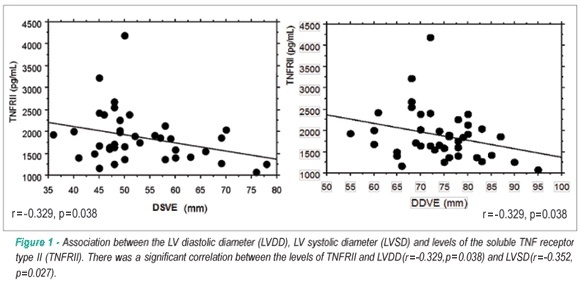
BACKGROUND: Neurohormones are involved in the physiopathology of heart failure, but little is known about its behavior in significant chronic aortic regurgitation (AR). We aimed at analyzing the behavior of these mediators in AF. OBJECTIVE: We aimed at analyzing the behavior of these mediators in AF. METHODS: We analyzed 89 patients with AF, whose mean age was 33.6±11.5 years and of whom 84.6% were males, 60% asymptomatic, all with rheumatic etiology. After the clinical and echocardiographic assessment, plasma measurements of tumor necrosis factor (TNF), soluble TNF receptor types I and II (sTNFRI e sTNFRII), interleukin-6 (IL-6), its soluble receptor (sIL6R), endothelin-1 and B-type natriuretic peptide (BNP) were carried out; 12 healthy individuals were used as controls. RESULTS: The mean values of the left ventricle diastolic diameter (LVDD) were 71.9±8.3mm, whereas the mean values of the LV systolic diameter (LVSD) were 50.4±9.3mm. The neurohormonal levels were elevated in patients with AF (TNF 92.65±110.24 pg/mL vs. 1.67±1.21 pg/ml in controls, p<0.001), (IL-6 7.17±7.78pg/ml vs. 0.81±0.38pg/mL in controls, p=0.0001) and TNFRI (894.75±348.87pg/mL vs. 521.42±395.13pg/ml, p=0.007). Except for the BNP levels, symptomatic and asymptomatic patients presented a similar neurohormonal profile. There was a correlation between TNFRII and LVDD (r=-0.329, p=0.038) and LVSD (r=-0.352, p=0.027). BNP levels were significantly higher in symptomatic patients and only in the latter it was possible to establish a correlation between BNP and ventricular diameters. CONCLUSION: Patients with significant chronic AF present high neurohormonal levels, with no correlation with the symptomatic status. The TNFRII and BNP levels could be correlated with ventricular diameters, but only the latter could be correlated with symptoms.

  • Aortic Valve Insufficiency
  • Cardiomegaly
  • pituitary hormones posterior
  • rheumatic diseases
Read Full Article
Creative Commons Attribution (CC BY) Creative Commons license
06/04/2009 DOI: 10.1590/S0066-782X2009000200012

How to cite this article

EndNote RIS

Electronic Document Format (Vancouver)

Fiuza M. Beyond Remission: The Cardiometabolic Burden of ANCA-Associated Vasculitis. Arquivos Brasileiros de Cardiologia 2026;123(4):e20260373.

Electronic Document Format (ABNT)

Fiuza, Manuela. Beyond Remission: The Cardiometabolic Burden of ANCA-Associated Vasculitis. Arquivos Brasileiros de Cardiologia, v. 123, n. 4, e20260373, Jul. 2026.

Electronic Document Format (APA)

Fiuza, M. (2026). Beyond Remission: The Cardiometabolic Burden of ANCA-Associated Vasculitis. Arquivos Brasileiros de Cardiologia, 123(4), e20260373.

Electronic Document Format (ISO)

Fiuza, Manuela. Beyond Remission: The Cardiometabolic Burden of ANCA-Associated Vasculitis. Arquivos Brasileiros de Cardiologia [online]. 2026, vol. 123, n. 4, [cited 2026-10-14], e20260373. Available from: <https://journals.cardiol.br/en/article/beyond-remission-the-cardiometabolic-burden-of-anca-associated-vasculitis/>. ISSN 0066-782X

EndNote RIS

Electronic Document Format (Vancouver)

Korkmaz A, Doğanay B, Basyigit F, Çöteli C, Yildiz A, Gursoy T, Guray U, et al. Serum Thiol Levels and Thiol/Disulfide Homeostasis in Patients with Rheumatic Mitral Valve Disease and Healthy Subjects. Arquivos Brasileiros de Cardiologia 2021;117(3):437-43.

Electronic Document Format (ABNT)

Korkmaz, Ahmet; Doğanay, Birsen; Basyigit, Funda; Çöteli, Cem; Yildiz, Abdulkadir; Gursoy, Tugba; Guray, Umit; Elalmis, Ozgul Ucar. Serum Thiol Levels and Thiol/Disulfide Homeostasis in Patients with Rheumatic Mitral Valve Disease and Healthy Subjects. Arquivos Brasileiros de Cardiologia, v. 117, n. 3, p. 437-443, Jul. 2021.

Electronic Document Format (APA)

Korkmaz, A., Doğanay, B., Basyigit, F., Çöteli, C., Yildiz, A., Gursoy, T., Guray, U., & Elalmis, O. U. (2021). Serum Thiol Levels and Thiol/Disulfide Homeostasis in Patients with Rheumatic Mitral Valve Disease and Healthy Subjects. Arquivos Brasileiros de Cardiologia, 117(3), 437-443.

Electronic Document Format (ISO)

Korkmaz, Ahmet and Doğanay, Birsen and Basyigit, Funda and Çöteli, Cem and Yildiz, Abdulkadir and Gursoy, Tugba and Guray, Umit and Elalmis, Ozgul Ucar. Serum Thiol Levels and Thiol/Disulfide Homeostasis in Patients with Rheumatic Mitral Valve Disease and Healthy Subjects. Arquivos Brasileiros de Cardiologia [online]. 2021, vol. 117, n. 3, [cited 2026-10-14], pp. 437-443. Available from: <https://journals.cardiol.br/en/article/serum-thiol-levels-and-thiol-disulfide-homeostasis-in-patients-with-rheumatic-mitral-valve-disease-and-healthy-subjects/>. ISSN 0066-782X

EndNote RIS

Electronic Document Format (Vancouver)

Moura EB, Gomes MR, Corso RB, Faber CN, Carneiro FP, Pacheco YG. Amplification of the genes that codify endothelin-1 and its receptors in rheumatic mitral valves. Arquivos Brasileiros de Cardiologia 2010;95(1):122-30.

Electronic Document Format (ABNT)

Moura, Edmilson Bastos de; Gomes, Mariana Ribeiro; Corso, Ricardo Barros; Faber, Cristiano Nicolleti; Carneiro, Fabiana Pirani; Pacheco, Yolanda Galindo. Amplification of the genes that codify endothelin-1 and its receptors in rheumatic mitral valves. Arquivos Brasileiros de Cardiologia, v. 95, n. 1, p. 122-130, Jun. 2010.

Electronic Document Format (APA)

Moura, E. B. , Gomes, M. R., Corso, R. B., Faber, C. N., Carneiro, F. P., & Pacheco, Y. G. (2010). Amplification of the genes that codify endothelin-1 and its receptors in rheumatic mitral valves. Arquivos Brasileiros de Cardiologia, 95(1), 122-130.

Electronic Document Format (ISO)

Moura, Edmilson Bastos de and Gomes, Mariana Ribeiro and Corso, Ricardo Barros and Faber, Cristiano Nicolleti and Carneiro, Fabiana Pirani and Pacheco, Yolanda Galindo. Amplification of the genes that codify endothelin-1 and its receptors in rheumatic mitral valves. Arquivos Brasileiros de Cardiologia [online]. 2010, vol. 95, n. 1, [cited 2026-10-14], pp. 122-130. Available from: <https://journals.cardiol.br/en/article/amplification-of-the-genes-that-codify-endothelin-1-and-its-receptors-in-rheumatic-mitral-valves/>. ISSN 0066-782X

EndNote RIS

Electronic Document Format (Vancouver)

Spina GS, Tarasoutchi F, Sampaio RO, Vieira MLC, Strunz C, Laurindo FR, Grinberg M, et al. Neurohormonal profile of rheumatic patients with significant chronic aortic regurgitation. Arquivos Brasileiros de Cardiologia 2009;92(2):150-6.

Electronic Document Format (ABNT)

Spina, Guilherme Sobreira; Tarasoutchi, Flávio; Sampaio, Roney Orismar; Vieira, Marcelo Luiz Campos; Strunz, Célia; Laurindo, Francisco Rafael; Grinberg, Max. Neurohormonal profile of rheumatic patients with significant chronic aortic regurgitation. Arquivos Brasileiros de Cardiologia, v. 92, n. 2, p. 150-156, Apr. 2009.

Electronic Document Format (APA)

Spina, G. S., Tarasoutchi, F., Sampaio, R. O., Vieira, M. L. C., Strunz, C., Laurindo, F. R., & Grinberg, M. (2009). Neurohormonal profile of rheumatic patients with significant chronic aortic regurgitation. Arquivos Brasileiros de Cardiologia, 92(2), 150-156.

Electronic Document Format (ISO)

Spina, Guilherme Sobreira and Tarasoutchi, Flávio and Sampaio, Roney Orismar and Vieira, Marcelo Luiz Campos and Strunz, Célia and Laurindo, Francisco Rafael and Grinberg, Max. Neurohormonal profile of rheumatic patients with significant chronic aortic regurgitation. Arquivos Brasileiros de Cardiologia [online]. 2009, vol. 92, n. 2, [cited 2026-10-14], pp. 150-156. Available from: <https://journals.cardiol.br/en/article/neurohormonal-profile-of-rheumatic-patients-with-significant-chronic-aortic-regurgitation/>. ISSN 0066-782X

  • About ABC Family
  • Internal Regulation
  • Editorial Board
  • Brazilian Society of Cardiology (SBC)

Issues

SBC Guidelines

  • Videos
  • Podcasts
  • News