ABC Family Arquivos Brasileiros de Cardiologia International Journal of Cardiovascular Sciences ABC Heart Failure & Cardiomyopathy ABC Imagem Cardiovascular
Português English
ABC Family
Português English
  • About
    • About ABC Family
    • Internal Regulation
    • Editorial Board
    • Brazilian Society of Cardiology (SBC)
  • Issues
  • SBC Guidelines
  • Content
    • Videos
    • Podcasts
    • News
  • About
    • About ABC Family
    • Internal Regulation
    • Editorial Board
    • Brazilian Society of Cardiology (SBC)
  • Issues
  • SBC Guidelines
  • Content
    • Videos
    • Podcasts
    • News

ABC Family

  • ABC Family
  • Arquivos Brasileiros de Cardiologia
  • International Journal of Cardiovascular Sciences
  • ABC Heart Failure & Cardiomyopathy
  • ABC Imagem Cardiovascular
Search in

No content found.

Journals
Ordering
Article types
Others

  1. Home
  2. Keyword: renal transplantation
Serum homocysteine levels in renal transplant recipients with and without hypercholesterolemia
ABC
Artigo Original

Serum homocysteine levels in renal transplant recipients with and without hypercholesterolemia

Fabiana Piovesan et al. Francisco José Veríssimo Veronese Auri Ferreira Santos Roberta Pozza … Péricles Serafim Sarturi Alexandre Tognon Valter Duro Garcia Elizete Keitel David Saitovitch

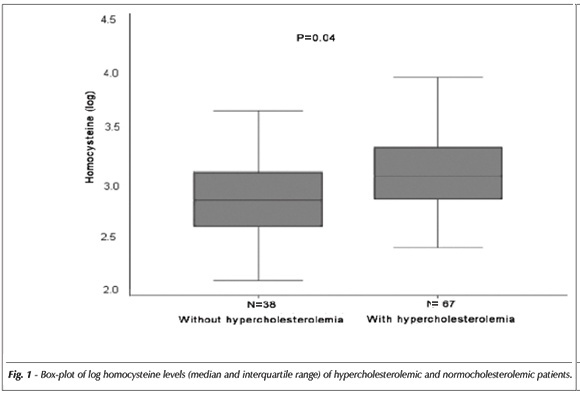
BACKGROUND: Hyperhomocysteinemia seems to be frequent after renal transplantation. No study so far has assessed the role of homocysteine (Hcy) associated with dyslipidemia in Brazil. OBJECTIVE: To determine the prevalence of hyperhomocysteinemia (serum Hcy >15 mmol/l) in stable renal transplant recipients and to evaluate the role of serum lipids and graft function in serum Hcy levels. METHODS: One hundred and five stable renal transplant recipients were evaluated, considering age, post-transplant time, cholesterol levels, graft function, proteinuria, and cyclosporine (analyzed using multiple linear regression). The prevalence of hyperhomocysteinemia was 74.3%. Patients were further divided into two groups, hyper (total cholesterol >200mg/dl, LDL-cholesterol >130mg/dl) and normocholesterolemic. RESULTS: Hypercholesterolemic recipients were older, had shorter post-transplant time, lower endogenous creatinine clearance, and higher proteinuria and Hcy serum levels. Patients with hyperhomocysteinemia had statistically significantly higher serum triglycerides and poorer graft function, and their LDL-cholesterol also tended to be higher. A positive correlation was found between serum creatinine and Hcy levels (r = 0.32, P = 0.01). Multiple regression analysis revealed that both dyslipidemia and renal function independently affect Hcy values. CONCLUSION: We observed a high prevalence of hyperhomocysteinemia in renal transplant recipients, especially in hypercholesterolemic, suggesting that worse graft function may influence serum Hcy and cholesterol levels negatively. Further studies should investigate if this adverse metabolic profile is associated with higher cardiovascular mortality in the long term.
  • dyslipidemia
  • hyperhomocysteinemia
  • renal transplantation
Read Full Article
Creative Commons Attribution (CC BY) Creative Commons license
25/09/2007 DOI: 10.1590/S0066-782X2007001500005
ABC
Artigo de Pesquisa

Hypolipidemic treatment under special conditions: posttransplant and/or immunosupressive therapy

Maria Cristina de Oliveira Izar

There are limited data regarding the use of hypolipidemic agents concomitantly with immunosuppressive drugs. Best evidence is provided for the use of statins and cyclosporine. In terms of pharmacodynamics, these two drugs have different substrates. In respect to pharmacokinetics, statins usually do not modify serum concentrations of cyclosporine, however when combined with any statin a careful monitoring of cyclosporine levels is recommended, due to a narrow therapeutic window of the immunosupressive agent. Conversely, cyclosporine does affect the area under the curve for many statins, by inhibiting the CYP450 3A4, thus increasing systemic exposure to statins. Pravastatin appears to be the safest compound, once it is glucuronized. The area under the curve for the other statins (simvastatin, lovastatin, atorvastatin, cerivastatin, and rosuvastatin) can be increased in variable degrees according to the site of metabolization, liver extraction by OATP-C transporter, biliary secretion, renal excretion, and drug extrusion by the MDR system.

  • cyclosporine
  • immunosuppressive therapy
  • renal transplantation
  • Statins
Read Full Article
Creative Commons Attribution (CC BY) Creative Commons license
02/01/2006 DOI: 10.1590/S0066-782X2005002400013
Cardiovascular disease and risk factors in candidates for renal transplantation
ABC
Artigo Original

Cardiovascular disease and risk factors in candidates for renal transplantation

Luís Henrique Wolff Gowdak et al. Flávio Jota de Paula Dante Marcelo Artigas Giorgi Marcelo Luís Campos Vieira … Eduardo Moacyr Krieger José Jayme Galvão De Lima

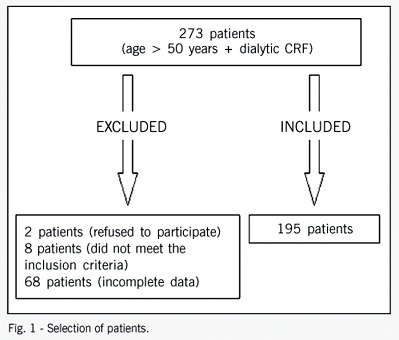
OBJECTIVE: To determine the prevalence of cardiovascular disease (CVD) and traditional risk factors in patients with chronic renal failure undergoing evaluation for inclusion on the renal transplantation list. METHODS: One hundred ninety-five patients with dialytic chronic renal failure underwent clinical evaluation and complementary tests and were compared with a group of 334 hypertensive patients paired for age. The Framingham equations were used for calculating the absolute risk (AR). The relative risk (RR) was calculated based on the absolute risk of the low-risk Framingham cohort. RESULTS: Thirty-seven percent of the patients had some sort of cardiovascular disease on the initial evaluation, peripheral vascular disease (23%) being the most prevalent. Patients with cardiovascular disease were excluded. Regarding traditional risk factors, a significant difference was observed in systolic blood pressure and total cholesterol (greater in the hypertensive group), and in the prevalence of men, diabetes, and smoking, which were greater in the chronic renal failure group. The latter had a greater degree of left ventricular hypertrophy, lower diastolic blood pressure, and a lower prevalence of familial history of cardiovascular disease and obesity. The relative risk for cardiovascular disease in patients with chronic renal failure was greater compared with that in the Framingham control population, but it did not differ from that observed in the group of hypertensive individuals. CONCLUSION: The prevalence of cardiovascular disease and traditional risk factors is high among candidates for renal transplantation; the Framingham equations do not adequately quantify the real cardiovascular risk, and other risk factors specific for that population should contribute for their greater cardiovascular risk.

  • Cardiovascular disease
  • renal transplantation
  • Risk Factors
Read Full Article
Creative Commons Attribution (CC BY) Creative Commons license
08/03/2005 DOI: 10.1590/S0066-782X2005000200012 Views 2
Myocardial revascularization in renal transplant patients
ABC
Original Article

Myocardial revascularization in renal transplant patients

Daniel de Souza Delgado et al. Luís Roberto Gerola Nelson Américo Hossne Jr. João Nelson R. Branco Enio Buffolo

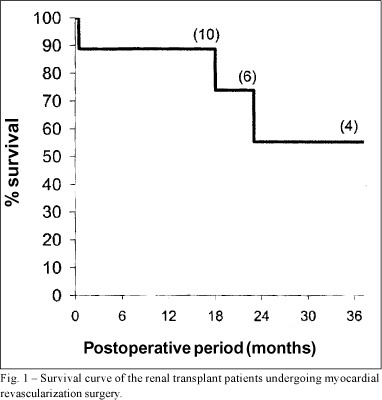
OBJECTIVE: To assess the results of surgical myocardial revascularization in renal transplant patients. METHODS: From 1991 to 2000, 11 renal transplant patients, whose ages ranged from 36 to 59 (47.5±8) years, 8 males and 3 females, underwent myocardial revascularization. The time interval between renal transplantation and myocardial revascularization ranged from 25 to 120 (mean of 63.8±32.7) months. RESULTS: The in-hospital mortality rate was 9%. One patient died on the 4th postoperative day from septicemia and respiratory failure. The mean graft/patient ratio was 2.7±0.8. Only 1 patient required slow hemodialysis during 24 hours in the postoperative period, and no patient had a definitive renal lesion or lost the transplanted kidney. The actuarial survival curves after 1, 2, and 3 years were, respectively, 90.9%, 56.8%, and 56.8%. CONCLUSION: Renal transplant patients may undergo myocardial revascularization with no lesion in or loss of the transplanted kidney.

  • coronary atherosclerosis
  • Myocardial Revascularization
  • renal transplantation
Read Full Article
Creative Commons Attribution (CC BY) Creative Commons license
17/12/2002 DOI: 10.1590/S0066-782X2002001400005 Views 2

How to cite this article

EndNote RIS

Electronic Document Format (Vancouver)

Piovesan F, Veronese FJV, Santos AF, Pozza R, Sarturi PS, Tognon A, Garcia VD, et al. Serum homocysteine levels in renal transplant recipients with and without hypercholesterolemia. Arquivos Brasileiros de Cardiologia 2007;89(3):170-5.

Electronic Document Format (ABNT)

Piovesan, Fabiana; Veronese, Francisco José Veríssimo; Santos, Auri Ferreira; Pozza, Roberta; Sarturi, Péricles Serafim; Tognon, Alexandre; Garcia, Valter Duro; Keitel, Elizete; Saitovitch, David. Serum homocysteine levels in renal transplant recipients with and without hypercholesterolemia. Arquivos Brasileiros de Cardiologia, v. 89, n. 3, p. 170-175, Sep. 2007.

Electronic Document Format (APA)

Piovesan, F., Veronese, F. J. V., Santos, A. F., Pozza, R., Sarturi, P. S., Tognon, A., Garcia, V. D., Keitel, E., & Saitovitch, D. (2007). Serum homocysteine levels in renal transplant recipients with and without hypercholesterolemia. Arquivos Brasileiros de Cardiologia, 89(3), 170-175.

Electronic Document Format (ISO)

Piovesan, Fabiana and Veronese, Francisco José Veríssimo and Santos, Auri Ferreira and Pozza, Roberta and Sarturi, Péricles Serafim and Tognon, Alexandre and Garcia, Valter Duro and Keitel, Elizete and Saitovitch, David. Serum homocysteine levels in renal transplant recipients with and without hypercholesterolemia. Arquivos Brasileiros de Cardiologia [online]. 2007, vol. 89, n. 3, [cited 2026-10-14], pp. 170-175. Available from: <https://journals.cardiol.br/en/article/serum-homocysteine-levels-in-renal-transplant-recipients-with-and-without-hypercholesterolemia/>. ISSN 0066-782X

EndNote RIS

Electronic Document Format (Vancouver)

Izar MCO. Hypolipidemic treatment under special conditions: posttransplant and/or immunosupressive therapy. Arquivos Brasileiros de Cardiologia 2006;85(suppl 5):50-7.

Electronic Document Format (ABNT)

Izar, Maria Cristina de Oliveira. Hypolipidemic treatment under special conditions: posttransplant and/or immunosupressive therapy. Arquivos Brasileiros de Cardiologia, v. 85, n. suppl 5, p. 50-57, Jan. 2006.

Electronic Document Format (APA)

Izar, M. C. O. (2006). Hypolipidemic treatment under special conditions: posttransplant and/or immunosupressive therapy. Arquivos Brasileiros de Cardiologia, 85(suppl 5), 50-57.

Electronic Document Format (ISO)

Izar, Maria Cristina de Oliveira. Hypolipidemic treatment under special conditions: posttransplant and/or immunosupressive therapy. Arquivos Brasileiros de Cardiologia [online]. 2006, vol. 85, n. suppl 5, [cited 2026-10-14], pp. 50-57. Available from: <https://journals.cardiol.br/article/hypolipidemic-treatment-under-special-conditions-posttransplant-and-or-immunosupressive-therapy/>. ISSN 0066-782X

EndNote RIS

Electronic Document Format (Vancouver)

Gowdak LHW, Paula FJ, Giorgi DMA, Vieira MLC, Krieger EM, Lima JJGD. Cardiovascular disease and risk factors in candidates for renal transplantation. Arquivos Brasileiros de Cardiologia 2005;84(2):156-60.

Electronic Document Format (ABNT)

Gowdak, Luís Henrique Wolff; Paula, Flávio Jota de; Giorgi, Dante Marcelo Artigas; Vieira, Marcelo Luís Campos; Krieger, Eduardo Moacyr; Lima, José Jayme Galvão De. Cardiovascular disease and risk factors in candidates for renal transplantation. Arquivos Brasileiros de Cardiologia, v. 84, n. 2, p. 156-160, Mar. 2005.

Electronic Document Format (APA)

Gowdak, L. H. W., Paula, F. J. , Giorgi, D. M. A., Vieira, M. L. C., Krieger, E. M., & Lima, J. J. G. D. (2005). Cardiovascular disease and risk factors in candidates for renal transplantation. Arquivos Brasileiros de Cardiologia, 84(2), 156-160.

Electronic Document Format (ISO)

Gowdak, Luís Henrique Wolff and Paula, Flávio Jota de and Giorgi, Dante Marcelo Artigas and Vieira, Marcelo Luís Campos and Krieger, Eduardo Moacyr and Lima, José Jayme Galvão De. Cardiovascular disease and risk factors in candidates for renal transplantation. Arquivos Brasileiros de Cardiologia [online]. 2005, vol. 84, n. 2, [cited 2026-10-14], pp. 156-160. Available from: <https://journals.cardiol.br/en/article/cardiovascular-disease-and-risk-factors-in-candidates-for-renal-transplantation/>. ISSN 0066-782X

EndNote RIS

Electronic Document Format (Vancouver)

Delgado DS, Gerola LR, Hossne Jr. NA, Branco JNR, Buffolo E. Myocardial revascularization in renal transplant patients. Arquivos Brasileiros de Cardiologia 2002;79(5):480-3.

Electronic Document Format (ABNT)

Delgado, Daniel de Souza; Gerola, Luís Roberto; Hossne Jr., Nelson Américo; Branco, João Nelson R.; Buffolo, Enio. Myocardial revascularization in renal transplant patients. Arquivos Brasileiros de Cardiologia, v. 79, n. 5, p. 480-483, Dec. 2002.

Electronic Document Format (APA)

Delgado, D. S., Gerola, L. R., Hossne Jr., N. A., Branco, J. N. R., & Buffolo, E. (2002). Myocardial revascularization in renal transplant patients. Arquivos Brasileiros de Cardiologia, 79(5), 480-483.

Electronic Document Format (ISO)

Delgado, Daniel de Souza and Gerola, Luís Roberto and Hossne Jr., Nelson Américo and Branco, João Nelson R. and Buffolo, Enio. Myocardial revascularization in renal transplant patients. Arquivos Brasileiros de Cardiologia [online]. 2002, vol. 79, n. 5, [cited 2026-10-14], pp. 480-483. Available from: <https://journals.cardiol.br/en/article/myocardial-revascularization-in-renal-transplant-patients/>. ISSN 0066-782X

  • About ABC Family
  • Internal Regulation
  • Editorial Board
  • Brazilian Society of Cardiology (SBC)

Issues

SBC Guidelines

  • Videos
  • Podcasts
  • News