ABC Family Arquivos Brasileiros de Cardiologia International Journal of Cardiovascular Sciences ABC Heart Failure & Cardiomyopathy ABC Imagem Cardiovascular
Português English
ABC Family
Português English
  • About
    • About ABC Family
    • Internal Regulation
    • Editorial Board
    • Brazilian Society of Cardiology (SBC)
  • Issues
  • SBC Guidelines
  • Content
    • Videos
    • Podcasts
    • News
  • About
    • About ABC Family
    • Internal Regulation
    • Editorial Board
    • Brazilian Society of Cardiology (SBC)
  • Issues
  • SBC Guidelines
  • Content
    • Videos
    • Podcasts
    • News

ABC Family

  • ABC Family
  • Arquivos Brasileiros de Cardiologia
  • International Journal of Cardiovascular Sciences
  • ABC Heart Failure & Cardiomyopathy
  • ABC Imagem Cardiovascular
Search in

No content found.

Journals
Ordering
Article types
Others

  1. Home
  2. Keyword: Patient Education as Topic
Assessment of ChatGPT-4.0 versus ChatGPT-Mini in Generating Guideline-Based Hypertension Content
ABC
Original Article

Assessment of ChatGPT-4.0 versus ChatGPT-Mini in Generating Guideline-Based Hypertension Content

Rômullo José Costa Ataídes et al. Marcos Adriano Garcia Campos João Vítor Perez de Souza Rafael Cardoso Rocha … Almir Alamino Lacalle Ciro Bezerra Vieira Thiago Artioli Tiago Cordeiro Medeiros Erito Marques de Souza Filho Ronaldo Gismondi Érika Maria Gonçalves Campana Francisco José Romeo Victor Razuk João Ricardo Nickenig Vissoci Renato Delascio Lopes

Abstract

Background

Artificial intelligence (AI) language models are increasingly used to generate patient education materials. However, their accuracy, completeness, and adherence to clinical guidelines remain uncertain.

Objectives

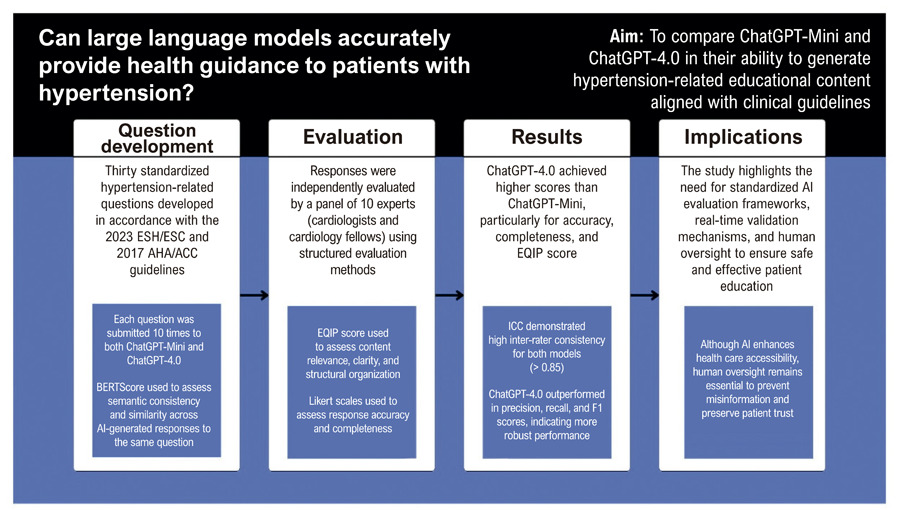
To compare ChatGPT-Mini and ChatGPT-4.0 in the generation of hypertension education content with respect to accuracy, completeness, structural quality using the Ensuring Quality Information for Patients (EQIP), response consistency, and alignment with established guidelines.

Methods

A standardized set of 31 hypertension-related questions was submitted to both models. Outputs were independently evaluated by 10 blinded clinicians using a modified EQIP score, a 5-point accuracy scale, and a 3-point completeness scale. Response consistency was assessed using BERTScore. Between-model comparisons were performed using the two-sided Wilcoxon rank-sum test (p < 0.05). Effect sizes were reported as Hodges–Lehmann (HL) median differences and Cliff’s delta (δ), both with 95% CIs. Inter-rater reliability was estimated using the intraclass correlation coefficient (ICC; two-way random effects model, absolute agreement).

Results

Central tendency measures favored ChatGPT-4.0, although differences were small. Median scores were as follows: accuracy, 4.10 (3.70-4.20) versus 3.73 (3.60-4.05); completeness, 1.26 (1.17-1.41) versus 1.10 (0.96-1.23); and total EQIP score, 19.5 (18.0-25.0) versus 18.5 (16.0-23.0) for ChatGPT-4.0 and ChatGPT-Mini, respectively. HL median differences were small, with 95% CIs crossing zero (accuracy: +0.37, −0.25 to +0.50; completeness: +0.16, −0.06 to +0.36; EQIP: +1.0, −1.0 to +6.0). Cliff’s δ values were consistently small and positive across primary outcomes, indicating only modest stochastic dominance of ChatGPT-4.0. Identification clarity tended to be higher with ChatGPT-4.0, whereas response consistency measured by BERTScore F1 was generally higher for ChatGPT-Mini (> 0.92 versus 0.885-0.932). Inter-rater reliability was good to excellent across all measures (ICC > 0.80).

Conclusions

ChatGPT-4.0 demonstrated small, non-significant improvements in accuracy, completeness, and structural quality compared with ChatGPT-Mini. Effect sizes were modest, and all 95% CIs included zero. ChatGPT-Mini produced more consistent responses. These findings underscore the importance of routinely reporting effect sizes with 95% CIs and support the use of standardized evaluation methods and real-time validation frameworks for AI-generated medical education content.

  • Artificial Intelligence
  • Hypertension
  • Patient Education as Topic
Read Full Article
Creative Commons Attribution (CC BY) Creative Commons license
16/03/2026 DOI: 10.36660/abc.20250498i Views 1
ABC
Original Article

Validation of the Brazilian Version of CADE-Q II to Assess Knowledge of Coronary Artery Disease Patients

Rafaella Zulianello dos Santos et al. Gabriela Lima Melo Ghisi Christiani Decker Batista Bonin Gabriela Chaves … Clarissa Machado Haase Raquel Rodrigues Britto Magnus Benetti

Abstract

Background:

The Coronary Artery Disease Education Questionnaire (CADE-Q), an instrument aimed at assessing patients’ knowledge about coronary artery disease (CAD), was originally developed and psychometrically validated in Brazil. It was later translated, cross-culturally adapted, and validated to English. Although both versions demonstrated good reliability and validity, new studies in the area have pointed out the need of implementing the CADE-Q with other components of cardiac rehabilitation (CR) programs, such as psychologic factors, which had not been considered in previous version and were added in the subsequent, adapted version. Thus, a second version of CADE-Q was developed in English, the CADE-Q II.

Objective:

to translate, culturally adapt and psychometrically validate the CADE-Q II in Brazilian Portuguese.

Methods:

After translation and review by a Committee of specialists in CR, a version in Brazilian Portuguese was generated and tested in 307 patients in CR. Test-retest reliability was assessed by intraclass correlation coefficient (ICC) in 49 patients; internal consistency was assessed using Cronbach’s alpha (α); and, criterion validity was assessed regarding patients’ educational level and family income. The level of significance adopted for all tests was 5%.

Results:

After the ICC analysis, 4 items were excluded. The questionnaire was considered internally consistent (α > 0.7). Associations were found between the mean total scores and the variables schooling (p < 0.001) and income (p < 0.001). Median total score was 53 (14) points corresponding to 65.4% of the total possible score.

Conclusion:

The Portuguese version of the CADE-Q II showed sufficient reliability, consistency and validity, supporting its use in future studies.

  • Cardiac Rehabilitation
  • Cardiovascular Diseases/physiopathology
  • Coronary Artery Disease
  • Patient Education as Topic
  • Surveys and Questionnaires
  • Validation Studies
Read Full Article
Creative Commons Attribution (CC BY) Creative Commons license
17/12/2018 DOI: 10.5935/abc.20180244 Views 1
ABC
Original Article

Validation of the Brazilian-Portuguese Version of a Short Questionnaire to Assess Knowledge in Cardiovascular Disease Patients (CADE-Q SV)

Gabriela Lima de Melo Ghisi et al. Gabriela S. S. Chaves Jessica Blanco Loures Gabriela Moreira Bonfim Raquel Britto

Abstract

Background:

Patient education is an essential part of cardiovascular patients’ care targeting self-management behavior to reduce risk factors and subsequent events. Herein, a short and reliable tool to assess patients’ knowledge in Brazil is warranted.

Objectives:

To translate, culturally-adapt and psychometrically validate the Portuguese version of the Coronary Artery Disease Education Questionnaire Short Version (CADE-Q SV).

Methods:

The Portuguese CADE-Q SV – translated and culturally-adapted – was reviewed by five bilingual experts in cardiovascular disease. This version was then pre-tested in 21 patients, and clarity of items was checked using a Likert-type scale ranging from 1 = not clear to 10 = very clear. It was then psychometrically tested in 200 cardiovascular patients (41%women; mean age = 58.4 ± 11.6 years old). The internal consistency was assessed using Kuder-Richardson-20 (KR-20) and Cronbach’s alpha, test-retest reliability through intraclass correlation coefficient (ICC), factor structure using confirmatory factor analysis, and construct validity regarding educational level, family income, and time of diagnosis.

Results:

All questions were considered clear by patients (clarity range:7.8-9.6). KR-20 was 0.70. All ICC values were > 0.70. Factor analysis revealed 6 factors, all internally consistent. Construct validity was supported by significant differences in total scores by educational level and family income (p < 0.001). The overall mean was 13.08 ± 2.61. The area with the highest knowledge was risk factors and the lowest was psychosocial risk.

Conclusions:

The Portuguese CADE-SV was demonstrated to have good validity and reliability. This tool can be applicable in clinical and research settings, assessing cardiovascular patients’ knowledge as part of an education programming.

  • Cardiovascular Diseases
  • Coronary Artery Disease
  • Educational Status
  • Knowledge
  • Patient Education as Topic
  • Surveys and Questionnaires
Read Full Article
Creative Commons Attribution (CC BY) Creative Commons license
21/09/2018 DOI: 10.5935/abc.20180169 Views 1

How to cite this article

EndNote RIS

Electronic Document Format (Vancouver)

Ataídes RJC, Campos MAG, Souza JVP, Rocha RC, Lacalle AA, Vieira CB, Artioli T, et al. Assessment of ChatGPT-4.0 versus ChatGPT-Mini in Generating Guideline-Based Hypertension Content. Arquivos Brasileiros de Cardiologia 2026;123(2):e20250498.

Electronic Document Format (ABNT)

Ataídes, Rômullo José Costa; Campos, Marcos Adriano Garcia; Souza, João Vítor Perez de; Rocha, Rafael Cardoso; Lacalle, Almir Alamino; Vieira, Ciro Bezerra; Artioli, Thiago; Medeiros, Tiago Cordeiro; Souza Filho, Erito Marques de; Gismondi, Ronaldo; Campana, Érika Maria Gonçalves; Romeo, Francisco José; Razuk, Victor; Vissoci, João Ricardo Nickenig; Lopes, Renato Delascio. Assessment of ChatGPT-4.0 versus ChatGPT-Mini in Generating Guideline-Based Hypertension Content. Arquivos Brasileiros de Cardiologia, v. 123, n. 2, e20250498, Mar. 2026.

Electronic Document Format (APA)

Ataídes, R. J. C., Campos, M. A. G., Souza, J. V. P. , Rocha, R. C., Lacalle, A. A., Vieira, C. B., Artioli, T., Medeiros, T. C., Souza Filho, E. M. , Gismondi, R., Campana, M. G., Romeo, F. J., Razuk, V., Vissoci, J. R. N., & Lopes, R. D. (2026). Assessment of ChatGPT-4.0 versus ChatGPT-Mini in Generating Guideline-Based Hypertension Content. Arquivos Brasileiros de Cardiologia, 123(2), e20250498.

Electronic Document Format (ISO)

Ataídes, Rômullo José Costa and Campos, Marcos Adriano Garcia and Souza, João Vítor Perez de and Rocha, Rafael Cardoso and Lacalle, Almir Alamino and Vieira, Ciro Bezerra and Artioli, Thiago and Medeiros, Tiago Cordeiro and Souza Filho, Erito Marques de and Gismondi, Ronaldo and Campana, Érika Maria Gonçalves and Romeo, Francisco José and Razuk, Victor and Vissoci, João Ricardo Nickenig and Lopes, Renato Delascio. Assessment of ChatGPT-4.0 versus ChatGPT-Mini in Generating Guideline-Based Hypertension Content. Arquivos Brasileiros de Cardiologia [online]. 2026, vol. 123, n. 2, [cited 2026-10-14], e20250498. Available from: <https://journals.cardiol.br/en/article/assessment-of-chatgpt-4-0-versus-chatgpt-mini-in-generating-guideline-based-hypertension-content/>. ISSN 0066-782X

EndNote RIS

Electronic Document Format (Vancouver)

Santos RZ, Ghisi GLM, Bonin CDB, Chaves G, Haase CM, Britto RR, Benetti M, et al. Validation of the Brazilian Version of CADE-Q II to Assess Knowledge of Coronary Artery Disease Patients. Arquivos Brasileiros de Cardiologia 2018;112(1):78-84.

Electronic Document Format (ABNT)

Santos, Rafaella Zulianello dos; Ghisi, Gabriela Lima Melo; Bonin, Christiani Decker Batista; Chaves, Gabriela; Haase, Clarissa Machado; Britto, Raquel Rodrigues; Benetti, Magnus. Validation of the Brazilian Version of CADE-Q II to Assess Knowledge of Coronary Artery Disease Patients. Arquivos Brasileiros de Cardiologia, v. 112, n. 1, p. 78-84, Dec. 2018.

Electronic Document Format (APA)

Santos, R. Z. , Ghisi, G. L. M., Bonin, C. D. B., Chaves, G., Haase, C. M., Britto, R. R., & Benetti, M. (2018). Validation of the Brazilian Version of CADE-Q II to Assess Knowledge of Coronary Artery Disease Patients. Arquivos Brasileiros de Cardiologia, 112(1), 78-84.

Electronic Document Format (ISO)

Santos, Rafaella Zulianello dos and Ghisi, Gabriela Lima Melo and Bonin, Christiani Decker Batista and Chaves, Gabriela and Haase, Clarissa Machado and Britto, Raquel Rodrigues and Benetti, Magnus. Validation of the Brazilian Version of CADE-Q II to Assess Knowledge of Coronary Artery Disease Patients. Arquivos Brasileiros de Cardiologia [online]. 2018, vol. 112, n. 1, [cited 2026-10-14], pp. 78-84. Available from: <https://journals.cardiol.br/en/article/validation-of-the-brazilian-version-of-cade-q-ii-to-assess-knowledge-of-coronary-artery-disease-patients/>. ISSN 0066-782X

EndNote RIS

Electronic Document Format (Vancouver)

Ghisi GLM, Chaves GSS, Loures JB, Bonfim GM, Britto R. Validation of the Brazilian-Portuguese Version of a Short Questionnaire to Assess Knowledge in Cardiovascular Disease Patients (CADE-Q SV). Arquivos Brasileiros de Cardiologia 2018;111(6):841-9.

Electronic Document Format (ABNT)

Ghisi, Gabriela Lima de Melo; Chaves, Gabriela S. S.; Loures, Jessica Blanco; Bonfim, Gabriela Moreira; Britto, Raquel. Validation of the Brazilian-Portuguese Version of a Short Questionnaire to Assess Knowledge in Cardiovascular Disease Patients (CADE-Q SV). Arquivos Brasileiros de Cardiologia, v. 111, n. 6, p. 841-849, Sep. 2018.

Electronic Document Format (APA)

Ghisi, G. L. M., Chaves, G. S. S., Loures, J. B., Bonfim, G. M., & Britto, R. (2018). Validation of the Brazilian-Portuguese Version of a Short Questionnaire to Assess Knowledge in Cardiovascular Disease Patients (CADE-Q SV). Arquivos Brasileiros de Cardiologia, 111(6), 841-849.

Electronic Document Format (ISO)

Ghisi, Gabriela Lima de Melo and Chaves, Gabriela S. S. and Loures, Jessica Blanco and Bonfim, Gabriela Moreira and Britto, Raquel. Validation of the Brazilian-Portuguese Version of a Short Questionnaire to Assess Knowledge in Cardiovascular Disease Patients (CADE-Q SV). Arquivos Brasileiros de Cardiologia [online]. 2018, vol. 111, n. 6, [cited 2026-10-14], pp. 841-849. Available from: <https://journals.cardiol.br/en/article/validation-of-the-brazilian-portuguese-version-of-a-short-questionnaire-to-assess-knowledge-in-cardiovascular-disease-patients-cade-q-sv/>. ISSN 0066-782X

  • About ABC Family
  • Internal Regulation
  • Editorial Board
  • Brazilian Society of Cardiology (SBC)

Issues

SBC Guidelines

  • Videos
  • Podcasts
  • News