ABC Family Arquivos Brasileiros de Cardiologia International Journal of Cardiovascular Sciences ABC Heart Failure & Cardiomyopathy ABC Imagem Cardiovascular
Português English
ABC Family
Português English
  • About
    • About ABC Family
    • Internal Regulation
    • Editorial Board
    • Brazilian Society of Cardiology (SBC)
  • Issues
  • SBC Guidelines
  • Content
    • Videos
    • Podcasts
    • News
  • About
    • About ABC Family
    • Internal Regulation
    • Editorial Board
    • Brazilian Society of Cardiology (SBC)
  • Issues
  • SBC Guidelines
  • Content
    • Videos
    • Podcasts
    • News

ABC Family

  • ABC Family
  • Arquivos Brasileiros de Cardiologia
  • International Journal of Cardiovascular Sciences
  • ABC Heart Failure & Cardiomyopathy
  • ABC Imagem Cardiovascular
Search in

No content found.

Journals
Ordering
Article types
Others

  1. Home
  2. Keyword: Myocardial Perfusion Imaging/methods
ABCIC
Review Article

What is the Value of Perfusion Scintigraphy and Cardiac PET in Hypertrophic Cardiomyopathy?

Elry Medeiros Vieira Segundo Neto et al. Rafael Willain Lopes Simone Cristina Soares Brandão

Abstract

Hypertrophic cardiomyopathy is the most common hereditary heart disease and affects about 1:500 individuals in the general population. Diagnosis is not always simple due to phenotypic variation and concomitance with other pathologies. It is initially based on electrocardiographic and echocardiographic criteria and on the absence of other diseases occurring with ventricular hypertrophy. Having myofibrillar derangement and fibrosis as a cellular base resulting in hemodynamic abnormalities, hypertrophic cardiomyopathy may reveal myocardial ischemia (not related to atherosclerosis) and sudden death. Therefore, evaluation of functional repercussion with myocardial perfusion scintigraphy using the Single Photon Emission Computed Tomography (SPECT) has gained space, since 25% of patients with hypertrophic cardiomyopathy have fixed or ischemic perfusion defects. In this context, some perfusion disorders are not necessarily associated with the type of hypertrophic cardiomyopathy, but are able to predict morbidity and mortality in these individuals. Another recent scintigraphy technique is the positron emission tomography (PET), which stands out in the evaluation of microcirculation, coronary flow reserve and myocardial metabolism. In patients with hypertrophic cardiomyopathy, studies have shown unfavorable results when myocardial blood flow and coronary flow reserve are lower. Metabolic myocardial evaluation using PET seems to be useful in the pathophysiological understanding of this disease and in the prognostic evaluation of alcohol ablation, a procedure performed in severe obstructive forms. This review addresses the role of nuclear cardiology using SPECT and myocardial PET in the diagnostic, prognostic and therapeutic evaluation of hypertrophic cardiomyopathy.
  • Cardiomyopathy, Hypertrophic, Familial
  • Echocardiography
  • Myocardial Ischemia
  • Myocardial Perfusion Imaging/methods
  • Positron-Emission Tomography/heart
  • Radionuclide Imaging
Read Full Article
Creative Commons Attribution (CC BY) Creative Commons license
20/01/2022 DOI: 10.5935/2318-8219.20190007
Figure 1
ABC
Editorial

Nuclear Cardiology in 2020 – Perspectives of the New SBC Guideline

Cláudio Tinoco Mesquita et al. Wilter dos Santos Ker Jader Cunha de Azevedo

French physicist François Arago’s quote is one of the most powerful summaries of scientific activity, starting with the search for existing knowledge, followed by the discovery of new information and culminating in their prompt communication. This flow is essential for scientific progress to reach and transform society. Thus, in the medical area, guidelines are considered to be essential for the organization and guidance of conducts and knowledge in a structured manner and within a pre-established method. The development of consistent and up-to-date guidelines is one of the most important tasks of a medical specialty society and involves the considerable effort of multiple specialists in the field of knowledge, reviewers, layout editors, among others. In addition to the arduous and complex task, the preparation of recommendations has against it the uninterrupted flow of publications that appear every day and that can change the current state of knowledge. We should highlight the amplitude, up-to-date status, and extensive applicability of this Nuclear Cardiology Guideline jointly developed by the Nuclear Cardiology Area of the Department of Ergometry, Exercise, Nuclear Cardiology and Cardiovascular Rehabilitation (DERC), by the Department of Cardiovascular Imaging (DIC) of the Brazilian Society of Cardiology (SBC) and the Brazilian Society of Nuclear Medicine (SBMN).

[…]

  • Biomedical Technology/trends
  • Coronary Artery Disease/diagnostic imaging
  • Myocardial Perfusion Imaging/methods
  • Positron Emission Tomography Computed Tomography/trends
  • Prognosis
  • Tomography Emission-Computed, Single/methods
Read Full Article
Creative Commons Attribution (CC BY) Creative Commons license
20/03/2020 DOI: 10.36660/abc.20190874 Views 1
Figure 1
ABC
Review Article

Evaluation of Myocardial Perfusion by Computed Tomography – Principles, Technical Background and Recommendations

Tiago Augusto Magalhães et al. Roberto Caldeira Cury Rodrigo Julio Cerci José Rodrigues Parga Filho … Ilan Gottlieb Marcelo Souto Nacif Ibraim Masciarelli Pinto Carlos Eduardo Rochitte Fabio Vilas-Boas Paulo R. Schvartzman

Abstract

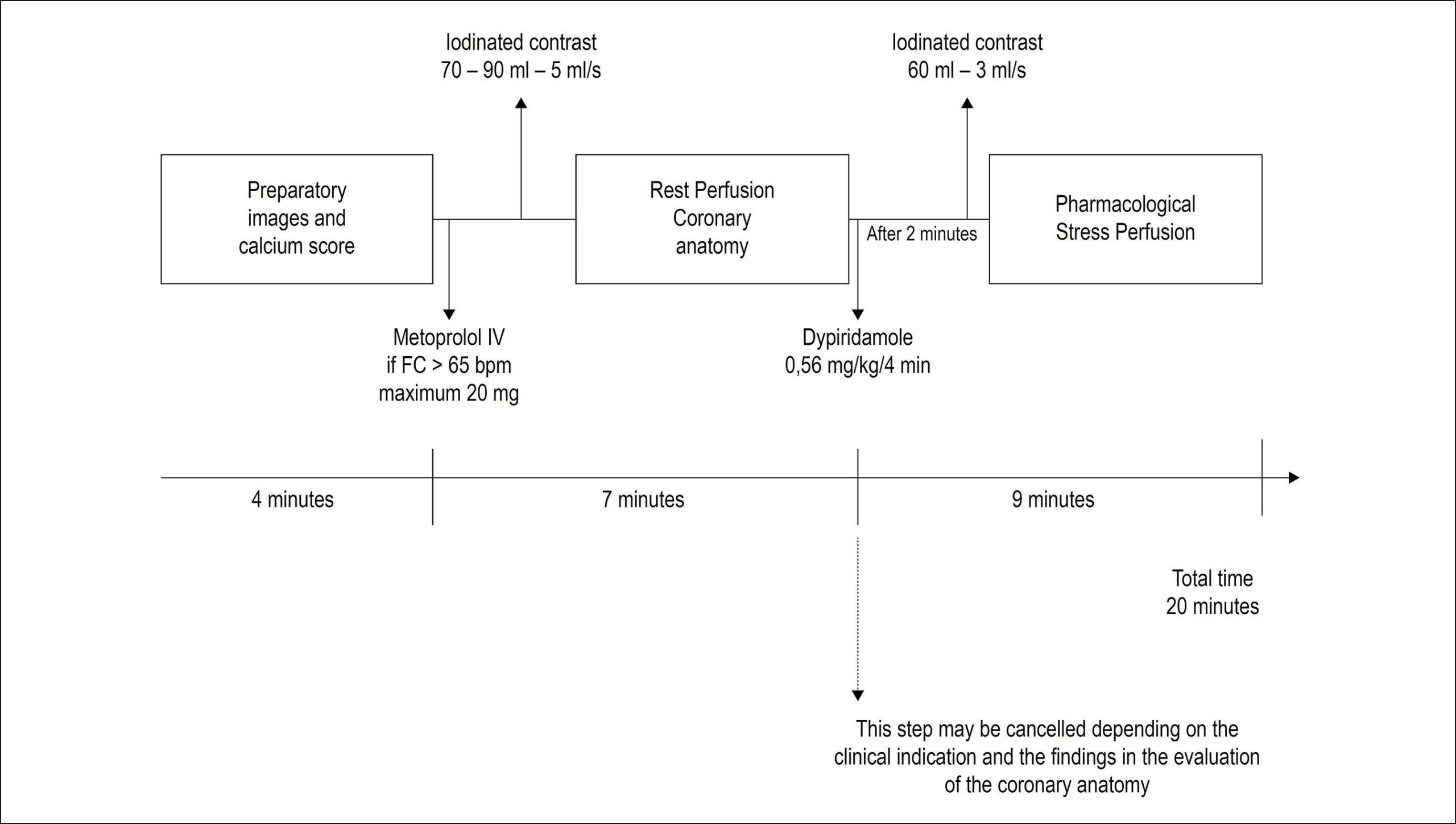
Coronary computed tomography angiography (CCTA) has gained a prominent role in the evaluation of coronary artery disease. However, its anatomical nature does not allow the evaluation of the functional repercussion of coronary obstructions. It has been made possible to evaluate Myocardial computed tomography perfusion (Myocardial CTP) recently, based on myocardial contrast changes related to coronary stenoses. Several studies have validated this technique against the anatomical reference method (cardiac catheterization) and other functional methods, including myocardial perfusion scintigraphy and fractional flow reserve. The Myocardial CTP is performed in conjunction with the CCTA, a combined analysis of anatomy and function. The stress phase (with assessment of myocardial perfusion) can be performed before or after the resting phase (assessment of resting perfusion and coronary arteries), and different acquisition parameters are proposed according to the protocol and type of equipment used. Stressors used are based on coronary vasodilation (e.g. dipyridamole, adenosine). Image interpretation, similar to other perfusion assessment methods, is based on the identification and quantification of myocardial perfusion defects. The integration of both perfusion and anatomical findings is fundamental for the examination interpretation algorithm, allowing to define if the stenoses identified are hemodynamically significant and may be related to myocardial ischemia.

  • Adenosine
  • Computed Tomography Angiography/ methods
  • Coronary Artery Disease
  • Dipyridamole
  • Myocardial Perfusion Imaging/methods
  • Vasodilatation
Read Full Article
Creative Commons Attribution (CC BY) Creative Commons license
04/11/2019 DOI: 10.5935/abc.20190217
Figure 1
ABC
Original Article

New Exercise-Dipyridamole Combined Test for Nuclear Cardiology in Insufficient Effort: Appropriate Diagnostic Sensitivity Keeping Exercise Prognosis

Inés Vidal et al. Mario Beretta Omar Alonso Fernando Mut

Abstract

Background:

Myocardial perfusion scintigraphy (MPS) in patients not reaching 85% of the maximum predicted heart rate (MPHR) has reduced sensitivity.

Objectives:

In an attempt to maintain diagnostic sensitivity without losing functional exercise data, a new exercise and dipyridamole combined protocol (EDCP) was developed. Our aim was to evaluate the feasibility and safety of this protocol and to compare its diagnostic sensitivity against standard exercise and dipyridamole protocols.

Methods:

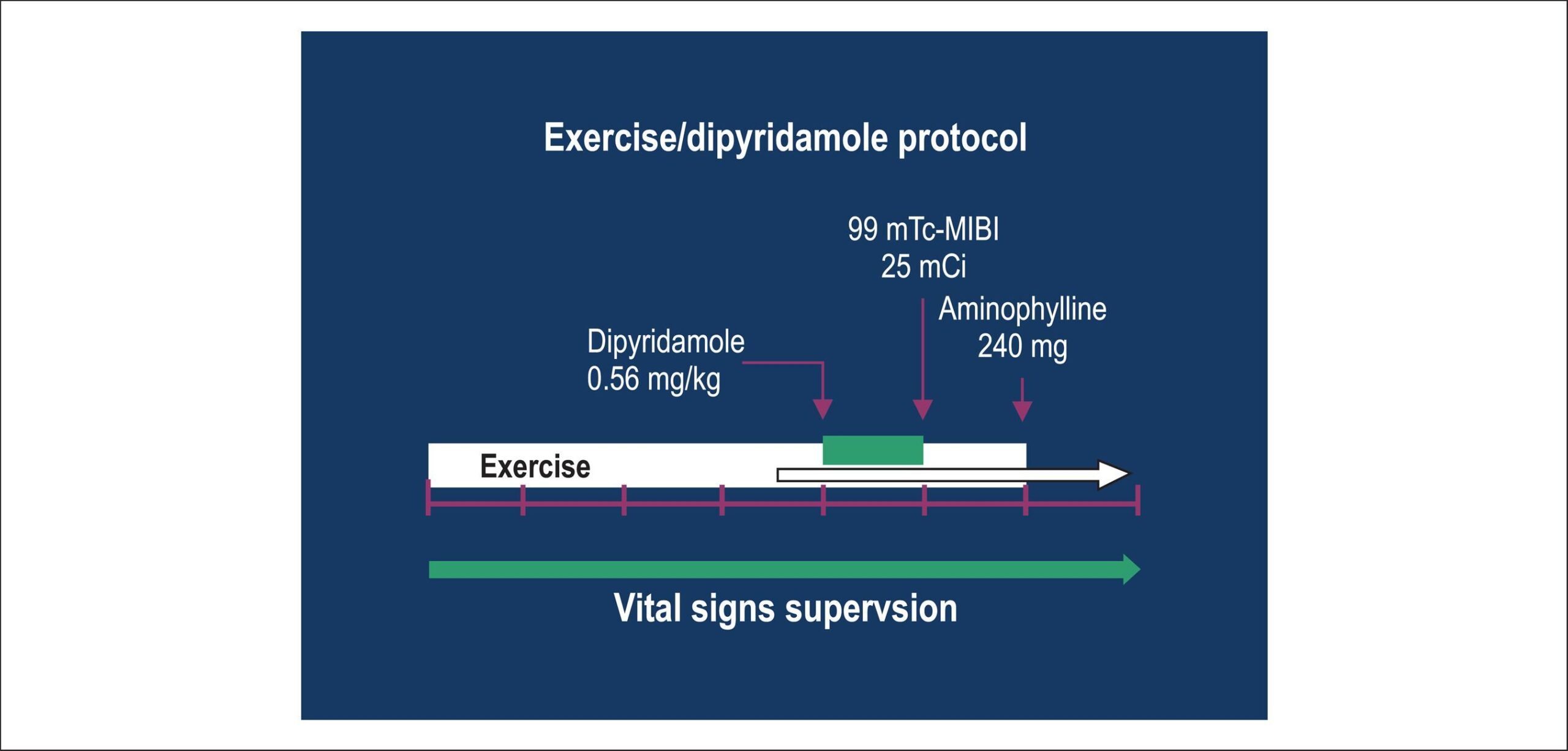
In patients not reaching a sufficient exercise (SE) test and with no contraindications, 0.56 mg/kg of dipyridamole were IV administered over 1 minute simultaneously with exercise, followed by 99mTc-MIBI injection.

Results:

Of 155 patients, 41 had MPS with EDCP, 47 had a SE test (≥ 85% MPHR) and 67 underwent the dipyridamole alone test (DIP). They all underwent coronary angiography within 3 months. The three stress methods for diagnosis of coronary lesions had their sensitivity compared. For stenosis ≥ 70%, EDCP yielded 97% sensitivity, SE 90% and DIP 95% (p = 0.43). For lesions ≥ 50%, the sensitivities were 94%, 88% and 95%, respectively (p = 0.35). Side effects of EDCP were present in only 12% of the patients, significantly less than with DIP (p < 0.001).

Conclusions:

The proposed combined protocol is a valid and safe method that yields adequate diagnostic sensitivity, keeping exercise prognostic information in patients unable to reach target heart rate, with fewer side effects than the DIP.

  • Coronary Artery Disease
  • Dipyridamole / diagnostic use
  • Exercise Test
  • Myocardial Perfusion Imaging/methods
Read Full Article
Creative Commons Attribution (CC BY) Creative Commons license
29/05/2015 DOI: 10.5935/abc.20150051

How to cite this article

EndNote RIS

Electronic Document Format (Vancouver)

Segundo Neto EMV, Lopes RW, Brandão SCS. What is the Value of Perfusion Scintigraphy and Cardiac PET in Hypertrophic Cardiomyopathy?. Arquivos Brasileiros de Cardiologia Imagem cardiovascular 2022;32(1):19-28.

Electronic Document Format (ABNT)

Segundo Neto, Elry Medeiros Vieira; Lopes, Rafael Willain; Brandão, Simone Cristina Soares. What is the Value of Perfusion Scintigraphy and Cardiac PET in Hypertrophic Cardiomyopathy?. Arquivos Brasileiros de Cardiologia Imagem cardiovascular, v. 32, n. 1, p. 19-28, Jan. 2022.

Electronic Document Format (APA)

Segundo Neto, E. M. V., Lopes, R. W., & Brandão, S. C. S. (2022). What is the Value of Perfusion Scintigraphy and Cardiac PET in Hypertrophic Cardiomyopathy?. Arquivos Brasileiros de Cardiologia Imagem cardiovascular, 32(1), 19-28.

Electronic Document Format (ISO)

Segundo Neto, Elry Medeiros Vieira and Lopes, Rafael Willain and Brandão, Simone Cristina Soares. What is the Value of Perfusion Scintigraphy and Cardiac PET in Hypertrophic Cardiomyopathy?. Arquivos Brasileiros de Cardiologia Imagem cardiovascular [online]. 2022, vol. 32, n. 1, [cited 2026-10-14], pp. 19-28. Available from: <https://journals.cardiol.br/en/article/what-is-the-value-of-perfusion-scintigraphy-and-cardiac-pet-in-hypertrophic-cardiomyopathy/>. ISSN 2318-8219

EndNote RIS

Electronic Document Format (Vancouver)

Mesquita CT, Ker WS, Azevedo JC. Nuclear Cardiology in 2020 – Perspectives of the New SBC Guideline. Arquivos Brasileiros de Cardiologia 2020;114(2):196-8.

Electronic Document Format (ABNT)

Mesquita, Cláudio Tinoco; Ker, Wilter dos Santos; Azevedo, Jader Cunha de. Nuclear Cardiology in 2020 – Perspectives of the New SBC Guideline. Arquivos Brasileiros de Cardiologia, v. 114, n. 2, p. 196-198, Mar. 2020.

Electronic Document Format (APA)

Mesquita, C. T., Ker, W. S., & Azevedo, J. C. (2020). Nuclear Cardiology in 2020 – Perspectives of the New SBC Guideline. Arquivos Brasileiros de Cardiologia, 114(2), 196-198.

Electronic Document Format (ISO)

Mesquita, Cláudio Tinoco and Ker, Wilter dos Santos and Azevedo, Jader Cunha de. Nuclear Cardiology in 2020 – Perspectives of the New SBC Guideline. Arquivos Brasileiros de Cardiologia [online]. 2020, vol. 114, n. 2, [cited 2026-10-14], pp. 196-198. Available from: <https://journals.cardiol.br/en/article/nuclear-cardiology-in-2020-perspectives-of-the-new-sbc-guideline/>. ISSN 0066-782X

EndNote RIS

Electronic Document Format (Vancouver)

Magalhães TA, Cury RC, Cerci RJ, Parga Filho JR, Gottlieb I, Nacif MS, Pinto IM, et al. Evaluation of Myocardial Perfusion by Computed Tomography – Principles, Technical Background and Recommendations. Arquivos Brasileiros de Cardiologia 2019;113(4):758-67.

Electronic Document Format (ABNT)

Magalhães, Tiago Augusto; Cury, Roberto Caldeira; Cerci, Rodrigo Julio; Parga Filho, José Rodrigues; Gottlieb, Ilan; Nacif, Marcelo Souto; Pinto, Ibraim Masciarelli; Rochitte, Carlos Eduardo; Vilas-Boas, Fabio; Schvartzman, Paulo R.. Evaluation of Myocardial Perfusion by Computed Tomography – Principles, Technical Background and Recommendations. Arquivos Brasileiros de Cardiologia, v. 113, n. 4, p. 758-767, Nov. 2019.

Electronic Document Format (APA)

Magalhães, T. A., Cury, R. C., Cerci, R. J., Parga Filho, J. R., Gottlieb, I., Nacif, M. S., Pinto, I. M., Rochitte, C. E., Vilas-Boas, F., & Schvartzman, P. R. (2019). Evaluation of Myocardial Perfusion by Computed Tomography – Principles, Technical Background and Recommendations. Arquivos Brasileiros de Cardiologia, 113(4), 758-767.

Electronic Document Format (ISO)

Magalhães, Tiago Augusto and Cury, Roberto Caldeira and Cerci, Rodrigo Julio and Parga Filho, José Rodrigues and Gottlieb, Ilan and Nacif, Marcelo Souto and Pinto, Ibraim Masciarelli and Rochitte, Carlos Eduardo and Vilas-Boas, Fabio and Schvartzman, Paulo R.. Evaluation of Myocardial Perfusion by Computed Tomography – Principles, Technical Background and Recommendations. Arquivos Brasileiros de Cardiologia [online]. 2019, vol. 113, n. 4, [cited 2026-10-14], pp. 758-767. Available from: <https://journals.cardiol.br/en/article/evaluation-of-myocardial-perfusion-by-computed-tomography-principles-technical-background-and-recommendations/>. ISSN 0066-782X

EndNote RIS

Electronic Document Format (Vancouver)

Vidal I, Beretta M, Alonso O, Mut F. New Exercise-Dipyridamole Combined Test for Nuclear Cardiology in Insufficient Effort: Appropriate Diagnostic Sensitivity Keeping Exercise Prognosis. Arquivos Brasileiros de Cardiologia 2015;105(2):123-9.

Electronic Document Format (ABNT)

Vidal, Inés; Beretta, Mario; Alonso, Omar; Mut, Fernando. New Exercise-Dipyridamole Combined Test for Nuclear Cardiology in Insufficient Effort: Appropriate Diagnostic Sensitivity Keeping Exercise Prognosis. Arquivos Brasileiros de Cardiologia, v. 105, n. 2, p. 123-129, May. 2015.

Electronic Document Format (APA)

Vidal, I., Beretta, M., Alonso, O., & Mut, F. (2015). New Exercise-Dipyridamole Combined Test for Nuclear Cardiology in Insufficient Effort: Appropriate Diagnostic Sensitivity Keeping Exercise Prognosis. Arquivos Brasileiros de Cardiologia, 105(2), 123-129.

Electronic Document Format (ISO)

Vidal, Inés and Beretta, Mario and Alonso, Omar and Mut, Fernando. New Exercise-Dipyridamole Combined Test for Nuclear Cardiology in Insufficient Effort: Appropriate Diagnostic Sensitivity Keeping Exercise Prognosis. Arquivos Brasileiros de Cardiologia [online]. 2015, vol. 105, n. 2, [cited 2026-10-14], pp. 123-129. Available from: <https://journals.cardiol.br/en/article/new-exercise-dipyridamole-combined-test-for-nuclear-cardiology-in-insufficient-effort-appropriate-diagnostic-sensitivity-keeping-exercise-prognosis/>. ISSN 0066-782X

  • About ABC Family
  • Internal Regulation
  • Editorial Board
  • Brazilian Society of Cardiology (SBC)

Issues

SBC Guidelines

  • Videos
  • Podcasts
  • News