ABC Family Arquivos Brasileiros de Cardiologia International Journal of Cardiovascular Sciences ABC Heart Failure & Cardiomyopathy ABC Imagem Cardiovascular
Português English
ABC Family
Português English
  • About
    • About ABC Family
    • Internal Regulation
    • Editorial Board
    • Brazilian Society of Cardiology (SBC)
  • Issues
  • SBC Guidelines
  • Content
    • Videos
    • Podcasts
    • News
  • About
    • About ABC Family
    • Internal Regulation
    • Editorial Board
    • Brazilian Society of Cardiology (SBC)
  • Issues
  • SBC Guidelines
  • Content
    • Videos
    • Podcasts
    • News

ABC Family

  • ABC Family
  • Arquivos Brasileiros de Cardiologia
  • International Journal of Cardiovascular Sciences
  • ABC Heart Failure & Cardiomyopathy
  • ABC Imagem Cardiovascular
Search in

No content found.

Journals
Ordering
Article types
Others

  1. Home
  2. Keyword: multivariate analysis
Figure 1
ABC
Original Article

Neutrophil-to-Lymphocyte Ratio and Platelet-to-Lymphocyte Ratio are Predictors of Heart Failure

Erdal Durmus et al. Tarik Kivrak Fethullah Gerin Murat Sunbul … Ibrahim Sari Okan Erdogan

Abstract

Background:

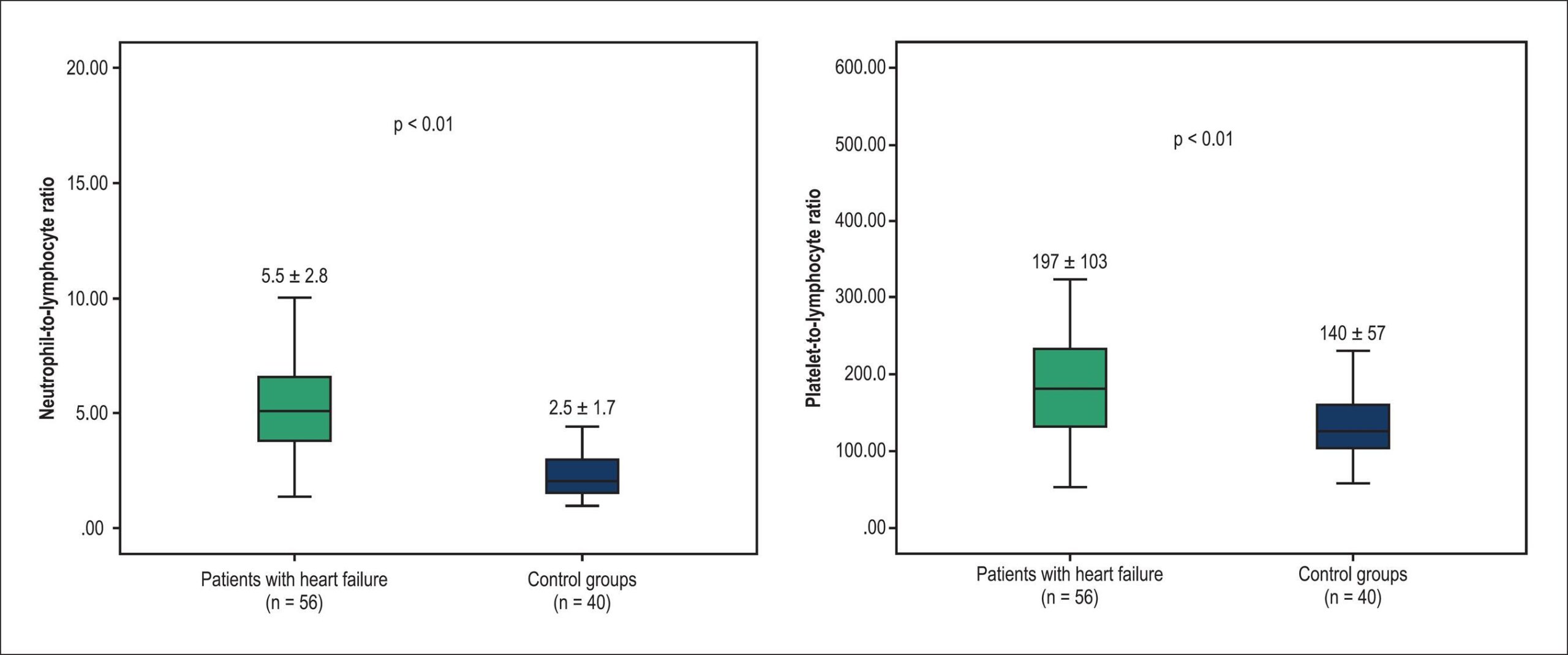
Neutrophil-to-lymphocyte ratio (NLR) and platelet-to-lymphocyte ratio (PLR) are inflammatory markers used as prognostic factors in various diseases. The aims of this study were to compare the PLR and the NLR of heart failure (HF) patients with those of age-sex matched controls, to evaluate the predictive value of those markers in detecting HF, and to demonstrate the effect of NLR and PLR on mortality in HF patients during follow-up.

Methods:

This study included 56 HF patients and 40 controls without HF. All subjects underwent transthoracic echocardiography to evaluate cardiac functions. The NLR and the PLR were calculated as the ratio of neutrophil count to lymphocyte count and as the ratio of platelet count to lymphocyte count, respectively. All HF patients were followed after their discharge from the hospital to evaluate mortality, cerebrovascular events, and re-hospitalization.

Results:

The NLR and the PLR of HF patients were significantly higher compared to those of the controls (p < 0.01). There was an inverse correlation between the NLR and the left ventricular ejection fraction of the study population (r: -0.409, p < 0.001). The best cut-off value of NLR to predict HF was 3.0, with 86.3% sensitivity and 77.5% specificity, and the best cut-off value of PLR to predict HF was 137.3, with 70% sensitivity and 60% specificity. Only NLR was an independent predictor of mortality in HF patients. A cut-off value of 5.1 for NLR can predict death in HF patients with 75% sensitivity and 62% specificity during a 12.8-month follow-up period on average.

Conclusion:

NLR and PLR were higher in HF patients than in age-sex matched controls. However, NLR and PLR were not sufficient to establish a diagnosis of HF. NLR can be used to predict mortality during the follow-up of HF patients.
  • Heart Failure / blood
  • Heart Failure / diagnosis
  • Leukocyte Count
  • Lymphocyte Count
  • multivariate analysis
  • Neutrophils / cytology
Read Full Article
Creative Commons Attribution (CC BY) Creative Commons license
03/11/2015 DOI: 10.5935/abc.20150126 Views 1
Figure 1
ABC
Special Article

Multivariate Analysis for Animal Selection in Experimental Research

Renan Mercuri Pinto et al. Dijon Henrique Salomé de Campos Loreta Casquel Tomasi Antonio Carlos Cicogna … Katashi Okoshi Carlos Roberto Padovani

Background:

Several researchers seek methods for the selection of homogeneous groups of animals in experimental studies, a fact justified because homogeneity is an indispensable prerequisite for casualization of treatments. The lack of robust methods that comply with statistical and biological principles is the reason why researchers use empirical or subjective methods, influencing their results.

Objective:

To develop a multivariate statistical model for the selection of a homogeneous group of animals for experimental research and to elaborate a computational package to use it.

Methods:

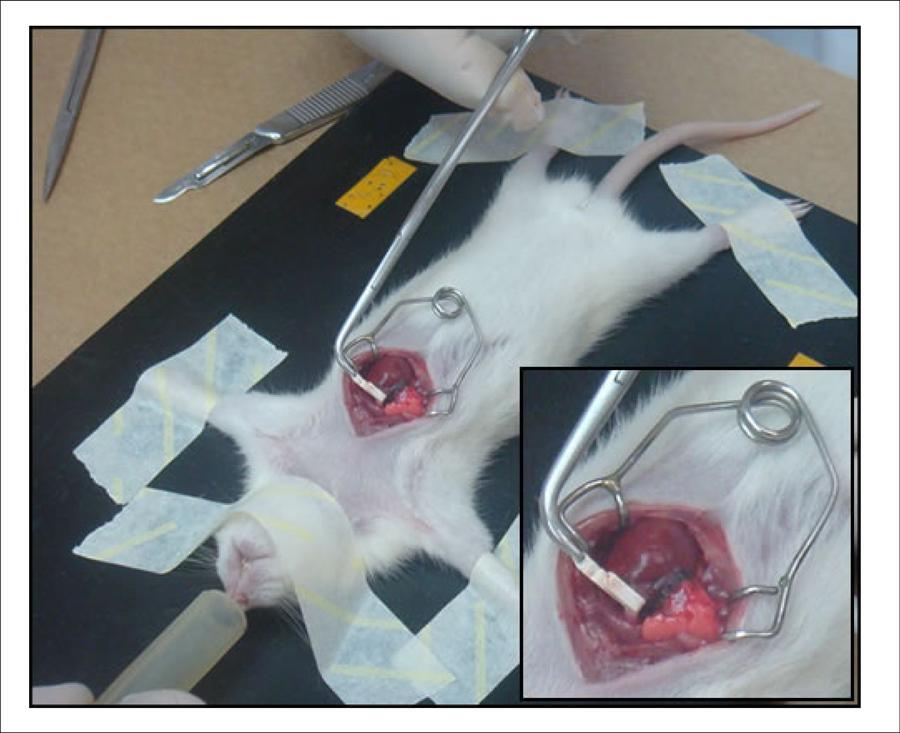
The set of echocardiographic data of 115 male Wistar rats with supravalvular aortic stenosis (AoS) was used as an example of model development. Initially, the data were standardized, and became dimensionless. Then, the variance matrix of the set was submitted to principal components analysis (PCA), aiming at reducing the parametric space and at retaining the relevant variability. That technique established a new Cartesian system into which the animals were allocated, and finally the confidence region (ellipsoid) was built for the profile of the animals’ homogeneous responses. The animals located inside the ellipsoid were considered as belonging to the homogeneous batch; those outside the ellipsoid were considered spurious.

Results:

The PCA established eight descriptive axes that represented the accumulated variance of the data set in 88.71%. The allocation of the animals in the new system and the construction of the confidence region revealed six spurious animals as compared to the homogeneous batch of 109 animals.

Conclusion:

The biometric criterion presented proved to be effective, because it considers the animal as a whole, analyzing jointly all parameters measured, in addition to having a small discard rate.

  • Animals
  • Aortic Valve Stenosis
  • Epidemiology
  • Experimental
  • multivariate analysis
Read Full Article
Creative Commons Attribution (CC BY) Creative Commons license
03/02/2015 DOI: 10.5935/abc.20140219 Views 1
Quality of life and clinical indicators in heart failure: a multivariate analysis
ABC
Artigo Original

Quality of life and clinical indicators in heart failure: a multivariate analysis

Jefferson Jovelino Amaral dos Santos et al. Jony Erwin Andreola Plewka Paulo Roberto Slud Brofman

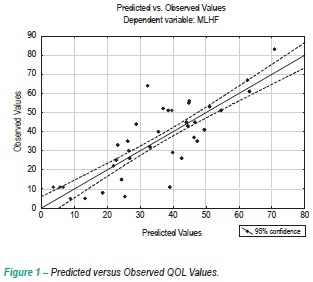
BACKGROUND: In Heart Failure (HF), special attention must be given not only to objective or isolated aspects, but also to the patient’s health self-perceptions. Subjective aspects can help healthcare providers understand and better treat HF. OBJECTIVE: The objective of this study was to evaluate the simultaneous effects of clinical indicators of HF on the Quality-of-Life (QOL). METHODS: We investigated, through a multivariate analysis, the QOL of 101 Brazilian HF outpatients using the Minnesota Living with Heart Failure Questionnaire (including subscales) and its correlation to clinical and physiological variables such as age, ethnicity, gender, echocardiogram parameters, body mass index, mean blood pressure at rest, time since diagnosis, Functional Classification according to the NYHA, functional capacity by a Specific Activity Scale, comorbidities, Framingham Score of Cardiac Risk (CR), Lung Function Test (spirometry) and Body Composition. RESULTS: QOL showed significant univariate correlations to the echocardiogram: ejection fraction (p=0.0415), left ventricular diastolic diameter (LVDD) (p=0.004), left ventricular systolic diameter (LVSD) (p=0.0001); comorbidities (p=0.002) and Lung Function Test: Forced Vital Capacity (FVC) (p<0.0001), Forced Expiratory Volume in the 1st second (FEV1) (p<0.0001) and Maximal Voluntary Ventilation (MVV) (p=0.001). In the multivariate analysis, the backward stepwise protocol detected important simultaneous influent variables (r²=0.60): gender (0.000178), ethnicity (p<0.00001), LVSD (P<0.00001), CR (p=0.000002), FVC (p=0.002027), FEV1 (p<0.00001) and MVV (p=0.00001). CONCLUSION: Gender, ethnicity, LVSD, CR, FVC, FEV1 and MVV are independent predictors of HF patients' QOL. Simultaneously, they are responsible for about 60% of the QOL variance. Biopsychosocial aspects could contribute to patient and health professional expectations and treatment results.

  • Heart Failure
  • Holistic Health
  • multivariate analysis
  • Quality of life
Read Full Article
Creative Commons Attribution (CC BY) Creative Commons license
13/10/2009 DOI: 10.1590/S0066-782X2009000800015 Views 1
ABC
Original Article

Acute myocardial infarction: clinical and epidemiological profile and factors associated with in-hospital death in the municipality of Rio de Janeiro

Claudia Caminha Escosteguy et al. Margareth Crisóstomo Portela Roberto de Andrade Medronho Maurício Teixeira Leite de Vasconcellos

OBJECTIVE: To study the factors associated with the risk of in-hospital death in acute myocardial infarction in the Brazilian public health system in Rio de Janeiro, Brazil. METHODS: Sectional study of a sample with 391 randomly drawn medical records of the hospitalizations due to acute myocardial infarction recorded in the hospital information system in 1997. RESULTS: The diagnosis was confirmed in 91.7% of the cases; 61.5% males; age = 60.2 ± 2.4 years; delta time until hospitalization of 11 hours; 25.3% were diabetic; 58.1% were hypertensive; 82.6% were in Killip I class. In-hospital mortality was 20.6%. Thrombolysis was used in 19.5%; acetylsalicylic acid (ASA) 86.5%; beta-blockers 49%; angiotensin-converting enzyme (ACE) inhibitors 63.3%; calcium channel blockers 30.5%. Factors associated with increased death: age (61-80 years: OR=2.5; > 80 years: OR=9.6); Killip class (II: OR=1.9; III: OR=6; IV: OR=26.5); diabetes (OR=2.4); ventricular tachycardia (OR=8.5); ventricular fibrillation (OR=34); recurrent ischemia (OR=2.7). The use of ASA (OR=0.3), beta-blockers (OR=0.3), and ACE inhibitors (OR=0.4) was associated with a reduction in the chance of death. CONCLUSION: General lethality was high and some interventions of confirmed efficacy were underutilizated. The logistic model showed the beneficial effect of beta-blockers, and ACE inhibitors on the risk of in-hospital death.

  • Acute Myocardial Infarction
  • in-hospital mortality
  • multivariate analysis
Read Full Article
Creative Commons Attribution (CC BY) Creative Commons license
02/07/2003 DOI: 10.1590/S0066-782X2003000600003 Views 1

How to cite this article

EndNote RIS

Electronic Document Format (Vancouver)

Durmus E, Kivrak T, Gerin F, Sunbul M, Sari I, Erdogan O. Neutrophil-to-Lymphocyte Ratio and Platelet-to-Lymphocyte Ratio are Predictors of Heart Failure. Arquivos Brasileiros de Cardiologia 2015;105(6):606-13.

Electronic Document Format (ABNT)

Durmus, Erdal; Kivrak, Tarik; Gerin, Fethullah; Sunbul, Murat; Sari, Ibrahim; Erdogan, Okan. Neutrophil-to-Lymphocyte Ratio and Platelet-to-Lymphocyte Ratio are Predictors of Heart Failure. Arquivos Brasileiros de Cardiologia, v. 105, n. 6, p. 606-613, Nov. 2015.

Electronic Document Format (APA)

Durmus, E., Kivrak, T., Gerin, F., Sunbul, M., Sari, I., & Erdogan, O. (2015). Neutrophil-to-Lymphocyte Ratio and Platelet-to-Lymphocyte Ratio are Predictors of Heart Failure. Arquivos Brasileiros de Cardiologia, 105(6), 606-613.

Electronic Document Format (ISO)

Durmus, Erdal and Kivrak, Tarik and Gerin, Fethullah and Sunbul, Murat and Sari, Ibrahim and Erdogan, Okan. Neutrophil-to-Lymphocyte Ratio and Platelet-to-Lymphocyte Ratio are Predictors of Heart Failure. Arquivos Brasileiros de Cardiologia [online]. 2015, vol. 105, n. 6, [cited 2026-10-14], pp. 606-613. Available from: <https://journals.cardiol.br/en/article/neutrophil-to-lymphocyte-ratio-and-platelet-to-lymphocyte-ratio-are-predictors-of-heart-failure/>. ISSN 0066-782X

EndNote RIS

Electronic Document Format (Vancouver)

Pinto RM, Campos DHS, Tomasi LC, Cicogna AC, Okoshi K, Padovani CR. Multivariate Analysis for Animal Selection in Experimental Research. Arquivos Brasileiros de Cardiologia 2015;104(2):97-103.

Electronic Document Format (ABNT)

Pinto, Renan Mercuri; Campos, Dijon Henrique Salomé de; Tomasi, Loreta Casquel; Cicogna, Antonio Carlos; Okoshi, Katashi; Padovani, Carlos Roberto. Multivariate Analysis for Animal Selection in Experimental Research. Arquivos Brasileiros de Cardiologia, v. 104, n. 2, p. 97-103, Feb. 2015.

Electronic Document Format (APA)

Pinto, R. M., Campos, D. H. S. , Tomasi, L. C., Cicogna, A. C., Okoshi, K., & Padovani, C. R. (2015). Multivariate Analysis for Animal Selection in Experimental Research. Arquivos Brasileiros de Cardiologia, 104(2), 97-103.

Electronic Document Format (ISO)

Pinto, Renan Mercuri and Campos, Dijon Henrique Salomé de and Tomasi, Loreta Casquel and Cicogna, Antonio Carlos and Okoshi, Katashi and Padovani, Carlos Roberto. Multivariate Analysis for Animal Selection in Experimental Research. Arquivos Brasileiros de Cardiologia [online]. 2015, vol. 104, n. 2, [cited 2026-10-14], pp. 97-103. Available from: <https://journals.cardiol.br/en/article/multivariate-analysis-for-animal-selection-in-experimental-research/>. ISSN 0066-782X

EndNote RIS

Electronic Document Format (Vancouver)

Santos JJA, Plewka JEA, Brofman PRS. Quality of life and clinical indicators in heart failure: a multivariate analysis. Arquivos Brasileiros de Cardiologia 2009;93(2):159-66.

Electronic Document Format (ABNT)

Santos, Jefferson Jovelino Amaral dos; Plewka, Jony Erwin Andreola; Brofman, Paulo Roberto Slud. Quality of life and clinical indicators in heart failure: a multivariate analysis. Arquivos Brasileiros de Cardiologia, v. 93, n. 2, p. 159-166, Oct. 2009.

Electronic Document Format (APA)

Santos, J. J. A. , Plewka, J. E. A., & Brofman, P. R. S. (2009). Quality of life and clinical indicators in heart failure: a multivariate analysis. Arquivos Brasileiros de Cardiologia, 93(2), 159-166.

Electronic Document Format (ISO)

Santos, Jefferson Jovelino Amaral dos and Plewka, Jony Erwin Andreola and Brofman, Paulo Roberto Slud. Quality of life and clinical indicators in heart failure: a multivariate analysis. Arquivos Brasileiros de Cardiologia [online]. 2009, vol. 93, n. 2, [cited 2026-10-14], pp. 159-166. Available from: <https://journals.cardiol.br/article/quality-of-life-and-clinical-indicators-in-heart-failure-a-multivariate-analysis/>. ISSN 0066-782X

EndNote RIS

Electronic Document Format (Vancouver)

Escosteguy CC, Portela MC, Medronho RA, Vasconcellos MTL. Acute myocardial infarction: clinical and epidemiological profile and factors associated with in-hospital death in the municipality of Rio de Janeiro. Arquivos Brasileiros de Cardiologia 2003;80(6):600-6.

Electronic Document Format (ABNT)

Escosteguy, Claudia Caminha; Portela, Margareth Crisóstomo; Medronho, Roberto de Andrade; Vasconcellos, Maurício Teixeira Leite de. Acute myocardial infarction: clinical and epidemiological profile and factors associated with in-hospital death in the municipality of Rio de Janeiro. Arquivos Brasileiros de Cardiologia, v. 80, n. 6, p. 600-606, Jul. 2003.

Electronic Document Format (APA)

Escosteguy, C. C., Portela, M. C., Medronho, R. A., & Vasconcellos, M. T. L. (2003). Acute myocardial infarction: clinical and epidemiological profile and factors associated with in-hospital death in the municipality of Rio de Janeiro. Arquivos Brasileiros de Cardiologia, 80(6), 600-606.

Electronic Document Format (ISO)

Escosteguy, Claudia Caminha and Portela, Margareth Crisóstomo and Medronho, Roberto de Andrade and Vasconcellos, Maurício Teixeira Leite de. Acute myocardial infarction: clinical and epidemiological profile and factors associated with in-hospital death in the municipality of Rio de Janeiro. Arquivos Brasileiros de Cardiologia [online]. 2003, vol. 80, n. 6, [cited 2026-10-14], pp. 600-606. Available from: <https://journals.cardiol.br/en/article/acute-myocardial-infarction-clinical-and-epidemiological-profile-and-factors-associated-with-in-hospital-death-in-the-municipality-of-rio-de-janeiro/>. ISSN 0066-782X

  • About ABC Family
  • Internal Regulation
  • Editorial Board
  • Brazilian Society of Cardiology (SBC)

Issues

SBC Guidelines

  • Videos
  • Podcasts
  • News