ABC Family Arquivos Brasileiros de Cardiologia International Journal of Cardiovascular Sciences ABC Heart Failure & Cardiomyopathy ABC Imagem Cardiovascular
Português English
ABC Family
Português English
  • About
    • About ABC Family
    • Internal Regulation
    • Editorial Board
    • Brazilian Society of Cardiology (SBC)
  • Issues
  • SBC Guidelines
  • Content
    • Videos
    • Podcasts
    • News
  • About
    • About ABC Family
    • Internal Regulation
    • Editorial Board
    • Brazilian Society of Cardiology (SBC)
  • Issues
  • SBC Guidelines
  • Content
    • Videos
    • Podcasts
    • News

ABC Family

  • ABC Family
  • Arquivos Brasileiros de Cardiologia
  • International Journal of Cardiovascular Sciences
  • ABC Heart Failure & Cardiomyopathy
  • ABC Imagem Cardiovascular
Search in

No content found.

Journals
Ordering
Article types
Others

  1. Home
  2. Keyword: in-hospital mortality
ABC
Editorial

In-Hospital Mortality in Patients Presenting Cardiogenic Shock After Myocardial Infarction: Does it Benefit Using an Intra-Aortic Balloon Pump?

Fernando Arturo Effio Solis et al. Adriana Brentegani Marcelo Luiz Campos Vieira

Cardiogenic shock (CS) represents a severe clinical syndrome characterized by systemic hypoperfusion and insufficient cardiac output due to primary cardiac dysfunction. Its mortality often exceeds 40%, of cases, being a highly complex cardiological condition. The etiology is multifactorial, with acute myocardial infarction (AMI) being the predominant cause, responsible for around 30% of cases. Other relevant conditions include acute decompensation of chronic heart failure and cases of acute myocardial dysfunction without a previous history of heart failure, as observed in myocarditis.

The management of post-AMI CS requires a comprehensive approach, which combines early revascularization and hemodynamic support.– In this context, devices such as the intra-aortic balloon pump (IABP) have their role due to their ability to increase diastolic pressure in the aorta and reduce left ventricular afterload. These physiological effects result in improved coronary perfusion and reduced myocardial oxygen consumption.

[…]

  • Cardiogenic shock
  • in-hospital mortality
  • intra-aortic balloon
  • ST-segment Elevation Myocardial Infarction
Read Full Article
Creative Commons Attribution (CC BY) Creative Commons license
21/03/2025 DOI: 10.36660/abc.20250080i Views 2
Predictive factors of in-hospital mortality and of severe perioperative complications in myocardial revascularization surgery
ABC
Original Article

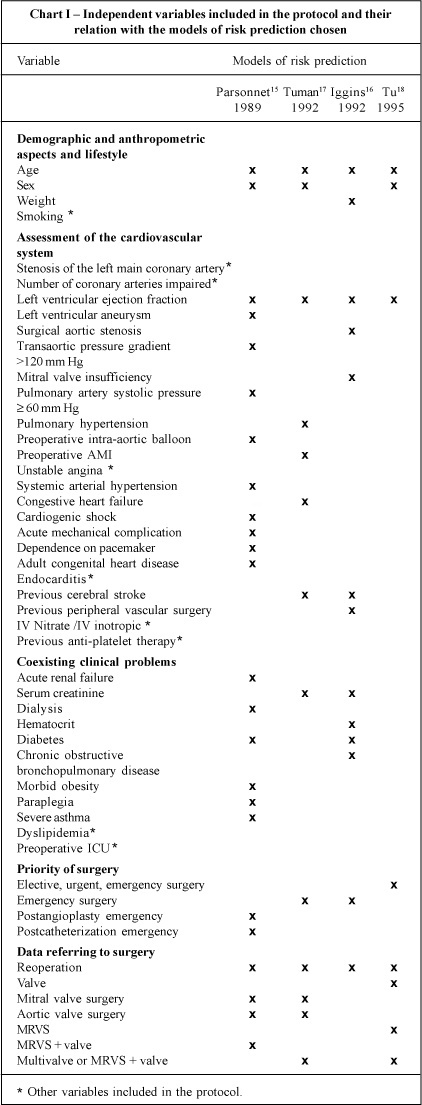
Predictive factors of in-hospital mortality and of severe perioperative complications in myocardial revascularization surgery

Fernanda Fuscaldi Almeida et al. Sandhi Maria Barreto Bráulio Roberto G. M. Couto Carlos E. F. Starling

OBJECTIVE: To investigate preoperative predictive factors of severe perioperative intercurrent events and in-hospital mortality in coronary artery bypass graft (CABG) surgery and to develop specific models of risk prediction for these events, mainly those that can undergo changes in the preoperative period. METHODS: We prospectively studied 453 patients who had undergone CABG. Factors independently associated with the events of interest were determined with multiple logistic regression and Cox proportional hazards regression model. RESULTS: The mortality rate was 11.3% (51/453), and 21.2% of the patients had 1 or more perioperative intercurrent events. In the final model, the following variables remained associated with the risk of intercurrent events: age ³ 70 years, female sex, hospitalization via SUS (Sistema Único de Saúde – the Brazilian public health system), cardiogenic shock, ischemia, and dependence on dialysis. Using multiple logistic regression for in-hospital mortality, the following variables participated in the model of risk prediction: age ³ 70 years, female sex, hospitalization via SUS, diabetes, renal dysfunction, and cardiogenic shock. According to the Cox regression model for death within the 7 days following surgery, the following variables remained associated with mortality: age ³ 70 years, female sex, cardiogenic shock, and hospitalization via SUS. CONCLUSION: The aspects linked to the structure of the Brazilian health system, such as factors of great impact on the results obtained, indicate that the events investigated also depend on factors that do not relate to the patient’s intrinsic condition.

  • in-hospital mortality
  • Myocardial Revascularization/surgery
  • perioperative complications
Read Full Article
Creative Commons Attribution (CC BY) Creative Commons license
04/01/2012 DOI: 10.1590/S0066-782X2003000100005 Views 1
Acute myocardial infarction: predictors of mortality at a public hospital in the city of Fortaleza, Ceará state
ABC
Original Article

Acute myocardial infarction: predictors of mortality at a public hospital in the city of Fortaleza, Ceará state

Demóstenes Gonçalves Lima Ribeiro et al. Pedro José Negreiros de Andrade José Nogueira Paes Júnior Lurildo Ribeiro Saraiva

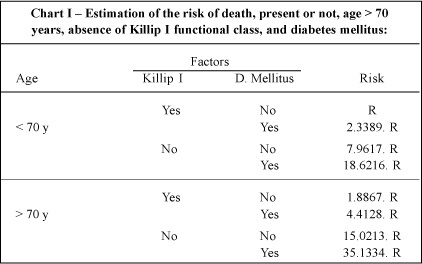
OBJECTIVE: To identify the clinical and demographic predictors of in-hospital mortality in acute myocardial infarction with elevation of the ST segment in a public hospital, in the city of Fortaleza, Ceará state, Brazil. METHODS: A retrospective study of 373 patients experiencing their first episode of acute myocardial infarction was carried out. Of the study patients, 289 were discharged from the hospital (group A) and 84 died (group B). Both groups were analyzed regarding: sex; age; time elapsed from the beginning of the symptoms of myocardial infarction to assistance at the hospital; use of streptokinase; risk factors for atherosclerosis; electrocardiographic location of myocardial infarct; and Killip functional class. RESULTS: In a univariate analysis, group B had a greater proportion of the following parameters as compared with group A: non-Killip I functional class; diabetes; age >70 years; infarction of the inferior wall associated with right ventricular impairment; time between symptom onset and treatment at the hospital >12 h; anteroseptal or extensive anterior infarction; no use of streptokinase; and no tobacco use. In a multivariate logistic regression analysis, only non-Killip I functional class, diabetes, and age >70 years persisted as independent factors for death. CONCLUSION: Non-Killip I functional class, diabetes, and age >70 years were independent predictors of mortality in acute myocardial infarction with elevation of the ST segment.

  • Diabetes Mellitus
  • Elderly
  • in-hospital mortality
  • Killip functional class
  • Myocardial Infarction
Read Full Article
Creative Commons Attribution (CC BY) Creative Commons license
02/07/2003 DOI: 10.1590/S0066-782X2003000600004 Views 1
ABC
Original Article

Acute myocardial infarction: clinical and epidemiological profile and factors associated with in-hospital death in the municipality of Rio de Janeiro

Claudia Caminha Escosteguy et al. Margareth Crisóstomo Portela Roberto de Andrade Medronho Maurício Teixeira Leite de Vasconcellos

OBJECTIVE: To study the factors associated with the risk of in-hospital death in acute myocardial infarction in the Brazilian public health system in Rio de Janeiro, Brazil. METHODS: Sectional study of a sample with 391 randomly drawn medical records of the hospitalizations due to acute myocardial infarction recorded in the hospital information system in 1997. RESULTS: The diagnosis was confirmed in 91.7% of the cases; 61.5% males; age = 60.2 ± 2.4 years; delta time until hospitalization of 11 hours; 25.3% were diabetic; 58.1% were hypertensive; 82.6% were in Killip I class. In-hospital mortality was 20.6%. Thrombolysis was used in 19.5%; acetylsalicylic acid (ASA) 86.5%; beta-blockers 49%; angiotensin-converting enzyme (ACE) inhibitors 63.3%; calcium channel blockers 30.5%. Factors associated with increased death: age (61-80 years: OR=2.5; > 80 years: OR=9.6); Killip class (II: OR=1.9; III: OR=6; IV: OR=26.5); diabetes (OR=2.4); ventricular tachycardia (OR=8.5); ventricular fibrillation (OR=34); recurrent ischemia (OR=2.7). The use of ASA (OR=0.3), beta-blockers (OR=0.3), and ACE inhibitors (OR=0.4) was associated with a reduction in the chance of death. CONCLUSION: General lethality was high and some interventions of confirmed efficacy were underutilizated. The logistic model showed the beneficial effect of beta-blockers, and ACE inhibitors on the risk of in-hospital death.

  • Acute Myocardial Infarction
  • in-hospital mortality
  • multivariate analysis
Read Full Article
Creative Commons Attribution (CC BY) Creative Commons license
02/07/2003 DOI: 10.1590/S0066-782X2003000600003 Views 1
ABC
Original Article

Difference in the in-hospital mortality of unstable angina pectoris between men and women

Luiz Carlos Santana Passos et al. Antonio Alberto Lopes Úrsula Costa Nelson Lobo Alvaro Rabelo Jr

PURPOSE: To assess differences in the in-hospital mortality (HM) rate between men and women with unstable angina pectoris (UA) according to age, depression of the ST segment, history of previous acute myocardial infarction (AMI), and risk factors for coronary heart disease. METHODS: From October 96 to March 98, 261 patients with UA were selected. Logistic regression models were developed to adjust the association between sex and HM for possible influence of covariables, such as hypertension, diabetes mellitus, dyslipidemia, sedentary lifestyle, smoking, and familial history of early coronary heart disease. RESULTS: HM due to UA was approximately three times higher in women (9.3%; 12/129) than in men (3.0%; 4/132) accounting for a relative risk of 3.07; 95% confidence interval (CI) =1.02-9.27. In logistic regression models, the association between sex and death was not significantly altered when the following parameters were considered: age, depression of the ST segment, history of previous AMI and risk factors for coronary heart disease. The nonadjusted and adjusted odds ratio (OR) for the distinct covariables were 3.28 (CI 95%=1.03-10.45) and 3.14 (CI = 95% = 0.88-11.20), respectively. CONCLUSION: Similarly to AMI, HM in UA is higher in women than in men. Age, risk factors for coronary heart disease, and depression of the ST segment in the electrocardiogram on patients’ admission to the hospital did not significantly influence the association between sex and death.

  • in-hospital mortality
  • unstable angina pectoris
  • Women
Read Full Article
Creative Commons Attribution (CC BY) Creative Commons license
08/01/2002 DOI: 10.1590/S0066-782X1999000600002
ABC
Original Article

Is female sex an independent predictor of in-hospital mortality in acute myocardial infarction?

Lúcia Pimenta et al. Roberto Bassan Alfredo Potsch José Francisco Soares Francisco Manes Albanesi Filho

OBJECTIVE: To assess whether female sex is a factor independently related to in-hospital mortality in acute myocardial infarction. METHODS: Of 600 consecutive patients (435 males and 165 females) with acute myocardial infarction, we studied 13 demographic and clinical variables obtained at the time of hospital admission through uni- and multivariate analysis, and analyzed their relation to in-hospital death. RESULTS: Females were older (p<0.001) and had a higher incidence of hypertension (p<0.001). Males were more frequently smokers (p<0.001). The remaining risk factors had a similar incidence among both sexes. All variables underwent uni- and multivariate analysis. Through univariate analysis, the following variables were found to be associated with in-hospital death: female sex (p70 years (p<0.001), the presence of previous coronary artery disease (p=0.0004), previous myocardial infarction (p<0.001), infarction in the anterior wall (p=0.007), presence of left ventricular dysfunction (p<0.001), and the absence of thrombolytic therapy (p=0.04). Through the multivariate analysis of logistic regression, the following variables were associated with in-hospital mortality: female sex (p=0.001), age (p=0.008), the presence of previous myocardial infarction (p=0.02), and left ventricular dysfunction (p<0.001). CONCLUSION: After adjusting for all risk variables, female sex proved to be a variable independently related to in-hospital mortality in acute myocardial infarction.

  • Acute Myocardial Infarction
  • female sex
  • in-hospital mortality
Read Full Article
Creative Commons Attribution (CC BY) Creative Commons license
30/07/2001 DOI: 10.1590/S0066-782X2001000700004 Views 2

How to cite this article

EndNote RIS

Electronic Document Format (Vancouver)

Solis FAE, Brentegani A, Vieira MLC. In-Hospital Mortality in Patients Presenting Cardiogenic Shock After Myocardial Infarction: Does it Benefit Using an Intra-Aortic Balloon Pump?. Arquivos Brasileiros de Cardiologia 2025;122(2):e20250080.

Electronic Document Format (ABNT)

Solis, Fernando Arturo Effio; Brentegani, Adriana; Vieira, Marcelo Luiz Campos. In-Hospital Mortality in Patients Presenting Cardiogenic Shock After Myocardial Infarction: Does it Benefit Using an Intra-Aortic Balloon Pump?. Arquivos Brasileiros de Cardiologia, v. 122, n. 2, e20250080, Mar. 2025.

Electronic Document Format (APA)

Solis, F. A. E., Brentegani, A., & Vieira, M. L. C. (2025). In-Hospital Mortality in Patients Presenting Cardiogenic Shock After Myocardial Infarction: Does it Benefit Using an Intra-Aortic Balloon Pump?. Arquivos Brasileiros de Cardiologia, 122(2), e20250080.

Electronic Document Format (ISO)

Solis, Fernando Arturo Effio and Brentegani, Adriana and Vieira, Marcelo Luiz Campos. In-Hospital Mortality in Patients Presenting Cardiogenic Shock After Myocardial Infarction: Does it Benefit Using an Intra-Aortic Balloon Pump?. Arquivos Brasileiros de Cardiologia [online]. 2025, vol. 122, n. 2, [cited 2026-10-14], e20250080. Available from: <https://journals.cardiol.br/en/article/in-hospital-mortality-in-patients-presenting-cardiogenic-shock-after-myocardial-infarction-does-it-benefit-using-an-intra-aortic-balloon-pump/>. ISSN 0066-782X

EndNote RIS

Electronic Document Format (Vancouver)

Almeida FF, Barreto SM, Couto BRGM, Starling CEF. Predictive factors of in-hospital mortality and of severe perioperative complications in myocardial revascularization surgery. Arquivos Brasileiros de Cardiologia 2012;80(1):51-60.

Electronic Document Format (ABNT)

Almeida, Fernanda Fuscaldi; Barreto, Sandhi Maria; Couto, Bráulio Roberto G. M.; Starling, Carlos E. F.. Predictive factors of in-hospital mortality and of severe perioperative complications in myocardial revascularization surgery. Arquivos Brasileiros de Cardiologia, v. 80, n. 1, p. 51-60, Jan. 2012.

Electronic Document Format (APA)

Almeida, F. F., Barreto, S. M., Couto, B. R. G. M., & Starling, C. E. F. (2012). Predictive factors of in-hospital mortality and of severe perioperative complications in myocardial revascularization surgery. Arquivos Brasileiros de Cardiologia, 80(1), 51-60.

Electronic Document Format (ISO)

Almeida, Fernanda Fuscaldi and Barreto, Sandhi Maria and Couto, Bráulio Roberto G. M. and Starling, Carlos E. F.. Predictive factors of in-hospital mortality and of severe perioperative complications in myocardial revascularization surgery. Arquivos Brasileiros de Cardiologia [online]. 2012, vol. 80, n. 1, [cited 2026-10-14], pp. 51-60. Available from: <https://journals.cardiol.br/en/article/predictive-factors-of-in-hospital-mortality-and-of-severe-perioperative-complications-in-myocardial-revascularization-surgery/>. ISSN 0066-782X

EndNote RIS

Electronic Document Format (Vancouver)

Ribeiro DGL, Andrade PJN, Paes Júnior JN, Saraiva LR. Acute myocardial infarction: predictors of mortality at a public hospital in the city of Fortaleza, Ceará state. Arquivos Brasileiros de Cardiologia 2003;80(6):614-20.

Electronic Document Format (ABNT)

Ribeiro, Demóstenes Gonçalves Lima; Andrade, Pedro José Negreiros de; Paes Júnior, José Nogueira; Saraiva, Lurildo Ribeiro. Acute myocardial infarction: predictors of mortality at a public hospital in the city of Fortaleza, Ceará state. Arquivos Brasileiros de Cardiologia, v. 80, n. 6, p. 614-620, Jul. 2003.

Electronic Document Format (APA)

Ribeiro, D. G. L., Andrade, P. J. N. , Paes Júnior, J. N., & Saraiva, L. R. (2003). Acute myocardial infarction: predictors of mortality at a public hospital in the city of Fortaleza, Ceará state. Arquivos Brasileiros de Cardiologia, 80(6), 614-620.

Electronic Document Format (ISO)

Ribeiro, Demóstenes Gonçalves Lima and Andrade, Pedro José Negreiros de and Paes Júnior, José Nogueira and Saraiva, Lurildo Ribeiro. Acute myocardial infarction: predictors of mortality at a public hospital in the city of Fortaleza, Ceará state. Arquivos Brasileiros de Cardiologia [online]. 2003, vol. 80, n. 6, [cited 2026-10-14], pp. 614-620. Available from: <https://journals.cardiol.br/en/article/acute-myocardial-infarction-predictors-of-mortality-at-a-public-hospital-in-the-city-of-fortaleza-ceara-state/>. ISSN 0066-782X

EndNote RIS

Electronic Document Format (Vancouver)

Escosteguy CC, Portela MC, Medronho RA, Vasconcellos MTL. Acute myocardial infarction: clinical and epidemiological profile and factors associated with in-hospital death in the municipality of Rio de Janeiro. Arquivos Brasileiros de Cardiologia 2003;80(6):600-6.

Electronic Document Format (ABNT)

Escosteguy, Claudia Caminha; Portela, Margareth Crisóstomo; Medronho, Roberto de Andrade; Vasconcellos, Maurício Teixeira Leite de. Acute myocardial infarction: clinical and epidemiological profile and factors associated with in-hospital death in the municipality of Rio de Janeiro. Arquivos Brasileiros de Cardiologia, v. 80, n. 6, p. 600-606, Jul. 2003.

Electronic Document Format (APA)

Escosteguy, C. C., Portela, M. C., Medronho, R. A., & Vasconcellos, M. T. L. (2003). Acute myocardial infarction: clinical and epidemiological profile and factors associated with in-hospital death in the municipality of Rio de Janeiro. Arquivos Brasileiros de Cardiologia, 80(6), 600-606.

Electronic Document Format (ISO)

Escosteguy, Claudia Caminha and Portela, Margareth Crisóstomo and Medronho, Roberto de Andrade and Vasconcellos, Maurício Teixeira Leite de. Acute myocardial infarction: clinical and epidemiological profile and factors associated with in-hospital death in the municipality of Rio de Janeiro. Arquivos Brasileiros de Cardiologia [online]. 2003, vol. 80, n. 6, [cited 2026-10-14], pp. 600-606. Available from: <https://journals.cardiol.br/en/article/acute-myocardial-infarction-clinical-and-epidemiological-profile-and-factors-associated-with-in-hospital-death-in-the-municipality-of-rio-de-janeiro/>. ISSN 0066-782X

EndNote RIS

Electronic Document Format (Vancouver)

Passos LCS, Lopes AA, Costa , Lobo N, Rabelo Jr A. Difference in the in-hospital mortality of unstable angina pectoris between men and women. Arquivos Brasileiros de Cardiologia 2002;72(6):673-6.

Electronic Document Format (ABNT)

Passos, Luiz Carlos Santana; Lopes, Antonio Alberto; Costa, Úrsula; Lobo, Nelson; Rabelo Jr, Alvaro. Difference in the in-hospital mortality of unstable angina pectoris between men and women. Arquivos Brasileiros de Cardiologia, v. 72, n. 6, p. 673-676, Jan. 2002.

Electronic Document Format (APA)

Passos, L. C. S., Lopes, A. A., Costa, , Lobo, N., & Rabelo Jr, A. (2002). Difference in the in-hospital mortality of unstable angina pectoris between men and women. Arquivos Brasileiros de Cardiologia, 72(6), 673-676.

Electronic Document Format (ISO)

Passos, Luiz Carlos Santana and Lopes, Antonio Alberto and Costa, Úrsula and Lobo, Nelson and Rabelo Jr, Alvaro. Difference in the in-hospital mortality of unstable angina pectoris between men and women. Arquivos Brasileiros de Cardiologia [online]. 2002, vol. 72, n. 6, [cited 2026-10-14], pp. 673-676. Available from: <https://journals.cardiol.br/en/article/difference-in-the-in-hospital-mortality-of-unstable-angina-pectoris-between-men-and-women/>. ISSN 0066-782X

EndNote RIS

Electronic Document Format (Vancouver)

Pimenta L, Bassan R, Potsch A, Soares JF, Albanesi Filho FM. Is female sex an independent predictor of in-hospital mortality in acute myocardial infarction?. Arquivos Brasileiros de Cardiologia 2001;77(1):44-50.

Electronic Document Format (ABNT)

Pimenta, Lúcia; Bassan, Roberto; Potsch, Alfredo; Soares, José Francisco; Albanesi Filho, Francisco Manes. Is female sex an independent predictor of in-hospital mortality in acute myocardial infarction?. Arquivos Brasileiros de Cardiologia, v. 77, n. 1, p. 44-50, Jul. 2001.

Electronic Document Format (APA)

Pimenta, L., Bassan, R., Potsch, A., Soares, J. F., & Albanesi Filho, F. M. (2001). Is female sex an independent predictor of in-hospital mortality in acute myocardial infarction?. Arquivos Brasileiros de Cardiologia, 77(1), 44-50.

Electronic Document Format (ISO)

Pimenta, Lúcia and Bassan, Roberto and Potsch, Alfredo and Soares, José Francisco and Albanesi Filho, Francisco Manes. Is female sex an independent predictor of in-hospital mortality in acute myocardial infarction?. Arquivos Brasileiros de Cardiologia [online]. 2001, vol. 77, n. 1, [cited 2026-10-14], pp. 44-50. Available from: <https://journals.cardiol.br/en/article/is-female-sex-an-independent-predictor-of-in-hospital-mortality-in-acute-myocardial-infarction/>. ISSN 0066-782X

  • About ABC Family
  • Internal Regulation
  • Editorial Board
  • Brazilian Society of Cardiology (SBC)

Issues

SBC Guidelines

  • Videos
  • Podcasts
  • News