ABC Family Arquivos Brasileiros de Cardiologia International Journal of Cardiovascular Sciences ABC Heart Failure & Cardiomyopathy ABC Imagem Cardiovascular
Português English
ABC Family
Português English
  • About
    • About ABC Family
    • Internal Regulation
    • Editorial Board
    • Brazilian Society of Cardiology (SBC)
  • Issues
  • SBC Guidelines
  • Content
    • Videos
    • Podcasts
    • News
  • About
    • About ABC Family
    • Internal Regulation
    • Editorial Board
    • Brazilian Society of Cardiology (SBC)
  • Issues
  • SBC Guidelines
  • Content
    • Videos
    • Podcasts
    • News

ABC Family

  • ABC Family
  • Arquivos Brasileiros de Cardiologia
  • International Journal of Cardiovascular Sciences
  • ABC Heart Failure & Cardiomyopathy
  • ABC Imagem Cardiovascular
Search in

No content found.

Journals
Ordering
Article types
Others

  1. Home
  2. Keyword: Frail Elderly
ABC
Viewpoint

Frailty and Atrial Fibrillation: A Closer Look at the FRAIL-AF Trial

Roberto Muniz Ferreira

Introduction

Although evidence-based medicine (EBM) has contributed to establishing the foundations of patient care for over 40 years, scientific principles are still often disregarded in clinical decision-making. As a result, EBM may be mistakenly characterized as a barrier that limits the applicability of poorly recognized concepts, otherwise perceived as thoroughly supported by medical literature. The critical analysis of medical publications should not rely on methods estranged from the scientific realm, and EBM provides the means to limit such hazardous misconceptions.

Despite the continuous progress in medical knowledge, numerous areas of uncertainty persist in clinical practice. In such cases, decision-making typically depends on information originating from dissimilar scenarios, unsuitably designed research or personal experience, and alternatives that are inherently fragile as supporting evidence. Indeed, frailty is a problem that most physicians ultimately have to manage, whether referring to scientific evidence or patient profiles. Greater difficulties arise when both are a source of fragility since misjudged decisions tend to have even poorer outcomes. Atrial fibrillation (AF) is a topic where this association potentially occurs.

[…]

  • Anticoagulants
  • Atrial Fibrillation
  • Evidence-Based Medicine
  • Frail Elderly
Read Full Article
Creative Commons Attribution (CC BY) Creative Commons license
17/06/2024 DOI: 10.36660/abc.20230671i Views 1
Figure 1
IJCS
Original Article

Prevalence of Frailty in Patients Undergoing Cardiac Valve Surgery: Comparison of Frailty Tools

Gabriela Harada et al. Monique Carvalho Andrade Julia Nobrega Brito Caio de Assis Moura Tavares … Flávio Tarasoutchi Pablo Maria Alberto Pomerantzeff Luiz Bortolotto Maria Ignez Zanetti Feltrim

Abstract

Background

There is no consensus among tools for assessing frailty.

Objective

To evaluate the prevalence of frailty according to different tools in patients referred for elective valve cardiac surgery.

Methods

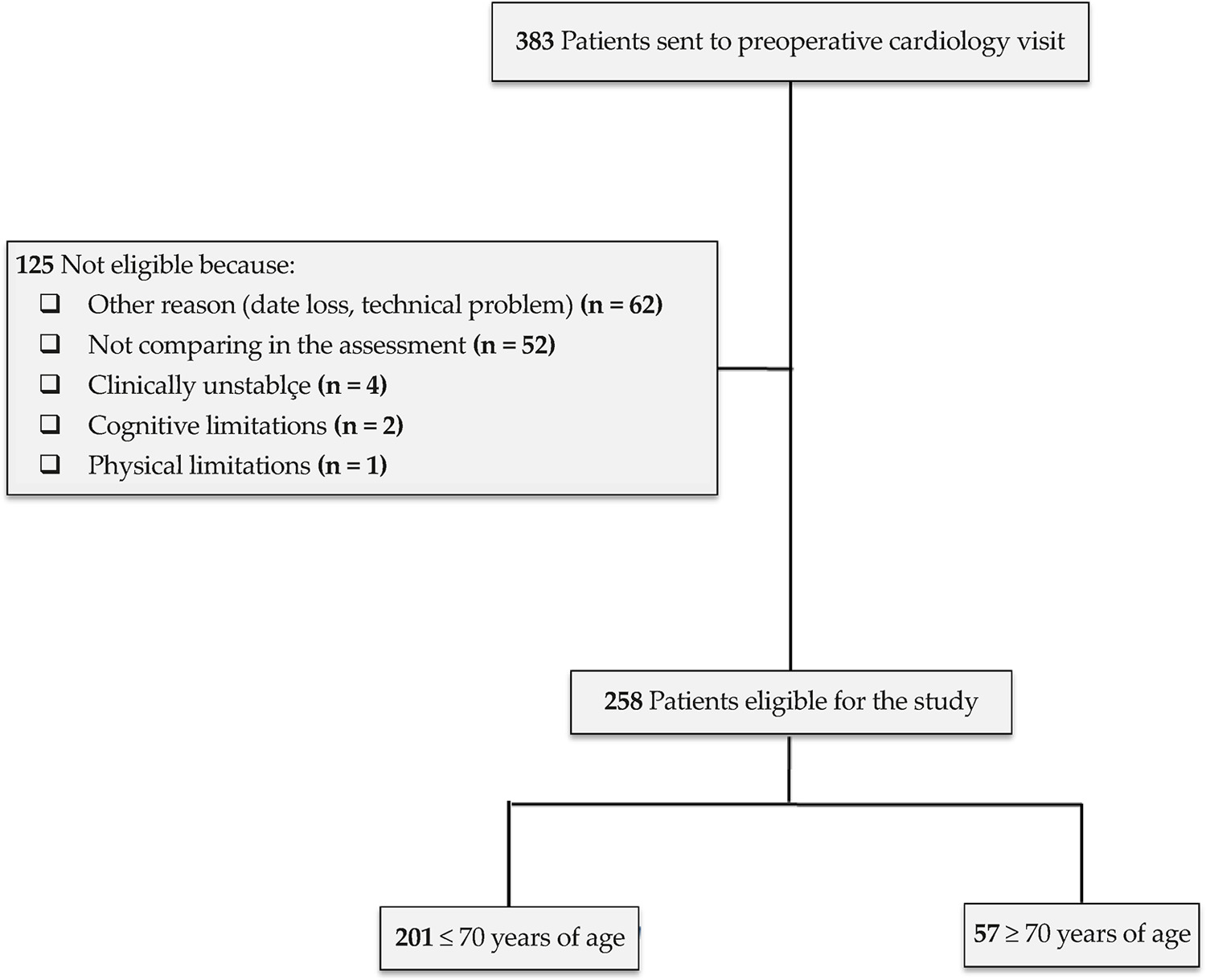
This is a cross-sectional study. All patients were ≥ 18 years of age, clinically stable. The following patients were excluded: those unable to perform the tests because of physical, cognitive, or neurological limitations; those requiring non elective/emergency procedures or hemodynamic instability. During the preoperative cardiology visit, frailty was assessed by the Short Physical Performance Battery (SPPB), the Frailty Deficit Index (FDI), handgrip strength, and gait speed 3m. For the entire analysis, the statistical significance was set at 5%.

Results

Our cohort consisted of 258 subjects. From the total cohort, 201 were ≤ 70 years of age (77.9%), the predominant etiology according to rheumatic disease (50.7% vs 8.8%; p=0.000) with double mitral lesion (24.9% vs 0%; p=0.000). Frailty was present in 32.9% according SPPB, 29.1% with reduced muscular strength. and 8.9% with FDI. Handgrip strength was weaker in elderly patients (26.7 vs 23.6; p=0.051) and gait speed was lower in the younger group, in which 36% were considered frail (36% vs 14%; p=0.002). Variables associated with frailty were age ≥ 70 years, female gender, aortic stenosis, and regurgitation.

Conclusion

Frailty in adult patients who will have elective heart valve surgery is present even in the younger groups, although the older group with comorbidities are more frail. Frailty was more clearly shown by the SPPB than by the FDI and handgrip tests.

  • Cardiac Surgery
  • Frail Elderly
  • Frailty
  • Heart Valve Diseases/surgery
Read Full Article
Creative Commons Attribution (CC BY) Creative Commons license
30/06/2021 DOI: 10.36660/ijcs.20200098
ABC
Viewpoint

The Evolving Landscape of the Geriatric Cardiology Field in Brazil: New Challenges for a New World

Caio de Assis Moura Tavares et al. André Feitosa Wanderley Cavalcanti Wilson Jacob Filho

The essence of geriatric cardiology

Because it is a recent and not widespread specialty, Geriatric Cardiology is often confused with Geriatrics that is practiced by a cardiologist or simply with Cardiology that is applied to elderly patients. Although this is part of the discipline’s core, it does not represent the whole picture. It would be more adequate to define it as integrated and age-adequate cardiovascular care, centered on the patients and their functionalities – a concept previously presented by our colleagues,– that has been evolving and taking shape, as a result of the use of specific and predetermined tools.

Objectively, one could consider it as cardiology practice integrated with the Geriatric’s 5 Ms: medication (focusing on prescribing the absolutely necessary, targeting at reducing polypharmacy, minimizing interactions and adverse reactions; following Beers criteria to select appropriate medication for the elderly), mentation (vigilance, prevention and treatment of cognitive disturbances), mobility (valuing and implementing strategies that seek to maintain the patient’s mechanical functionality), multimorbidity (approaching the patient not only by looking up the cardiovascular system, but also by considering the occurrence of multiple comorbidities to be the rule, not the exception, in these individuals), and last, but literally not least is matters most (always consider the patient’s opinion regarding the benefits and burdens of the treatment, taking into account the biography and personal values, bringing the patient into the center of decision making). We would also add a sixth and last M, multidisciplinary, for the care of the elderly, remembering it must be coordinated in a horizontal fashion by a professional, but never concentrated in only one person, giving due importance to the participation of other specialists and healthcare professionals. At our institute, in the Geriatric Cardiology Unit, we perform in all patients a Comprehensive Geriatric Assessment with the aid of the 10-TaGA (10-Minute Targeted Geriatric Assessment) tool.,

[…]

  • Aged
  • Cardiology/trends
  • Delivery of Health Care
  • Frail Elderly
  • Geriatric Assessment
  • Geriatrics/trends
  • Health Services for the Aged
  • Population Dynamics
Read Full Article
Creative Commons Attribution (CC BY) Creative Commons license
06/04/2020 DOI: 10.36660/abc.20190292 Views 1
ABC
Original Article

Depression as a Clinical Determinant of Dependence and Low Quality of Life in Elderly Patients with Cardiovascular Disease

Giselle Helena de Paula Rodrigues et al. Otavio Celso Eluf Gebara Catia Cilene da Silva Gerbi Humberto Pierri Mauricio Wajngarten

Background:

The aging process promotes a progressive increase in chronic-degenerative diseases. The effect of these diseases on the functional capacity has been well recognized. Another health parameter concerns “quality of life related to health”. Among the elderly population, cardiovascular diseases stand out due to the epidemiological and clinical impact. Usually, these diseases have been associated with others. This set of problems may compromise both independence and quality of life in elderly patients who seek cardiologic treatment. These health parameters have not been well contemplated by cardiologists.

Objective:

Evaluating, among the elderly population with cardiovascular disease, which are the most relevant clinical determinants regarding dependence and quality of life.

Methods:

This group was randomly and consecutively selected and four questionnaires were applied: HAQ, SF-36, PRIME-MD e Mini Mental State.

Results:

The study included 1,020 elderly patients, 63.3% women. The group had been between 60 and 97 years-old (mean: 75.56 ± 6.62 years-old). 61.4% were independent or mild dependence. The quality of life total score was high (HAQ: 88.66 ± 2.68). 87.8% of patients had a SF-36 total score > 66. In the multivariate analysis, the association between diagnoses and high degrees of dependence was significant only for previous stroke (p = 0.014), obesity (p < 0.001), lack of physical activity (p = 0.016), osteoarthritis (p < 0.001), cognitive impairment (p < 0.001), and major depression (p < 0.001). Analyzing the quality of life, major depression and physical illness for depression was significantly associated with all domains of the SF-36.

Conclusion:

Among an elderly outpatient cardiology population, dependence and quality of life clinical determinants are not cardiovascular comorbidities, especially the depression.

  • Aged
  • Cardiovascular Diseases
  • Depression
  • Frail Elderly
  • Quality of life
Read Full Article
Creative Commons Attribution (CC BY) Creative Commons license
14/04/2015 DOI: 10.5935/abc.20150034

How to cite this article

EndNote RIS

Electronic Document Format (Vancouver)

Ferreira RM. Frailty and Atrial Fibrillation: A Closer Look at the FRAIL-AF Trial. Arquivos Brasileiros de Cardiologia 2024;121(5):e20230671.

Electronic Document Format (ABNT)

Ferreira, Roberto Muniz. Frailty and Atrial Fibrillation: A Closer Look at the FRAIL-AF Trial. Arquivos Brasileiros de Cardiologia, v. 121, n. 5, e20230671, Jun. 2024.

Electronic Document Format (APA)

Ferreira, R. M. (2024). Frailty and Atrial Fibrillation: A Closer Look at the FRAIL-AF Trial. Arquivos Brasileiros de Cardiologia, 121(5), e20230671.

Electronic Document Format (ISO)

Ferreira, Roberto Muniz. Frailty and Atrial Fibrillation: A Closer Look at the FRAIL-AF Trial. Arquivos Brasileiros de Cardiologia [online]. 2024, vol. 121, n. 5, [cited 2026-10-14], e20230671. Available from: <https://journals.cardiol.br/en/article/frailty-and-atrial-fibrillation-a-closer-look-at-the-frail-af-trial/>. ISSN 0066-782X

EndNote RIS

Electronic Document Format (Vancouver)

Harada G, Andrade MC, Brito JN, Tavares CAM, Tarasoutchi F, Pomerantzeff PMA, Bortolotto L, et al. Prevalence of Frailty in Patients Undergoing Cardiac Valve Surgery: Comparison of Frailty Tools. International Journal of Cardiovascular Sciences 2021;34(5 Supl 1):78-86.

Electronic Document Format (ABNT)

Harada, Gabriela; Andrade, Monique Carvalho; Brito, Julia Nobrega; Tavares, Caio de Assis Moura; Tarasoutchi, Flávio; Pomerantzeff, Pablo Maria Alberto; Bortolotto, Luiz; Feltrim, Maria Ignez Zanetti. Prevalence of Frailty in Patients Undergoing Cardiac Valve Surgery: Comparison of Frailty Tools. International Journal of Cardiovascular Sciences, v. 34, n. 5 Supl 1, p. 78-86, Jun. 2021.

Electronic Document Format (APA)

Harada, G., Andrade, M. C., Brito, J. N., Tavares, C. A. M., Tarasoutchi, F., Pomerantzeff, P. M. A., Bortolotto, L., & Feltrim, M. I. Z. (2021). Prevalence of Frailty in Patients Undergoing Cardiac Valve Surgery: Comparison of Frailty Tools. International Journal of Cardiovascular Sciences, 34(5 Supl 1), 78-86.

Electronic Document Format (ISO)

Harada, Gabriela and Andrade, Monique Carvalho and Brito, Julia Nobrega and Tavares, Caio de Assis Moura and Tarasoutchi, Flávio and Pomerantzeff, Pablo Maria Alberto and Bortolotto, Luiz and Feltrim, Maria Ignez Zanetti. Prevalence of Frailty in Patients Undergoing Cardiac Valve Surgery: Comparison of Frailty Tools. International Journal of Cardiovascular Sciences [online]. 2021, vol. 34, n. 5 Supl 1, [cited 2026-10-14], pp. 78-86. Available from: <https://journals.cardiol.br/en/article/prevalence-of-frailty-in-patients-undergoing-cardiac-valve-surgery-comparison-of-frailty-tools/>. ISSN 2359-4802

EndNote RIS

Electronic Document Format (Vancouver)

Tavares CAM, Cavalcanti AFW, Jacob Filho W. The Evolving Landscape of the Geriatric Cardiology Field in Brazil: New Challenges for a New World. Arquivos Brasileiros de Cardiologia 2020;114(3):571-3.

Electronic Document Format (ABNT)

Tavares, Caio de Assis Moura; Cavalcanti, André Feitosa Wanderley; Jacob Filho, Wilson. The Evolving Landscape of the Geriatric Cardiology Field in Brazil: New Challenges for a New World. Arquivos Brasileiros de Cardiologia, v. 114, n. 3, p. 571-573, Apr. 2020.

Electronic Document Format (APA)

Tavares, C. A. M., Cavalcanti, A. F. W., & Jacob Filho, W. (2020). The Evolving Landscape of the Geriatric Cardiology Field in Brazil: New Challenges for a New World. Arquivos Brasileiros de Cardiologia, 114(3), 571-573.

Electronic Document Format (ISO)

Tavares, Caio de Assis Moura and Cavalcanti, André Feitosa Wanderley and Jacob Filho, Wilson. The Evolving Landscape of the Geriatric Cardiology Field in Brazil: New Challenges for a New World. Arquivos Brasileiros de Cardiologia [online]. 2020, vol. 114, n. 3, [cited 2026-10-14], pp. 571-573. Available from: <https://journals.cardiol.br/en/article/the-evolving-landscape-of-the-geriatric-cardiology-field-in-brazil-new-challenges-for-a-new-world/>. ISSN 0066-782X

EndNote RIS

Electronic Document Format (Vancouver)

Rodrigues GHP, Gebara OCE, Gerbi CCS, Pierri H, Wajngarten M. Depression as a Clinical Determinant of Dependence and Low Quality of Life in Elderly Patients with Cardiovascular Disease. Arquivos Brasileiros de Cardiologia 2015;104(6):443-9.

Electronic Document Format (ABNT)

Rodrigues, Giselle Helena de Paula; Gebara, Otavio Celso Eluf; Gerbi, Catia Cilene da Silva; Pierri, Humberto; Wajngarten, Mauricio. Depression as a Clinical Determinant of Dependence and Low Quality of Life in Elderly Patients with Cardiovascular Disease. Arquivos Brasileiros de Cardiologia, v. 104, n. 6, p. 443-449, Apr. 2015.

Electronic Document Format (APA)

Rodrigues, G. H. P., Gebara, O. C. E., Gerbi, C. C. S., Pierri, H., & Wajngarten, M. (2015). Depression as a Clinical Determinant of Dependence and Low Quality of Life in Elderly Patients with Cardiovascular Disease. Arquivos Brasileiros de Cardiologia, 104(6), 443-449.

Electronic Document Format (ISO)

Rodrigues, Giselle Helena de Paula and Gebara, Otavio Celso Eluf and Gerbi, Catia Cilene da Silva and Pierri, Humberto and Wajngarten, Mauricio. Depression as a Clinical Determinant of Dependence and Low Quality of Life in Elderly Patients with Cardiovascular Disease. Arquivos Brasileiros de Cardiologia [online]. 2015, vol. 104, n. 6, [cited 2026-10-14], pp. 443-449. Available from: <https://journals.cardiol.br/en/article/depression-as-a-clinical-determinant-of-dependence-and-low-quality-of-life-in-elderly-patients-with-cardiovascular-disease/>. ISSN 0066-782X

  • About ABC Family
  • Internal Regulation
  • Editorial Board
  • Brazilian Society of Cardiology (SBC)

Issues

SBC Guidelines

  • Videos
  • Podcasts
  • News