ABC Family Arquivos Brasileiros de Cardiologia International Journal of Cardiovascular Sciences ABC Heart Failure & Cardiomyopathy ABC Imagem Cardiovascular
Português English
ABC Family
Português English
  • About
    • About ABC Family
    • Internal Regulation
    • Editorial Board
    • Brazilian Society of Cardiology (SBC)
  • Issues
  • SBC Guidelines
  • Content
    • Videos
    • Podcasts
    • News
  • About
    • About ABC Family
    • Internal Regulation
    • Editorial Board
    • Brazilian Society of Cardiology (SBC)
  • Issues
  • SBC Guidelines
  • Content
    • Videos
    • Podcasts
    • News

ABC Family

  • ABC Family
  • Arquivos Brasileiros de Cardiologia
  • International Journal of Cardiovascular Sciences
  • ABC Heart Failure & Cardiomyopathy
  • ABC Imagem Cardiovascular
Search in

No content found.

Journals
Ordering
Article types
Others

  1. Home
  2. Keyword: Food Consumption
Figure 1
ABC
Original Article

Stress and Food Consumption Relationship in Hypertensive Patients

Aline Lopes Dalmazo et al. Claudia Fetter Silvia Goldmeier Maria Claudia Irigoyen … Lucia Campos Pellanda Eduardo Costa Duarte Barbosa Thais Rodrigues Moreira Denise Ruttke Dillenburg Osório

Abstract

Background:

Stress is a state of threat to the balance of the organism, which can cause biological and psychological changes. In hypertensive patients, stress can interfere with blood pressure levels, influence on food choices and neglect of the diet.

Objective:

This study aims to describe the relationship between stress and dietary intake of hypertensive patients.

Methods:

A transversal study was carried out at the Arterial Hypertension Clinic of the Cardiology Institute of Rio Grande do Sul, Brazil. The participants were aged ≥ 18 years and hypertensive. Blood pressure, food consumption and anthropometric measurements were collected. The variables related to stress were evaluated by the Lipp’s Stress Symptoms Inventory (LSSI) for adults. Significance level of 5% has been considered for all analyzed data.

Results:

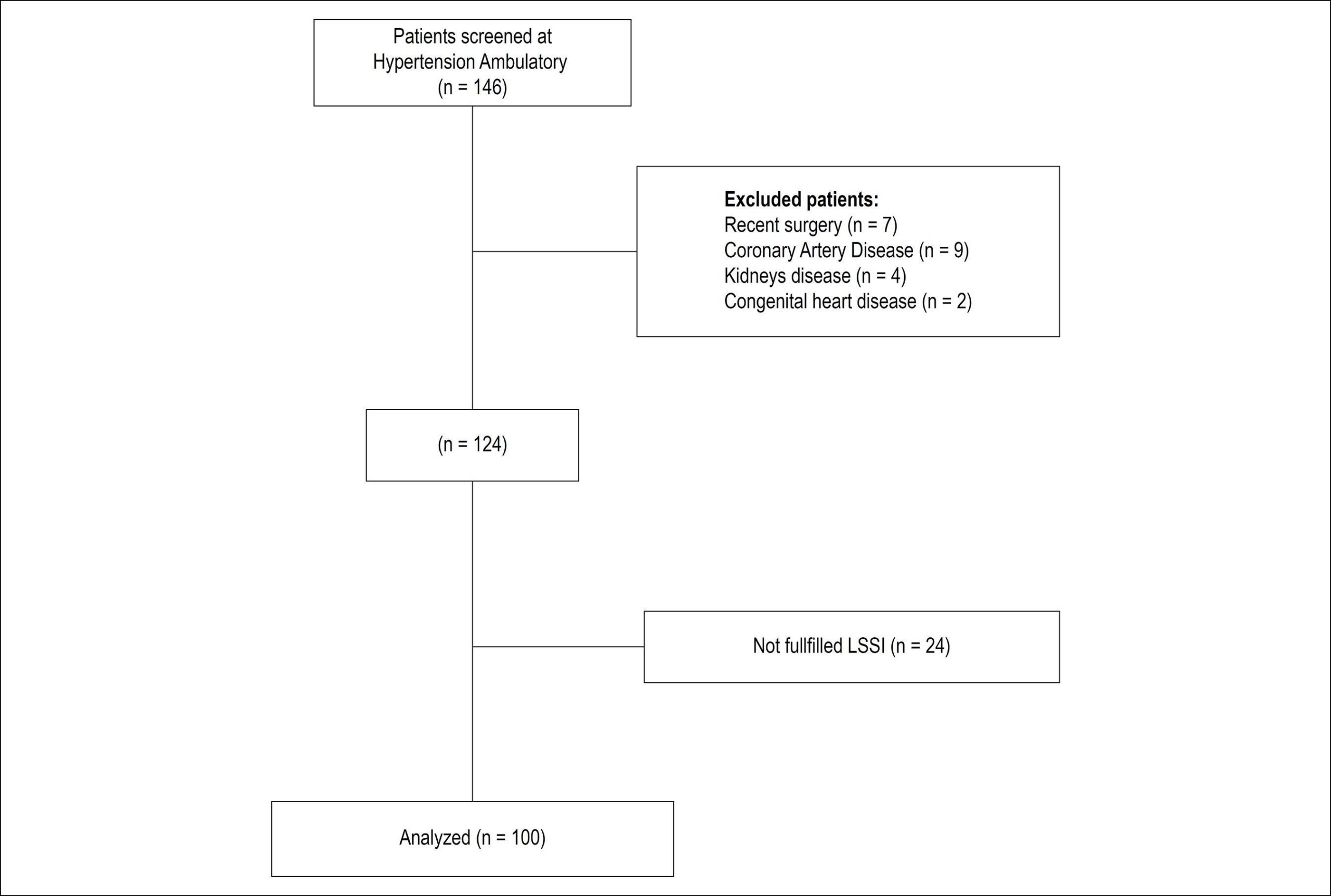
The number of participants was 100. There was a higher prevalence of the female sex (67%), the mean age of the study population was 55.87 ± 12.55 years. Among the participants, 86% were classified in some of the stress phases, on which 57% were in the resistance phase. It was observed that there was no correlation between the presence of stress (as well as their actions), pressure levels and food consumption. The consumption of foods rich in lipids and individuals with a prevalence of psychological symptoms of stress displayed a significant association.

Conclusions:

Rich in fat dietary has been the first choice in patients with psychological symptoms of stress. Further studies regarding remodeled dietary intake and blood pressure levels in relation to the stress phases are suggested. These findings are important to contribute to the development of prevention and treatment strategies for cardiovascular diseases.
  • Body Weights and Measures
  • Dietary Fats/metabolismo
  • Food Consumption
  • Hypertension
  • Metabolism
  • Stress, Physiological
Read Full Article
Creative Commons Attribution (CC BY) Creative Commons license
02/09/2019 DOI: 10.5935/abc.20190175 Views 1
ABC
Original Article

Obesity and its Association with Food Consumption, Diabetes Mellitus, and Acute Myocardial Infarction in the Elderly

Erika Aparecida da Silveira et al. Liana Lima Vieira Thiago Veiga Jardim Jacqueline Danesio de Souza

Abstract

Background:

Obesity affects a large part of elderly individuals worldwide and is considered a risk predictor for the development of chronic diseases such as cardiac diseases, the leading causes of death in the elderly population.

Objective:

To investigate the prevalence of obesity and associated factors, with emphasis on the occurrence of other diseases and on food consumption in elderly individuals treated at the Brazilian Unified Health System (Sistema Único de Saúde, SUS).

Methods:

Cross-sectional sampling study performed in the city of Goiânia (Brazil) including elderly individuals (≥ 60 years) receiving primary care. During home visits, we performed anthropometric measurements and applied a structured, standardized, and pre-tested questionnaire assessing socioeconomic, demographic and lifestyle conditions, occurrence of diseases, and food consumption. We performed multiple Poisson regression analysis using a hierarchical model and adopting a significance level of 5%.

Results:

We evaluated 418 elderly patients with a mean age of 70.7 ± 7 years. Their body mass indices had a mean value of 27.0 kg/m2 and were higher in women than in men (27.4 kg/m2 versus 26.1 kg/m2, respectively, p = 0.017). Obesity had a prevalence of 49.0%, a risk 1.87 times higher between the ages of 60-69 years and 70-79 years, and a rate 1.4 times higher among individuals with more than four morbidities. On multivariate analysis, the factors associated with obesity were age 60-69 and 70-79 years, inadequate consumption of whole-wheat grains and adequate consumption of fruit, musculoskeletal diseases, diabetes mellitus, and acute myocardial infarction.

Conclusions:

Obesity had a high prevalence in the evaluated elderly population and was associated with food consumption, musculoskeletal disease, diabetes mellitus, and acute myocardial infarction.

  • Aged
  • Diabetes Complications
  • Diabetes Mellitus
  • Food Consumption
  • Myocardial Infarction/complications
  • Obesity/complications
  • Risk Factors
Read Full Article
Creative Commons Attribution (CC BY) Creative Commons license
01/12/2016 DOI: 10.5935/abc.20160182
Assessment of a short food frequency questionnaire as predictor of hypercholesterolemia in adolescents
ABC
Artigo Original

Assessment of a short food frequency questionnaire as predictor of hypercholesterolemia in adolescents

Márcia Henriques Teixeira et al. Gloria Valeria da Veiga Rosely Sichieri

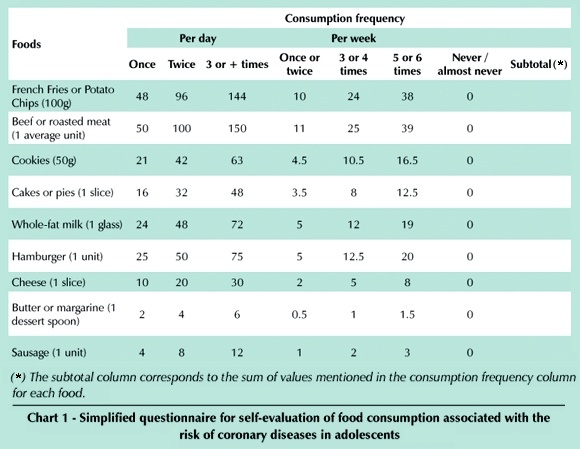
OBJECTIVE: To evaluate a short questionnaire as predictor of serum cholesterol obtained from a probabilistic sample of adolescents. METHODS: A probabilistic sample of 5th to12th grade students from state public schools in Niteroi, state of Rio de Janeiro, Brazil was drawn based on 28 classes. Five hundred seventy-seven subjects had their blood collected, and 539 answered the simplified questionnaire (23.7% of non-respondents). The questionnaire internal consistence was evaluated through Cronbach’s alpha, and agreement between cholesterol levels and food intake was assessed through weighted Kappa (Kw). RESULTS: Weighted Kappa value was very low ( 0.66). CONCLUSION: The results show that the short questionnaire was not a predictor of cholesterol concentration.

  • Adolescent
  • Brazil
  • Food Consumption
  • Hypercholesterolemia
  • Reproducibility of Results
Read Full Article
Creative Commons Attribution (CC BY) Creative Commons license
07/03/2007 DOI: 10.1590/S0066-782X2007000100011 Views 1

How to cite this article

EndNote RIS

Electronic Document Format (Vancouver)

Dalmazo AL, Fetter C, Goldmeier S, Irigoyen MC, Pellanda LC, Barbosa ECD, Moreira TR, et al. Stress and Food Consumption Relationship in Hypertensive Patients. Arquivos Brasileiros de Cardiologia 2019;113(3):374-80.

Electronic Document Format (ABNT)

Dalmazo, Aline Lopes; Fetter, Claudia; Goldmeier, Silvia; Irigoyen, Maria Claudia; Pellanda, Lucia Campos; Barbosa, Eduardo Costa Duarte; Moreira, Thais Rodrigues; Osório, Denise Ruttke Dillenburg. Stress and Food Consumption Relationship in Hypertensive Patients. Arquivos Brasileiros de Cardiologia, v. 113, n. 3, p. 374-380, Sep. 2019.

Electronic Document Format (APA)

Dalmazo, A. L., Fetter, C., Goldmeier, S., Irigoyen, M. C., Pellanda, L. C., Barbosa, E. C. D., Moreira, T. R., & Osório, D. R. D. (2019). Stress and Food Consumption Relationship in Hypertensive Patients. Arquivos Brasileiros de Cardiologia, 113(3), 374-380.

Electronic Document Format (ISO)

Dalmazo, Aline Lopes and Fetter, Claudia and Goldmeier, Silvia and Irigoyen, Maria Claudia and Pellanda, Lucia Campos and Barbosa, Eduardo Costa Duarte and Moreira, Thais Rodrigues and Osório, Denise Ruttke Dillenburg. Stress and Food Consumption Relationship in Hypertensive Patients. Arquivos Brasileiros de Cardiologia [online]. 2019, vol. 113, n. 3, [cited 2026-10-14], pp. 374-380. Available from: <https://journals.cardiol.br/en/article/stress-and-food-consumption-relationship-in-hypertensive-patients/>. ISSN 0066-782X

EndNote RIS

Electronic Document Format (Vancouver)

Silveira EA, Vieira LL, Jardim TV, Souza JD. Obesity and its Association with Food Consumption, Diabetes Mellitus, and Acute Myocardial Infarction in the Elderly. Arquivos Brasileiros de Cardiologia 2016;107(6):509-17.

Electronic Document Format (ABNT)

Silveira, Erika Aparecida da; Vieira, Liana Lima; Jardim, Thiago Veiga; Souza, Jacqueline Danesio de. Obesity and its Association with Food Consumption, Diabetes Mellitus, and Acute Myocardial Infarction in the Elderly. Arquivos Brasileiros de Cardiologia, v. 107, n. 6, p. 509-517, Nov. 2016.

Electronic Document Format (APA)

Silveira, E. A. , Vieira, L. L., Jardim, T. V., & Souza, J. D. (2016). Obesity and its Association with Food Consumption, Diabetes Mellitus, and Acute Myocardial Infarction in the Elderly. Arquivos Brasileiros de Cardiologia, 107(6), 509-517.

Electronic Document Format (ISO)

Silveira, Erika Aparecida da and Vieira, Liana Lima and Jardim, Thiago Veiga and Souza, Jacqueline Danesio de. Obesity and its Association with Food Consumption, Diabetes Mellitus, and Acute Myocardial Infarction in the Elderly. Arquivos Brasileiros de Cardiologia [online]. 2016, vol. 107, n. 6, [cited 2026-10-14], pp. 509-517. Available from: <https://journals.cardiol.br/en/article/obesity-and-its-association-with-food-consumption-diabetes-mellitus-and-acute-myocardial-infarction-in-the-elderly/>. ISSN 0066-782X

EndNote RIS

Electronic Document Format (Vancouver)

Teixeira MH, Veiga GV, Sichieri R. Assessment of a short food frequency questionnaire as predictor of hypercholesterolemia in adolescents. Arquivos Brasileiros de Cardiologia 2007;88(1):66-71.

Electronic Document Format (ABNT)

Teixeira, Márcia Henriques; Veiga, Gloria Valeria da; Sichieri, Rosely. Assessment of a short food frequency questionnaire as predictor of hypercholesterolemia in adolescents. Arquivos Brasileiros de Cardiologia, v. 88, n. 1, p. 66-71, Mar. 2007.

Electronic Document Format (APA)

Teixeira, M. H., Veiga, G. V. , & Sichieri, R. (2007). Assessment of a short food frequency questionnaire as predictor of hypercholesterolemia in adolescents. Arquivos Brasileiros de Cardiologia, 88(1), 66-71.

Electronic Document Format (ISO)

Teixeira, Márcia Henriques and Veiga, Gloria Valeria da and Sichieri, Rosely. Assessment of a short food frequency questionnaire as predictor of hypercholesterolemia in adolescents. Arquivos Brasileiros de Cardiologia [online]. 2007, vol. 88, n. 1, [cited 2026-10-14], pp. 66-71. Available from: <https://journals.cardiol.br/en/article/assessment-of-a-short-food-frequency-questionnaire-as-predictor-of-hypercholesterolemia-in-adolescents/>. ISSN 0066-782X

  • About ABC Family
  • Internal Regulation
  • Editorial Board
  • Brazilian Society of Cardiology (SBC)

Issues

SBC Guidelines

  • Videos
  • Podcasts
  • News