ABC Family Arquivos Brasileiros de Cardiologia International Journal of Cardiovascular Sciences ABC Heart Failure & Cardiomyopathy ABC Imagem Cardiovascular
Português English
ABC Family
Português English
  • About
    • About ABC Family
    • Internal Regulation
    • Editorial Board
    • Brazilian Society of Cardiology (SBC)
  • Issues
  • SBC Guidelines
  • Content
    • Videos
    • Podcasts
    • News
  • About
    • About ABC Family
    • Internal Regulation
    • Editorial Board
    • Brazilian Society of Cardiology (SBC)
  • Issues
  • SBC Guidelines
  • Content
    • Videos
    • Podcasts
    • News

ABC Family

  • ABC Family
  • Arquivos Brasileiros de Cardiologia
  • International Journal of Cardiovascular Sciences
  • ABC Heart Failure & Cardiomyopathy
  • ABC Imagem Cardiovascular
Search in

No content found.

Journals
Ordering
Article types
Others

  1. Home
  2. Keyword: Exercise Tests
Figure 1
IJCS
Original Article

Sociodemographic, Clinical Condition, and Functional Aerobic Capacity in Patients With Heart Failure With Varying Ventricular Ejection Fraction

Jhonatan Betancourt Peña et al. Iago Portela Pino Maria Jose Martinez Patino

Abstract

Background

Recently, a new heart failure (HF) classification was made considering the left ventricular ejection fraction (LVEF) phenotype. Comprehensive assessments of the groups are required to guide patient management.

Objective

To determine the differences in sociodemographic, clinical, functional aerobic capacity, and health-related quality of life (HRQOL) variables in patients with HF classified with different LVEFs and to explore the correlations between the variables.

Methods

This work is a cross-sectional descriptive and correlational study. Three groups of patients with HF (LVEF≥50%, LVEF<40%, and LVEF40-49%) were compared. Sociodemographic, clinical variables and functional aerobic capacity with Sit to Stand (STS), 6-minute walk test (6MWT), Duke Activity Status Index (DASI), Minnesota Living with HF Questionnaire (MLFHQ), and Patient Health Questionnaire 9 (PHQ-9) were considered. The Chi-square test, one-way analysis of variance (ANOVA) test, and Spearman's correlation were used for statistical analysis. The statistical significance level was set at 5%.

Results

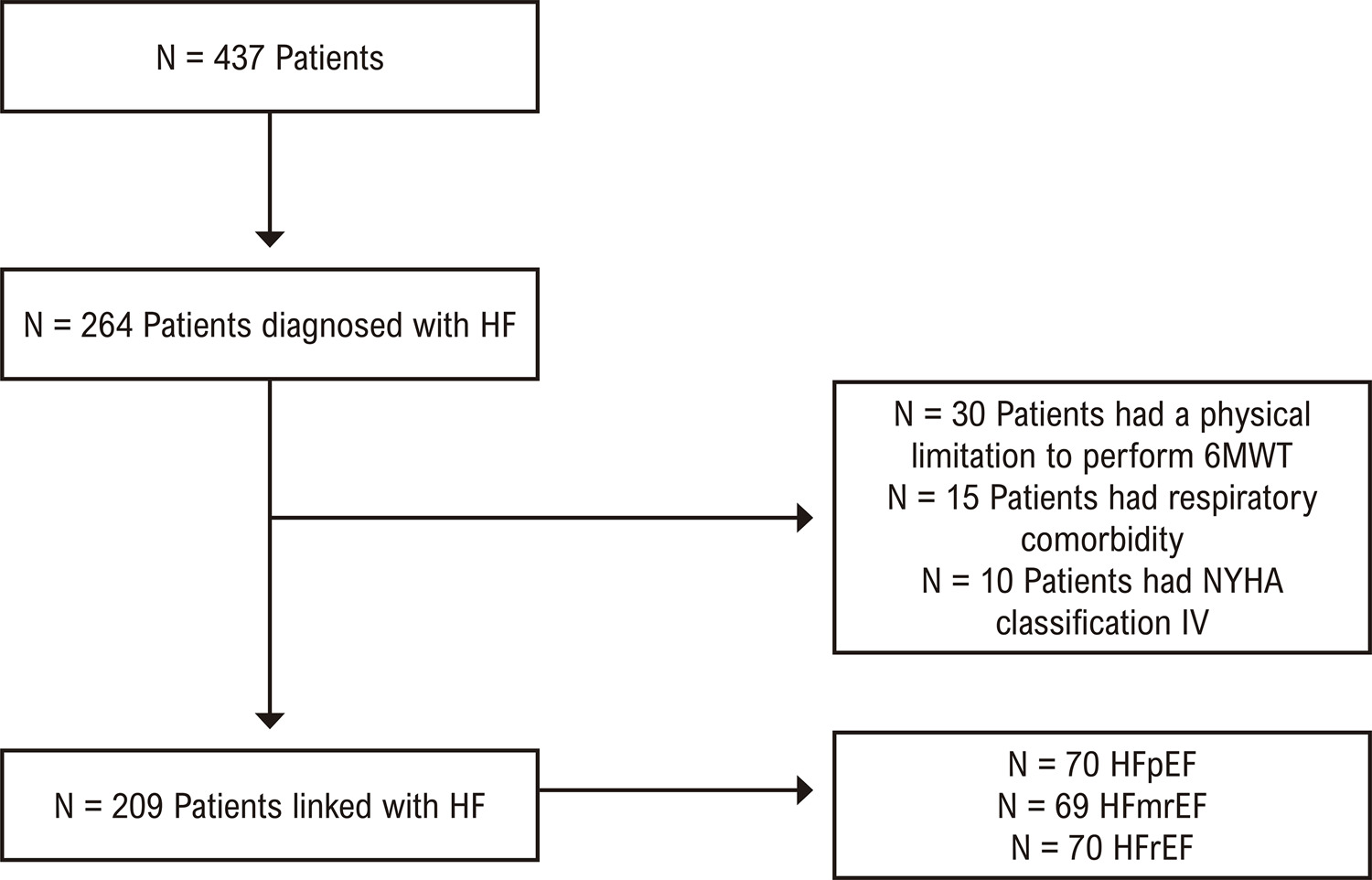
A total of 209 patients were admitted with a diagnosis of HF, with a more significant number of men. Marital status was a predominantly stable union in the HF with preserved ejection fraction (HFpEF) and HF with mid-range ejection fraction (HFmrEF) groups. A sedentary lifestyle was lower in the HF with reduced ejection fraction (HFrEF) group 59 (84.3%), p-value = 0.033, and the angina pectoris was higher in the HFpEF 30 (42.9%). Systolic blood pressure at the end of the 6MWT evidenced a higher score in HFpEF 132.0±17.25 concerning HFrEF 128.0±16.57, p-value=0.043. The fat percentage was higher in HFpEF 30.20±8.80 regarding the HFmrEF group 26.51±7.60, p-value = 0.028.

Conclusion

There were significant differences according to the LVEF classification in marital status, angina symptoms, fat percentage, and blood pressure at rest.
  • Exercise Tests
  • Heart Failure
  • Left Ventricular Function
  • Quality of life
  • Socioeconomic Factors
Read Full Article
Creative Commons Attribution (CC BY) Creative Commons license
08/03/2024 DOI: 10.36660/ijcs.20230079 Views 1
Figure 1
IJCS
Original Article

Classification System for Cardiorespiratory Fitness Based on a Sample of the Brazilian Population

Antonio Eduardo Monteiro de Almeida et al. Igor Rafael Miranda Ferreira Santander Maria Izabel Macedo Campos Jorge René Garcia Arévalo … João Agnaldo do Nascimento Luiz Eduardo Fonteles Ritt Karlyse Claudino Belli Jorge Pinto Ribeiro Ricardo Stein

Abstract

Background:

Peak oxygen consumption (VO2peak) is an important prognostic marker and its classification helps the cardiologist in the therapeutic decision-making process. The most commonly used cardiorespiratory fitness (CRF) classification has not been validated for the Brazilian population.

Objective:

To elaborate a CRF classification using a Brazilian sample and to compare it with the American Heart Association (AHA), Cooper and UNIFESP classifications.

Methods:

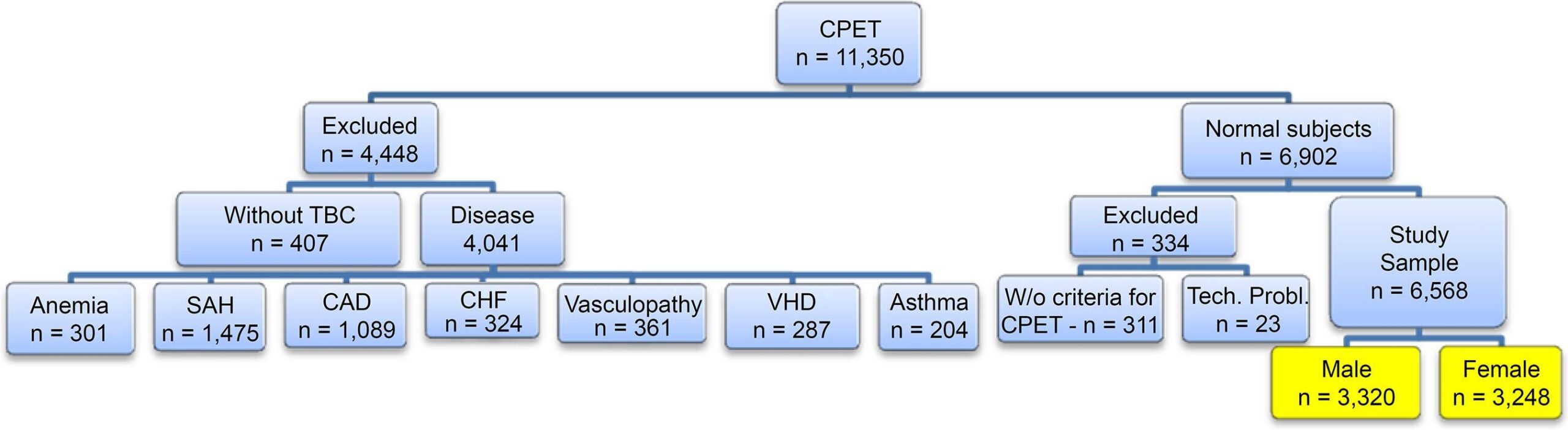
A total of 6,568 healthy subjects were analyzed through cardiopulmonary exercise testing (CPET). They were distributed by sex and the following age groups (years): 7-12, 13-19, 20-79 (per decades) and > 80 years. After measurement of the VO2peak, participants were distributed into quintiles of CRF in very poor, poor, moderate, high and very high (AEMA Table). The CRF classifications by AEMA, AHA, Cooper, and UNIFESP were compared using the Wilcoxon, Kappa and concordance percentages.

Results:

VO2peak presented an inverse and moderate correlation with age considering both sexes (R = -0.488, p < 0.001). All paired comparisons between CRF classification systems showed differences (p < 0.001) and disagreement percentage – AEMA versus AHA (k = 0.291, 56.7%), AEMA versus Cooper (k = 0.220, 62.4%) and AEMA versus UNIFESP (k = 0.201, 63.9 %).

Conclusion:

The AEMA table showed important discrepancies in the classification of CRF when compared to other tables widely used in our setting. Because it was obtained from a large sample of the Brazilian population, the AEMA table should be preferred over other classification systems in our population.

  • Cardiorespiratory Fitness
  • Exercise
  • Exercise Tests
  • Oxygen Consumption
  • Population Health
  • Respiratory Function Tests
Read Full Article
Creative Commons Attribution (CC BY) Creative Commons license
12/08/2019 DOI: 10.5935/2359-4802.20190057 Views 2

How to cite this article

EndNote RIS

Electronic Document Format (Vancouver)

Peña JB, Pino IP, Patino MJM. Sociodemographic, Clinical Condition, and Functional Aerobic Capacity in Patients With Heart Failure With Varying Ventricular Ejection Fraction. International Journal of Cardiovascular Sciences 2024;37:e20230079.

Electronic Document Format (ABNT)

Peña, Jhonatan Betancourt; Pino, Iago Portela; Patino, Maria Jose Martinez. Sociodemographic, Clinical Condition, and Functional Aerobic Capacity in Patients With Heart Failure With Varying Ventricular Ejection Fraction. International Journal of Cardiovascular Sciences, v. 37, e20230079, Mar. 2024.

Electronic Document Format (APA)

Peña, J. B., Pino, I. P., & Patino, M. J. M. (2024). Sociodemographic, Clinical Condition, and Functional Aerobic Capacity in Patients With Heart Failure With Varying Ventricular Ejection Fraction. International Journal of Cardiovascular Sciences, 37, e20230079.

Electronic Document Format (ISO)

Peña, Jhonatan Betancourt and Pino, Iago Portela and Patino, Maria Jose Martinez. Sociodemographic, Clinical Condition, and Functional Aerobic Capacity in Patients With Heart Failure With Varying Ventricular Ejection Fraction. International Journal of Cardiovascular Sciences [online]. 2024, vol. 37, [cited 2026-10-14], e20230079. Available from: <https://journals.cardiol.br/en/article/sociodemographic-clinical-condition-and-functional-aerobic-capacity-in-patients-with-heart-failure-with-varying-ventricular-ejection-fraction/>. ISSN 2359-4802

EndNote RIS

Electronic Document Format (Vancouver)

Almeida AEM, Santander IRMF, Campos MIM, Arévalo JRG, Nascimento JA, Ritt LEF, Belli KC, et al. Classification System for Cardiorespiratory Fitness Based on a Sample of the Brazilian Population. International Journal of Cardiovascular Sciences 2019;32(4):343-54.

Electronic Document Format (ABNT)

Almeida, Antonio Eduardo Monteiro de; Santander, Igor Rafael Miranda Ferreira; Campos, Maria Izabel Macedo; Arévalo, Jorge René Garcia; Nascimento, João Agnaldo do; Ritt, Luiz Eduardo Fonteles; Belli, Karlyse Claudino; Ribeiro, Jorge Pinto; Stein, Ricardo. Classification System for Cardiorespiratory Fitness Based on a Sample of the Brazilian Population. International Journal of Cardiovascular Sciences, v. 32, n. 4, p. 343-354, Aug. 2019.

Electronic Document Format (APA)

Almeida, A. E. M. , Santander, I. R. M. F., Campos, M. I. M., Arévalo, J. R. G., Nascimento, J. A. , Ritt, L. E. F., Belli, K. C., Ribeiro, J. P., & Stein, R. (2019). Classification System for Cardiorespiratory Fitness Based on a Sample of the Brazilian Population. International Journal of Cardiovascular Sciences, 32(4), 343-354.

Electronic Document Format (ISO)

Almeida, Antonio Eduardo Monteiro de and Santander, Igor Rafael Miranda Ferreira and Campos, Maria Izabel Macedo and Arévalo, Jorge René Garcia and Nascimento, João Agnaldo do and Ritt, Luiz Eduardo Fonteles and Belli, Karlyse Claudino and Ribeiro, Jorge Pinto and Stein, Ricardo. Classification System for Cardiorespiratory Fitness Based on a Sample of the Brazilian Population. International Journal of Cardiovascular Sciences [online]. 2019, vol. 32, n. 4, [cited 2026-10-14], pp. 343-354. Available from: <https://journals.cardiol.br/en/article/classification-system-for-cardiorespiratory-fitness-based-on-a-sample-of-the-brazilian-population/>. ISSN 2359-4802

  • About ABC Family
  • Internal Regulation
  • Editorial Board
  • Brazilian Society of Cardiology (SBC)

Issues

SBC Guidelines

  • Videos
  • Podcasts
  • News