ABC Family Arquivos Brasileiros de Cardiologia International Journal of Cardiovascular Sciences ABC Heart Failure & Cardiomyopathy ABC Imagem Cardiovascular
Português English
ABC Family
Português English
  • About
    • About ABC Family
    • Internal Regulation
    • Editorial Board
    • Brazilian Society of Cardiology (SBC)
  • Issues
  • SBC Guidelines
  • Content
    • Videos
    • Podcasts
    • News
  • About
    • About ABC Family
    • Internal Regulation
    • Editorial Board
    • Brazilian Society of Cardiology (SBC)
  • Issues
  • SBC Guidelines
  • Content
    • Videos
    • Podcasts
    • News

ABC Family

  • ABC Family
  • Arquivos Brasileiros de Cardiologia
  • International Journal of Cardiovascular Sciences
  • ABC Heart Failure & Cardiomyopathy
  • ABC Imagem Cardiovascular
Search in

No content found.

Journals
Ordering
Article types
Others

  1. Home
  2. Keyword: complete atrioventricular block
Figure 1
ABC
Research Letter

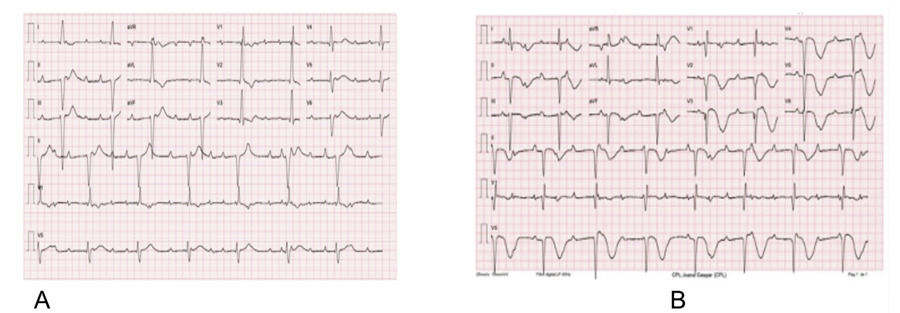
Takotsubo Syndrome, Complete Heart Block, and Cardiac Arrest: A Clinical Challenge

Ana Abrantes et al. Catarina Gregório Miguel Raposo Nelson Cunha … Dulce Brito Fausto J. Pinto

Abstract

Complete atrioventricular block may be associated with Takotsubo syndrome, and the decision of device implantation in such patients is challenging. We present a case of a 76-year-old woman admitted after out-of-hospital cardiac arrest that was reverted after defibrillation treatment. Post-resuscitation electrocardiogram documented complete atrioventricular block, and echocardiogram revealed severe left ventricular dysfunction with apical ballooning. Coronary angiography excluded coronary artery disease, and Takotsubo syndrome was diagnosed based on clinical and imaging features. Atrioventricular block persisted despite normalization of left ventricular function; therefore, cardiac arrest was considered secondary to a ventricular arrhythmia induced by atrioventricular block, and a pacemaker, rather than an implantable cardioverter-defibrillator, was implanted. During follow-up, complete atrioventricular block persisted, with 99% of ventricular pacing observed upon device interrogation. This case supports that the stress of atrioventricular block may trigger Takotsubo syndrome, which is reinforced by the persistence of conduction abnormalities despite reversal of ventricular defects. Therefore, early implantation of a cardiac device should be carefully considered on a case-by-case basis.

  • Cardiac arrest
  • complete atrioventricular block
  • Pacemaker
  • Takotsubo syndrome
Read Full Article
Creative Commons Attribution (CC BY) Creative Commons license
09/01/2026 DOI: 10.36660/abc.20250245i Views 1
ABC
Original Article

Bundle branch and atrioventricular block as complications of acute myocardial infarction in the thrombolytic era

Claudia Caminha Escosteguy et al. Marciano de Almeida Carvalho Roberto de Andrade Medronho Luiz Maurino Abreu Mario Ypiranga Monteiro Filho

OBJECTIVE: To analyze the incidence of intraventricular and atrioventricular conduction defects associated with acute myocardial infarction and the degree of in hospital mortality resulting from this condition during the era of thrombolytic therapy. METHODS: Observational study of a cohort of 929 consecutive patients with acute myocardial infarction. Multivariate analysis by logistic regression. Was used. RESULTS: Logistic regression showed a greater incidence of bundle branch block in male sex (odds ratio = 1.87, 95% CI = 1.02-3.42), age over 70 years (odds ratio = 2.31, 95% CI = 1.68-5.00), anterior localization of the infarction (odds ratio = 1.93, 95% CI = 1.03-3.65). There was a greater incidence of complete atrioventricular block in inferior infarcts (odds ratio = 2.59, 95% CI 1.30-5.18) and the presence of cardiogenic shock (odds ratio = 3.90, 95% CI = 1.43-10.65). Use of a thrombolytic agent was associated with a tendency toward a lower occurrence of bundle branch block (odds ratio = 0.68) and a greater occurrence of complete atrioventricular block (odds ratio = 1.44). The presence of bundle branch block (odds ratio = 2.45 95% , CI = 1.14-5.28) and of complete atrioventricular block (odds ratio = 13.59, 95% CI = 5.43-33.98) was associated with a high and independent probability of inhospital death. CONCLUSION: During the current era of thrombolytic therapy and in this population, intraventricular disturbances of electrical conduction and complete atrioventricular block were associated with a high and independent risk of inhospital death during acute myocardial infarction.

  • Bundle Branch Block
  • complete atrioventricular block
  • thrombolysis
Read Full Article
Creative Commons Attribution (CC BY) Creative Commons license
08/01/2002 DOI: 10.1590/S0066-782X2001000400003 Views 2
ABC
Artigo Original

Cardiac amyloidosis. A disease with many faces and different prognoses

Antonio Carlos Pereira Barretto et al. Dalton Precoma João Batista Serro-Azul Mauricio Wajngarten … Humberto Pierri Ligia Pivotto Amit Nussbacher Otavio Celso Eluf Gebara Giovanni Bellotti

PURPOSE: To identify the principal forms of cardiac amiloydosis presentation in a terciary hospital. METHODS: Eight cases whith cardiac amyloidosis were identified. Five were woman, their ages ranged from 23 to 83 years (mean 62). After a medical history and clinical examination the patients, were submitted to complementary tests: electrocardiogram (EKG), echocardiogram (ECHO), scintigraphy with technecium pirophosfate and cardiac biopsy these results allowed the identification of their clinical situation. RESULTS: Seven patients refered dyspnea, 6 were in heart failure, 1 patient had syncope. The EKG identified complete atrioventricular (AV) block in 4 patients, and antero septal inactive area in the other 4. The ECHO showed normal cardiac diameter in all (mean left ventricular diastolic diameter of 46.8) and slight reduction of left ventricular ejection fraction; hypertrophy of the left ventricular septal and posterior walls in all cases, in 7 cases there was a hyper refractile granular sparkling ECHO. Two different groups were identified: one with complete AV block and the second with restrictive cardiomyopathy. The prognosis was different in these two groups. Those with complete AV block evolved better after pacemaker implantation and those with restrictive cardiomyopathy had refractary heart failure and 3 of them died. CONCLUSION: The increased free wall and septal thickness, the slight systolic dysfunction and the infiltration aspect at ECHO allow us to identify the great majority of the cases. Those patients with restrictive cardiomyopathy evolve with refractory heart failure and most of them die in a few months.

  • Cardiac Amyloidosis
  • complete atrioventricular block
  • Heart Failure
Read Full Article
Creative Commons Attribution (CC BY) Creative Commons license
14/02/2001 DOI: 10.1590/S0066-782X1997000800003 Views 1

How to cite this article

EndNote RIS

Electronic Document Format (Vancouver)

Abrantes A, Gregório C, Raposo M, Cunha N, Brito D, Pinto FJ. Takotsubo Syndrome, Complete Heart Block, and Cardiac Arrest: A Clinical Challenge. Arquivos Brasileiros de Cardiologia 2026;122(11):e20250245.

Electronic Document Format (ABNT)

Abrantes, Ana; Gregório, Catarina; Raposo, Miguel; Cunha, Nelson; Brito, Dulce; Pinto, Fausto J.. Takotsubo Syndrome, Complete Heart Block, and Cardiac Arrest: A Clinical Challenge. Arquivos Brasileiros de Cardiologia, v. 122, n. 11, e20250245, Jan. 2026.

Electronic Document Format (APA)

Abrantes, A., Gregório, C., Raposo, M., Cunha, N., Brito, D., & Pinto, F. J. (2026). Takotsubo Syndrome, Complete Heart Block, and Cardiac Arrest: A Clinical Challenge. Arquivos Brasileiros de Cardiologia, 122(11), e20250245.

Electronic Document Format (ISO)

Abrantes, Ana and Gregório, Catarina and Raposo, Miguel and Cunha, Nelson and Brito, Dulce and Pinto, Fausto J.. Takotsubo Syndrome, Complete Heart Block, and Cardiac Arrest: A Clinical Challenge. Arquivos Brasileiros de Cardiologia [online]. 2026, vol. 122, n. 11, [cited 2026-10-14], e20250245. Available from: <https://journals.cardiol.br/en/article/takotsubo-syndrome-complete-heart-block-and-cardiac-arrest-a-clinical-challenge/>. ISSN 0066-782X

EndNote RIS

Electronic Document Format (Vancouver)

Escosteguy CC, Carvalho MA, Medronho RA, Abreu LM, Monteiro Filho MY. Bundle branch and atrioventricular block as complications of acute myocardial infarction in the thrombolytic era. Arquivos Brasileiros de Cardiologia 2002;76(4):291-6.

Electronic Document Format (ABNT)

Escosteguy, Claudia Caminha; Carvalho, Marciano de Almeida; Medronho, Roberto de Andrade; Abreu, Luiz Maurino; Monteiro Filho, Mario Ypiranga. Bundle branch and atrioventricular block as complications of acute myocardial infarction in the thrombolytic era. Arquivos Brasileiros de Cardiologia, v. 76, n. 4, p. 291-296, Jan. 2002.

Electronic Document Format (APA)

Escosteguy, C. C., Carvalho, M. A., Medronho, R. A., Abreu, L. M., & Monteiro Filho, M. Y. (2002). Bundle branch and atrioventricular block as complications of acute myocardial infarction in the thrombolytic era. Arquivos Brasileiros de Cardiologia, 76(4), 291-296.

Electronic Document Format (ISO)

Escosteguy, Claudia Caminha and Carvalho, Marciano de Almeida and Medronho, Roberto de Andrade and Abreu, Luiz Maurino and Monteiro Filho, Mario Ypiranga. Bundle branch and atrioventricular block as complications of acute myocardial infarction in the thrombolytic era. Arquivos Brasileiros de Cardiologia [online]. 2002, vol. 76, n. 4, [cited 2026-10-14], pp. 291-296. Available from: <https://journals.cardiol.br/en/article/bundle-branch-and-atrioventricular-block-as-complications-of-acute-myocardial-infarction-in-the-thrombolytic-era/>. ISSN 0066-782X

EndNote RIS

Electronic Document Format (Vancouver)

Barretto ACP, Precoma D, Serro-Azul JB, Wajngarten M, Pierri H, Pivotto L, Nussbacher A, et al. Cardiac amyloidosis. A disease with many faces and different prognoses. Arquivos Brasileiros de Cardiologia 2001;69(2):89-93.

Electronic Document Format (ABNT)

Barretto, Antonio Carlos Pereira; Precoma, Dalton; Serro-Azul, João Batista; Wajngarten, Mauricio; Pierri, Humberto; Pivotto, Ligia; Nussbacher, Amit; Gebara, Otavio Celso Eluf; Bellotti, Giovanni. Cardiac amyloidosis. A disease with many faces and different prognoses. Arquivos Brasileiros de Cardiologia, v. 69, n. 2, p. 89-93, Feb. 2001.

Electronic Document Format (APA)

Barretto, A. C. P., Precoma, D., Serro-Azul, J. B., Wajngarten, M., Pierri, H., Pivotto, L., Nussbacher, A., Gebara, O. C. E., & Bellotti, G. (2001). Cardiac amyloidosis. A disease with many faces and different prognoses. Arquivos Brasileiros de Cardiologia, 69(2), 89-93.

Electronic Document Format (ISO)

Barretto, Antonio Carlos Pereira and Precoma, Dalton and Serro-Azul, João Batista and Wajngarten, Mauricio and Pierri, Humberto and Pivotto, Ligia and Nussbacher, Amit and Gebara, Otavio Celso Eluf and Bellotti, Giovanni. Cardiac amyloidosis. A disease with many faces and different prognoses. Arquivos Brasileiros de Cardiologia [online]. 2001, vol. 69, n. 2, [cited 2026-10-14], pp. 89-93. Available from: <https://journals.cardiol.br/en/article/cardiac-amyloidosis-a-disease-with-many-faces-and-different-prognoses/>. ISSN 0066-782X

  • About ABC Family
  • Internal Regulation
  • Editorial Board
  • Brazilian Society of Cardiology (SBC)

Issues

SBC Guidelines

  • Videos
  • Podcasts
  • News