ABC Family Arquivos Brasileiros de Cardiologia International Journal of Cardiovascular Sciences ABC Heart Failure & Cardiomyopathy ABC Imagem Cardiovascular
Português English
ABC Family
Português English
  • About
    • About ABC Family
    • Internal Regulation
    • Editorial Board
    • Brazilian Society of Cardiology (SBC)
  • Issues
  • SBC Guidelines
  • Content
    • Videos
    • Podcasts
    • News
  • About
    • About ABC Family
    • Internal Regulation
    • Editorial Board
    • Brazilian Society of Cardiology (SBC)
  • Issues
  • SBC Guidelines
  • Content
    • Videos
    • Podcasts
    • News

ABC Family

  • ABC Family
  • Arquivos Brasileiros de Cardiologia
  • International Journal of Cardiovascular Sciences
  • ABC Heart Failure & Cardiomyopathy
  • ABC Imagem Cardiovascular
Search in

No content found.

Journals
Ordering
Article types
Others

  1. Home
  2. Keyword: Comparative Studies
ABC
Editorial

Short Editorial: Clinical Characteristics of Resistant vs. Refractory Hypertension in a Population of Hypertensive Afro-descendants

Rui Póvoa

Differences in the clinical behavior of arterial hypertension (AH) in diverse ethnic groups have long been the object of intense scientific investigation. The American Heart Association statistics for 2015 found that Afro-descendants have the highest prevalence of hypertension worldwide. In black, non-Hispanic men and women, the prevalence was 44.9% and 46.1%, respectively. Although such figures are not universal for all Afro-descendant populations, there are groups in which blood pressure levels are much higher, such as South-African blacks, in whom systolic blood pressure is 9.7 mmHg higher when compared to African-Americans. ,

Target-organ lesions and complications are more prevalent in Afro-descendants, when compared to Caucasians or Hispanics for the same pressure levels, in addition to the fact that they are more resistant to treatment. ,

[…]

  • African Continental Ancestry Group/genetics
  • Comparative Studies
  • Epidemiology
  • Hypertension/complications
  • Myocardial Infarction
  • Stroke
Read Full Article
Creative Commons Attribution (CC BY) Creative Commons license
07/08/2020 DOI: 10.36660/abc.20200344 Views 2
Figure 1
ABC
Case Report

Report of a Family with Craniofrontonasal Syndrome and Wolff-Parkinson-White Syndrome: Is it a New Finding?

Celal Kilit et al. Türkan Pasali Kilit

Introduction

Craniofrontonasal syndrome (CFNS; OMIM# 304110) is one of the craniofacial conditions that fall into the group called Craniofacial Dysostosis syndromes. Alternative names are Craniofrontonasal Dysplasia and Craniofrontonasal Dysostosis. CFNS is a rare X-linked disorder caused by mutations in the ephrin-B1 gene (EFNB1). CFNS predominantly affects the head, face and limbs and characterized by coronal craniosynostosis, frontal bossing, severe hypertelorism, craniofacial asymmetry, down slant palpebral fissure, broad nasal root, bifid nasal tip, grooved fingernails, curly wiry hair, and abnormalities of the thoracic skeleton. Phenotypic expression varies greatly amongst affected individuals. Paradoxical to other X-linked conditions, CFNS generally affects females more frequently and more severely than males., Cellular or metabolic interference due to X inactivation explains this situation. There is no accurate measurement of its birth frequency and the incidence values that were reported ranged from 1:100,000 to 1:120,000. CFNS is not diagnosed in males unless they are a member of a family known to have the condition or the father of a daughter with the condition. In females, physical characteristics play a supportive role in establishing the diagnosis but the diagnosis CFNS is determined by the presence of a mutation in the EFNB1 gene.

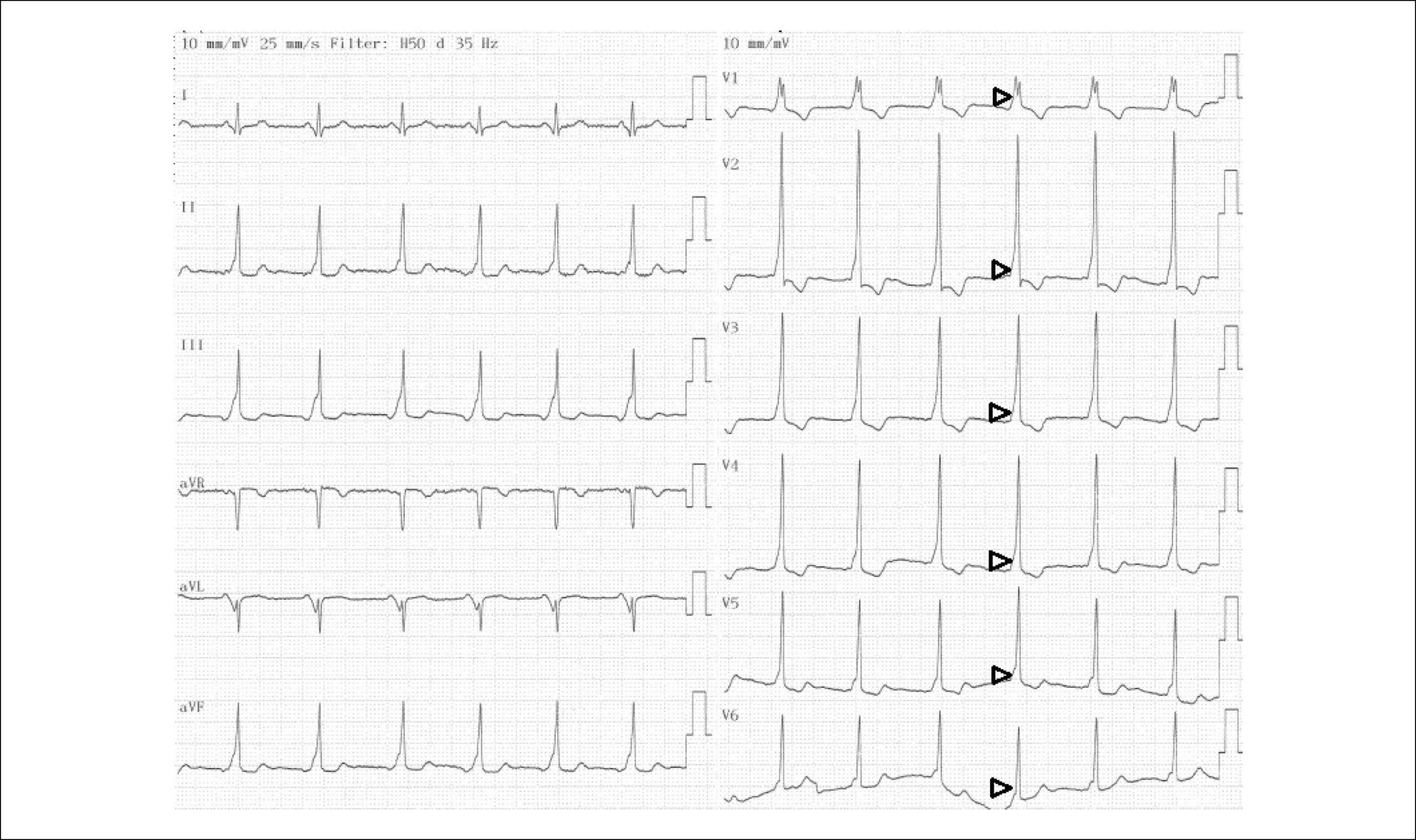
Wolff-Parkinson-White (WPW) syndrome is a pre-excitation syndrome which is a common cause of supraventricular tachycardia with prevalence in Western countries of 1.5 to 3.1 per 1000 persons. It is maintained by accessory pathway or pathways secondary to a developmental cardiac defect in atrioventricular electrical insulation. Among patients with the WPW syndrome, 3.4% have first degree-relatives with a pre-excitation syndrome. A familial form of WPW has infrequently been reported and is usually inherited as an autosomal dominant trait.–

[…]

  • Comparative Studies
  • Craniofacial Abnormalities
  • Craniofacial Dysostose
  • Tachycardia, Supraventricular
  • Wolff-Parkinson White Syndrome
Read Full Article
Creative Commons Attribution (CC BY) Creative Commons license
06/06/2019 DOI: 10.5935/abc.20190033 Views 3
Magnetic resonance vs technetium-99m pyrophosphate scintigraphy in the detection of perioperative myocardial necrosis
ABC
Artigo Original

Magnetic resonance vs technetium-99m pyrophosphate scintigraphy in the detection of perioperative myocardial necrosis

Guilherme Urpia Monte et al. Luciano Ferreira Drager Fábio Solano de Freitas Souza Luiz Francisco Rodrigues de Ávila … José Rodrigues Parga Filho Luiz Antônio Machado César Marisa Izaki José Cláudio Meneghetti Carlos Eduardo Rochitte Roberto Kalil Filho

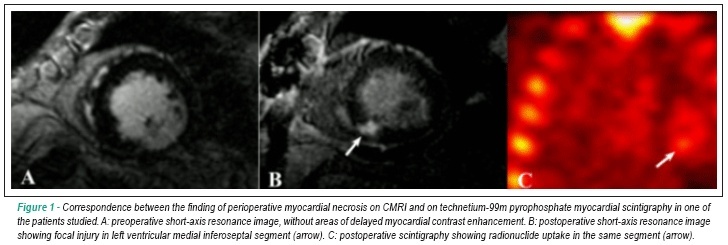
BACKGROUND: Perioperative myocardial infarction (POMI) is a complication of coronary artery bypass grafting (CABG) with a potential prognostic impact. Technetium-99m pyrophosphate myocardial scintigraphy (MS) is used in the diagnosis of POMI; however it shows a limited sensitivity for subendocardial lesions. Cardiovascular magnetic resonance imaging (CMRI), in turn, has a high accuracy in the detection of myocardial necrosis. OBJECTIVE: To compare CMRI and MS for the detection of POMI after CABG. METHODS: A total of 24 patients with chronic coronary artery disease were studied using the delayed contrast enhanced CMRI and MS before and after CABG by analyzing the development of areas of perioperative myocardial necrosis (POMI). Biochemical markers of myocardial injury (CKMB and troponin I) were also determined before and after surgery. RESULTS: Nineteen patients completed the study. Of these, 6 (32%) presented POMI on CMRI and 4 (21%) on MS (p = NS). Of the 323 left ventricular segments assessed, 17 (5.3%) showed perioperative necrosis on CMRI and 7 (2.2%) on MS (p = 0.013). Moderate agreement was observed between the methods (kappa = 0.46). There was disagreement regarding the diagnosis of POMI in 4 (21%) cases, most of them with small areas of perioperative necrosis on CMRI which were not visualized on MS. In all cases with POMI on CMRI, significant CKMB and troponin I elevations were observed. CONCLUSION: Moderate diagnostic agreement was observed between the methods for the detection of POMI, but CMRI enabled visualization of small areas of perioperative myocardial necrosis which were not identified on MS and were associated with elevation of biochemical markers of myocardial injury.

  • Comparative Studies
  • Magnetic Resonance Imaging
  • Myocardial
  • Myocardial Infarction
  • Myocardial Revascularization
  • technetium Tc99m pyrophosphate
Read Full Article
Creative Commons Attribution (CC BY) Creative Commons license
08/08/2008 DOI: 10.1590/S0066-782X2008001400009 Views 1

How to cite this article

EndNote RIS

Electronic Document Format (Vancouver)

Póvoa R. Short Editorial: Clinical Characteristics of Resistant vs. Refractory Hypertension in a Population of Hypertensive Afro-descendants. Arquivos Brasileiros de Cardiologia 2020;115(1):40-1.

Electronic Document Format (ABNT)

Póvoa, Rui. Short Editorial: Clinical Characteristics of Resistant vs. Refractory Hypertension in a Population of Hypertensive Afro-descendants. Arquivos Brasileiros de Cardiologia, v. 115, n. 1, p. 40-41, Aug. 2020.

Electronic Document Format (APA)

Póvoa, R. (2020). Short Editorial: Clinical Characteristics of Resistant vs. Refractory Hypertension in a Population of Hypertensive Afro-descendants. Arquivos Brasileiros de Cardiologia, 115(1), 40-41.

Electronic Document Format (ISO)

Póvoa, Rui. Short Editorial: Clinical Characteristics of Resistant vs. Refractory Hypertension in a Population of Hypertensive Afro-descendants. Arquivos Brasileiros de Cardiologia [online]. 2020, vol. 115, n. 1, [cited 2026-10-14], pp. 40-41. Available from: <https://journals.cardiol.br/en/article/short-editorial-clinical-characteristics-of-resistant-vs-refractory-hypertension-in-a-population-of-hypertensive-afro-descendants/>. ISSN 0066-782X

EndNote RIS

Electronic Document Format (Vancouver)

Kilit C, Kilit TP. Report of a Family with Craniofrontonasal Syndrome and Wolff-Parkinson-White Syndrome: Is it a New Finding?. Arquivos Brasileiros de Cardiologia 2019;112(5):594-6.

Electronic Document Format (ABNT)

Kilit, Celal; Kilit, Türkan Pasali. Report of a Family with Craniofrontonasal Syndrome and Wolff-Parkinson-White Syndrome: Is it a New Finding?. Arquivos Brasileiros de Cardiologia, v. 112, n. 5, p. 594-596, Jun. 2019.

Electronic Document Format (APA)

Kilit, C., & Kilit, T. P. (2019). Report of a Family with Craniofrontonasal Syndrome and Wolff-Parkinson-White Syndrome: Is it a New Finding?. Arquivos Brasileiros de Cardiologia, 112(5), 594-596.

Electronic Document Format (ISO)

Kilit, Celal and Kilit, Türkan Pasali. Report of a Family with Craniofrontonasal Syndrome and Wolff-Parkinson-White Syndrome: Is it a New Finding?. Arquivos Brasileiros de Cardiologia [online]. 2019, vol. 112, n. 5, [cited 2026-10-14], pp. 594-596. Available from: <https://journals.cardiol.br/en/article/report-of-a-family-with-craniofrontonasal-syndrome-and-wolff-parkinson-white-syndrome-is-it-a-new-finding/>. ISSN 0066-782X

EndNote RIS

Electronic Document Format (Vancouver)

Monte GU, Drager LF, Souza FSF, Ávila LFR, Parga Filho JR, César LAM, Izaki M, et al. Magnetic resonance vs technetium-99m pyrophosphate scintigraphy in the detection of perioperative myocardial necrosis. Arquivos Brasileiros de Cardiologia 2008;91(2):126-31.

Electronic Document Format (ABNT)

Monte, Guilherme Urpia; Drager, Luciano Ferreira; Souza, Fábio Solano de Freitas; Ávila, Luiz Francisco Rodrigues de; Parga Filho, José Rodrigues; César, Luiz Antônio Machado; Izaki, Marisa; Meneghetti, José Cláudio; Rochitte, Carlos Eduardo; Kalil Filho, Roberto. Magnetic resonance vs technetium-99m pyrophosphate scintigraphy in the detection of perioperative myocardial necrosis. Arquivos Brasileiros de Cardiologia, v. 91, n. 2, p. 126-131, Aug. 2008.

Electronic Document Format (APA)

Monte, G. U., Drager, L. F., Souza, F. S. F., Ávila, L. F. R. , Parga Filho, J. R., César, L. A. M., Izaki, M., Meneghetti, J. C., Rochitte, C. E., & Kalil Filho, R. (2008). Magnetic resonance vs technetium-99m pyrophosphate scintigraphy in the detection of perioperative myocardial necrosis. Arquivos Brasileiros de Cardiologia, 91(2), 126-131.

Electronic Document Format (ISO)

Monte, Guilherme Urpia and Drager, Luciano Ferreira and Souza, Fábio Solano de Freitas and Ávila, Luiz Francisco Rodrigues de and Parga Filho, José Rodrigues and César, Luiz Antônio Machado and Izaki, Marisa and Meneghetti, José Cláudio and Rochitte, Carlos Eduardo and Kalil Filho, Roberto. Magnetic resonance vs technetium-99m pyrophosphate scintigraphy in the detection of perioperative myocardial necrosis. Arquivos Brasileiros de Cardiologia [online]. 2008, vol. 91, n. 2, [cited 2026-10-14], pp. 126-131. Available from: <https://journals.cardiol.br/en/article/magnetic-resonance-vs-technetium-99m-pyrophosphate-scintigraphy-in-the-detection-of-perioperative-myocardial-necrosis/>. ISSN 0066-782X

  • About ABC Family
  • Internal Regulation
  • Editorial Board
  • Brazilian Society of Cardiology (SBC)

Issues

SBC Guidelines

  • Videos
  • Podcasts
  • News