ABC Family Arquivos Brasileiros de Cardiologia International Journal of Cardiovascular Sciences ABC Heart Failure & Cardiomyopathy ABC Imagem Cardiovascular
Português English
ABC Family
Português English
  • About
    • About ABC Family
    • Internal Regulation
    • Editorial Board
    • Brazilian Society of Cardiology (SBC)
  • Issues
  • SBC Guidelines
  • Content
    • Videos
    • Podcasts
    • News
  • About
    • About ABC Family
    • Internal Regulation
    • Editorial Board
    • Brazilian Society of Cardiology (SBC)
  • Issues
  • SBC Guidelines
  • Content
    • Videos
    • Podcasts
    • News

ABC Family

  • ABC Family
  • Arquivos Brasileiros de Cardiologia
  • International Journal of Cardiovascular Sciences
  • ABC Heart Failure & Cardiomyopathy
  • ABC Imagem Cardiovascular
Search in

No content found.

Journals
Ordering
Article types
Others

  1. Home
  2. Keyword: Valvular heart disease
ABC
Editorial

Prevalence in Evidence: Valvular Heart Diseases Dominating the Brazilian Scenario

Ana Teresa Timóteo

Valvular heart disease is a highly prevalent cardiovascular condition, estimated to affect more than 2% of the population, and is associated with increased mortality. However, most epidemiological studies are conducted in high-income countries, and we know that the characteristics vary according to the country and region of the world. In fact, degenerative valvular heart disease predominates in high-income countries, while rheumatic and infectious diseases are still very prevalent in lower-income countries. Socioeconomic conditions also have important implications for the diagnosis and treatment of this condition.

Data from the EURObservational Research Programme Valvular Heart Disease II (EORP-VHD II) Survey, with participants from 28 European countries and an average age of 71 years, reported aortic valve stenosis as the most frequent valvular disease, present in 41% of patients, followed at a distance by mitral regurgitation, aortic regurgitation, and mitral stenosis. Degenerative etiology was the most common, except for mitral stenosis, where rheumatic etiology predominated. This record reinforced the results of the initial EORP-VHD, conducted in 2001. The increase in aortic stenosis is likely a consequence of population aging, and the reduction in rheumatic mitral stenosis is a result of the decrease in rheumatic fever in Europe. Data recently published in the ATLAS of the European Society of Cardiology also highlight that valvular diseases continue to increase in prevalence and are responsible for thousands of deaths annually.

[…]

  • Brazil
  • Prevalence
  • Valvular heart disease
Read Full Article
Creative Commons Attribution (CC BY) Creative Commons license
03/08/2026 DOI: 10.36660/abc.20260464i Views 2
ABC
Editorial

Beyond Atherosclerosis: Mind the Valves in Chronic Kidney Disease

Sofia Cabral

Cardiovascular disease (CVD) remains the leading cause of morbidity and mortality among patients with chronic kidney disease (CKD), far surpassing the risk of progression to end-stage renal disease, and accounting for approximately 40% to 50% of all deaths in the advanced stages.– Growing attention has been directed toward the intersection of renal dysfunction and valvular heart disease (VHD), which plays a major role in the cardiovascular complications and adverse outcomes observed in this population., Valvular calcification, particularly affecting the aortic and mitral valves, is the hallmark manifestation of VHD in this setting, representing a highly prevalent, progressive, and prognostically significant process driven by disordered mineral metabolism, its crosstalk with persistent inflammation, and the toxic uremic milieu., Despite growing acknowledgment of its clinical impact, the biological underpinnings remain incompletely understood, even as emerging evidence begins to clarify the processes driving valvular calcification in CKD.

While several mechanistic pathways have been identified, robust clinical and laboratory markers that predict its development remain elusive. In this regard, the study by Conceição et al. offers valuable insight into the factors associated with valvular calcification, helping to address a relevant blind spot in current knowledge and underscoring the need for continued research into its clinical implications and underlying mechanisms in this high-risk population. Their systematic review was based on twenty observational studies involving 13,314 patients from varied geographic contexts, including individuals both on and off dialysis. Most were cross-sectional in design, with fewer cohort studies and a single case-control study, reflecting the predominantly descriptive and observational nature of the available evidence. The breadth of the population analyzed, combined with the methodological rigor adopted, offers a comprehensive overview of the existing body of evidence in this still underexplored domain. Among the thirty-eight risk factors identified, advanced age (tipically above 55 years),was the most consistently associated with valvular calcification, reported in half of the studies reviewed. These findings lend further support to the concept that ageing represents a major determinant in valvular degeneration in CKD, as it does in the broader context of age-related valve disease in the general population.

[…]

  • calcification
  • Cardiovascular risk
  • Chronic Kidney Disease
  • Valvular heart disease
Read Full Article
Creative Commons Attribution (CC BY) Creative Commons license
08/09/2025 DOI: 10.36660/abc.20250376i Views 1
Predictive Factors for Bleeding Risk in Patients Undergoing Valvular Surgery
ABC
Original Article

Predictive Factors for Bleeding Risk in Patients Undergoing Valvular Surgery

Alef de Carvalho Vieira et al. Renato Tambellini Arnoni Ana Beatriz Silva Barbosa Attila Santos Berriel … Rafael Guimarães Vianna Mario Issa

Abstract

Background:

The postoperative period of heart valve surgery is challenging due to the risk of bleeding, leading to complications and increased morbidity and mortality.

Objective:

To develop a risk score to predict bleeding in patients after valve surgery.

Methods:

Retrospective study of patients operated on between 2021 and 2022. Patients with major bleeding were selected based on the BARC and Bojar criteria. A logistic regression analysis was performed for factors related to bleeding and a nomogram of scores was created. For statistical significance, p<0.05 and a 95% confidence interval were considered. The study was approved by the CEP.

Results:

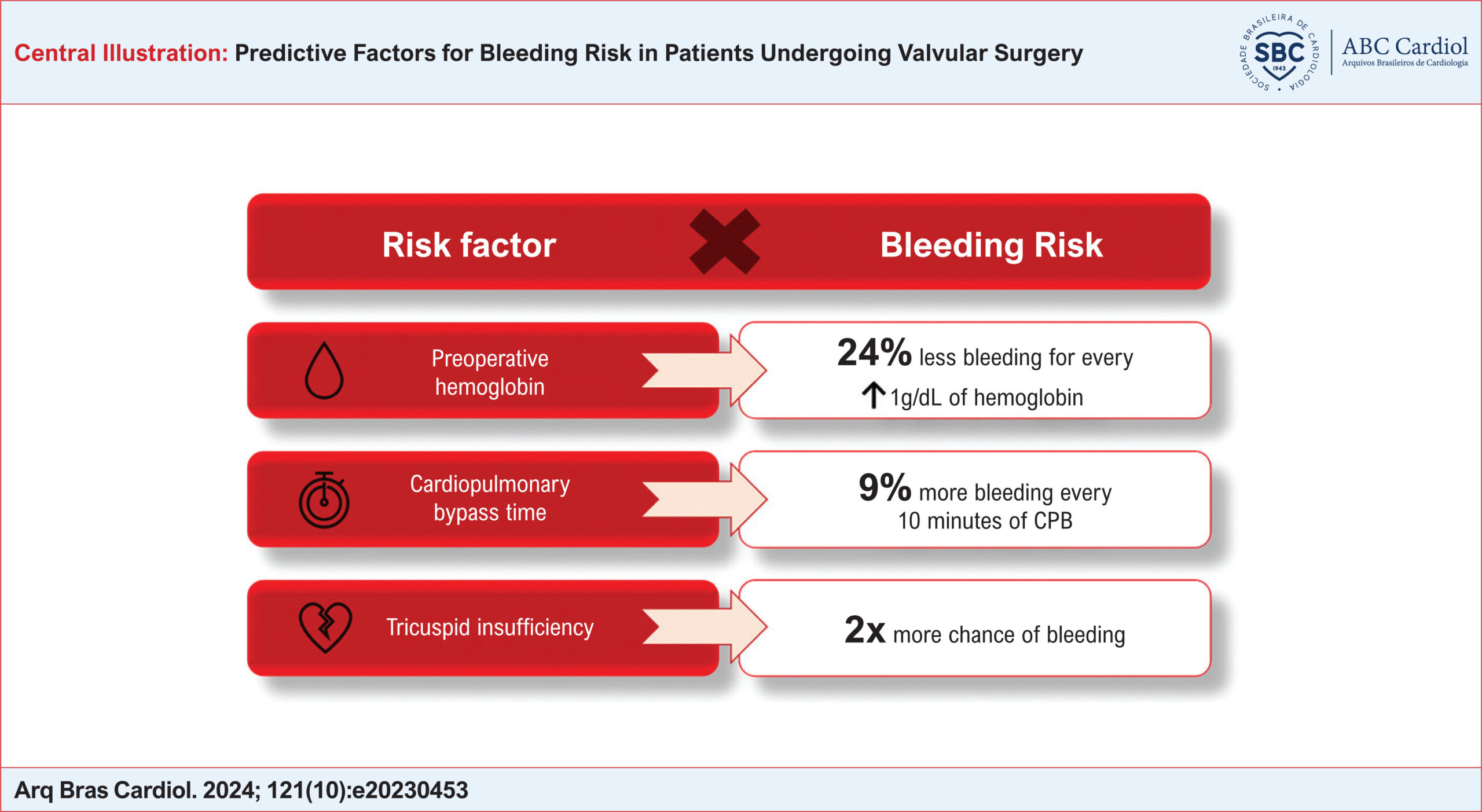
525 patients were analyzed, with a mean age of 56 years and a predominance of females. The most common valve disease was mitral insufficiency, 8.8% had increased bleeding and 4.3% had surgical reoperations. The variables with statistical significance were tricuspid insufficiency (OR 3.31, p < 0.001), chronic kidney disease/acute kidney injury (OR 2.97, p = 0.006), preoperative hemoglobin (OR 0.73, p < 0.001), reoperations (OR 2, 5, p = 0.003), cardiopulmonary bypass (CPB) time (OR 1.12, p < 0.001), 2-valve approach OR of 2.23 (p = 0.013), use of packed red blood cells OR of 2.8 (p = 0.001). In the multiple model, tricuspid insufficiency, CPB time and preoperative hemoglobin reached statistical significance.

Conclusion:

CPB time, preoperative hemoglobin and tricuspid insufficiency were independently associated with postoperative bleeding. The proposed scale is plausible and can help predict the risk of bleeding.

  • Cardiovascular Surgery
  • Postoperative Bleeding
  • risk score
  • Valvular heart disease
Read Full Article
Creative Commons Attribution (CC BY) Creative Commons license
18/10/2024 DOI: 10.36660/abc.20230453i Views 1
Central Illustration
ABC
Review Article

Valvular Heart Disease Emergencies: A Comprehensive Review Focusing on the Initial Approach in the Emergency Department

Tarso Augusto Duenhas Accorsi et al. Milena Ribeiro Paixão José Leão de Souza Júnior Marcus Vinicius Burato Gaz … Ricardo Galesso Cardoso Karen Francine Köhler Karine De Amicis Lima Flavio Tarasoutchi INTEGRATE Investigadores

Abstract

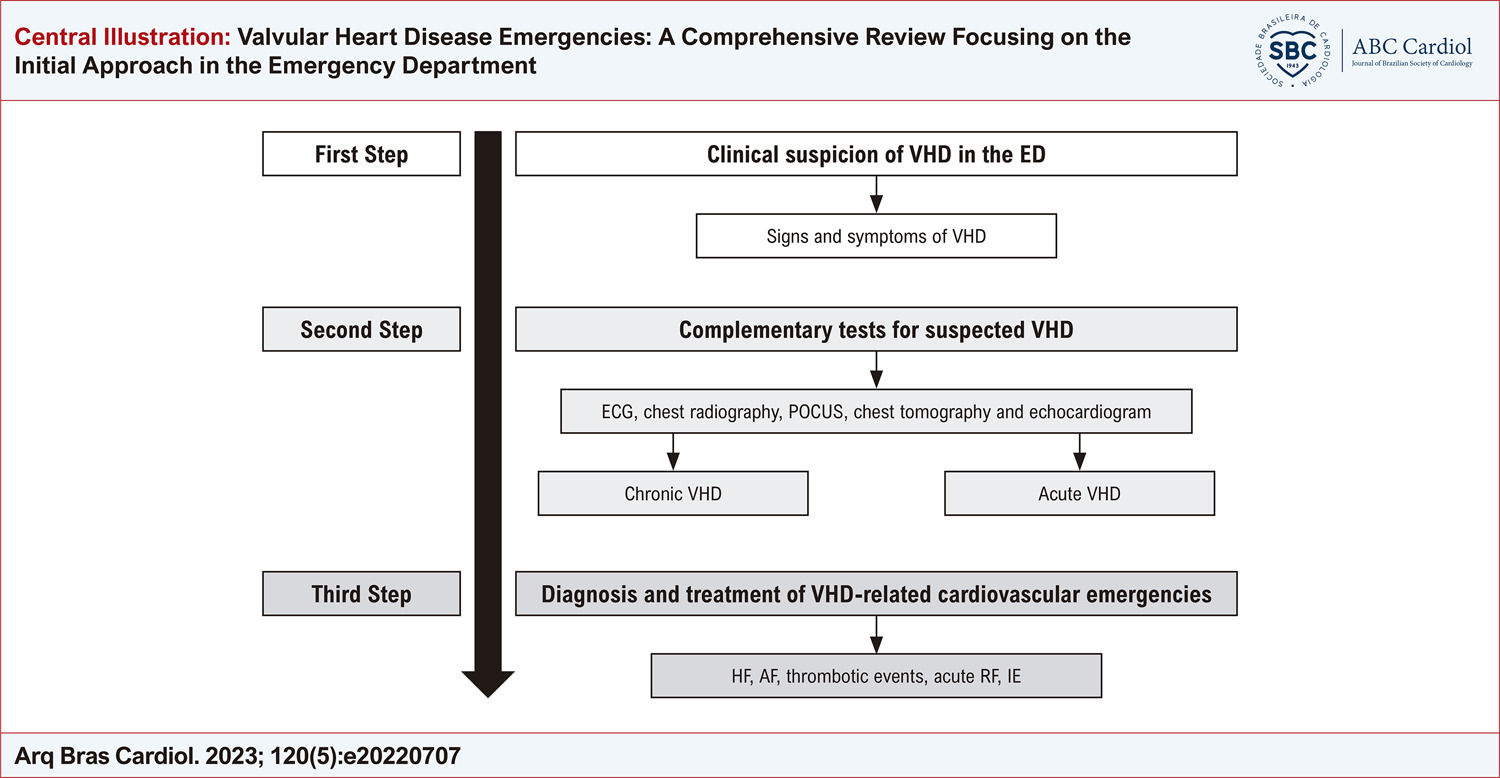
Valvular heart disease (VHD) is an increasing health problem worldwide. Patients with VHD may experience several cardiovascular-related emergencies. The management of these patients is a challenge in the emergency department, especially when the previous heart condition is unknown. Specific recommendations for the initial management are currently poor. This integrative review proposes an evidence-based three-step approach from bedside VHD suspicion to the initial treatment of the emergencies. The first step is the suspicion of underlying valvular condition based on signs and symptoms. The second step comprises the attempt to confirm the diagnosis and assessment of VHD severity with complementary tests. Finally, the third step addresses the diagnosis and treatment options for heart failure, atrial fibrillation, valvular thrombosis, acute rheumatic fever, and infective endocarditis. In addition, several images of complementary tests and summary tables are provided for physician support.

  • emergency medicine
  • Heart Valve Prosthesis
  • Heart valves
  • Valvular heart disease
Read Full Article
Creative Commons Attribution (CC BY) Creative Commons license
19/06/2023 DOI: 10.36660/abc.20220707 Views 1

How to cite this article

EndNote RIS

Electronic Document Format (Vancouver)

Timóteo AT. Prevalence in Evidence: Valvular Heart Diseases Dominating the Brazilian Scenario. Arquivos Brasileiros de Cardiologia 2026;123(6):e20260464.

Electronic Document Format (ABNT)

Timóteo, Ana Teresa. Prevalence in Evidence: Valvular Heart Diseases Dominating the Brazilian Scenario. Arquivos Brasileiros de Cardiologia, v. 123, n. 6, e20260464, Aug. 2026.

Electronic Document Format (APA)

Timóteo, A. T. (2026). Prevalence in Evidence: Valvular Heart Diseases Dominating the Brazilian Scenario. Arquivos Brasileiros de Cardiologia, 123(6), e20260464.

Electronic Document Format (ISO)

Timóteo, Ana Teresa. Prevalence in Evidence: Valvular Heart Diseases Dominating the Brazilian Scenario. Arquivos Brasileiros de Cardiologia [online]. 2026, vol. 123, n. 6, [cited 2026-10-14], e20260464. Available from: <https://journals.cardiol.br/en/article/prevalence-in-evidence-valvular-heart-diseases-dominating-the-brazilian-scenario/>. ISSN 0066-782X

EndNote RIS

Electronic Document Format (Vancouver)

Cabral S. Beyond Atherosclerosis: Mind the Valves in Chronic Kidney Disease. Arquivos Brasileiros de Cardiologia 2025;122(8):e20250376.

Electronic Document Format (ABNT)

Cabral, Sofia. Beyond Atherosclerosis: Mind the Valves in Chronic Kidney Disease. Arquivos Brasileiros de Cardiologia, v. 122, n. 8, e20250376, Sep. 2025.

Electronic Document Format (APA)

Cabral, S. (2025). Beyond Atherosclerosis: Mind the Valves in Chronic Kidney Disease. Arquivos Brasileiros de Cardiologia, 122(8), e20250376.

Electronic Document Format (ISO)

Cabral, Sofia. Beyond Atherosclerosis: Mind the Valves in Chronic Kidney Disease. Arquivos Brasileiros de Cardiologia [online]. 2025, vol. 122, n. 8, [cited 2026-10-14], e20250376. Available from: <https://journals.cardiol.br/en/article/beyond-atherosclerosis-mind-the-valves-in-chronic-kidney-disease/>. ISSN 0066-782X

EndNote RIS

Electronic Document Format (Vancouver)

Vieira AC, Arnoni RT, Barbosa ABS, Berriel AS, Vianna RG, Issa M. Predictive Factors for Bleeding Risk in Patients Undergoing Valvular Surgery. Arquivos Brasileiros de Cardiologia 2024;121(10):e20230453.

Electronic Document Format (ABNT)

Vieira, Alef de Carvalho; Arnoni, Renato Tambellini; Barbosa, Ana Beatriz Silva; Berriel, Attila Santos; Vianna, Rafael Guimarães; Issa, Mario. Predictive Factors for Bleeding Risk in Patients Undergoing Valvular Surgery. Arquivos Brasileiros de Cardiologia, v. 121, n. 10, e20230453, Oct. 2024.

Electronic Document Format (APA)

Vieira, A. C., Arnoni, R. T., Barbosa, A. B. S., Berriel, A. S., Vianna, R. G., & Issa, M. (2024). Predictive Factors for Bleeding Risk in Patients Undergoing Valvular Surgery. Arquivos Brasileiros de Cardiologia, 121(10), e20230453.

Electronic Document Format (ISO)

Vieira, Alef de Carvalho and Arnoni, Renato Tambellini and Barbosa, Ana Beatriz Silva and Berriel, Attila Santos and Vianna, Rafael Guimarães and Issa, Mario. Predictive Factors for Bleeding Risk in Patients Undergoing Valvular Surgery. Arquivos Brasileiros de Cardiologia [online]. 2024, vol. 121, n. 10, [cited 2026-10-14], e20230453. Available from: <https://journals.cardiol.br/en/article/predictive-factors-for-bleeding-risk-in-patients-undergoing-valvular-surgery/>. ISSN 0066-782X

EndNote RIS

Electronic Document Format (Vancouver)

Accorsi TAD, Paixão MR, Souza Júnior JL, Gaz MVB, Cardoso RG, Köhler KF, Lima KDA, et al. Valvular Heart Disease Emergencies: A Comprehensive Review Focusing on the Initial Approach in the Emergency Department. Arquivos Brasileiros de Cardiologia 2023;120(5):e20220707.

Electronic Document Format (ABNT)

Accorsi, Tarso Augusto Duenhas; Paixão, Milena Ribeiro; Souza Júnior, José Leão de; Gaz, Marcus Vinicius Burato; Cardoso, Ricardo Galesso; Köhler, Karen Francine; Lima, Karine De Amicis; Tarasoutchi, Flavio; Investigadores, INTEGRATE. Valvular Heart Disease Emergencies: A Comprehensive Review Focusing on the Initial Approach in the Emergency Department. Arquivos Brasileiros de Cardiologia, v. 120, n. 5, e20220707, Jun. 2023.

Electronic Document Format (APA)

Accorsi, T. A. D., Paixão, M. R., Souza Júnior, J. L. , Gaz, M. V. B., Cardoso, R. G., Köhler, K. F., Lima, K. D. A., Tarasoutchi, F., & Investigadores, I. (2023). Valvular Heart Disease Emergencies: A Comprehensive Review Focusing on the Initial Approach in the Emergency Department. Arquivos Brasileiros de Cardiologia, 120(5), e20220707.

Electronic Document Format (ISO)

Accorsi, Tarso Augusto Duenhas and Paixão, Milena Ribeiro and Souza Júnior, José Leão de and Gaz, Marcus Vinicius Burato and Cardoso, Ricardo Galesso and Köhler, Karen Francine and Lima, Karine De Amicis and Tarasoutchi, Flavio and Investigadores, INTEGRATE. Valvular Heart Disease Emergencies: A Comprehensive Review Focusing on the Initial Approach in the Emergency Department. Arquivos Brasileiros de Cardiologia [online]. 2023, vol. 120, n. 5, [cited 2026-10-14], e20220707. Available from: <https://journals.cardiol.br/en/article/valvular-heart-disease-emergencies-a-comprehensive-review-focusing-on-the-initial-approach-in-the-emergency-department/>. ISSN 0066-782X

  • About ABC Family
  • Internal Regulation
  • Editorial Board
  • Brazilian Society of Cardiology (SBC)

Issues

SBC Guidelines

  • Videos
  • Podcasts
  • News