ABC Family Arquivos Brasileiros de Cardiologia International Journal of Cardiovascular Sciences ABC Heart Failure & Cardiomyopathy ABC Imagem Cardiovascular
Português English
ABC Family
Português English
  • About
    • About ABC Family
    • Internal Regulation
    • Editorial Board
    • Brazilian Society of Cardiology (SBC)
  • Issues
  • SBC Guidelines
  • Content
    • Videos
    • Podcasts
    • News
  • About
    • About ABC Family
    • Internal Regulation
    • Editorial Board
    • Brazilian Society of Cardiology (SBC)
  • Issues
  • SBC Guidelines
  • Content
    • Videos
    • Podcasts
    • News

ABC Family

  • ABC Family
  • Arquivos Brasileiros de Cardiologia
  • International Journal of Cardiovascular Sciences
  • ABC Heart Failure & Cardiomyopathy
  • ABC Imagem Cardiovascular
Search in

No content found.

Journals
Ordering
Article types
Others

  1. Home
  2. Keyword: Breathing Exercise
ABC
Editorial

Continuous Non-Invasive Cardiac Output: Myth or Reality

João Manoel Rossi Neto

Cardiac output (CO) is an important cardiovascular system function parameter. Changes in cardiac function are commonly observed as a response to physical training and pharmacological interventions. Unfortunately, the methods for assessing CO are invasive, leading to well-known complications and considered inconvenient in daily practice. For this reason, the search for new noninvasive methods that can accurately detect CO at rest, at physical exertion or as a response to a clinical intervention has become desirable in academic and non-academic circles. The ideal method for measuring CO at rest and during exercise should be noninvasive, safe, reproducible and inexpensive.

The Cardiopulmonary Exercise Testing (CPT) is recommended in the evaluation of cardiorespiratory fitness and exercise tolerance in athletes, the general population and in patients. Briefly, CO and systolic volume can be estimated during CPT through measured VO2. In 2001, Williams et al. were the first ones to integrate CPT with non-invasive measures of CO using rebreathing (RB) of carbon dioxide, but the technique was quickly abandoned due to its difficulty and inaccuracy. Another non-invasive method is thoracic electrical bioimpedance (TEB), first described in 1966 by Kubicek et al., which measures thoracic resistance as a result of changes in blood velocity during the cardiac cycle and uses an algorithm to calculate the CO.

[…]

  • Breathing Exercise
  • Cardiac Ouput
  • Electric
  • Impedance
  • Interventions
  • Pharmacological
Read Full Article
Creative Commons Attribution (CC BY) Creative Commons license
02/09/2019 DOI: 10.5935/abc.20190163
Chart 1
IJCS
Original Article

Cardiopulmonary Exercise Testing in Patients with Implantable Cardioverter-Defibrillator: A Retrospective Study

Carolina Mizzaci et al. Thiago Fagundes Felipe Malafaia Sandro Felicioni … Susimeire Buglia Carlos Alberto Hossri Almir Ferraz Rica Buchler Romeu Meneghelo Luiz Mastrocolla

Abstract

Background:

Cardiopulmonary exercise testing is widely used in the evaluation of patients with left ventricular dysfunction, and some of these patients have an implantable cardioverter-defibrillator (ICD). However, this test presents specific challenges because of the susceptibility to ventricular arrhythmias during maximal levels of exercise.

Objective:

To evaluate the safety of cardiopulmonary exercise testing in patients with ICD.

Methods:

The study included patients with ICD who underwent cardiopulmonary exercise testing between 2007 and 2015. The tests were completed once the electronic devices were programmed. The maximum allowed heart rate reached during exercise was 10 beats below the first therapy zone programmed.

Results:

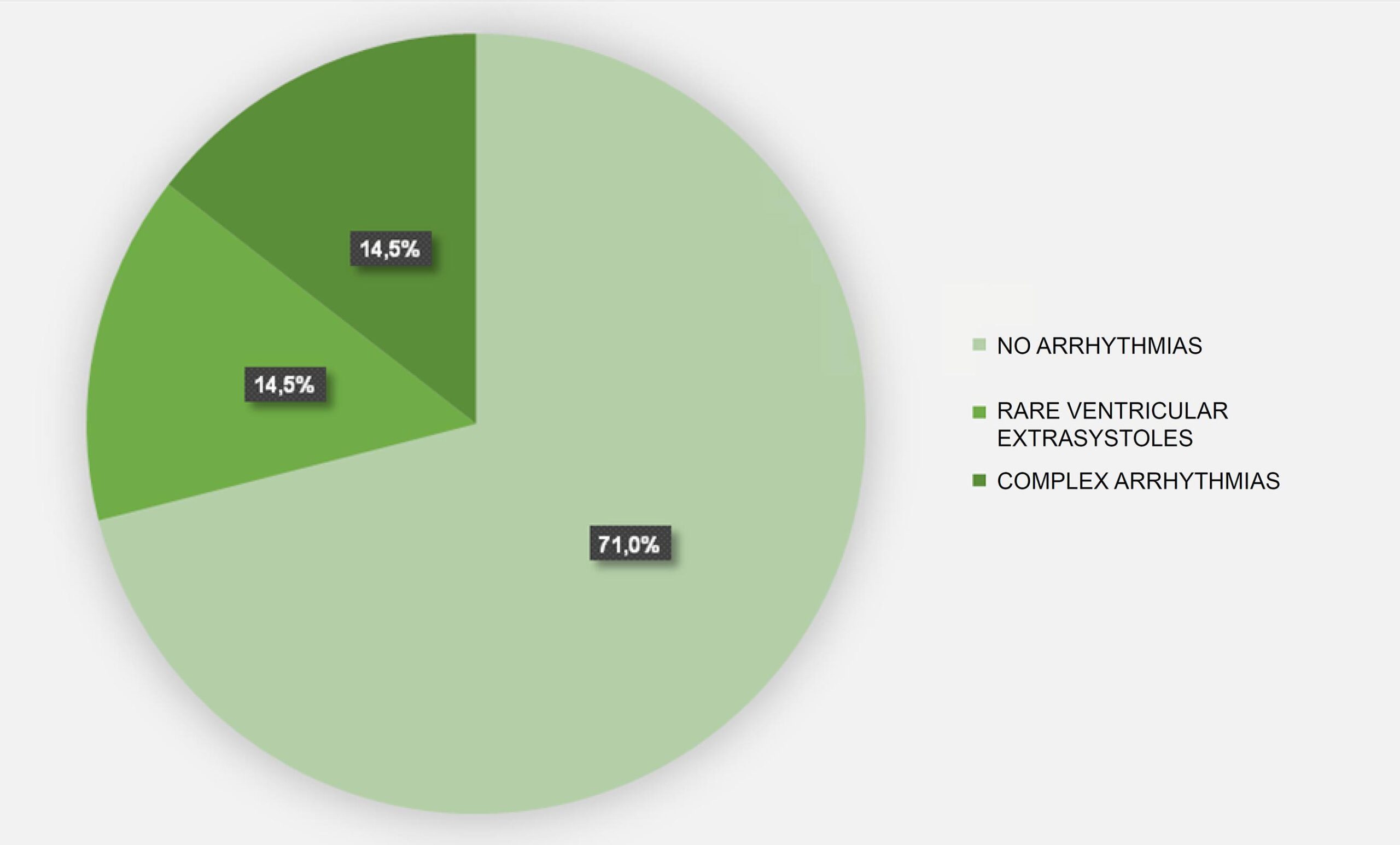
The study included 69 patients with mean age 53.7 ± 10.8 years, including 68% men. Exercise time was 8.7±2.3 minutes, with peak oxygen consumption of 13.3 ± 4.3 ml.kg-1.min-1. Peak heart rate was 62.9 ± 13.4% of the maximum rate predicted, with all patients taking specific medication. Ventricular arrhythmia was observed in 29% of the patients, and paired ventricular extrasystoles, ventricular bigeminism or non-sustained ventricular tachycardia were observed in only 14.5% of the patients. There was no sustained ventricular arrhythmia resulting in ICD therapy or other complications, such as inappropriate therapies. The frequency of severe events was 0%, 95% CI (0 – 5.2%).

Conclusion:

In the sample of patients evaluated, the cardiopulmonary exercise testing was shown to be safe during its performance in a hospital setting, following the safety standards.

  • Arrhythmias Cardiac
  • Breathing Exercise
  • Cardiovascular Diseases
  • Defibrillators, Implantable
  • Left Ventricular Dysfunction
  • Sudden Cardiac Death
Read Full Article
Creative Commons Attribution (CC BY) Creative Commons license
12/08/2019 DOI: 10.5935/2359-4802.20190066 Views 1

How to cite this article

EndNote RIS

Electronic Document Format (Vancouver)

Rossi Neto JM. Continuous Non-Invasive Cardiac Output: Myth or Reality. Arquivos Brasileiros de Cardiologia 2019;113(2):240-1.

Electronic Document Format (ABNT)

Rossi Neto, João Manoel. Continuous Non-Invasive Cardiac Output: Myth or Reality. Arquivos Brasileiros de Cardiologia, v. 113, n. 2, p. 240-241, Sep. 2019.

Electronic Document Format (APA)

Rossi Neto, J. M. (2019). Continuous Non-Invasive Cardiac Output: Myth or Reality. Arquivos Brasileiros de Cardiologia, 113(2), 240-241.

Electronic Document Format (ISO)

Rossi Neto, João Manoel. Continuous Non-Invasive Cardiac Output: Myth or Reality. Arquivos Brasileiros de Cardiologia [online]. 2019, vol. 113, n. 2, [cited 2026-10-15], pp. 240-241. Available from: <https://journals.cardiol.br/en/article/continuous-non-invasive-cardiac-output-myth-or-reality/>. ISSN 0066-782X

EndNote RIS

Electronic Document Format (Vancouver)

Mizzaci C, Fagundes T, Malafaia F, Felicioni S, Buglia S, Hossri CA, Ferraz A, et al. Cardiopulmonary Exercise Testing in Patients with Implantable Cardioverter-Defibrillator: A Retrospective Study. International Journal of Cardiovascular Sciences 2019;32(4):368-73.

Electronic Document Format (ABNT)

Mizzaci, Carolina; Fagundes, Thiago; Malafaia, Felipe; Felicioni, Sandro; Buglia, Susimeire; Hossri, Carlos Alberto; Ferraz, Almir; Buchler, Rica; Meneghelo, Romeu; Mastrocolla, Luiz. Cardiopulmonary Exercise Testing in Patients with Implantable Cardioverter-Defibrillator: A Retrospective Study. International Journal of Cardiovascular Sciences, v. 32, n. 4, p. 368-373, Aug. 2019.

Electronic Document Format (APA)

Mizzaci, C., Fagundes, T., Malafaia, F., Felicioni, S., Buglia, S., Hossri, C. A., Ferraz, A., Buchler, R., Meneghelo, R., & Mastrocolla, L. (2019). Cardiopulmonary Exercise Testing in Patients with Implantable Cardioverter-Defibrillator: A Retrospective Study. International Journal of Cardiovascular Sciences, 32(4), 368-373.

Electronic Document Format (ISO)

Mizzaci, Carolina and Fagundes, Thiago and Malafaia, Felipe and Felicioni, Sandro and Buglia, Susimeire and Hossri, Carlos Alberto and Ferraz, Almir and Buchler, Rica and Meneghelo, Romeu and Mastrocolla, Luiz. Cardiopulmonary Exercise Testing in Patients with Implantable Cardioverter-Defibrillator: A Retrospective Study. International Journal of Cardiovascular Sciences [online]. 2019, vol. 32, n. 4, [cited 2026-10-15], pp. 368-373. Available from: <https://journals.cardiol.br/en/article/cardiopulmonary-exercise-testing-in-patients-with-implantable-cardioverter-defibrillator-a-retrospective-study/>. ISSN 2359-4802

  • About ABC Family
  • Internal Regulation
  • Editorial Board
  • Brazilian Society of Cardiology (SBC)

Issues

SBC Guidelines

  • Videos
  • Podcasts
  • News