ABC Family Arquivos Brasileiros de Cardiologia International Journal of Cardiovascular Sciences ABC Heart Failure & Cardiomyopathy ABC Imagem Cardiovascular
Português English
ABC Family
Português English
  • About
    • About ABC Family
    • Internal Regulation
    • Editorial Board
    • Brazilian Society of Cardiology (SBC)
  • Issues
  • SBC Guidelines
  • Content
    • Videos
    • Podcasts
    • News
  • About
    • About ABC Family
    • Internal Regulation
    • Editorial Board
    • Brazilian Society of Cardiology (SBC)
  • Issues
  • SBC Guidelines
  • Content
    • Videos
    • Podcasts
    • News

ABC Family

  • ABC Family
  • Arquivos Brasileiros de Cardiologia
  • International Journal of Cardiovascular Sciences
  • ABC Heart Failure & Cardiomyopathy
  • ABC Imagem Cardiovascular
Search in

No content found.

Journals
Ordering
Article types
Others

  1. Home
  2. Keyword: transluminal
Coronary angioplasty versus CABG: review of randomized
ABC
Atualização

Coronary angioplasty versus CABG: review of randomized

Pedro José Negreiros de Andrade et al. Marta Maria das Chagas Medeiros Antonio Thomaz de Andrade Antonio Augusto Guimarães Lima

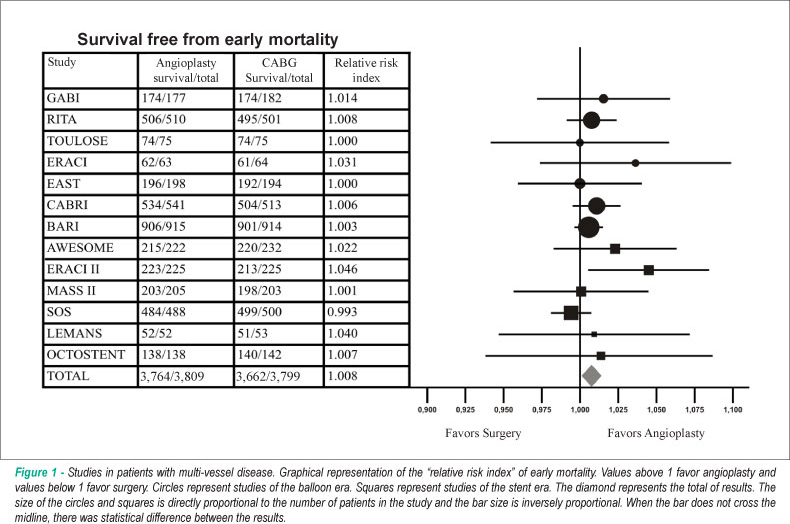
We carried out a review that included results of randomized trials that made a comparison between percutaneous coronary intervention (PCI) and coronary artery bypass grafting (CABG). The 25 selected trials involved 12,305 patients, 11,103 of whom were from studies in patients with multi-vessel disease and 1,212 were from studies in patients with single lesion of the left anterior descending (LAD). In the studies of multi-vessel disease patients, the PCI showed a trend towards lower early mortality (1.2% versus 2%) and lower incidence of stroke: 0.7% versus 1.65%. There was no difference in the intermediate mortality (3.8% versus 3.8%). There was a trend towards the superiority of CABG in late mortality (10.5% versus 9.6%). The difference was exclusively due to “balloon era” studies, with a trend towards an inversion in the “stent era” (9.6% versus 9.9%). In studies of single lesion of LAD, there was no significant difference in any endpoint. The aggregation of results from nine studies that assessed late mortality in diabetic patients showed a difference in favor of surgery (21.3% versus 15.9%). Two studies that evaluated main coronary artery disease did not show a significant difference in mortality at one year (3.9% versus 4.7%). The incidence of repeat revascularization was consistently higher in PCI, despite the progressive improvement in results in the stent era.
  • Angioplasty
  • Coronary Artery Bypass
  • Meta-Analysis
  • Myocardial Revascularization
  • percutaneous coronary
  • transluminal
Read Full Article
Creative Commons Attribution (CC BY) Creative Commons license
21/10/2011 DOI: 10.1590/S0066-782X2011001200021 Views 1
Myocardial bridging: therapeutic and clinical development
ABC
Artigo Original

Myocardial bridging: therapeutic and clinical development

Aline Braz Pereira et al. Danilo Spricigo Peressoni Castro Emanuela Todeschini Menegotto Wladimir Maia do Amaral Gustavo Spricigo Peressoni Castro

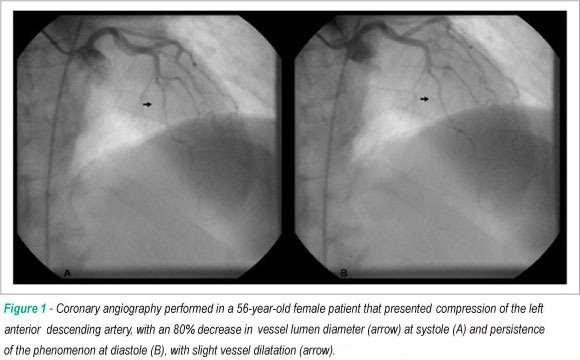
BACKGROUND: The myocardial bridge constitutes one of the main differential diagnoses of coronary artery disease. However, it remains an underdiagnosed condition and its physiopathological mechanisms and therapeutics are yet to be elucidated. OBJECTIVE: To analyze and describe the clinical and therapeutic evolution of patients with an angiographic diagnosis of myocardial bridge, comparing the data with that in the current literature, in order to clarify the patients’ clinical profile and prognosis. METHODS: The results of coronary angiographies carried out from 2003 to 2007 in a Laboratory of Hemodynamics were reviewed; the analysis of patients’ files was carried out and selected patients were interviewed. RESULTS: The frequency of myocardial bridge diagnosis was 3.6%. The mean age of patients was 56.8 years (SD = 11.83; CI = 0.73). The anterior descending artery was affected in isolation in 100% of the cases. After the selection, the analysis and interview of 31 patients were carried out. There was no correlation between symptoms and degree of angiographic narrowing observed in the studied patients. The drug treatment included the use of beta-blockers, calcium-channel antagonists, platelet antiaggregants and/or nitrates and resulted in clinical improvement in 30%, absence of alterations in the clinical picture in 60% and symptom worsening in 10% of the patients. One patient presented sudden death; two patients underwent angioplasty followed by significant clinical improvement and none of the patients underwent surgical procedures. CONCLUSION: Most of the patients with myocardial bridge have a good prognosis, but in the long term, there are not enough data, obtained from a large sample of symptomatic patients, to draw definitive conclusions.

  • Angioplasty
  • Cohort Studies
  • Coronary Artery Disease
  • Myocardial Bridging
  • percutaneous coronary
  • transluminal
Read Full Article
Creative Commons Attribution (CC BY) Creative Commons license
05/05/2010 DOI: 10.1590/S0066-782X2010000200008
What is the angiography error when defining myocardial ischemia during percutaneous coronary interventions?
ABC
Artigo Original

What is the angiography error when defining myocardial ischemia during percutaneous coronary interventions?

Fernando Mendes Sant'Anna et al. Expedito Ribeiro da Silva Leonardo Alves Batista Marcelo Bastos Brito … Fábio Machado Ventura Haroldo Adans Ferraz Leonardo Buczynski Carlos Alberto Mussel Barrozo Nico Pijls

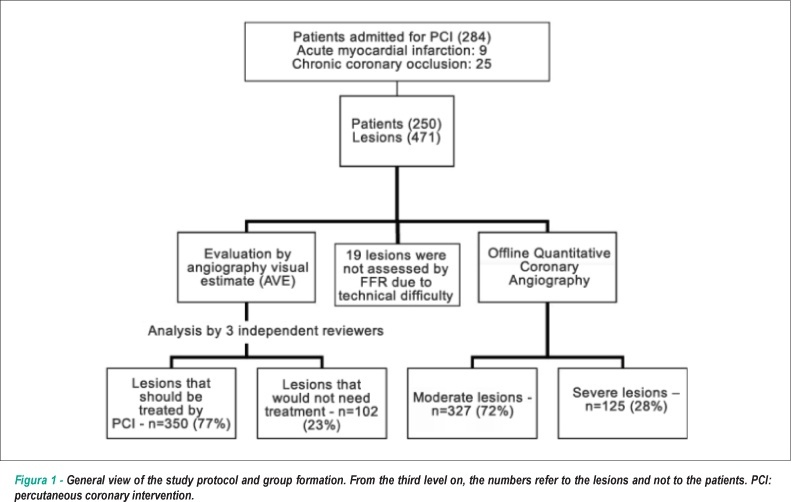
BACKGROUND: The angiography has been used as a reference standard to define coronary artery disease (CAD), although its limitations are well-known. The significance of the myocardial fractional flow reserve (FFR) in the assessment of CAD is well established. OBJECTIVE: The aim of this study was to evaluate the accuracy of angiography when defining ischemic lesions and its correlation with FFR. METHODS: Two hundred and fifty consecutive patients (471 arteries) were included in this study. All stenoses > 50% at the angiography visual estimate (AVE) were assessed by FFR measurements. When FFR was 0.75, no interventional treatment was carried out. Offline quantitative coronary angiography (QCA) was performed in all stenoses, which were divided in intermediate (< 70% – 327) and severe (125). The correlation coefficients between the diameter of the stenosis (%DS) and FFR and the accuracy of VA of the angiography when assessing ischemia were determined. RESULTS: FFR could be obtained in 452 lesions (96%). Mean %DS and FFR were 56 ± 8% and 0.74 and 76 ± 6% and 0.48 for moderate and severe stenoses, respectively. Concordance between QCA and FFR was poor, especially in intermediate stenoses (Spearman's rho = – 0.33, p<0.0001). Visual assessment resulted in an accuracy of 57% and 96% in intermediate and severe lesions, respectively. CONCLUSION: Neither the visual assessment of an angiogram nor QCA can accurately predict the significance of most intermediate coronary stenoses, which emphasizes the importance of associating it to a functional evaluation of the coronary circulation, resulting in an adequate treatment of these stenoses.

  • angioplasty, transluminal, percutaneous
  • Coronary Angiography
  • Myocardial Ischemia
  • Stents
  • transluminal
Read Full Article
Creative Commons Attribution (CC BY) Creative Commons license
01/10/2008 DOI: 10.1590/S0066-782X2008001500007
Proximal left anterior descending coronary artery revascularization with drug-eluting stents
ABC
Artigo Original

Proximal left anterior descending coronary artery revascularization with drug-eluting stents

Jorge Humberto Guardado et al. Raúl Moreno João Costa Maria J. Perez-Viscayno … Luís Segura Fernando Alfonso Rosana Hernández Javier Escaned Camiño Bañuelos Carlos Macaya

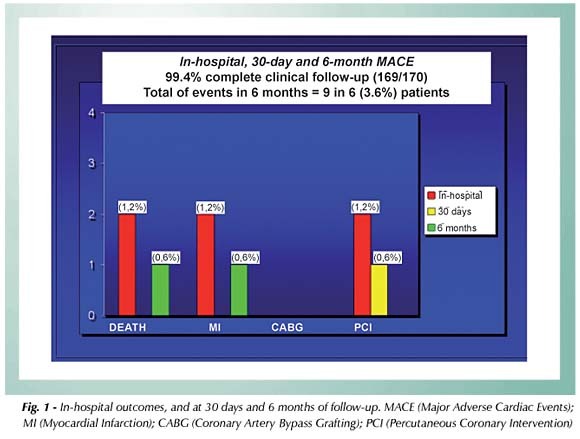
OBJECTIVE: To assess the clinical prognosis of patients with coronary artery diseases undergoing percutaneous revascularization with drug-eluting stent implantation in the proximal left anterior descending coronary artery. METHODS: One hundred and seventy consecutive patients with mean age of 65 years, 49 of them females (29%), undergoing implantation of at least one drug-eluting stent in our medical center. The total number of drug-eluting stents implanted was 189, of which 115 (61%) were sirolimus-eluting (CYPHER TM) and 74 (39%) were paclitaxel-eluting stents (TAXUS TM). In 100 (60%) of the cases, multivessel coronary artery disease was present. In 61 (36%) patients another coronary artery segment was treated in addition to the proximal left anterior descending coronary artery. The mean clinical follow-up period was 11 ± 5 months, and angiographic controls were performed between 6 and 9 months. The final endpoint was a composite of death, acute myocardial infarction and need for reintervention on the anterior descending. The secondary endpoint included the occurrence of restenosis, need for reintervention on the proximal segment of the left anterior descending and stent thrombosis. RESULTS: The procedure achieved immediate angiographic success in all patients. Two deaths, two acute myocardial infarctions, and two percutaneous coronary reinterventions due to stent thrombosis were recorded during in-hospital stay. At the sixth month of follow-up, an additional cardiac death and three myocardial infarctions were observed; three repeat revascularization procedures were required. Up to the end of the follow-up, three additional deaths, three myocardial infarctions and eight revascularization procedures of the anterior descending, two of them surgical, were verified. Survival free from major adverse cardiac events was 91%. Cardiac mortality was 3%. Binary restenosis in the proximal segment of the left anterior descending coronary artery was 4.1%. Target vessel revascularization-free survival was 94%. No cases of late stent thrombosis were observed. CONCLUSION: Percutaneous revascularization of the proximal left anterior descending coronary artery with implantation of drug-eluting stents is a safe and very efficient therapeutic strategy in the short and long terms.

  • Angioplasty
  • Paclitaxel
  • percutaneous coronary
  • Sirolimus
  • stent
  • transluminal
Read Full Article
Creative Commons Attribution (CC BY) Creative Commons license
20/03/2007 DOI: 10.1590/S0066-782X2007000200005

How to cite this article

EndNote RIS

Electronic Document Format (Vancouver)

Andrade PJN, Medeiros MMC, Andrade AT, Lima AAG. Coronary angioplasty versus CABG: review of randomized. Arquivos Brasileiros de Cardiologia 2011;97(3):e60-9.

Electronic Document Format (ABNT)

Andrade, Pedro José Negreiros de; Medeiros, Marta Maria das Chagas; Andrade, Antonio Thomaz de; Lima, Antonio Augusto Guimarães. Coronary angioplasty versus CABG: review of randomized. Arquivos Brasileiros de Cardiologia, v. 97, n. 3, p. e60-e69, Oct. 2011.

Electronic Document Format (APA)

Andrade, P. J. N. , Medeiros, M. M. C., Andrade, A. T. , & Lima, A. A. G. (2011). Coronary angioplasty versus CABG: review of randomized. Arquivos Brasileiros de Cardiologia, 97(3), e60-e69.

Electronic Document Format (ISO)

Andrade, Pedro José Negreiros de and Medeiros, Marta Maria das Chagas and Andrade, Antonio Thomaz de and Lima, Antonio Augusto Guimarães. Coronary angioplasty versus CABG: review of randomized. Arquivos Brasileiros de Cardiologia [online]. 2011, vol. 97, n. 3, [cited 2026-10-14], pp. e60-e69. Available from: <https://journals.cardiol.br/en/article/coronary-angioplasty-versus-cabg-review-of-randomized/>. ISSN 0066-782X

EndNote RIS

Electronic Document Format (Vancouver)

Pereira AB, Castro DSP, Menegotto ET, Amaral WM, Castro GSP. Myocardial bridging: therapeutic and clinical development. Arquivos Brasileiros de Cardiologia 2010;94(2):188-94.

Electronic Document Format (ABNT)

Pereira, Aline Braz; Castro, Danilo Spricigo Peressoni; Menegotto, Emanuela Todeschini; Amaral, Wladimir Maia do; Castro, Gustavo Spricigo Peressoni. Myocardial bridging: therapeutic and clinical development. Arquivos Brasileiros de Cardiologia, v. 94, n. 2, p. 188-194, May. 2010.

Electronic Document Format (APA)

Pereira, A. B., Castro, D. S. P., Menegotto, E. T., Amaral, W. M. , & Castro, G. S. P. (2010). Myocardial bridging: therapeutic and clinical development. Arquivos Brasileiros de Cardiologia, 94(2), 188-194.

Electronic Document Format (ISO)

Pereira, Aline Braz and Castro, Danilo Spricigo Peressoni and Menegotto, Emanuela Todeschini and Amaral, Wladimir Maia do and Castro, Gustavo Spricigo Peressoni. Myocardial bridging: therapeutic and clinical development. Arquivos Brasileiros de Cardiologia [online]. 2010, vol. 94, n. 2, [cited 2026-10-14], pp. 188-194. Available from: <https://journals.cardiol.br/en/article/myocardial-bridging-therapeutic-and-clinical-development/>. ISSN 0066-782X

EndNote RIS

Electronic Document Format (Vancouver)

Sant’Anna FM, Silva ER, Batista LA, Brito MB, Ventura FM, Ferraz HA, Buczynski L, et al. What is the angiography error when defining myocardial ischemia during percutaneous coronary interventions?. Arquivos Brasileiros de Cardiologia 2008;91(3):179-84.

Electronic Document Format (ABNT)

Sant’Anna, Fernando Mendes; Silva, Expedito Ribeiro da; Batista, Leonardo Alves; Brito, Marcelo Bastos; Ventura, Fábio Machado; Ferraz, Haroldo Adans; Buczynski, Leonardo; Barrozo, Carlos Alberto Mussel; Pijls, Nico. What is the angiography error when defining myocardial ischemia during percutaneous coronary interventions?. Arquivos Brasileiros de Cardiologia, v. 91, n. 3, p. 179-184, Sep. 2008.

Electronic Document Format (APA)

Sant’Anna, F. M., Silva, E. R. , Batista, L. A., Brito, M. B., Ventura, F. M., Ferraz, H. A., Buczynski, L., Barrozo, C. A. M., & Pijls, N. (2008). What is the angiography error when defining myocardial ischemia during percutaneous coronary interventions?. Arquivos Brasileiros de Cardiologia, 91(3), 179-184.

Electronic Document Format (ISO)

Sant’Anna, Fernando Mendes and Silva, Expedito Ribeiro da and Batista, Leonardo Alves and Brito, Marcelo Bastos and Ventura, Fábio Machado and Ferraz, Haroldo Adans and Buczynski, Leonardo and Barrozo, Carlos Alberto Mussel and Pijls, Nico. What is the angiography error when defining myocardial ischemia during percutaneous coronary interventions?. Arquivos Brasileiros de Cardiologia [online]. 2008, vol. 91, n. 3, [cited 2026-10-14], pp. 179-184. Available from: <https://journals.cardiol.br/en/article/what-is-the-angiography-error-when-defining-myocardial-ischemia-during-percutaneous-coronary-interventions/>. ISSN 0066-782X

EndNote RIS

Electronic Document Format (Vancouver)

Guardado JH, Moreno R, Costa J, Perez-Viscayno MJ, Segura L, Alfonso F, Hernández R, et al. Proximal left anterior descending coronary artery revascularization with drug-eluting stents. Arquivos Brasileiros de Cardiologia 2007;88(2):159-66.

Electronic Document Format (ABNT)

Guardado, Jorge Humberto; Moreno, Raúl; Costa, João; Perez-Viscayno, Maria J.; Segura, Luís; Alfonso, Fernando; Hernández, Rosana; Escaned, Javier; Bañuelos, Camiño; Macaya, Carlos. Proximal left anterior descending coronary artery revascularization with drug-eluting stents. Arquivos Brasileiros de Cardiologia, v. 88, n. 2, p. 159-166, Mar. 2007.

Electronic Document Format (APA)

Guardado, J. H., Moreno, R., Costa, J., Perez-Viscayno, M. J., Segura, L., Alfonso, F., Hernández, R., Escaned, J., Bañuelos, C., & Macaya, C. (2007). Proximal left anterior descending coronary artery revascularization with drug-eluting stents. Arquivos Brasileiros de Cardiologia, 88(2), 159-166.

Electronic Document Format (ISO)

Guardado, Jorge Humberto and Moreno, Raúl and Costa, João and Perez-Viscayno, Maria J. and Segura, Luís and Alfonso, Fernando and Hernández, Rosana and Escaned, Javier and Bañuelos, Camiño and Macaya, Carlos. Proximal left anterior descending coronary artery revascularization with drug-eluting stents. Arquivos Brasileiros de Cardiologia [online]. 2007, vol. 88, n. 2, [cited 2026-10-14], pp. 159-166. Available from: <https://journals.cardiol.br/en/article/proximal-left-anterior-descending-coronary-artery-revascularization-with-drug-eluting-stents/>. ISSN 0066-782X

  • About ABC Family
  • Internal Regulation
  • Editorial Board
  • Brazilian Society of Cardiology (SBC)

Issues

SBC Guidelines

  • Videos
  • Podcasts
  • News