ABC Family Arquivos Brasileiros de Cardiologia International Journal of Cardiovascular Sciences ABC Heart Failure & Cardiomyopathy ABC Imagem Cardiovascular
Português English
ABC Family
Português English
  • About
    • About ABC Family
    • Internal Regulation
    • Editorial Board
    • Brazilian Society of Cardiology (SBC)
  • Issues
  • SBC Guidelines
  • Content
    • Videos
    • Podcasts
    • News
  • About
    • About ABC Family
    • Internal Regulation
    • Editorial Board
    • Brazilian Society of Cardiology (SBC)
  • Issues
  • SBC Guidelines
  • Content
    • Videos
    • Podcasts
    • News

ABC Family

  • ABC Family
  • Arquivos Brasileiros de Cardiologia
  • International Journal of Cardiovascular Sciences
  • ABC Heart Failure & Cardiomyopathy
  • ABC Imagem Cardiovascular
Search in

No content found.

Journals
Ordering
Article types
Others

  1. Home
  2. Keyword: Telemedicine/methods
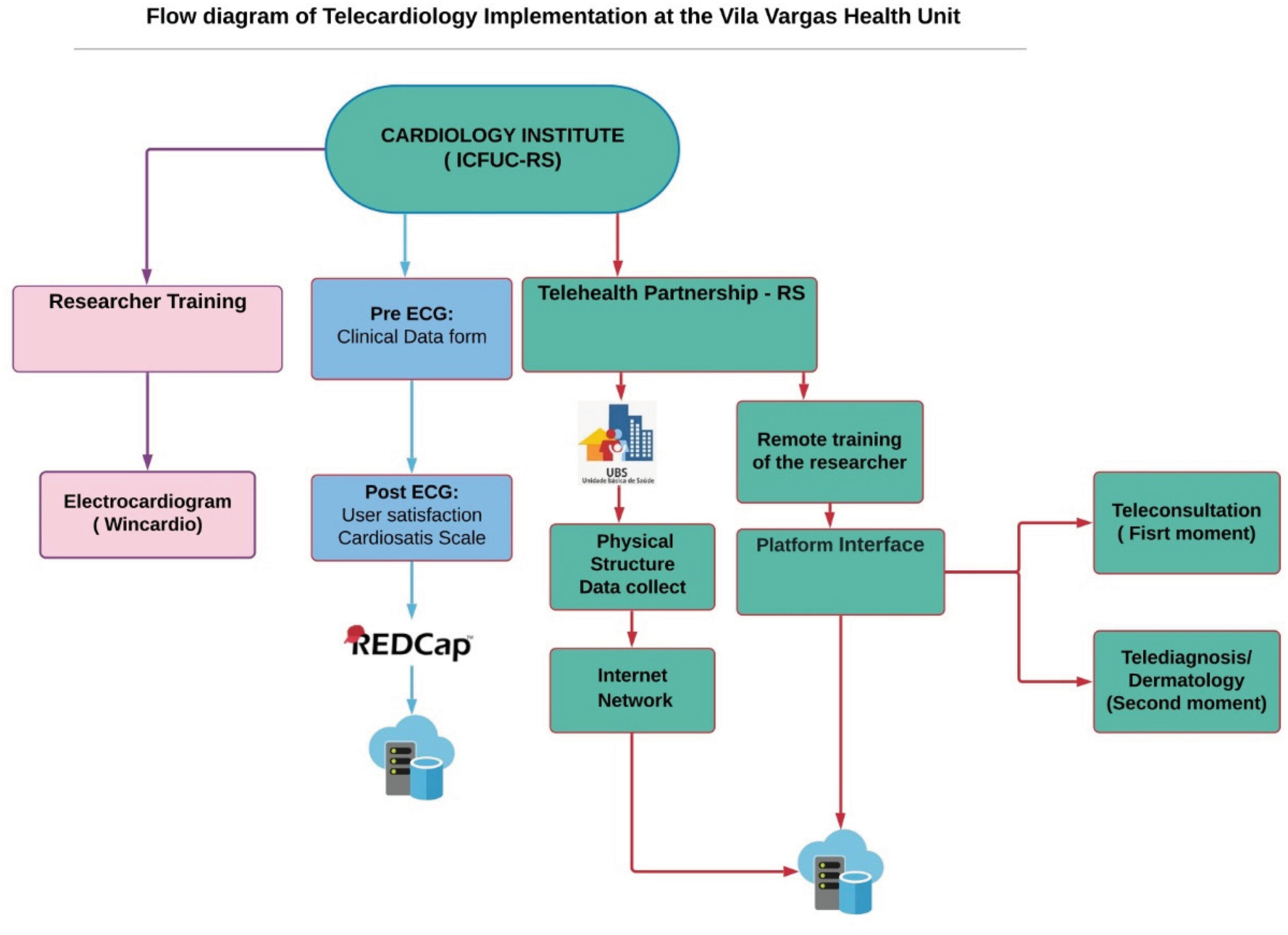
Figure 1
IJCS
Original Article

Implementation of a Telecardiology Service in a Health Unit in the City of Porto Alegre, Brazil: A Pilot Study

Francieli Giachini Esmerio et al. Silvia Goldmeier Eduardo Costa Duarte Barbosa Luis Marcelo Segredo … Rodolfo Silva Maria Claudia Irigoyen Bruna Eibel Patricia Oliveira Dias

Abstract

Background:

The implementation of Telecardiology in primary care in the city of Porto Alegre, Brazil, is a viable and promising strategy. It would decrease the distance between patient and specialized professional services by reducing unnecessary referrals and improving the quality of primary care and satisfaction of patients and health professionals.

Objective:

To implement a Telecardiology service and assess user satisfaction using the CARDIOSATIS scale.

Methods:

This was a pilot study developed by a partnership between the Institute of Cardiology and the Telehealth Center of Rio Grande do Sul. The study was carried out at Eri Flores-Vila Vargas health center in the city of Porto Alegre, from May to October 2019, and included 21 patients attending the health center. The descriptive analysis of data was performed using the SPSS program (Statistical Package for the Sciences) version 23. Data normality was checked using the Kolmogorov-Smirnov test. Statistical significance was set at 10%.

Results:

Mean age of participants was 43.8 ± 16.1 years. The most common risk factors in the sample were physical inactivity (81%) and smoking (43%). Most patients had normal electrocardiogram (ECG) readings. The time elapsed from the performance of the ECG test, transmission of the ECG traces to Telehealth, and return of the final ECG report to the health center was 0-7 days. The CARDIOSATIS scale revealed a high prevalence of “very satisfied” users for the general satisfaction domain, and only 14.3% of patients were dissatisfied with their health.

Conclusions:

Telecardiology reduced the distance between patient and the specialized professional, with a high level of patient and health professional satisfaction. Our study can serve as a basis for the implementation of a telecardiology network in the city of Porto Alegre in the future.

  • Cardiovascular Diseases
  • Electrocardiography
  • Telemedicine/ethics
  • Telemedicine/methods
  • Telemedicine/trends
Read Full Article
Creative Commons Attribution (CC BY) Creative Commons license
01/11/2021 DOI: 10.36660/ijcs.20200305
ABC
Viewpoint

Echoes of Telecardiology Guideline

Silvio Henrique Barberato et al. Marcelo Antônio Cartaxo Queiroga Lopes

Echocardiography has an established role in the diagnosis, prognostic evaluation and therapeutic orientation in several cardiovascular diseases. The great technological development in the last decades has allowed the digitization and standardization of medical images (DICOM), miniaturization of echocardiography equipment (portable cardiac ultrasound) and the transfer of images over the internet. In this scenario, strategies for the use of telemedicine-associated echocardiography, called tele-echocardiography, have been employed in the context of clinical research with the support of teleconsultation for remote expert review, in real time or after image storage and submission. In recognition of the demands generated by the ongoing digital transformation in health, the Brazilian Society of Cardiology recently published the Telemedicine Guideline in Cardiology. The document recognizes tele-echocardiography as a strategy for early detection of congenital heart disease in newborns and screening for early detection of subclinical cases of rheumatic heart disease in children and adolescents (both recommended as indication class IIa, level of evidence B). In addition, it evokes potential application in primary health care in remote locations, where it could enable early detection of cases of heart disease and assist in prioritizing referrals to specialized care (indication class IIb, level of evidence C). It should be emphasized that such recommendations are made within the conditions of regular use of the method in Brazil, which would include the need for doctors at both ends, i.e., the execution and interpretation of the exam. The text of the Guideline explicitly states the need for regulation and legal provision for the participation of other professionals in performing diagnostic procedures (in this case, obtaining echocardiographic images by non-doctors), currently not allowed by the country’s legislation.

In recent years, tele-echocardiography has extended the application of the method to individuals in geographically distant locations, such as remote rural communities or even space. A rural area is classified as remote when 50% of the local population needs at least 45 to 60 minutes of travel by motor vehicle to reach a population center of at least 50,000 inhabitants. Several situations have been experimentally tested, with a study on focused echocardiographic by non-cardiologist physicians,, non-physicians,, or remote-operated robotic devices, combined with remote interpretation by echocardiography cardiologists.

[…]

  • Cardiovascular Diseases
  • Diagnosis Imaging
  • Echocardiography/methods
  • Image Interpretation, Computer-Assisted
  • Robotics/trends
  • Telemedicine/methods
  • Telemedicine/trends
  • Telemonitoring
  • Training
Read Full Article
Creative Commons Attribution (CC BY) Creative Commons license
10/02/2020 DOI: 10.36660/abc.20190720 Views 1
ABC
Editorial

Behavioral Economics and Innovation Uptake: Building New Capabilities to Overcome Barriers to Technology-Enabled Care

Alexandre Siciliano Colafranceschi

Introduction

The Federal Medical Council (CFM) has recently published a new resolution on telemedicine in Brazil. The 2227/2018 resolution, establishing the criteria for the use of telemedicine, was published in Diario Oficial da União (DOU, the official journal of the federal government of Brazil) on February 6, 2019. This new policy, aimed at defining telemedicine as a way of providing medical services by means of technology, is much more aggressive than the previous one published in 2002, which limited the use of telemedicine to medical consultations made by telephone or internet, and implied the presence of a health professional at both ends of the communication channel. The current resolution expanded the concept of telemedicine in providing technological solutions for remote patient monitoring and treatment (drug prescription and surgical interventions), and analysis of laboratory results. However, soon after its release, the new document caused an intense public debate on the theme dividing stakeholders for and against the incorporation of telemedicine into practice nationwide. The debate was so intense that the Federal Medical Council revoked the resolution, as published in the DOU on March 6, 2019.

The revocation of the policy after intense societal debate indicates the significant challenges regarding the implementation of technology-enabled care in Brazil. Such debate should not be the end, but rather, the beginning of a social mobilization to reframe the use of connected technology in healthcare in the country. To tackle the barriers to the uptake of technology-enabled care in Brazil, one should better understand the stakeholder positions, and consider the political and cultural environment, the ethical and legal apparatus and the available technology infrastructure.

[…]

  • National Health Science, Technology and Innovation Policy
  • Telemedicine/economics
  • Telemedicine/legislation and jurisprudence
  • Telemedicine/methods
  • Telemedicine/trends
Read Full Article
Creative Commons Attribution (CC BY) Creative Commons license
04/11/2019 DOI: 10.5935/abc.20190216 Views 1
IJCS
Original Article

Telecardiology on the Diagnostic Support of Chest Pain in Twenty-Two Emergency Care Units (UPA 24h) in The State of Rio de Janeiro

Simone Farah et al. Bruno Rustum Andréa Rogério Casemiro da Silva Alexandra Monteiro

Abstract

Background:

Telecardiology may be a useful support in diagnosis and management of chest pain.

Objective:

Evaluate the application of telecardiology to support the differential diagnosis of chest pain in patients admitted to Emergency Care Units.

Method:

Observational, retrospective and documental study of 5,816 patients admitted with supposedly cardiological chest pain in twenty two Emergency Care Units in the state of Rio de Janeiro. Data were tabulated and analyzed by Excel® software, using simple descriptive statistics, from the database of the Cardiology Consultancy Nucleus.

Results:

Diagnostic disagreement was found in 1,593 (27.39%) cases. Of these, 1,477 (92.72%) were diagnosed locally as non-ST-elevation myocardial infarction (non-STEMI), 74 (4.64%) as acute myocardial infarction with ST-segment elevation (STEMI), 40 (2.52%) as acute pulmonary edema (APE) and 2 (0.12%) as tachyarrhythmia. Intensive care referral was requested to 100% of these patients. After telecardiology, the diagnoses were: 385 (24.17%) unstable angina, 289 (18.14%) congestive heart failure, 212 (13.31%) APE, 174 (10.92%) STEMI, 152 (9.54%) hypertensive emergency, 113 (7.09%) acute chronic renal failure, 89 (5.59%) non-STEMI, 89 (5.59%) pneumonia, 39 (2.45%) sepsis, 26 (1.63 %) myopericarditis, 20 (1.26%) tachyarrhythmia and 5 (0.31%) orovalvar disease. The outcome after telecardiology was 1,178 discharges (73.94%), 338 (21.21%) referrals, 62 (3.90%) deaths and 15 (0.95%) unknown.

Conclusion:

Telecardiology was effective in chest pain diagnosis and management, optimizing hospital admission in the public health system.

  • Chest Pain/diagnostic imaging
  • Electrocardiography/methods
  • Emergency Medical Services
  • Myocardial Infarction
  • Telemedicine/methods
Read Full Article
Creative Commons Attribution (CC BY) Creative Commons license
21/01/2019 DOI: 10.5935/2359-4802.20180099 Views 1

How to cite this article

EndNote RIS

Electronic Document Format (Vancouver)

Esmerio FG, Goldmeier S, Barbosa ECD, Segredo LM, Silva R, Irigoyen MC, Eibel B, et al. Implementation of a Telecardiology Service in a Health Unit in the City of Porto Alegre, Brazil: A Pilot Study. International Journal of Cardiovascular Sciences 2021;35(2):152-8.

Electronic Document Format (ABNT)

Esmerio, Francieli Giachini; Goldmeier, Silvia; Barbosa, Eduardo Costa Duarte; Segredo, Luis Marcelo; Silva, Rodolfo; Irigoyen, Maria Claudia; Eibel, Bruna; Dias, Patricia Oliveira. Implementation of a Telecardiology Service in a Health Unit in the City of Porto Alegre, Brazil: A Pilot Study. International Journal of Cardiovascular Sciences, v. 35, n. 2, p. 152-158, Oct. 2021.

Electronic Document Format (APA)

Esmerio, F. G., Goldmeier, S., Barbosa, E. C. D., Segredo, L. M., Silva, R., Irigoyen, M. C., Eibel, B., & Dias, P. O. (2021). Implementation of a Telecardiology Service in a Health Unit in the City of Porto Alegre, Brazil: A Pilot Study. International Journal of Cardiovascular Sciences, 35(2), 152-158.

Electronic Document Format (ISO)

Esmerio, Francieli Giachini and Goldmeier, Silvia and Barbosa, Eduardo Costa Duarte and Segredo, Luis Marcelo and Silva, Rodolfo and Irigoyen, Maria Claudia and Eibel, Bruna and Dias, Patricia Oliveira. Implementation of a Telecardiology Service in a Health Unit in the City of Porto Alegre, Brazil: A Pilot Study. International Journal of Cardiovascular Sciences [online]. 2021, vol. 35, n. 2, [cited 2026-10-14], pp. 152-158. Available from: <https://journals.cardiol.br/en/article/implementation-of-a-telecardiology-service-in-a-health-unit-in-the-city-of-porto-alegre-brazil-a-pilot-study/>. ISSN 2359-4802

EndNote RIS

Electronic Document Format (Vancouver)

Barberato SH, Lopes MACQ. Echoes of Telecardiology Guideline. Arquivos Brasileiros de Cardiologia 2020;114(1):130-2.

Electronic Document Format (ABNT)

Barberato, Silvio Henrique; Lopes, Marcelo Antônio Cartaxo Queiroga. Echoes of Telecardiology Guideline. Arquivos Brasileiros de Cardiologia, v. 114, n. 1, p. 130-132, Feb. 2020.

Electronic Document Format (APA)

Barberato, S. H., & Lopes, M. A. C. Q. (2020). Echoes of Telecardiology Guideline. Arquivos Brasileiros de Cardiologia, 114(1), 130-132.

Electronic Document Format (ISO)

Barberato, Silvio Henrique and Lopes, Marcelo Antônio Cartaxo Queiroga. Echoes of Telecardiology Guideline. Arquivos Brasileiros de Cardiologia [online]. 2020, vol. 114, n. 1, [cited 2026-10-14], pp. 130-132. Available from: <https://journals.cardiol.br/en/article/echoes-of-telecardiology-guideline/>. ISSN 0066-782X

EndNote RIS

Electronic Document Format (Vancouver)

Colafranceschi AS. Behavioral Economics and Innovation Uptake: Building New Capabilities to Overcome Barriers to Technology-Enabled Care. Arquivos Brasileiros de Cardiologia 2019;113(4):664-6.

Electronic Document Format (ABNT)

Colafranceschi, Alexandre Siciliano. Behavioral Economics and Innovation Uptake: Building New Capabilities to Overcome Barriers to Technology-Enabled Care. Arquivos Brasileiros de Cardiologia, v. 113, n. 4, p. 664-666, Nov. 2019.

Electronic Document Format (APA)

Colafranceschi, A. S. (2019). Behavioral Economics and Innovation Uptake: Building New Capabilities to Overcome Barriers to Technology-Enabled Care. Arquivos Brasileiros de Cardiologia, 113(4), 664-666.

Electronic Document Format (ISO)

Colafranceschi, Alexandre Siciliano. Behavioral Economics and Innovation Uptake: Building New Capabilities to Overcome Barriers to Technology-Enabled Care. Arquivos Brasileiros de Cardiologia [online]. 2019, vol. 113, n. 4, [cited 2026-10-14], pp. 664-666. Available from: <https://journals.cardiol.br/en/article/behavioral-economics-and-innovation-uptake-building-new-capabilities-to-overcome-barriers-to-technology-enabled-care/>. ISSN 0066-782X

EndNote RIS

Electronic Document Format (Vancouver)

Farah S, Andréa BR, Silva RC, Monteiro A. Telecardiology on the Diagnostic Support of Chest Pain in Twenty-Two Emergency Care Units (UPA 24h) in The State of Rio de Janeiro. International Journal of Cardiovascular Sciences 2019;32(2):158-62.

Electronic Document Format (ABNT)

Farah, Simone; Andréa, Bruno Rustum; Silva, Rogério Casemiro da; Monteiro, Alexandra. Telecardiology on the Diagnostic Support of Chest Pain in Twenty-Two Emergency Care Units (UPA 24h) in The State of Rio de Janeiro. International Journal of Cardiovascular Sciences, v. 32, n. 2, p. 158-162, Jan. 2019.

Electronic Document Format (APA)

Farah, S., Andréa, B. R., Silva, R. C. , & Monteiro, A. (2019). Telecardiology on the Diagnostic Support of Chest Pain in Twenty-Two Emergency Care Units (UPA 24h) in The State of Rio de Janeiro. International Journal of Cardiovascular Sciences, 32(2), 158-162.

Electronic Document Format (ISO)

Farah, Simone and Andréa, Bruno Rustum and Silva, Rogério Casemiro da and Monteiro, Alexandra. Telecardiology on the Diagnostic Support of Chest Pain in Twenty-Two Emergency Care Units (UPA 24h) in The State of Rio de Janeiro. International Journal of Cardiovascular Sciences [online]. 2019, vol. 32, n. 2, [cited 2026-10-14], pp. 158-162. Available from: <https://journals.cardiol.br/en/article/telecardiology-on-the-diagnostic-support-of-chest-pain-in-twenty-two-emergency-care-units-upa-24h-in-the-state-of-rio-de-janeiro/>. ISSN 2359-4802

  • About ABC Family
  • Internal Regulation
  • Editorial Board
  • Brazilian Society of Cardiology (SBC)

Issues

SBC Guidelines

  • Videos
  • Podcasts
  • News