ABC Family Arquivos Brasileiros de Cardiologia International Journal of Cardiovascular Sciences ABC Heart Failure & Cardiomyopathy ABC Imagem Cardiovascular
Português English
ABC Family
Português English
  • About
    • About ABC Family
    • Internal Regulation
    • Editorial Board
    • Brazilian Society of Cardiology (SBC)
  • Issues
  • SBC Guidelines
  • Content
    • Videos
    • Podcasts
    • News
  • About
    • About ABC Family
    • Internal Regulation
    • Editorial Board
    • Brazilian Society of Cardiology (SBC)
  • Issues
  • SBC Guidelines
  • Content
    • Videos
    • Podcasts
    • News

ABC Family

  • ABC Family
  • Arquivos Brasileiros de Cardiologia
  • International Journal of Cardiovascular Sciences
  • ABC Heart Failure & Cardiomyopathy
  • ABC Imagem Cardiovascular
Search in

No content found.

Journals
Ordering
Article types
Others

  1. Home
  2. Keyword: Risk Grade
Combination of Tele-Cardiology Tools for Cardiovascular Risk Stratification in Primary Care: Data from the PROVAR+ Study
ABC
Original Article

Combination of Tele-Cardiology Tools for Cardiovascular Risk Stratification in Primary Care: Data from the PROVAR+ Study

Lucas Leal Fraga et al. Bruno Ramos Nascimento Beatriz Costa Haiashi Alexandre Melo Ferreira … Mauro Henrique Agapito Silva Isabely Karoline da Silva Ribeiro Gabriela Aparecida Silva Wanessa Campos Vinhal Mariela Mata Coimbra Cássia Aparecida Silva Cristiana Rosa Lima Machado Magda C. Pires Marina Gomes Diniz Luiza Pereira Afonso Santos Arthur Maia Amaral Lucas Chaves Diamante Henrique Leão Fava Craig Sable Maria Carmo Pereira Nunes Antonio Luiz P. Ribeiro Clareci Silva Cardoso

Abstract

Background:

Tele-cardiology tools are valuable strategies to improve risk stratification.

Objective:

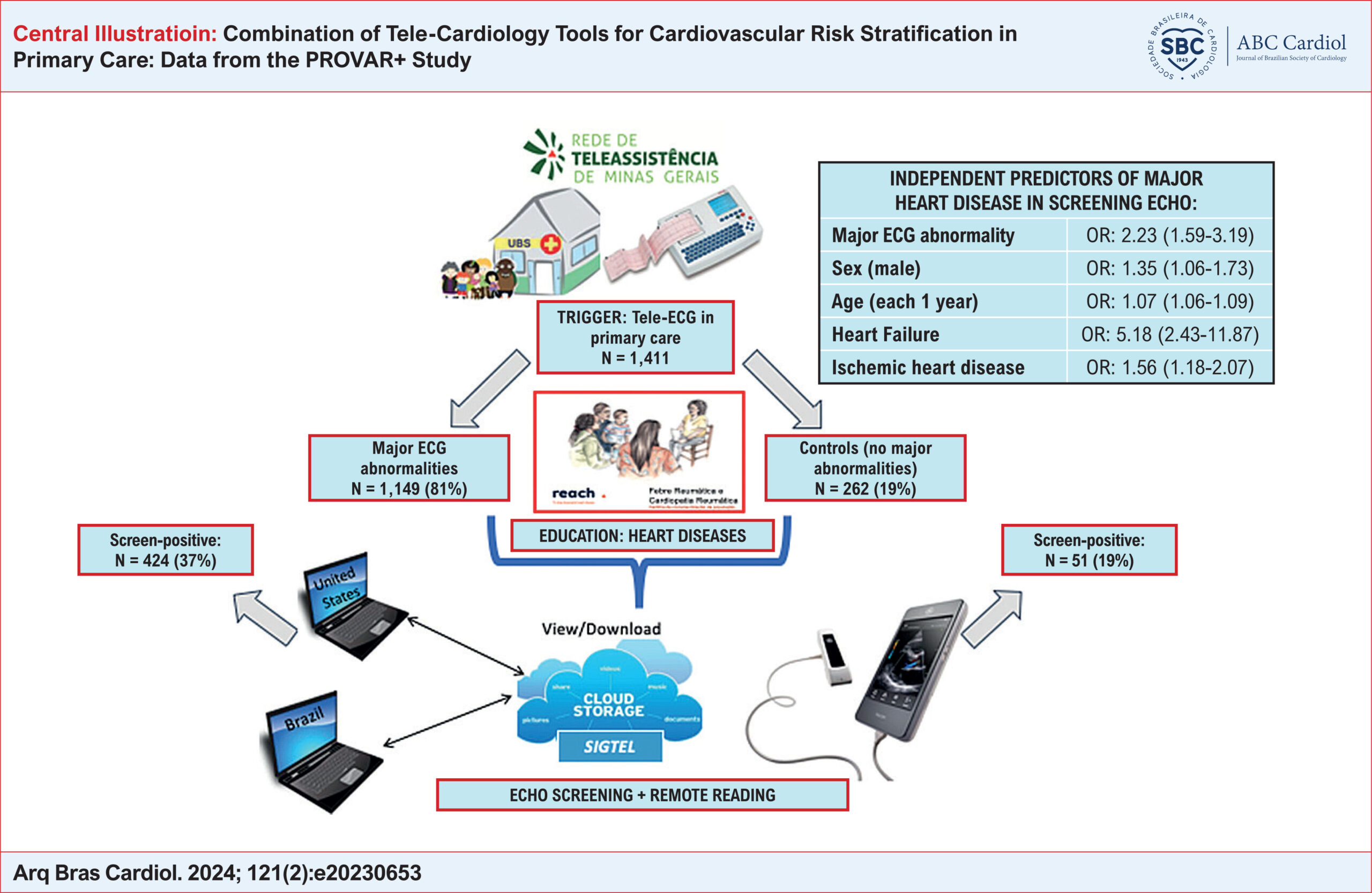
We aimed to evaluate the accuracy of tele-electrocardiography (ECG) to predict abnormalities in screening echocardiography (echo) in primary care (PC).

Methods:

In 17 months, 6 health providers at 16 PC units were trained on simplified handheld echo protocols. Tele-ECGs were recorded for final diagnosis by a cardiologist. Consented patients with major ECG abnormalities by the Minnesota code, and a 1:5 sample of normal individuals underwent clinical questionnaire and screening echo interpreted remotely. Major heart disease was defined as moderate/severe valve disease, ventricular dysfunction/hypertrophy, pericardial effusion, or wall-motion abnormalities. Association between major ECG and echo abnormalities was assessed by logistic regression as follows: 1) unadjusted model; 2) model 1 adjusted for age/sex; 3) model 2 plus risk factors (hypertension/diabetes); 4) model 3 plus history of cardiovascular disease (Chagas/rheumatic heart disease/ischemic heart disease/stroke/heart failure). P-values < 0.05 were considered significant.

Results:

A total 1,411 patients underwent echo; 1,149 (81%) had major ECG abnormalities. Median age was 67 (IQR 60 to 74) years, and 51.4% were male. Major ECG abnormalities were associated with a 2.4-fold chance of major heart disease on echo in bivariate analysis (OR = 2.42 [95% CI 1.76 to 3.39]), and remained significant after adjustments in models (p < 0.001) 2 (OR = 2.57 [95% CI 1.84 to 3.65]), model 3 (OR = 2.52 [95% CI 1.80 to3.58]), and model 4 (OR = 2.23 [95%CI 1.59 to 3.19]). Age, male sex, heart failure, and ischemic heart disease were also independent predictors of major heart disease on echo.

Conclusions:

Tele-ECG abnormalities increased the likelihood of major heart disease on screening echo, even after adjustments for demographic and clinical variables.

  • Cardiovascular Diseases
  • Electrocardiography
  • Mass Screening
  • Risk Grade
  • Telemedicine
Read Full Article
Creative Commons Attribution (CC BY) Creative Commons license
05/04/2024 DOI: 10.36660/abc.20230653 Views 2
ABC
Editorial

The Rare Alternans Pre-Excitation Pattern: Is It a Genuinely Benign Phenomenon?

Mirella Facin et al. Nelson Samesima

The conduction system is a specialized myocardial cell arrangement that neatly generates and transmits electrical stimuli, leading to sequentially coordinated contractions in each cardiac cycle.A thick layer of fibrous tissue, the annulus fibrosus, almost entirely insulates the atrial from the ventricular myocardia, except in the region of the atrioventricular (AV) node and His-Purkinje system, which, in normal hearts, stands as the single electric pathway between the upper and lower chambers. ,

In some individuals, however, threads of myocardial tissue directly connecting atria to ventricles remain from previous developmental stages and endure after childbirth.The presence of additional atrioventricular conduits or accessory pathways (AP) allows the electrical stimuli to bypass the AV node, resulting in earlier activation of the ventricles or pre-excitation. Bypass tracts may cross the atrioventricular groove wherever atrial and ventricular myocardium are juxtaposed. Most are capable of bidirectional and non-decremental conduction and may serve as a limb to reentrant orthodromic/antidromic circuits or fast lanes for impulse transmission during other supraventricular tachycardias, such as atrial fibrillation (AF).

[…]

  • atrioventricular node
  • Prevalence
  • Risk Grade
  • Wolff-Parkinson White Syndrome
Read Full Article
Creative Commons Attribution (CC BY) Creative Commons license
10/02/2023 DOI: 10.36660/abc.20220864 Views 1

How to cite this article

EndNote RIS

Electronic Document Format (Vancouver)

Fraga LL, Nascimento BR, Haiashi BC, Ferreira AM, Silva MHA, Ribeiro IKS, Silva GA, et al. Combination of Tele-Cardiology Tools for Cardiovascular Risk Stratification in Primary Care: Data from the PROVAR+ Study. Arquivos Brasileiros de Cardiologia 2024;121(2):e20230653.

Electronic Document Format (ABNT)

Fraga, Lucas Leal; Nascimento, Bruno Ramos; Haiashi, Beatriz Costa; Ferreira, Alexandre Melo; Silva, Mauro Henrique Agapito; Ribeiro, Isabely Karoline da Silva; Silva, Gabriela Aparecida; Vinhal, Wanessa Campos; Coimbra, Mariela Mata; Silva, Cássia Aparecida; Machado, Cristiana Rosa Lima; Pires, Magda C.; Diniz, Marina Gomes; Santos, Luiza Pereira Afonso; Amaral, Arthur Maia; Diamante, Lucas Chaves; Fava, Henrique Leão; Sable, Craig; Nunes, Maria Carmo Pereira; Ribeiro, Antonio Luiz P.; Cardoso, Clareci Silva. Combination of Tele-Cardiology Tools for Cardiovascular Risk Stratification in Primary Care: Data from the PROVAR+ Study. Arquivos Brasileiros de Cardiologia, v. 121, n. 2, e20230653, Apr. 2024.

Electronic Document Format (APA)

Fraga, L. L., Nascimento, B. R., Haiashi, B. C., Ferreira, A. M., Silva, M. H. A., Ribeiro, I. K. S., Silva, G. A., Vinhal, W. C., Coimbra, M. M., Silva, C. A., Machado, C. R. L., Pires, M. C., Diniz, M. G., Santos, L. P. A., Amaral, A. M., Diamante, L. C., Fava, H. L., Sable, C., Nunes, M. C. P., Ribeiro, A. L. P., & Cardoso, C. S. (2024). Combination of Tele-Cardiology Tools for Cardiovascular Risk Stratification in Primary Care: Data from the PROVAR+ Study. Arquivos Brasileiros de Cardiologia, 121(2), e20230653.

Electronic Document Format (ISO)

Fraga, Lucas Leal and Nascimento, Bruno Ramos and Haiashi, Beatriz Costa and Ferreira, Alexandre Melo and Silva, Mauro Henrique Agapito and Ribeiro, Isabely Karoline da Silva and Silva, Gabriela Aparecida and Vinhal, Wanessa Campos and Coimbra, Mariela Mata and Silva, Cássia Aparecida and Machado, Cristiana Rosa Lima and Pires, Magda C. and Diniz, Marina Gomes and Santos, Luiza Pereira Afonso and Amaral, Arthur Maia and Diamante, Lucas Chaves and Fava, Henrique Leão and Sable, Craig and Nunes, Maria Carmo Pereira and Ribeiro, Antonio Luiz P. and Cardoso, Clareci Silva. Combination of Tele-Cardiology Tools for Cardiovascular Risk Stratification in Primary Care: Data from the PROVAR+ Study. Arquivos Brasileiros de Cardiologia [online]. 2024, vol. 121, n. 2, [cited 2026-10-14], e20230653. Available from: <https://journals.cardiol.br/en/article/combination-of-tele-cardiology-tools-for-cardiovascular-risk-stratification-in-primary-care-data-from-the-provar-study/>. ISSN 0066-782X

EndNote RIS

Electronic Document Format (Vancouver)

Facin M, Samesima N. The Rare Alternans Pre-Excitation Pattern: Is It a Genuinely Benign Phenomenon?. Arquivos Brasileiros de Cardiologia 2023;120(1):e20220864.

Electronic Document Format (ABNT)

Facin, Mirella; Samesima, Nelson. The Rare Alternans Pre-Excitation Pattern: Is It a Genuinely Benign Phenomenon?. Arquivos Brasileiros de Cardiologia, v. 120, n. 1, e20220864, Feb. 2023.

Electronic Document Format (APA)

Facin, M., & Samesima, N. (2023). The Rare Alternans Pre-Excitation Pattern: Is It a Genuinely Benign Phenomenon?. Arquivos Brasileiros de Cardiologia, 120(1), e20220864.

Electronic Document Format (ISO)

Facin, Mirella and Samesima, Nelson. The Rare Alternans Pre-Excitation Pattern: Is It a Genuinely Benign Phenomenon?. Arquivos Brasileiros de Cardiologia [online]. 2023, vol. 120, n. 1, [cited 2026-10-14], e20220864. Available from: <https://journals.cardiol.br/en/article/the-rare-alternans-pre-excitation-pattern-is-it-a-genuinely-benign-phenomenon/>. ISSN 0066-782X

  • About ABC Family
  • Internal Regulation
  • Editorial Board
  • Brazilian Society of Cardiology (SBC)

Issues

SBC Guidelines

  • Videos
  • Podcasts
  • News