ABC Family Arquivos Brasileiros de Cardiologia International Journal of Cardiovascular Sciences ABC Heart Failure & Cardiomyopathy ABC Imagem Cardiovascular
Português English
ABC Family
Português English
  • About
    • About ABC Family
    • Internal Regulation
    • Editorial Board
    • Brazilian Society of Cardiology (SBC)
  • Issues
  • SBC Guidelines
  • Content
    • Videos
    • Podcasts
    • News
  • About
    • About ABC Family
    • Internal Regulation
    • Editorial Board
    • Brazilian Society of Cardiology (SBC)
  • Issues
  • SBC Guidelines
  • Content
    • Videos
    • Podcasts
    • News

ABC Family

  • ABC Family
  • Arquivos Brasileiros de Cardiologia
  • International Journal of Cardiovascular Sciences
  • ABC Heart Failure & Cardiomyopathy
  • ABC Imagem Cardiovascular
Search in

No content found.

Journals
Ordering
Article types
Others

  1. Home
  2. Keyword: Rest
ABC
Original Article

Relationship between Cardiometabolic Parameters and Elevated Resting and Effort Heart Rate in Schoolchildren

Cristiane Fernanda da Silva et al. Miria Suzana Burgos Priscila Tatiana da Silva Leandro Tibiriçá Burgos … Letícia Welser Ana Paula Sehn Jorge André Horta Elza Daniel de Mello Cézane Priscila Reuter

Abstract

Background:

Little has been studied on heart rate and its relationship with metabolic disorders.

Objective:

To identify possible association between heart rate (HR) and metabolic disorders in children and adolescents.

Methods:

This cross-sectional study evaluated 2.098 subjects, aged between 7 and 17 years. The variables evaluated were: HR, systolic (SBP) and diastolic blood pressure (DBP), pulse pressure (PP), double-product (DP), myocardial oxygen consumption (mVO2), lipids, glucose and uric acid levels, body mass index (BMI) and waist circumference (WC). The values of HR at rest and effort were divided into quartiles. The association between continuous values of HR and cardiometabolic indicators was tested by linear regression.

Results:

LDL cholesterol presented a significantly higher mean (p = 0.003) in schoolchildren with resting HR greater or equal to 91 bpm, compared to students with less than 75 bpm. Compared with the quartiles of effort HR, SBP, DBP, glucose and uric acid presented high values when HR was greater or equal than 185 bpm. SBP, glucose and HDL cholesterol demonstrated a significant association with resting HR. Uric acid was observed as a predictor of increased effort HR.

Conclusion:

Schoolchildren with a higher resting HR have higher mean of LDL cholesterol. For effort HR, there was an increase in blood pressure, glucose and uric acid levels. Uric acid has been shown to be a predictor of elevated effort HR.
  • Adolescent Health
  • Child Health
  • Heart Rate
  • Metabolism Syndrome
  • Physical Exertion
  • Rest
Read Full Article
Creative Commons Attribution (CC BY) Creative Commons license
20/07/2017 DOI: 10.5935/abc.20170103 Views 1
ABC
Original Article

Relationship between Resting Heart Rate, Blood Pressure and Pulse Pressure in Adolescents

Diego Giulliano Destro Christofaro et al. Juliano Casonatto Luiz Carlos Marques Vanderlei Gabriel Grizzo Cucato Raphael Mendes Ritti Dias

Abstract

Background:

High resting heart rate is considered an important factor for increasing mortality chance in adults. However, it remains unclear whether the observed associations would remain after adjustment for confounders in adolescents.

Objectives:

To analyze the relationship between resting heart rate, blood pressure and pulse pressure in adolescents of both sexes.

Methods:

A cross-sectional study with 1231 adolescents (716 girls and 515 boys) aged 14-17 years. Heart rate, blood pressure and pulse pressure were evaluated using an oscillometric blood pressure device, validated for this population. Weight and height were measured with an electronic scale and a stadiometer, respectively, and waist circumference with a non-elastic tape. Multivariate analysis using linear regression investigated the relationship between resting heart rate and blood pressure and pulse pressure in boys and girls, controlling for general and abdominal obesity.

Results:

Higher resting heart rate values were observed in girls (80.1 ± 11.0 beats/min) compared to boys (75.9 ± 12.7 beats/min) (p ≤ 0.001). Resting heart rate was associated with systolic blood pressure in boys (Beta = 0.15 [0.04; 0.26]) and girls (Beta = 0.24 [0.16; 0.33]), with diastolic blood pressure in boys (Beta = 0.50 [0.37; 0.64]) and girls (Beta = 0.41 [0.30; 0.53]), and with pulse pressure in boys (Beta = -0.16 [-0.27; -0.04]).

Conclusions:

This study demonstrated a relationship between elevated resting heart rate and increased systolic and diastolic blood pressure in both sexes and pulse pressure in boys even after controlling for potential confounders, such as general and abdominal obesity.

  • Adolescents
  • Arterial Pressure
  • Heart Rate
  • Rest
Read Full Article
Creative Commons Attribution (CC BY) Creative Commons license
04/05/2017 DOI: 10.5935/abc.20170050 Views 1
Association between initial and final transient heart rate responses in exercise testing
ABC
Artigo Original

Association between initial and final transient heart rate responses in exercise testing

Gisele Messias Mattioli et al. Claudio Gil Soares de Araújo

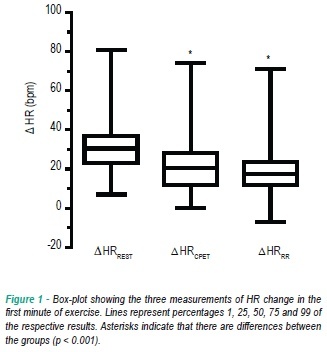
BACKGROUND: The rest-exercise-rest transition is accompanied by rapid and slow heart rate (HR) changes modulated by the branches of the autonomic nervous system. Vagal participation seems to be distinct in these different transitions. Additionally, it is methodologically difficult to determine the best moment and how to measure resting HR. OBJECTIVE: To determine the association between initial (rapid and slow) and final transient HR responses during exercise, considering different forms of measuring resting HR. METHODS: We retrospectively studied 103 non-athlete adults (76 males) who underwent 4-second exercise test to obtain the rapid transient HR response as measured by the cardiac vagal index (CVI), and completed a maximal cardiopulmonary exercise test in exactly 10 minutes. HR changes were measured in the first few minutes of exercise (ΔHR) and recovery (dHR). RESULTS: Modest associations were found between CVI and the three forms of measuring ΔHR, r between 0.27 and 0.31 (p<0.05), and a more significant association between dHR and CVI, r=0.53 (p<0.05). The means of the three measurements of resting HR were different (p<0.05) and showed only reasonable correlations between them (r between 0.64 and 0.76; p<0.05). CONCLUSION: It is important to standardize the measurement of resting HR for the analysis of transient HR responses; small or moderate association between the results of the different transients suggests that partially distinct autonomic mechanisms are involved and that their measurements may provide different and potentially complementary clinical information.

  • Exercise
  • Exercise Rate
  • Heart Rate
  • Rest
Read Full Article
Creative Commons Attribution (CC BY) Creative Commons license
13/10/2009 DOI: 10.1590/S0066-782X2009000800012 Views 1
Use of resting myocardial scintigraphy during chest pain to exclude diagnosis of acute myocardial infarction
ABC
Artigo Original

Use of resting myocardial scintigraphy during chest pain to exclude diagnosis of acute myocardial infarction

Gustavo Borges Barbirato et al. Jader Cunha de Azevedo Renata Christian Martins Felix Patricia Lavatori Correa … André Volschan Monica Viegas Lucia Pimenta Hans Fernando Rocha Dohmann Evandro Tinoco Mesquita Claudio Tinoco Mesquita

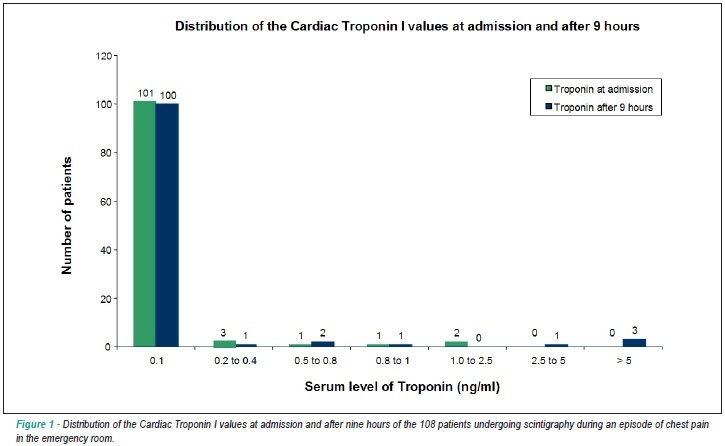
BACKGROUND: Images of myocardial perfusion taken during an episode of chest pain have been used for patients in the emergency department. OBJECTIVE: To evaluate the operating characteristics of 99mTc-Tetrofosmin scintigraphy during an episode of chest pain to exclude the diagnosis of acute myocardial infarction. METHODS: One hundred and eight patients admitted with chest pain, or up to four hours after the end of symptoms and nondiagnostic electrocardiogram, underwent resting scintigraphy and measurement of troponin I concentrations. Patients with a history of myocardial infarction (MI) were not excluded (24 patients). Troponin I concentrations were determined at admission and 6 hours later. Nuclear physicians performed a blind analysis of the images, and myocardial infarction was confirmed whenever troponin I level increase was three times that of the control. RESULTS: Resting perfusion image was abnormal in all 6 patients with MI. Only 1 patient had a normal image and increased troponin levels. Fifty-five patients had positive images without MI, and 46 patients had normal images and troponin levels. The prevalence of the disease was 6.5%. The sensitivity and specificity of the resting images during an episode of chest pain to diagnose MI was 85.7% and 45.5%, respectively. The negative predictive value was 97.7%. CONCLUSION: Patients undergoing chest pain protocol with SPECT showed an excellent negative predictive value to exclude diagnosis of myocardial infarction. These results suggest that resting perfusion image is an important tool at the chest pain unit.

  • Chest Pain
  • Coronary Disease
  • Radionuclide Imaging
  • Rest
Read Full Article
Creative Commons Attribution (CC BY) Creative Commons license
23/06/2009 DOI: 10.1590/S0066-782X2009000400004

How to cite this article

EndNote RIS

Electronic Document Format (Vancouver)

Silva CF, Burgos MS, Silva PT, Burgos LT, Welser L, Sehn AP, Horta JA, et al. Relationship between Cardiometabolic Parameters and Elevated Resting and Effort Heart Rate in Schoolchildren. Arquivos Brasileiros de Cardiologia 2017;109(3):191-8.

Electronic Document Format (ABNT)

Silva, Cristiane Fernanda da; Burgos, Miria Suzana; Silva, Priscila Tatiana da; Burgos, Leandro Tibiriçá; Welser, Letícia; Sehn, Ana Paula; Horta, Jorge André; Mello, Elza Daniel de; Reuter, Cézane Priscila. Relationship between Cardiometabolic Parameters and Elevated Resting and Effort Heart Rate in Schoolchildren. Arquivos Brasileiros de Cardiologia, v. 109, n. 3, p. 191-198, Jul. 2017.

Electronic Document Format (APA)

Silva, C. F. , Burgos, M. S., Silva, P. T. , Burgos, L. T., Welser, L., Sehn, A. P., Horta, J. A., Mello, E. D. , & Reuter, C. P. (2017). Relationship between Cardiometabolic Parameters and Elevated Resting and Effort Heart Rate in Schoolchildren. Arquivos Brasileiros de Cardiologia, 109(3), 191-198.

Electronic Document Format (ISO)

Silva, Cristiane Fernanda da and Burgos, Miria Suzana and Silva, Priscila Tatiana da and Burgos, Leandro Tibiriçá and Welser, Letícia and Sehn, Ana Paula and Horta, Jorge André and Mello, Elza Daniel de and Reuter, Cézane Priscila. Relationship between Cardiometabolic Parameters and Elevated Resting and Effort Heart Rate in Schoolchildren. Arquivos Brasileiros de Cardiologia [online]. 2017, vol. 109, n. 3, [cited 2026-10-14], pp. 191-198. Available from: <https://journals.cardiol.br/en/article/relationship-between-cardiometabolic-parameters-and-elevated-resting-and-effort-heart-rate-in-schoolchildren/>. ISSN 0066-782X

EndNote RIS

Electronic Document Format (Vancouver)

Christofaro DGD, Casonatto J, Vanderlei LCM, Cucato GG, Dias RMR. Relationship between Resting Heart Rate, Blood Pressure and Pulse Pressure in Adolescents. Arquivos Brasileiros de Cardiologia 2017;108(5):405-10.

Electronic Document Format (ABNT)

Christofaro, Diego Giulliano Destro; Casonatto, Juliano; Vanderlei, Luiz Carlos Marques; Cucato, Gabriel Grizzo; Dias, Raphael Mendes Ritti. Relationship between Resting Heart Rate, Blood Pressure and Pulse Pressure in Adolescents. Arquivos Brasileiros de Cardiologia, v. 108, n. 5, p. 405-410, May. 2017.

Electronic Document Format (APA)

Christofaro, D. G. D., Casonatto, J., Vanderlei, L. C. M., Cucato, G. G., & Dias, R. M. R. (2017). Relationship between Resting Heart Rate, Blood Pressure and Pulse Pressure in Adolescents. Arquivos Brasileiros de Cardiologia, 108(5), 405-410.

Electronic Document Format (ISO)

Christofaro, Diego Giulliano Destro and Casonatto, Juliano and Vanderlei, Luiz Carlos Marques and Cucato, Gabriel Grizzo and Dias, Raphael Mendes Ritti. Relationship between Resting Heart Rate, Blood Pressure and Pulse Pressure in Adolescents. Arquivos Brasileiros de Cardiologia [online]. 2017, vol. 108, n. 5, [cited 2026-10-14], pp. 405-410. Available from: <https://journals.cardiol.br/en/article/relationship-between-resting-heart-rate-blood-pressure-and-pulse-pressure-in-adolescents/>. ISSN 0066-782X

EndNote RIS

Electronic Document Format (Vancouver)

Mattioli GM, Araújo CGS. Association between initial and final transient heart rate responses in exercise testing. Arquivos Brasileiros de Cardiologia 2009;93(2):141-6.

Electronic Document Format (ABNT)

Mattioli, Gisele Messias; Araújo, Claudio Gil Soares de. Association between initial and final transient heart rate responses in exercise testing. Arquivos Brasileiros de Cardiologia, v. 93, n. 2, p. 141-146, Oct. 2009.

Electronic Document Format (APA)

Mattioli, G. M., & Araújo, C. G. S. (2009). Association between initial and final transient heart rate responses in exercise testing. Arquivos Brasileiros de Cardiologia, 93(2), 141-146.

Electronic Document Format (ISO)

Mattioli, Gisele Messias and Araújo, Claudio Gil Soares de. Association between initial and final transient heart rate responses in exercise testing. Arquivos Brasileiros de Cardiologia [online]. 2009, vol. 93, n. 2, [cited 2026-10-14], pp. 141-146. Available from: <https://journals.cardiol.br/en/article/association-between-initial-and-final-transient-heart-rate-responses-in-exercise-testing/>. ISSN 0066-782X

EndNote RIS

Electronic Document Format (Vancouver)

Barbirato GB, Azevedo JC, Felix RCM, Correa PL, Volschan A, Viegas M, Pimenta L, et al. Use of resting myocardial scintigraphy during chest pain to exclude diagnosis of acute myocardial infarction. Arquivos Brasileiros de Cardiologia 2009;92(4):269-74.

Electronic Document Format (ABNT)

Barbirato, Gustavo Borges; Azevedo, Jader Cunha de; Felix, Renata Christian Martins; Correa, Patricia Lavatori; Volschan, André; Viegas, Monica; Pimenta, Lucia; Dohmann, Hans Fernando Rocha; Mesquita, Evandro Tinoco; Mesquita, Claudio Tinoco. Use of resting myocardial scintigraphy during chest pain to exclude diagnosis of acute myocardial infarction. Arquivos Brasileiros de Cardiologia, v. 92, n. 4, p. 269-274, Jun. 2009.

Electronic Document Format (APA)

Barbirato, G. B., Azevedo, J. C. , Felix, R. C. M., Correa, P. L., Volschan, A., Viegas, M., Pimenta, L., Dohmann, H. F. R., Mesquita, E. T., & Mesquita, C. T. (2009). Use of resting myocardial scintigraphy during chest pain to exclude diagnosis of acute myocardial infarction. Arquivos Brasileiros de Cardiologia, 92(4), 269-274.

Electronic Document Format (ISO)

Barbirato, Gustavo Borges and Azevedo, Jader Cunha de and Felix, Renata Christian Martins and Correa, Patricia Lavatori and Volschan, André and Viegas, Monica and Pimenta, Lucia and Dohmann, Hans Fernando Rocha and Mesquita, Evandro Tinoco and Mesquita, Claudio Tinoco. Use of resting myocardial scintigraphy during chest pain to exclude diagnosis of acute myocardial infarction. Arquivos Brasileiros de Cardiologia [online]. 2009, vol. 92, n. 4, [cited 2026-10-14], pp. 269-274. Available from: <https://journals.cardiol.br/en/article/use-of-resting-myocardial-scintigraphy-during-chest-pain-to-exclude-diagnosis-of-acute-myocardial-infarction/>. ISSN 0066-782X

  • About ABC Family
  • Internal Regulation
  • Editorial Board
  • Brazilian Society of Cardiology (SBC)

Issues

SBC Guidelines

  • Videos
  • Podcasts
  • News