ABC Family Arquivos Brasileiros de Cardiologia International Journal of Cardiovascular Sciences ABC Heart Failure & Cardiomyopathy ABC Imagem Cardiovascular
Português English
ABC Family
Português English
  • About
    • About ABC Family
    • Internal Regulation
    • Editorial Board
    • Brazilian Society of Cardiology (SBC)
  • Issues
  • SBC Guidelines
  • Content
    • Videos
    • Podcasts
    • News
  • About
    • About ABC Family
    • Internal Regulation
    • Editorial Board
    • Brazilian Society of Cardiology (SBC)
  • Issues
  • SBC Guidelines
  • Content
    • Videos
    • Podcasts
    • News

ABC Family

  • ABC Family
  • Arquivos Brasileiros de Cardiologia
  • International Journal of Cardiovascular Sciences
  • ABC Heart Failure & Cardiomyopathy
  • ABC Imagem Cardiovascular
Search in

No content found.

Journals
Ordering
Article types
Others

  1. Home
  2. Keyword: prediction
Prediction of metabolic syndrome in children through anthropometric indicators
ABC
Artigo Original

Prediction of metabolic syndrome in children through anthropometric indicators

Aparecido Pimentel Ferreira et al. Cristiane Batisti Ferreira Ciro José Brito Francisco José Gondim Pitanga … Clayton Franco Moraes Luciana Ansaneli Naves Otávio de Toledo Nóbrega Nancí Maria de França

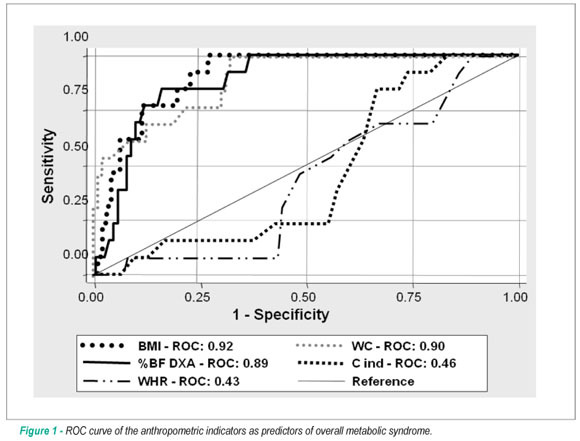
BACKGROUND: Because of the need to measure anthropometric, biochemical and hemodynamic variables for the diagnosis of metabolic syndrome, we realize how difficult it is to analyze large populations, especially children, due to the poor accessibility and the invasive character. There is an urgent need to develop easy-to-use, accurate and low-cost diagnostic tools in order to predict metabolic syndrome at early ages. OBJECTIVE: To verify the prevalence of metabolic syndrome in children and to test predictive anthropometric indicators. METHODS: Cross-sectional study conducted among 109 children aged 7 to 11 years. The age-adjusted National Cholesterol Education Program definition was used for the diagnosis of metabolic syndrome. The following parameters were tested as possible predictors: body mass index (BMI), waist circumference (WC), waist-to-hip ratio (WHR), conicity index (C index), and body fat percentage. RESULTS: The prevalence of metabolic syndrome was 13.3% and 36% for boys and girls, respectively. The main anthropometric indicators were: BMI = 0.81 (0.69 – 0.94), WC = 0.79 (0.64 – 0.94), body fat = 0.79 (0.66 – 0.92) and WHR = 0.37 (0.21 – 0.54). CONCLUSION: WC higher than 78 cm, body fat higher than 41%, and BMI higher than 24.5 kg/m² were considered predictors of metabolic syndrome. The C index and WHR were not considered predictors.
  • Child
  • Metabolic Syndrome
  • Obesity
  • Overweight
  • prediction
Read Full Article
Creative Commons Attribution (CC BY) Creative Commons license
14/01/2011 DOI: 10.1590/S0066-782X2011005000005 Views 1
Anthropometric indicators as predictors of high blood pressure in adolescents
ABC
Artigo Original

Anthropometric indicators as predictors of high blood pressure in adolescents

Carmem Cristina Beck et al. Adair da Silva Lopes Francisco José Gondim Pitanga

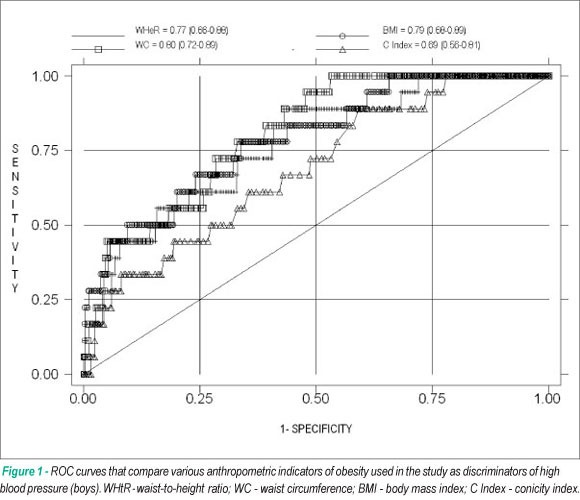
BACKGROUND: Hypertension is related to increased body fat, which can be evaluated by anthropometric indicators. OBJECTIVE: To determine the predictive power of anthropometric indicators and establish their cutoff points as discriminators of high blood pressure. METHODS: Cross-sectional study with a sample of 660 adolescents aged 14 to 19 including 51.9% girls. We considered the following anthropometric indicators: body mass index (BMI), waist circumference, waist-to-height ratio and conicity index. High blood pressure was characterized by values above the 90th percentile for systolic and/or diastolic blood pressure. To identify predictors of high blood pressure, we adopted the analysis of receiver operating characteristic curves (ROC) with a confidence interval of 95%. Subsequently, we identified the cutoff points with their relevant sensitivities and specificities. RESULTS: The areas under the ROC curves with confidence intervals were: boys – waist circumference = 0.80 (0.72 to 0.89); BMI = 0.79 (0.68 to 0.89), waist-to-height ratio = 0.77 (0.66 to 0.88); conicity index = 0.69 (0.56 to 0.81) and for girls – waist circumference = 0.96 (0.92 to 1.00); BMI 0.95 (0.87 to 1.00), waist-to-height ratio = 0.93 (0.85 to 1.00); conicity index = 0.74 (0.50 to 0.98). The different cutoff points of anthropometric indicators with better predictive power and their relevant sensitivities and specificities were identified. CONCLUSION: Although the waist-to-height ratio and BMI have shown good areas under the ROC curve, we suggest the use of waist circumference to predict high blood pressure.

  • Adolescent
  • Anthropometry
  • Hypertension
  • Obesity
  • prediction
Read Full Article
Creative Commons Attribution (CC BY) Creative Commons license
19/11/2010 DOI: 10.1590/S0066-782X2010005000153
Waist circumference and body mass index as predictors of hypertension
ABC
Artigo Original

Waist circumference and body mass index as predictors of hypertension

Maria do Rosário Gondim Peixoto et al. Maria Helena D'Aquino Benício Maria do Rosário Dias de Oliveira Latorre Paulo César Brandão Veiga Jardim

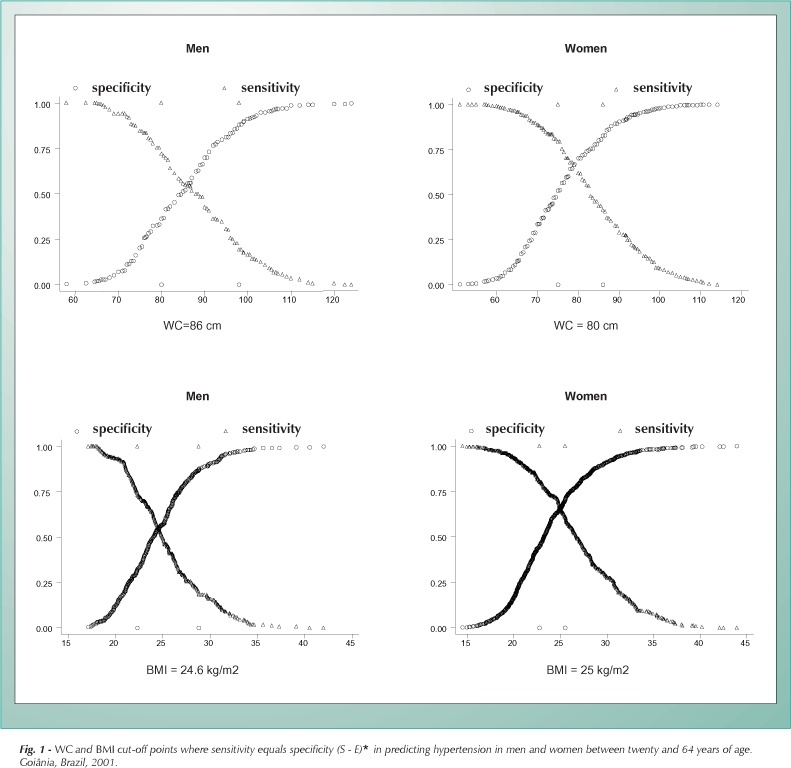
OBJECTIVE: To evaluate the association between anthropometric indexes – body mass index (BMI) and waist circumference (WC) – and hypertension, and to evaluate the predictive value of these indexes in detecting hypertension. METHODS: Cross-sectional population study conducted in the city of Goiânia (GO) with a sample of 1,238 adults aged twenty to 64 years, in 2001. Total obesity was defined as BMI > 30 kg/m²; abdominal obesity was defined as level 2 WC > 88 cm for women and > 102 cm for men, and hypertension was defined as systolic pressure > 140 mmHg, or diastolic pressure > 90 mmHg, or utilization of hypotensive drugs). Multiple logistic regression analysis was used to evaluate the associations between anthropometric indexes and hypertension. The Receiver Operating Characteristic (ROC) curve analysis was used to evaluate sensitivity and specificity of BMI (> 30) and level 2 WC as predictive factors of hypertension, and to determine the best predictive cut-off points for hypertension. RESULTS: WC was associated with hypertension in both genders. Level 2 WC and BMI >30 kg/m² showed a low sensitivity in identifying hypertension. The best predictive cut-off points for hypertension coincided with level 1 WC (> 80 cm) and with BMI >25 kg/m² (overweight) for women, and were lower than the values of level 1 WC and of overweight for men. CONCLUSION: Level 2 WC and BMI > 30 kg/m² are not adequate to identify the groups at the highest risk of hypertension, since this risk rises with small increases in adiposity.

  • body mass index
  • Hypertension
  • prediction
  • Waist Circumference
Read Full Article
Creative Commons Attribution (CC BY) Creative Commons license
21/11/2006 DOI: 10.1590/S0066-782X2006001700011

How to cite this article

EndNote RIS

Electronic Document Format (Vancouver)

Ferreira AP, Ferreira CB, Brito CJ, Pitanga FJG, Moraes CF, Naves LA, Nóbrega OT, et al. Prediction of metabolic syndrome in children through anthropometric indicators. Arquivos Brasileiros de Cardiologia 2011;96(2):121-5.

Electronic Document Format (ABNT)

Ferreira, Aparecido Pimentel; Ferreira, Cristiane Batisti; Brito, Ciro José; Pitanga, Francisco José Gondim; Moraes, Clayton Franco; Naves, Luciana Ansaneli; Nóbrega, Otávio de Toledo; França, Nancí Maria de. Prediction of metabolic syndrome in children through anthropometric indicators. Arquivos Brasileiros de Cardiologia, v. 96, n. 2, p. 121-125, Jan. 2011.

Electronic Document Format (APA)

Ferreira, A. P., Ferreira, C. B., Brito, C. J., Pitanga, F. J. G., Moraes, C. F., Naves, L. A., Nóbrega, O. T., & França, N. M. (2011). Prediction of metabolic syndrome in children through anthropometric indicators. Arquivos Brasileiros de Cardiologia, 96(2), 121-125.

Electronic Document Format (ISO)

Ferreira, Aparecido Pimentel and Ferreira, Cristiane Batisti and Brito, Ciro José and Pitanga, Francisco José Gondim and Moraes, Clayton Franco and Naves, Luciana Ansaneli and Nóbrega, Otávio de Toledo and França, Nancí Maria de. Prediction of metabolic syndrome in children through anthropometric indicators. Arquivos Brasileiros de Cardiologia [online]. 2011, vol. 96, n. 2, [cited 2026-10-14], pp. 121-125. Available from: <https://journals.cardiol.br/en/article/prediction-of-metabolic-syndrome-in-children-through-anthropometric-indicators/>. ISSN 0066-782X

EndNote RIS

Electronic Document Format (Vancouver)

Beck CC, Lopes AS, Pitanga FJG. Anthropometric indicators as predictors of high blood pressure in adolescents. Arquivos Brasileiros de Cardiologia 2010;96(2):126-33.

Electronic Document Format (ABNT)

Beck, Carmem Cristina; Lopes, Adair da Silva; Pitanga, Francisco José Gondim. Anthropometric indicators as predictors of high blood pressure in adolescents. Arquivos Brasileiros de Cardiologia, v. 96, n. 2, p. 126-133, Nov. 2010.

Electronic Document Format (APA)

Beck, C. C., Lopes, A. S., & Pitanga, F. J. G. (2010). Anthropometric indicators as predictors of high blood pressure in adolescents. Arquivos Brasileiros de Cardiologia, 96(2), 126-133.

Electronic Document Format (ISO)

Beck, Carmem Cristina and Lopes, Adair da Silva and Pitanga, Francisco José Gondim. Anthropometric indicators as predictors of high blood pressure in adolescents. Arquivos Brasileiros de Cardiologia [online]. 2010, vol. 96, n. 2, [cited 2026-10-14], pp. 126-133. Available from: <https://journals.cardiol.br/en/article/anthropometric-indicators-as-predictors-of-high-blood-pressure-in-adolescents/>. ISSN 0066-782X

EndNote RIS

Electronic Document Format (Vancouver)

Peixoto MRG, Benício MHD, Latorre MRDO, Jardim PCBV. Waist circumference and body mass index as predictors of hypertension. Arquivos Brasileiros de Cardiologia 2006;87(4):462-70.

Electronic Document Format (ABNT)

Peixoto, Maria do Rosário Gondim; Benício, Maria Helena D’Aquino; Latorre, Maria do Rosário Dias de Oliveira; Jardim, Paulo César Brandão Veiga. Waist circumference and body mass index as predictors of hypertension. Arquivos Brasileiros de Cardiologia, v. 87, n. 4, p. 462-470, Nov. 2006.

Electronic Document Format (APA)

Peixoto, M. R. G., Benício, M. H. D., Latorre, M. R. D. O., & Jardim, P. C. B. V. (2006). Waist circumference and body mass index as predictors of hypertension. Arquivos Brasileiros de Cardiologia, 87(4), 462-470.

Electronic Document Format (ISO)

Peixoto, Maria do Rosário Gondim and Benício, Maria Helena D’Aquino and Latorre, Maria do Rosário Dias de Oliveira and Jardim, Paulo César Brandão Veiga. Waist circumference and body mass index as predictors of hypertension. Arquivos Brasileiros de Cardiologia [online]. 2006, vol. 87, n. 4, [cited 2026-10-14], pp. 462-470. Available from: <https://journals.cardiol.br/en/article/waist-circumference-and-body-mass-index-as-predictors-of-hypertension/>. ISSN 0066-782X

  • About ABC Family
  • Internal Regulation
  • Editorial Board
  • Brazilian Society of Cardiology (SBC)

Issues

SBC Guidelines

  • Videos
  • Podcasts
  • News