ABC Family Arquivos Brasileiros de Cardiologia International Journal of Cardiovascular Sciences ABC Heart Failure & Cardiomyopathy ABC Imagem Cardiovascular
Português English
ABC Family
Português English
  • About
    • About ABC Family
    • Internal Regulation
    • Editorial Board
    • Brazilian Society of Cardiology (SBC)
  • Issues
  • SBC Guidelines
  • Content
    • Videos
    • Podcasts
    • News
  • About
    • About ABC Family
    • Internal Regulation
    • Editorial Board
    • Brazilian Society of Cardiology (SBC)
  • Issues
  • SBC Guidelines
  • Content
    • Videos
    • Podcasts
    • News

ABC Family

  • ABC Family
  • Arquivos Brasileiros de Cardiologia
  • International Journal of Cardiovascular Sciences
  • ABC Heart Failure & Cardiomyopathy
  • ABC Imagem Cardiovascular
Search in

No content found.

Journals
Ordering
Article types
Others

  1. Home
  2. Keyword: phytotherapy
ABC
Editorial

A New Therapeutic Alternative for the Treatment of Pulmonary Hypertension?

Ricardo J Gelpi

In this issue of the journal Arquivos Brasileiros de Cardiologia, important and original research work on rats is published. The work is important because pulmonary hypertension represents a serious pathology that is very difficult to treat. The only way to relieve patients is lung transplantation, but are very well known the difficulties and limitations of this treatment. The work is also original because a lot has been published about the beneficial effects of copaiba oil, such as its anti-inflammatory action, analgesic effect, and ability to prevent infections and improve the healing process. However, the beneficial effect of copaiba oil on pulmonary hypertension had not been described. In this sense, the group led by Adriane Belló Klein has been working for several years on this important issue of pulmonary hypertension in general,– and the effects of copaiba oil on this particular pathology,, which has made this research group an international benchmark on this theme.

It is important to mention that pulmonary hypertension induced in rats by monocrotaline produces vascular lesions very similar to those found in patients with this pathology., In essence, what the work published in this issue of the journal Arquivos Brasileiros de Cardiologia shows is that the administration of copaiba oil to a group of rats with pulmonary hypertension induced by monocrotaline produces a clear beneficial effect, through the decrease in peripheral blood indicators of oxidative stress, a reduction in pulmonary vascular resistance, and a favorable remodeling of the right ventricle, with a reduction in hypertrophy, which translates into a better systolic function of that ventricle. This finding is very important because it is well known that myocardial hypertrophy is one of the most important causes of heart failure and sudden death. The positive relationship between the degree of hypertrophy and the decrease in oxidative stress shown by the authors is clearly proven in this work by the high r-value obtained when these two variables were correlated. However, and beyond this important correlation, future studies should determine if the beneficial effect on the right ventricle is due to the reduction of oxidative stress or if there is also a direct effect of copaiba oil on myocardial fibers. Perhaps experiments that could be carried out on isolated hearts would make it possible to detect or not a direct impact of this natural agent. In this sense, it is important to mention that the authors of this study also published an interesting work previously where they showed that the administration of copaiba oil decreased apoptosis signals in the hypertrophic right ventricle and attributed the better remodeling to a possible decrease in the apoptosis mentioned above; obviously this same mechanism could be acting in the work that we are commenting now. Nevertheless, here it is important to make some clarifications that may allow a better understanding of what is happening in these hearts with hypertrophy secondary to pulmonary hypertension.

[…]
  • Cardiomegaly
  • Copaiba Oil
  • Cor Pulmonale
  • Fabaceae
  • Heart Failure
  • Hypertension,Pulmonary
  • Lung Transplantation
  • Monocrotaline
  • Oxidative Stress
  • phytotherapy
  • Rats
Read Full Article
Creative Commons Attribution (CC BY) Creative Commons license
03/12/2021 DOI: 10.36660/abc.20210935
Figure 1
ABC
Original Article

Effects of Copaiba Oil in Peripheral Markers of Oxidative Stress in a Model of Cor Pulmonale in Rats

Cristina Campos et al. Patrick Turck Angela Maria Vicente Tavares Giana Corssac … Denise Lacerda Alex Araujo Susana Llesuy Adriane Bello Klein

Abstract

Background

To date, copaiba oil’s systemic effects have never documented in Cor pulmonale induced by monocrotaline.

Objectives

To investigate copaiba oil’s effects in peripheral markers of oxidative stress in rats with Cor pulmonale.

Methods

Male Wistar rats (170±20g, n=7/group) were divided into four groups: control (CO), monocrotaline (MCT), copaiba oil (O), and monocrotaline+copaiba oil (MCT-O). MCT (60 mg/kg i.p.) was administered, and after one week, treatment with copaiba oil (400 mg/kg/day-gavage-14 days) was begun. Echocardiography was performed and, later, trunk blood collection was performed for oxidative stress evaluations. Statistical analysis: two-way ANOVA with Student-Newman-Keuls post-hoc test. P values<0.05 were considered significant.

Results

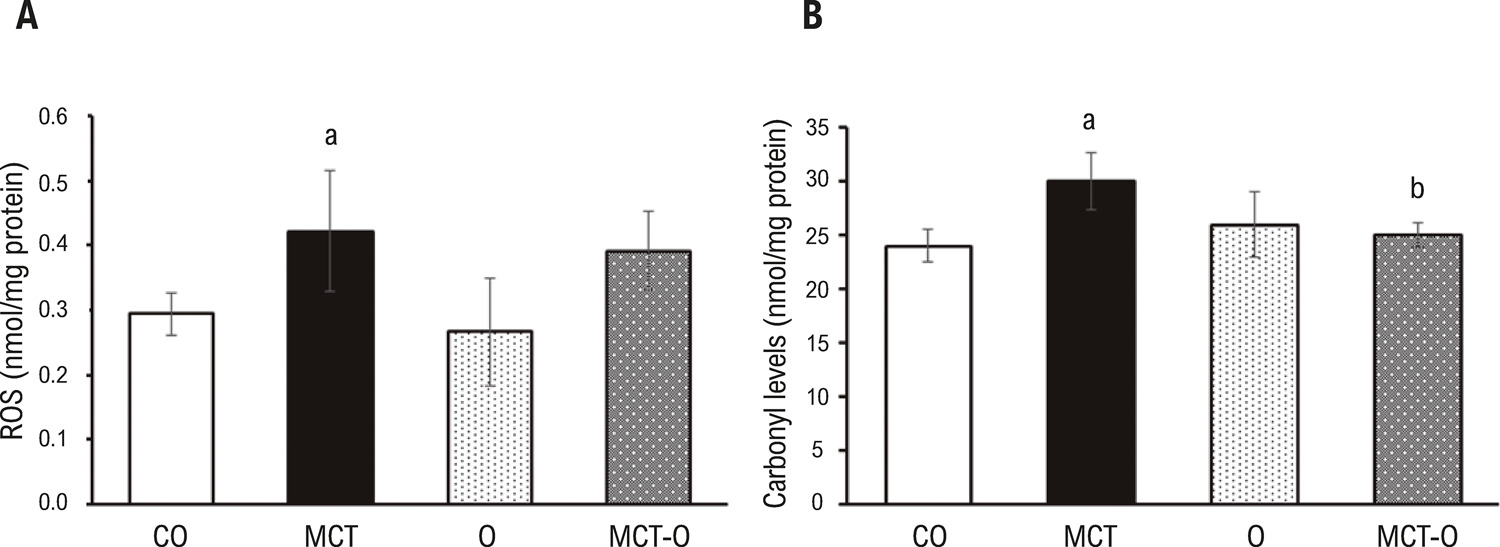
Copaiba oil reduced pulmonary vascular resistance and right ventricle (RV) hypertrophy (Fulton index (mg/mg): MCT-O=0.39±0.03; MCT=0.49±0.01), and improved RV systolic function (RV shortening fraction, %) in the MCT-O group (17.8±8.2) as compared to the MCT group (9.4±3.1; p<0.05). Moreover, in the MCT-O group, reactive oxygen species and carbonyl levels were reduced, and antioxidant parameters were increased in the peripheral blood (p<0.05). Conclusions: Our results suggest that copaiba oil has an interesting systemic antioxidant effect, which is reflected in the improvements in function and RV morphometry in this Cor pulmonale model. Cor pulmonale attenuation promoted by copaiba oil coincided with a reduction in systemic oxidative stress.

  • Copaiba Oil
  • Cor Pulmonale
  • Fabaceae
  • Hypertrophy, Right Ventricular
  • Monocrotaline,Rats
  • Oxidative Stress
  • phytotherapy
Read Full Article
Creative Commons Attribution (CC BY) Creative Commons license
08/10/2021 DOI: 10.36660/abc.20200929 Views 2
ABC
Artigo Original

Prospective double-blind crossover study of Camellia sinensis (green tea) in dyslipidemias

Gesiani de Almeida Pierin Batista et al. Cláudio L. Pereira da Cunha Mariléia Scartezini Raul von der Heyde … Murílo G Bitencourt Sandra Fabrício de Melo

BACKGROUND: Epidemiological studies have established an association between dyslipidemias and atherosclerosis. Nutritional therapy is a key point in the prevention strategy for individuals who present with risk factors for atherosclerotic disease. OBJECTIVES: To investigate the effects of green tea (Camellia sinensis) in patients with dyslipidemias. METHODS: The study included 33 patients aged between 21 and 71 years who had a low-fat diet (25-35% of total calories and 200 mg of cholesterol per day). They were randomized for two sequential treatments: 250-mg capsules of green tea dry extract or placebo for a total period of 16 weeks; each patient received green tea (Camellia sinensis) for eight weeks and placebo for another eight weeks. RESULTS: Baseline lipid values (mg/dL) were: HDL-cholesterol 60.7 ± 7.3; total cholesterol 255 ± 30.9; LDL-cholesterol 158.8 ± 29.0; triglycerides 169.0 ± 61.3 and Apo-B 120.2 ± 18.9. Mean lipid variations induced by the use of green tea (Camellia sinensis) showed a 3.9% reduction (p = 0.006) in total cholesterol concentrations and a 4.5% reduction (p = 0.026) in LDL-cholesterol. The intake of green tea did not significantly influence HDL-cholesterol, triglyceride, and Apo-B levels. Non-significant results were found in the assessment of blood lipids (total cholesterol and LDL-cholesterol) with the use of placebo. CONCLUSION: A beneficial effect of green tea (Camellia sinensis) was demonstrated, with a significant reduction of total cholesterol and LDL-cholesterol levels in eight weeks, in the patients studied.

  • Camellia sinensis
  • Case-Control Studies
  • Dyslipidemias
  • epidemiologic studies
  • phytotherapy
  • thea sinensis
Read Full Article
Creative Commons Attribution (CC BY) Creative Commons license
13/10/2009 DOI: 10.1590/S0066-782X2009000800010 Views 1

How to cite this article

EndNote RIS

Electronic Document Format (Vancouver)

Gelpi RJ. A New Therapeutic Alternative for the Treatment of Pulmonary Hypertension?. Arquivos Brasileiros de Cardiologia 2021;117(6):1113-4.

Electronic Document Format (ABNT)

Gelpi, Ricardo J. A New Therapeutic Alternative for the Treatment of Pulmonary Hypertension?. Arquivos Brasileiros de Cardiologia, v. 117, n. 6, p. 1113-1114, Dec. 2021.

Electronic Document Format (APA)

Gelpi, R. J. (2021). A New Therapeutic Alternative for the Treatment of Pulmonary Hypertension?. Arquivos Brasileiros de Cardiologia, 117(6), 1113-1114.

Electronic Document Format (ISO)

Gelpi, Ricardo J. A New Therapeutic Alternative for the Treatment of Pulmonary Hypertension?. Arquivos Brasileiros de Cardiologia [online]. 2021, vol. 117, n. 6, [cited 2026-10-14], pp. 1113-1114. Available from: <https://journals.cardiol.br/en/article/a-new-therapeutic-alternative-for-the-treatment-of-pulmonary-hypertension/>. ISSN 0066-782X

EndNote RIS

Electronic Document Format (Vancouver)

Campos C, Turck P, Tavares AMV, Corssac G, Lacerda D, Araujo A, Llesuy S, et al. Effects of Copaiba Oil in Peripheral Markers of Oxidative Stress in a Model of Cor Pulmonale in Rats. Arquivos Brasileiros de Cardiologia 2021;117(6):1106-12.

Electronic Document Format (ABNT)

Campos, Cristina; Turck, Patrick; Tavares, Angela Maria Vicente; Corssac, Giana; Lacerda, Denise; Araujo, Alex; Llesuy, Susana; Klein, Adriane Bello. Effects of Copaiba Oil in Peripheral Markers of Oxidative Stress in a Model of Cor Pulmonale in Rats. Arquivos Brasileiros de Cardiologia, v. 117, n. 6, p. 1106-1112, Oct. 2021.

Electronic Document Format (APA)

Campos, C., Turck, P., Tavares, A. M. V., Corssac, G., Lacerda, D., Araujo, A., Llesuy, S., & Klein, A. B. (2021). Effects of Copaiba Oil in Peripheral Markers of Oxidative Stress in a Model of Cor Pulmonale in Rats. Arquivos Brasileiros de Cardiologia, 117(6), 1106-1112.

Electronic Document Format (ISO)

Campos, Cristina and Turck, Patrick and Tavares, Angela Maria Vicente and Corssac, Giana and Lacerda, Denise and Araujo, Alex and Llesuy, Susana and Klein, Adriane Bello. Effects of Copaiba Oil in Peripheral Markers of Oxidative Stress in a Model of Cor Pulmonale in Rats. Arquivos Brasileiros de Cardiologia [online]. 2021, vol. 117, n. 6, [cited 2026-10-14], pp. 1106-1112. Available from: <https://journals.cardiol.br/en/article/effects-of-copaiba-oil-in-peripheral-markers-of-oxidative-stress-in-a-model-of-cor-pulmonale-in-rats/>. ISSN 0066-782X

EndNote RIS

Electronic Document Format (Vancouver)

Batista GAP, Cunha CLP, Scartezini M, Heyde R, Bitencourt MG, Melo SF. Prospective double-blind crossover study of Camellia sinensis (green tea) in dyslipidemias. Arquivos Brasileiros de Cardiologia 2009;93(2):128-34.

Electronic Document Format (ABNT)

Batista, Gesiani de Almeida Pierin; Cunha, Cláudio L. Pereira da; Scartezini, Mariléia; Heyde, Raul von der; Bitencourt, Murílo G; Melo, Sandra Fabrício de. Prospective double-blind crossover study of Camellia sinensis (green tea) in dyslipidemias. Arquivos Brasileiros de Cardiologia, v. 93, n. 2, p. 128-134, Oct. 2009.

Electronic Document Format (APA)

Batista, G. A. P., Cunha, C. L. P. , Scartezini, M., Heyde, R. , Bitencourt, M. G., & Melo, S. F. (2009). Prospective double-blind crossover study of Camellia sinensis (green tea) in dyslipidemias. Arquivos Brasileiros de Cardiologia, 93(2), 128-134.

Electronic Document Format (ISO)

Batista, Gesiani de Almeida Pierin and Cunha, Cláudio L. Pereira da and Scartezini, Mariléia and Heyde, Raul von der and Bitencourt, Murílo G and Melo, Sandra Fabrício de. Prospective double-blind crossover study of Camellia sinensis (green tea) in dyslipidemias. Arquivos Brasileiros de Cardiologia [online]. 2009, vol. 93, n. 2, [cited 2026-10-14], pp. 128-134. Available from: <https://journals.cardiol.br/en/article/prospective-double-blind-crossover-study-of-camellia-sinensis-green-tea-in-dyslipidemias/>. ISSN 0066-782X

  • About ABC Family
  • Internal Regulation
  • Editorial Board
  • Brazilian Society of Cardiology (SBC)

Issues

SBC Guidelines

  • Videos
  • Podcasts
  • News