ABC Family Arquivos Brasileiros de Cardiologia International Journal of Cardiovascular Sciences ABC Heart Failure & Cardiomyopathy ABC Imagem Cardiovascular
Português English
ABC Family
Português English
  • About
    • About ABC Family
    • Internal Regulation
    • Editorial Board
    • Brazilian Society of Cardiology (SBC)
  • Issues
  • SBC Guidelines
  • Content
    • Videos
    • Podcasts
    • News
  • About
    • About ABC Family
    • Internal Regulation
    • Editorial Board
    • Brazilian Society of Cardiology (SBC)
  • Issues
  • SBC Guidelines
  • Content
    • Videos
    • Podcasts
    • News

ABC Family

  • ABC Family
  • Arquivos Brasileiros de Cardiologia
  • International Journal of Cardiovascular Sciences
  • ABC Heart Failure & Cardiomyopathy
  • ABC Imagem Cardiovascular
Search in

No content found.

Journals
Ordering
Article types
Others

  1. Home
  2. Keyword: Intervention Coronary Percutaneous
ABC
Editorial

Left Main Coronary Artery Percutaneous Intervention. Why are Real-World Data so Important?

Vinicius Daher Vaz

The estimated prevalence of left main artery disease found during diagnostic angiography is 6% in published series. The enthusiasm for a less invasive therapy than coronary artery bypass grafting (CABG) for patients with unprotected left main coronary artery (ULMCA) disease dates back to the 90s. Although the contribution of CABG in the survival of patients with ULMCA disease is undeniable, in the last few years, several authors have demonstrated the safety and efficacy of percutaneous coronary intervention (PCI).

Despite the controversies regarding the 5-year publication of the Evaluation of XIENCE versus Coronary Artery Bypass Surgery for Effectiveness of Left Main Revascularization (EXCEL) trial, when it comes to hard outcomes, as death and stroke, in the last years several randomized and non-randomized trials have demonstrated non-inferiority or even superiority of PCI against CABG. – Recently, these data were compiled in two meta-analysis where long term follow-up has shown no significant difference in mortality and stroke rate between PCI and CABG. , In addition, two of these randomized trials with extended long-term follow-up, up to 10 years, have demonstrated sustained good results after PCI, with death rates similar to CABG, respectively, 14.5% x 13.8% and 27% x 28%. ,

[…]

  • Angiography/diagnostic imaging
  • Coronary Artery Disease
  • Intervention Coronary Percutaneous
  • Mortality
  • Myocardial Revascularization
  • Precalenve
  • Stroke
Read Full Article
Creative Commons Attribution (CC BY) Creative Commons license
14/06/2021 DOI: 10.36660/abc.20210236 Views 2
Figure 1
ABC
Original Article

Patients' Preferences after Recurrent Coronary Narrowing: Discrete Choice Experiments

Carlos Alberto da Silva Magliano et al. Andrea Liborio Monteiro Amanda Rebeca de Oliveira Rebelo Giovanna Francisconi Santos … Claudia Cristina de Aguiar Pereira Nikolas Krucien Roberto Magalhães Saraiva

Abstract

Background:

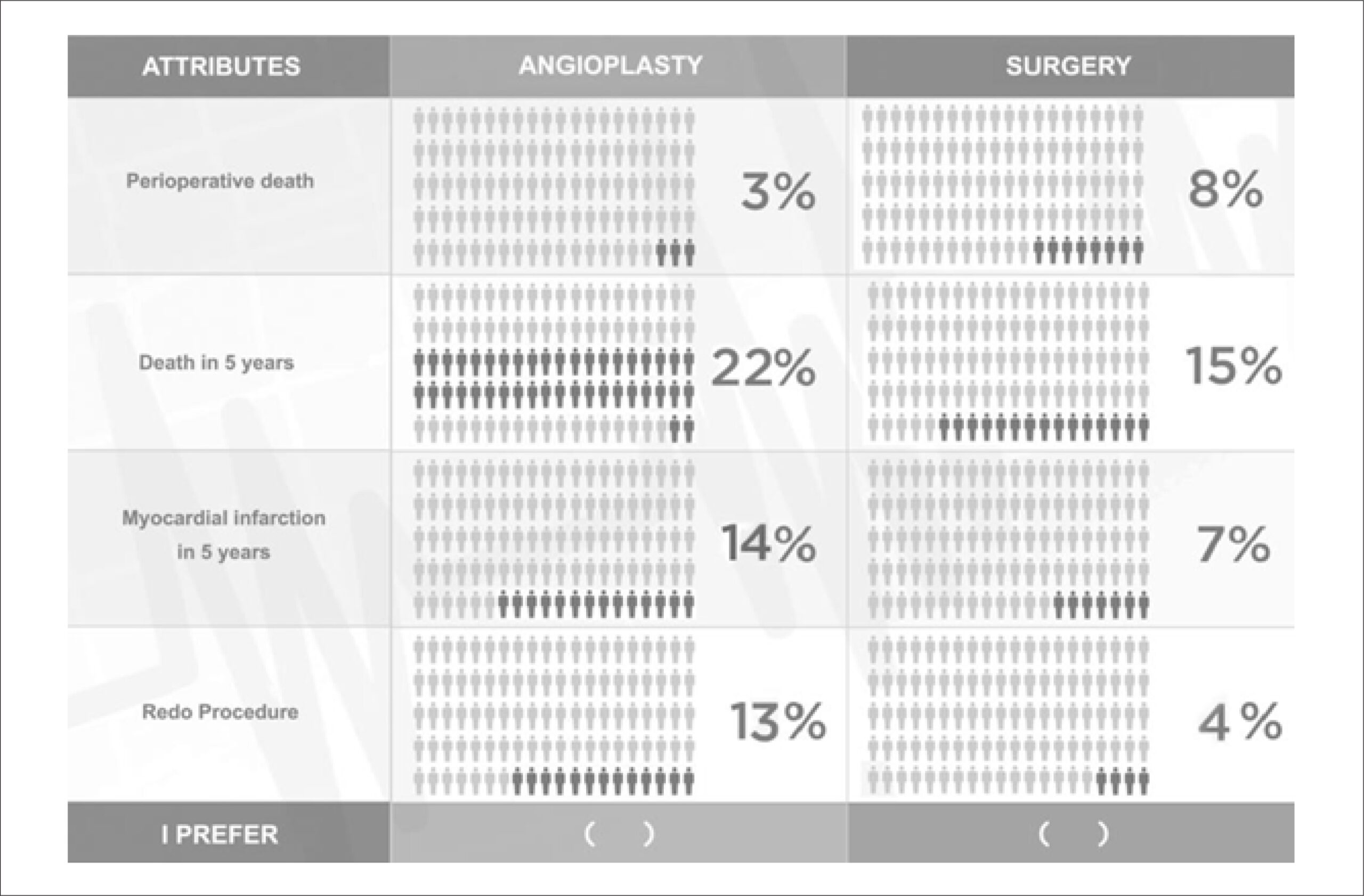
Selecting the optimal treatment strategy for coronary revascularization is challenging. A crucial endpoint to be considered when making this choice is the necessity to repeat revascularization since it is much more frequent after percutaneous coronary intervention (PCI) than after coronary artery bypass grafting (CABG).

Objective:

This study intends to provide insights on patients’ preferences for revascularization, strategies in the perspective of patients who had to repeat revascularization.

Methods:

We selected a sample of patients who had undergone PCI and were hospitalized to repeat coronary revascularization and elicited their preferences for a new PCI or CABG. Perioperative death, long-term death, myocardial infarction, and repeat revascularization were used to design scenarios describing hypothetical treatments that were labeled as PCI or CABG. PCI was always presented as the option with lower perioperative death risk and a higher necessity to repeat procedure. A conditional logit model was used to analyze patients’ choices using R software. A p value < 0.05 was considered statistically significant.

Results:

A total of 144 patients participated, most of them (73.7%) preferred CABG over PCI (p < 0.001). The regression coefficients were statistically significant for PCI label, PCI long-term death, CABG perioperative death, CABG long-term death and repeat CABG. The PCI label was the most important parameter (p < 0.05).

Conclusion:

Most patients who face the necessity to repeat coronary revascularization reject a new PCI, considering realistic levels of risks and benefits. Incorporating patients’ preferences into benefit-risk calculation and treatment recommendations could enhance patient-centered care.

  • Coronary Artery Disease/surgery
  • Coronary Restenosis
  • Intervention Coronary Percutaneous
  • Myocardial Revascularization
  • Patient Preference
  • Surveys and Questionnaires
Read Full Article
Creative Commons Attribution (CC BY) Creative Commons license
23/10/2020 DOI: 10.36660/abc.20190305

How to cite this article

EndNote RIS

Electronic Document Format (Vancouver)

Vaz VD. Left Main Coronary Artery Percutaneous Intervention. Why are Real-World Data so Important?. Arquivos Brasileiros de Cardiologia 2021;116(6):1109-10.

Electronic Document Format (ABNT)

Vaz, Vinicius Daher. Left Main Coronary Artery Percutaneous Intervention. Why are Real-World Data so Important?. Arquivos Brasileiros de Cardiologia, v. 116, n. 6, p. 1109-1110, Jun. 2021.

Electronic Document Format (APA)

Vaz, V. D. (2021). Left Main Coronary Artery Percutaneous Intervention. Why are Real-World Data so Important?. Arquivos Brasileiros de Cardiologia, 116(6), 1109-1110.

Electronic Document Format (ISO)

Vaz, Vinicius Daher. Left Main Coronary Artery Percutaneous Intervention. Why are Real-World Data so Important?. Arquivos Brasileiros de Cardiologia [online]. 2021, vol. 116, n. 6, [cited 2026-10-14], pp. 1109-1110. Available from: <https://journals.cardiol.br/en/article/left-main-coronary-artery-percutaneous-intervention-why-are-real-world-data-so-important/>. ISSN 0066-782X

EndNote RIS

Electronic Document Format (Vancouver)

Magliano CAS, Monteiro AL, Rebelo ARO, Santos GF, Pereira CCA, Krucien N, Saraiva RM, et al. Patients’ Preferences after Recurrent Coronary Narrowing: Discrete Choice Experiments. Arquivos Brasileiros de Cardiologia 2020;115(4):613-9.

Electronic Document Format (ABNT)

Magliano, Carlos Alberto da Silva; Monteiro, Andrea Liborio; Rebelo, Amanda Rebeca de Oliveira; Santos, Giovanna Francisconi; Pereira, Claudia Cristina de Aguiar; Krucien, Nikolas; Saraiva, Roberto Magalhães. Patients’ Preferences after Recurrent Coronary Narrowing: Discrete Choice Experiments. Arquivos Brasileiros de Cardiologia, v. 115, n. 4, p. 613-619, Oct. 2020.

Electronic Document Format (APA)

Magliano, C. A. S., Monteiro, A. L., Rebelo, A. R. O., Santos, G. F., Pereira, C. C. A., Krucien, N., & Saraiva, R. M. (2020). Patients’ Preferences after Recurrent Coronary Narrowing: Discrete Choice Experiments. Arquivos Brasileiros de Cardiologia, 115(4), 613-619.

Electronic Document Format (ISO)

Magliano, Carlos Alberto da Silva and Monteiro, Andrea Liborio and Rebelo, Amanda Rebeca de Oliveira and Santos, Giovanna Francisconi and Pereira, Claudia Cristina de Aguiar and Krucien, Nikolas and Saraiva, Roberto Magalhães. Patients’ Preferences after Recurrent Coronary Narrowing: Discrete Choice Experiments. Arquivos Brasileiros de Cardiologia [online]. 2020, vol. 115, n. 4, [cited 2026-10-14], pp. 613-619. Available from: <https://journals.cardiol.br/en/article/patients-preferences-after-recurrent-coronary-narrowing-discrete-choice-experiments/>. ISSN 0066-782X

  • About ABC Family
  • Internal Regulation
  • Editorial Board
  • Brazilian Society of Cardiology (SBC)

Issues

SBC Guidelines

  • Videos
  • Podcasts
  • News