ABC Family Arquivos Brasileiros de Cardiologia International Journal of Cardiovascular Sciences ABC Heart Failure & Cardiomyopathy ABC Imagem Cardiovascular
Português English
ABC Family
Português English
  • About
    • About ABC Family
    • Internal Regulation
    • Editorial Board
    • Brazilian Society of Cardiology (SBC)
  • Issues
  • SBC Guidelines
  • Content
    • Videos
    • Podcasts
    • News
  • About
    • About ABC Family
    • Internal Regulation
    • Editorial Board
    • Brazilian Society of Cardiology (SBC)
  • Issues
  • SBC Guidelines
  • Content
    • Videos
    • Podcasts
    • News

ABC Family

  • ABC Family
  • Arquivos Brasileiros de Cardiologia
  • International Journal of Cardiovascular Sciences
  • ABC Heart Failure & Cardiomyopathy
  • ABC Imagem Cardiovascular
Search in

No content found.

Journals
Ordering
Article types
Others

  1. Home
  2. Keyword: inflammation mediators
ABC
Editorial

A New Risk Predictor in Acute Myocardial Infarction. Is There Still Room for One More?

Dalton Bertolim Précoma

Cardiology is one of the specialties that traditionally uses scientific evidence in daily practice, both in risk stratification and diagnosis, therapy and prognosis. One of the most discussed topics is atherosclerosis and inflammation, arousing great interest in the continuous knowledge acquired over the last two centuries. Several authors stand out in this historical context, for example, Rudolf Virchow in the 19th century who described the association of atherosclerosis with inflammation; Marchand in 1904, who suggested the relationship between atherosclerosis and the process of clogging of the arteries and in 1908, Ignatowski who observed the relationship between dietary cholesterol and atherosclerosis. Over the last 100 years, many articles have elucidated the pathophysiological sequence that we know today. Understanding atherosclerotic plaque formation and evolution through complex molecular mechanisms and innate and adaptive immunity, which culminate in acute myocardial infarction (AMI), is well established.– In 1974, Friedman GD et al., described the role of leukocyte count in the prognosis of AMI, and subsequently, other studies highlighted the importance of these cells in the deterioration and recovery of infarcted myocardium.– In the same line of investigation, Coste MER et al. investigated cytokines in patients with ST-segment elevation myocardial infarction (STEMI) and the relationship with ventricular function. They observed a balance of pro-inflammatory and anti-inflammatory cytokines, except for IL-6, suggesting a residual inflammatory risk.

In addition to these aspects related to atherosclerotic plaque and inflammatory activity in AMI, another process related to these so-called immuno-inflammatory cells, such as platelets, leukocytes, neutrophils, and lymphocytes, initially gained prominence in the field of oncology when described as a reliable prognostic marker in the progression of various malignant tumors, by the so-called “systemic immuno-inflammation index” (IIIS). The systematic review and meta-analysis by Zhong et al. emphasize the importance of this index in predicting survival since high rates were associated with a worse prognosis in solid tumors. In addition to neoplasms, other factors alter IIIS, such as age, obesity, type 2 diabetes, emotional stress, exogenous steroids, endogenous sex hormones, hematological disorders, stroke, pulmonary embolism, and trauma.

[…]
  • Atherosclerosis
  • Cardiovascular Diseases
  • Cholesterol
  • inflammation mediators
  • Myocardial Infarction/complications
  • Plaque, Atherosclertic
  • Risk Factors
Read Full Article
Creative Commons Attribution (CC BY) Creative Commons license
11/07/2022 DOI: 10.36660/abc.20220367
IJCS
Review Article

Cardiovascular Complications of HIV

Hugo Ribeiro Zanetti et al. Leonardo Roever Alexandre Gonçalves Elmiro Santos Resende

Abstract

With the advent of the antiretroviral therapy (ART), people infected with HIV are experiencing a significant increase in life expectancy. However, as this population ages, the morbidity and mortality due to events not related to HIV infection and/or treatment become increasingly clear. Cardiovascular diseases are among the major causes of death, and, thus, understanding the factors that trigger this situation is necessary. This review article will assess how the intrinsic and extrinsic factors related to HIV, ART and the associated risk factors can aid the epidemiological transition of mortality in this population. Moreover, we will present the studies on the epidemiology and pathogenesis of each clinical condition related to HIV-infected individuals, in addition to introducing the major markers of cardiovascular disease in this population. Finally, we will point the main issues to be addressed by health professionals for an adequate prognosis.

  • Acquired Immunodeficiency Syndrome
  • Acute Retroviral Syndrome/therapy
  • Cardiovascular Diseases
  • HIV
  • inflammation mediators
Read Full Article
Creative Commons Attribution (CC BY) Creative Commons license
30/07/2018 DOI: 10.5935/2359-4802.20180049
Predictive value of myeloperoxidase to identify high risk patients admitted to the hospital with acute chest pain
ABC
Artigo Original

Predictive value of myeloperoxidase to identify high risk patients admitted to the hospital with acute chest pain

Roberto Esporcatte et al. Helena Cramer Veiga Rey Fernando Oswaldo Dias Rangel Ricardo Mourilhe Rocha … Hugo Tannus Furtado de Mendonça Filho Hans Fernando Rocha Dohmann Francisco Manes Albanesi Filho

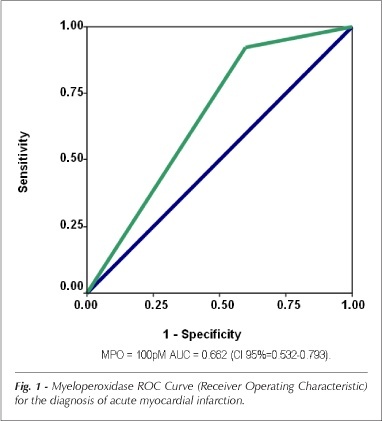
BACKGROUND: Myeloperoxidase (MPO) is a highly expressed enzyme due to leukocyte activation, with multiple atherogenic actions, including LDL cholesterol oxidation, and is related to the instability of atherosclerotic plaque. It is a predictor of adverse events in healthy individuals, patients with heart disease or those undergoing chest pain investigations. OBJECTIVE: To analyze the contribution of MPO to identify patients with acute chest pain, non-ST elevation ECG and at high risk for in-hospital adverse events. METHODS: Patients presenting acute chest pain and a non-ST elevation ECG, were admitted to the hospital and submitted to serum MPO level measurements and a structured examination protocol. RESULTS: From a cohort of 140 patients, 49 (35%) were diagnosed with acute coronary syndrome, of which 13 patients (9.3%) were diagnosed with non-ST elevation acute myocardial infarction (AMI) (troponin I >1.0 ng/mL). The best MPO cut-off point for AMI was identified as >100 pM using the ROC curve (AUC=0.662; CI 95%=0.532-0.793) revealing elevated sensitivity (92.3%) and negative predictive value (98.1%), however with low specificity (40.2%). In the multivariate analysis, MPO proved to be the only independent variable to diagnose AMI in evolution, with an odds ratio of 8.04 (p=0.048). CONCLUSION: In patients with acute chest pain and no ST elevation, high MPO levels upon admission to the hospital are an important tool to predict in-hospital adverse events, with an odds ratio of eight for the diagnosis of AMI.

  • Chest Pain
  • Coronary Disease
  • inflammation mediators
  • Peroxidases
Read Full Article
Creative Commons Attribution (CC BY) Creative Commons license
18/04/2008 DOI: 10.1590/S0066-782X2007001800005

How to cite this article

EndNote RIS

Electronic Document Format (Vancouver)

Précoma DB. A New Risk Predictor in Acute Myocardial Infarction. Is There Still Room for One More?. Arquivos Brasileiros de Cardiologia 2022;119(1):23-4.

Electronic Document Format (ABNT)

Précoma, Dalton Bertolim. A New Risk Predictor in Acute Myocardial Infarction. Is There Still Room for One More?. Arquivos Brasileiros de Cardiologia, v. 119, n. 1, p. 23-24, Jul. 2022.

Electronic Document Format (APA)

Précoma, D. B. (2022). A New Risk Predictor in Acute Myocardial Infarction. Is There Still Room for One More?. Arquivos Brasileiros de Cardiologia, 119(1), 23-24.

Electronic Document Format (ISO)

Précoma, Dalton Bertolim. A New Risk Predictor in Acute Myocardial Infarction. Is There Still Room for One More?. Arquivos Brasileiros de Cardiologia [online]. 2022, vol. 119, n. 1, [cited 2026-10-14], pp. 23-24. Available from: <https://journals.cardiol.br/en/article/a-new-risk-predictor-in-acute-myocardial-infarction-is-there-still-room-for-one-more/>. ISSN 0066-782X

EndNote RIS

Electronic Document Format (Vancouver)

Zanetti HR, Roever L, Gonçalves A, Resende ES. Cardiovascular Complications of HIV. International Journal of Cardiovascular Sciences 2018;31(5):538-43.

Electronic Document Format (ABNT)

Zanetti, Hugo Ribeiro; Roever, Leonardo; Gonçalves, Alexandre; Resende, Elmiro Santos. Cardiovascular Complications of HIV. International Journal of Cardiovascular Sciences, v. 31, n. 5, p. 538-543, Jul. 2018.

Electronic Document Format (APA)

Zanetti, H. R., Roever, L., Gonçalves, A., & Resende, E. S. (2018). Cardiovascular Complications of HIV. International Journal of Cardiovascular Sciences, 31(5), 538-543.

Electronic Document Format (ISO)

Zanetti, Hugo Ribeiro and Roever, Leonardo and Gonçalves, Alexandre and Resende, Elmiro Santos. Cardiovascular Complications of HIV. International Journal of Cardiovascular Sciences [online]. 2018, vol. 31, n. 5, [cited 2026-10-14], pp. 538-543. Available from: <https://journals.cardiol.br/en/article/cardiovascular-complications-of-hiv/>. ISSN 2359-4802

EndNote RIS

Electronic Document Format (Vancouver)

Esporcatte R, Rey HCV, Rangel FOD, Rocha RM, Mendonça Filho HTF, Dohmann HFR, Albanesi Filho FM, et al. Predictive value of myeloperoxidase to identify high risk patients admitted to the hospital with acute chest pain. Arquivos Brasileiros de Cardiologia 2008;89(6):377-84.

Electronic Document Format (ABNT)

Esporcatte, Roberto; Rey, Helena Cramer Veiga; Rangel, Fernando Oswaldo Dias; Rocha, Ricardo Mourilhe; Mendonça Filho, Hugo Tannus Furtado de; Dohmann, Hans Fernando Rocha; Albanesi Filho, Francisco Manes. Predictive value of myeloperoxidase to identify high risk patients admitted to the hospital with acute chest pain. Arquivos Brasileiros de Cardiologia, v. 89, n. 6, p. 377-384, Apr. 2008.

Electronic Document Format (APA)

Esporcatte, R., Rey, H. C. V., Rangel, F. O. D., Rocha, R. M., Mendonça Filho, H. T. F. , Dohmann, H. F. R., & Albanesi Filho, F. M. (2008). Predictive value of myeloperoxidase to identify high risk patients admitted to the hospital with acute chest pain. Arquivos Brasileiros de Cardiologia, 89(6), 377-384.

Electronic Document Format (ISO)

Esporcatte, Roberto and Rey, Helena Cramer Veiga and Rangel, Fernando Oswaldo Dias and Rocha, Ricardo Mourilhe and Mendonça Filho, Hugo Tannus Furtado de and Dohmann, Hans Fernando Rocha and Albanesi Filho, Francisco Manes. Predictive value of myeloperoxidase to identify high risk patients admitted to the hospital with acute chest pain. Arquivos Brasileiros de Cardiologia [online]. 2008, vol. 89, n. 6, [cited 2026-10-14], pp. 377-384. Available from: <https://journals.cardiol.br/en/article/predictive-value-of-myeloperoxidase-to-identify-high-risk-patients-admitted-to-the-hospital-with-acute-chest-pain/>. ISSN 0066-782X

  • About ABC Family
  • Internal Regulation
  • Editorial Board
  • Brazilian Society of Cardiology (SBC)

Issues

SBC Guidelines

  • Videos
  • Podcasts
  • News