ABC Family Arquivos Brasileiros de Cardiologia International Journal of Cardiovascular Sciences ABC Heart Failure & Cardiomyopathy ABC Imagem Cardiovascular
Português English
ABC Family
Português English
  • About
    • About ABC Family
    • Internal Regulation
    • Editorial Board
    • Brazilian Society of Cardiology (SBC)
  • Issues
  • SBC Guidelines
  • Content
    • Videos
    • Podcasts
    • News
  • About
    • About ABC Family
    • Internal Regulation
    • Editorial Board
    • Brazilian Society of Cardiology (SBC)
  • Issues
  • SBC Guidelines
  • Content
    • Videos
    • Podcasts
    • News

ABC Family

  • ABC Family
  • Arquivos Brasileiros de Cardiologia
  • International Journal of Cardiovascular Sciences
  • ABC Heart Failure & Cardiomyopathy
  • ABC Imagem Cardiovascular
Search in

No content found.

Journals
Ordering
Article types
Others

  1. Home
  2. Keyword: Immunohistochemistry
Vortioxetine’s Therapeutic Potential: Cardiac Responses to Chronic Unpredictable Mild Stress in a Rat Model
ABC
Original Article

Vortioxetine’s Therapeutic Potential: Cardiac Responses to Chronic Unpredictable Mild Stress in a Rat Model

Ozlem Ozmen et al. Serife Tasan Gulin Ozdamar Unal

Abstract

Background

Stress arises in response to threats or challenges, affecting both physical and mental health. While its harmful effects on the heart are widely recognized, cellular-level investigations remain limited. Antidepressants, including vortioxetine (VOR), are known to impact the cardiovascular system. VOR, used to treat major depressive disorder, is considered a promising option for patients with heart disease due to its anti-inflammatory and antioxidant properties, which may reduce cardiac damage.

Objectives

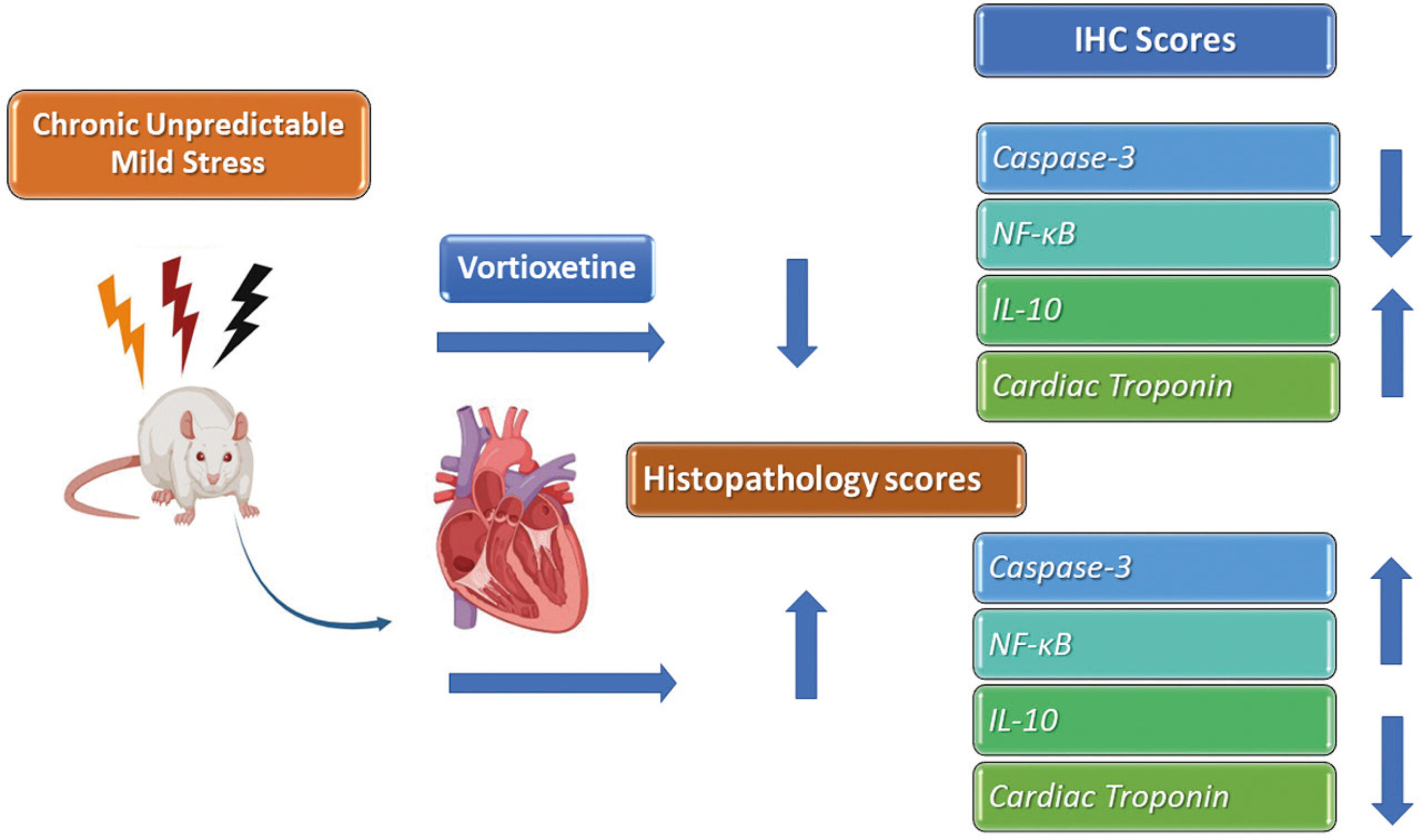
This study aimed to assess the effects of chronic unpredictable mild stress (CUMS) on rat hearts and evaluate VOR’s potential protective effects against stress-induced cardiac damage.

Methods

Twenty-eight male Wistar Albino rats were divided into four groups. The CUMS group experienced random daily stress for 6 weeks, while the CUMS+VOR group received VOR treatment alongside stress. VOR and control groups were not exposed to stress. Heart samples were examined histopathologically and immunohistochemically.

Results

The CUMS group showed increased hyperemia, hemorrhage, edema, vacuolar degeneration, and mononuclear cell infiltrations, with reduced troponin and IL-10 and increased caspase-3 and NF-κB expressions compared to the control group (p≤0.001). VOR treatment improved these findings, normalizing histopathological and immunohistochemical results.

Conclusions

CUMS caused significant cardiac damage in rats, while VOR treatment showed protective effects by alleviating these pathological changes.

  • Heart
  • Immunohistochemistry
  • Pathology
  • Vortioxetine
Read Full Article
Creative Commons Attribution (CC BY) Creative Commons license
10/02/2025 DOI: 10.36660/abc.20240159i
Figure 1
ABC
Original Article

Persistent Inflammatory Activity in Blood Cells and Artery Tissue from Patients with Previous Bare Metal Stent

Pedro Silvio Farsky et al. Mario H. Hirata Renato Tambellini Arnoni Antonio Flavio Sanches Almeida … Mario Issa Paula Helena Ortiz Lima Maria de Lourdes Higuchi Hui T Lin-Wang

Abstract

Background:

Studies have pointed out a higher mortality after coronary artery bypass surgery (CABG) in patients with stent.

Objective:

To evaluate inflammatory markers in peripheral blood cells and in coronary artery tissue samples obtained during CABG in patients with stent compared to controls.

Methods:

The case series consisted of two groups, one with previous stent implantation (n = 41) and one control (n = 26). The expression of the LIGHT, IL-6, ICAM, VCAM, CD40, NFKB, TNF, IFNG genes was analyzed in peripheral blood cells collected preoperatively. The coronary artery was evaluated for: interleukin-6, ICAM, VCAM, CD40, NFKB, TNF-alpha and IFN-gamma by immunohistochemistry. A total of 176 tissue samples were grouped for analysis in: A1- arteries with stent (n = 38); A2- native arteries from patients with stent in another artery (n = 68); and A3- arteries without stent from controls undergoing routinely CABG surgery (n = 70). A significance level of 0.05 was adopted.

Results:

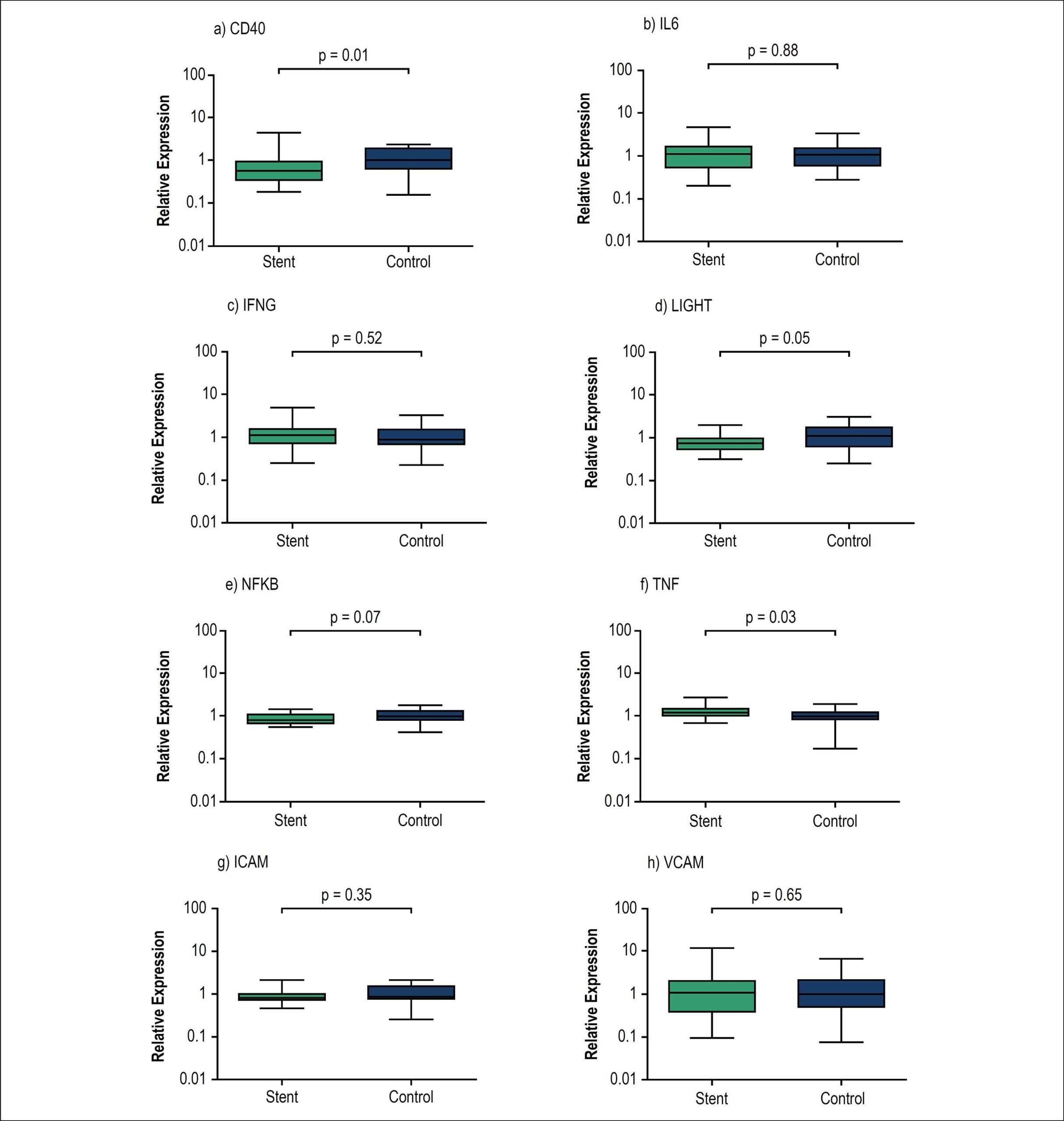
Patients with stent showed higher TNF (p = 0.03) and lower CD40 gene expression (p = 0.01) in peripheral blood cells than controls without stent. In coronary artery samples, the TNF-alpha protein staining was higher in the group A1, not only in the intima-media layer (5.16 ± 5.05 vs 1.90 ± 2.27; p = 0.02), but also in the adipose tissue (6.69 ± 3.87 vs 2.27 ± 4.00; p < 0.001). Furthermore, group A1 had a higher interleukin-6 protein staining in adipose tissue than group A3 (p = 0.04).

Conclusion:

We observed a persistently higher systemic TNF expression associated with exacerbated TNF-alpha and interleukin-6 local production in patients with stents. This finding may contribute to a worse clinical outcome.

  • Blood Cells
  • Immunohistochemistry
  • Inflammation
  • Interleukin-6
  • Percutaneous Coronary Intervention
  • Polymerase Chain Reaction
  • Stents
  • Tumor Necrosis Factor-alpha
Read Full Article
Creative Commons Attribution (CC BY) Creative Commons license
16/07/2018 DOI: 10.5935/abc.20180119 Views 1
ABC
Artigo Original

Immunohistochemical expression of cell differentiation and growth in neonate cardiomyocytes

Tarcísio Fulgêncio Alves da Silva et al. Greyce Kelly de Souza Mona Adalgisa Simões Francisco Cesar Pabis Lucia de Noronha

BACKGROUND: The cardiac alterations during the fetal heart transition to extrauterine life have been explored by several animal studies and the cell mechanisms responsible for these modifications are not well documented in humans. OBJECTIVE: To evaluate the mechanism of cell differentiation into cardiomyocytes that occur in the first days of life, through immunohistochemical analysis of proteins involved in proliferation and muscle contraction processes, in samples of human neonate myocardium. METHODS: Cross-sectional study of paraffin-sample sections of myocardium from an autopsy database of human neonates, divided into two sample groups: full-term neonates who died after a maximum of two days of life (NEO1) with 10 cases, and full-term infants who died between 3 and 10 days of life (NEO2) with 14 cases, in order to follow a temporal line that would contemplate the transition from fetal circulation to extrauterine life. The samples were studied in tissue microarray and the antibodies used were Ki67, PCNA, PTEN, Bcl2 (proliferation), HHF35 and sarcomeric actin (contractile proteins). RESULTS: Difference was observed regarding Ki67, p = 0.02; HHF35, p <0.01 and sarcomeric actin, p = 0.02, with Ki67 expression being higher in NEO1 group, whereas HHF35 and sarcomeric actin expression was higher in the NEO2 group. CONCLUSION: The results suggest that cardiomyocytes have a proliferation characteristic (Ki67) in NEO1 which, following a temporal line, will be replaced by a differentiation characteristic (HHF35 and sarcomeric actin) in NEO2.

  • Immunohistochemistry
  • Infant, Newborn
  • Myocytes, Cardiac
  • phase transition
  • placental circulation
Read Full Article
Creative Commons Attribution (CC BY) Creative Commons license
09/08/2012 DOI: 10.1590/S0066-782X2012005000074

How to cite this article

EndNote RIS

Electronic Document Format (Vancouver)

Ozmen O, Tasan S, Unal GO. Vortioxetine’s Therapeutic Potential: Cardiac Responses to Chronic Unpredictable Mild Stress in a Rat Model. Arquivos Brasileiros de Cardiologia 2025;122(2):e20240159.

Electronic Document Format (ABNT)

Ozmen, Ozlem; Tasan, Serife; Unal, Gulin Ozdamar. Vortioxetine’s Therapeutic Potential: Cardiac Responses to Chronic Unpredictable Mild Stress in a Rat Model. Arquivos Brasileiros de Cardiologia, v. 122, n. 2, e20240159, Feb. 2025.

Electronic Document Format (APA)

Ozmen, O., Tasan, S., & Unal, G. O. (2025). Vortioxetine’s Therapeutic Potential: Cardiac Responses to Chronic Unpredictable Mild Stress in a Rat Model. Arquivos Brasileiros de Cardiologia, 122(2), e20240159.

Electronic Document Format (ISO)

Ozmen, Ozlem and Tasan, Serife and Unal, Gulin Ozdamar. Vortioxetine’s Therapeutic Potential: Cardiac Responses to Chronic Unpredictable Mild Stress in a Rat Model. Arquivos Brasileiros de Cardiologia [online]. 2025, vol. 122, n. 2, [cited 2026-10-14], e20240159. Available from: <https://journals.cardiol.br/en/article/vortioxetines-therapeutic-potential-cardiac-responses-to-chronic-unpredictable-mild-stress-in-a-rat-model/>. ISSN 0066-782X

EndNote RIS

Electronic Document Format (Vancouver)

Farsky PS, Hirata MH, Arnoni RT, Almeida AFS, Issa M, Lima PHO, Higuchi ML, et al. Persistent Inflammatory Activity in Blood Cells and Artery Tissue from Patients with Previous Bare Metal Stent. Arquivos Brasileiros de Cardiologia 2018;111(2):134-41.

Electronic Document Format (ABNT)

Farsky, Pedro Silvio; Hirata, Mario H.; Arnoni, Renato Tambellini; Almeida, Antonio Flavio Sanches; Issa, Mario; Lima, Paula Helena Ortiz; Higuchi, Maria de Lourdes; Lin-Wang, Hui T. Persistent Inflammatory Activity in Blood Cells and Artery Tissue from Patients with Previous Bare Metal Stent. Arquivos Brasileiros de Cardiologia, v. 111, n. 2, p. 134-141, Jul. 2018.

Electronic Document Format (APA)

Farsky, P. S., Hirata, M. H., Arnoni, R. T., Almeida, A. F. S., Issa, M., Lima, P. H. O., Higuchi, M. L., & Lin-Wang, H. T. (2018). Persistent Inflammatory Activity in Blood Cells and Artery Tissue from Patients with Previous Bare Metal Stent. Arquivos Brasileiros de Cardiologia, 111(2), 134-141.

Electronic Document Format (ISO)

Farsky, Pedro Silvio and Hirata, Mario H. and Arnoni, Renato Tambellini and Almeida, Antonio Flavio Sanches and Issa, Mario and Lima, Paula Helena Ortiz and Higuchi, Maria de Lourdes and Lin-Wang, Hui T. Persistent Inflammatory Activity in Blood Cells and Artery Tissue from Patients with Previous Bare Metal Stent. Arquivos Brasileiros de Cardiologia [online]. 2018, vol. 111, n. 2, [cited 2026-10-14], pp. 134-141. Available from: <https://journals.cardiol.br/en/article/persistent-inflammatory-activity-in-blood-cells-and-artery-tissue-from-patients-with-previous-bare-metal-stent-2/>. ISSN 0066-782X

EndNote RIS

Electronic Document Format (Vancouver)

Silva TFA, Souza GK, Simões MA, Pabis FC, Noronha L. Immunohistochemical expression of cell differentiation and growth in neonate cardiomyocytes. Arquivos Brasileiros de Cardiologia 2012;99(3):797-801.

Electronic Document Format (ABNT)

Silva, Tarcísio Fulgêncio Alves da; Souza, Greyce Kelly de; Simões, Mona Adalgisa; Pabis, Francisco Cesar; Noronha, Lucia de. Immunohistochemical expression of cell differentiation and growth in neonate cardiomyocytes. Arquivos Brasileiros de Cardiologia, v. 99, n. 3, p. 797-801, Aug. 2012.

Electronic Document Format (APA)

Silva, T. F. A. , Souza, G. K. , Simões, M. A., Pabis, F. C., & Noronha, L. (2012). Immunohistochemical expression of cell differentiation and growth in neonate cardiomyocytes. Arquivos Brasileiros de Cardiologia, 99(3), 797-801.

Electronic Document Format (ISO)

Silva, Tarcísio Fulgêncio Alves da and Souza, Greyce Kelly de and Simões, Mona Adalgisa and Pabis, Francisco Cesar and Noronha, Lucia de. Immunohistochemical expression of cell differentiation and growth in neonate cardiomyocytes. Arquivos Brasileiros de Cardiologia [online]. 2012, vol. 99, n. 3, [cited 2026-10-14], pp. 797-801. Available from: <https://journals.cardiol.br/en/article/immunohistochemical-expression-of-cell-differentiation-and-growth-in-neonate-cardiomyocytes/>. ISSN 0066-782X

  • About ABC Family
  • Internal Regulation
  • Editorial Board
  • Brazilian Society of Cardiology (SBC)

Issues

SBC Guidelines

  • Videos
  • Podcasts
  • News