ABC Family Arquivos Brasileiros de Cardiologia International Journal of Cardiovascular Sciences ABC Heart Failure & Cardiomyopathy ABC Imagem Cardiovascular
Português English
ABC Family
Português English
  • About
    • About ABC Family
    • Internal Regulation
    • Editorial Board
    • Brazilian Society of Cardiology (SBC)
  • Issues
  • SBC Guidelines
  • Content
    • Videos
    • Podcasts
    • News
  • About
    • About ABC Family
    • Internal Regulation
    • Editorial Board
    • Brazilian Society of Cardiology (SBC)
  • Issues
  • SBC Guidelines
  • Content
    • Videos
    • Podcasts
    • News

ABC Family

  • ABC Family
  • Arquivos Brasileiros de Cardiologia
  • International Journal of Cardiovascular Sciences
  • ABC Heart Failure & Cardiomyopathy
  • ABC Imagem Cardiovascular
Search in

No content found.

Journals
Ordering
Article types
Others

  1. Home
  2. Keyword: Polymerase Chain Reaction
ABC
Editorial

L-Carnitine Supplementation in the Diabetic Heart

Filipe Welson Leal Pereira et al. Sergio Alberto Rupp de Paiva

Carnitine is a non-essential nutrient, which is derived from amino acids. The main food source of carnitine is red meat, poultry and dairy products. Part of the carnitine can be produced endogenously, from lysine and methionine mainly by the liver and kidneys. It acts primarily as an enzymatic cofactor for the transport of long-chain fatty acids from the cytoplasm into the mitochondria, and subsequent degradation to beta-oxidation, being a very important energy metabolism pathway. Therefore, carnitine is essential as fuel for muscles, and more than 95% of the total body carnitine is found in skeletal muscle. The liver, heart, brain and kidneys have the remainder of the body’s carnitine reserves or are able to synthesize it. This distribution shows the importance of carnitine in these organs. L-carnitine supplementation has been studied in sarcopenia, in liver diseases, in heart failure, in kidney diseases and in neurological diseases. ,

Most studies have shown the benefit of L-carnitine on cardiovascular risk factors. L-carnitine supplementation reduces hypertension, hyperlipidemia, hyperglycemia, insulin-dependent diabetes mellitus, insulin resistance, obesity, inflammation and oxidative stress. , –

[…]

  • Carnitine
  • Energy metabolism
  • Polymerase Chain Reaction
Read Full Article
Creative Commons Attribution (CC BY) Creative Commons license
25/10/2021 DOI: 10.36660/abc.20210717 Views 1
Figure 1
ABC
Original Article

Persistent Inflammatory Activity in Blood Cells and Artery Tissue from Patients with Previous Bare Metal Stent

Pedro Silvio Farsky et al. Mario H. Hirata Renato Tambellini Arnoni Antonio Flavio Sanches Almeida … Mario Issa Paula Helena Ortiz Lima Maria de Lourdes Higuchi Hui T Lin-Wang

Abstract

Background:

Studies have pointed out a higher mortality after coronary artery bypass surgery (CABG) in patients with stent.

Objective:

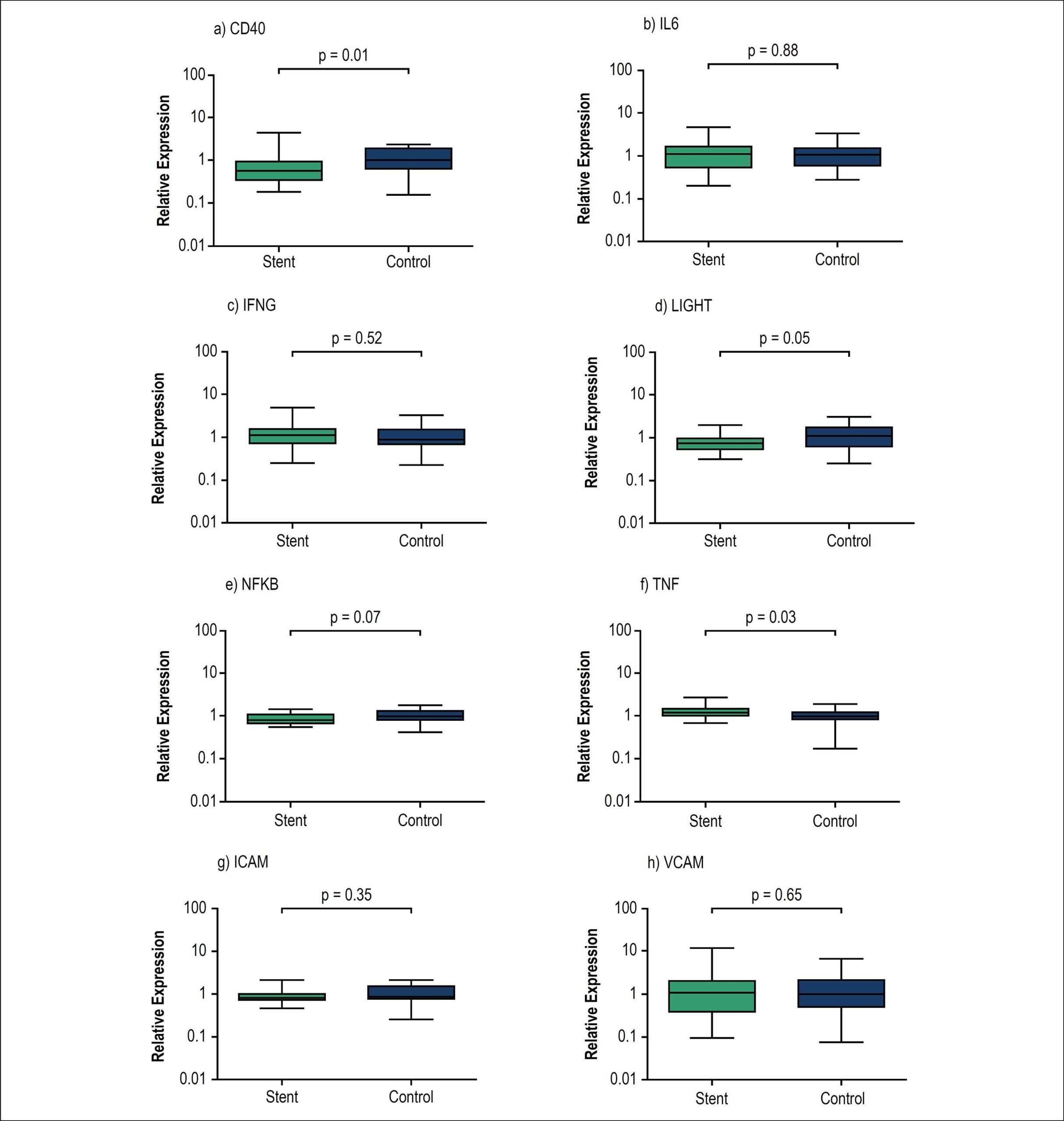
To evaluate inflammatory markers in peripheral blood cells and in coronary artery tissue samples obtained during CABG in patients with stent compared to controls.

Methods:

The case series consisted of two groups, one with previous stent implantation (n = 41) and one control (n = 26). The expression of the LIGHT, IL-6, ICAM, VCAM, CD40, NFKB, TNF, IFNG genes was analyzed in peripheral blood cells collected preoperatively. The coronary artery was evaluated for: interleukin-6, ICAM, VCAM, CD40, NFKB, TNF-alpha and IFN-gamma by immunohistochemistry. A total of 176 tissue samples were grouped for analysis in: A1- arteries with stent (n = 38); A2- native arteries from patients with stent in another artery (n = 68); and A3- arteries without stent from controls undergoing routinely CABG surgery (n = 70). A significance level of 0.05 was adopted.

Results:

Patients with stent showed higher TNF (p = 0.03) and lower CD40 gene expression (p = 0.01) in peripheral blood cells than controls without stent. In coronary artery samples, the TNF-alpha protein staining was higher in the group A1, not only in the intima-media layer (5.16 ± 5.05 vs 1.90 ± 2.27; p = 0.02), but also in the adipose tissue (6.69 ± 3.87 vs 2.27 ± 4.00; p < 0.001). Furthermore, group A1 had a higher interleukin-6 protein staining in adipose tissue than group A3 (p = 0.04).

Conclusion:

We observed a persistently higher systemic TNF expression associated with exacerbated TNF-alpha and interleukin-6 local production in patients with stents. This finding may contribute to a worse clinical outcome.

  • Blood Cells
  • Immunohistochemistry
  • Inflammation
  • Interleukin-6
  • Percutaneous Coronary Intervention
  • Polymerase Chain Reaction
  • Stents
  • Tumor Necrosis Factor-alpha
Read Full Article
Creative Commons Attribution (CC BY) Creative Commons license
16/07/2018 DOI: 10.5935/abc.20180119 Views 1
ABC
Original Article

Chlamydia pneumoniae and atherosclerosis. Identification of bacterial DNA in the arterial wall

Mário Sérgio Soares de Azeredo Coutinho et al. Fernando Joo Daniel Nakamae Maria Elizabeth Menezes

OBJECTIVE: The intracellular Gram-negative bacterium Chlamydia pneumoniae has been associated with atherosclerosis. The presence of Chlamydia pneumoniae has been investigated in fragments of the arterial wall with a technique for DNA identification. METHODS: Arterial fragments obtained from vascular surgical procedures in 58 patients were analyzed. From these patients, 39 were males and the mean age was 65±6 years. The polymerase chain reaction was used to identify the bacterial DNA with a pair of primers that codify the major outer membrane protein (MOMP) of Chlamydia pneumoniae. The amplified product was visualized by electrophoresis in the 2% agarose gel stained with ethidium bromide, and it was considered positive when migrating in the band of molecular weight of the positive controls. RESULTS: Seven (12%) out of the 58 patients showed positive results for Chlamydia pneumoniae. CONCLUSION: DNA from Chlamydia pneumoniae was identified in the arterial wall of a substantial number of patients with atherosclerosis. This association, which has already been described in other countries, corroborates the evidence favoring a role played by Chlamydia pneumoniae in atherogenesis.

  • Atherosclerosis
  • Chlamydia pneumoniae
  • Polymerase Chain Reaction
Read Full Article
Creative Commons Attribution (CC BY) Creative Commons license
05/09/2000 DOI: 10.1590/S0066-782X2000000200002 Views 1

How to cite this article

EndNote RIS

Electronic Document Format (Vancouver)

Pereira FWL, Paiva SAR. L-Carnitine Supplementation in the Diabetic Heart. Arquivos Brasileiros de Cardiologia 2021;117(4):726-7.

Electronic Document Format (ABNT)

Pereira, Filipe Welson Leal; Paiva, Sergio Alberto Rupp de. L-Carnitine Supplementation in the Diabetic Heart. Arquivos Brasileiros de Cardiologia, v. 117, n. 4, p. 726-727, Oct. 2021.

Electronic Document Format (APA)

Pereira, F. W. L., & Paiva, S. A. R. (2021). L-Carnitine Supplementation in the Diabetic Heart. Arquivos Brasileiros de Cardiologia, 117(4), 726-727.

Electronic Document Format (ISO)

Pereira, Filipe Welson Leal and Paiva, Sergio Alberto Rupp de. L-Carnitine Supplementation in the Diabetic Heart. Arquivos Brasileiros de Cardiologia [online]. 2021, vol. 117, n. 4, [cited 2026-10-14], pp. 726-727. Available from: <https://journals.cardiol.br/en/article/l-carnitine-supplementation-in-the-diabetic-heart/>. ISSN 0066-782X

EndNote RIS

Electronic Document Format (Vancouver)

Farsky PS, Hirata MH, Arnoni RT, Almeida AFS, Issa M, Lima PHO, Higuchi ML, et al. Persistent Inflammatory Activity in Blood Cells and Artery Tissue from Patients with Previous Bare Metal Stent. Arquivos Brasileiros de Cardiologia 2018;111(2):134-41.

Electronic Document Format (ABNT)

Farsky, Pedro Silvio; Hirata, Mario H.; Arnoni, Renato Tambellini; Almeida, Antonio Flavio Sanches; Issa, Mario; Lima, Paula Helena Ortiz; Higuchi, Maria de Lourdes; Lin-Wang, Hui T. Persistent Inflammatory Activity in Blood Cells and Artery Tissue from Patients with Previous Bare Metal Stent. Arquivos Brasileiros de Cardiologia, v. 111, n. 2, p. 134-141, Jul. 2018.

Electronic Document Format (APA)

Farsky, P. S., Hirata, M. H., Arnoni, R. T., Almeida, A. F. S., Issa, M., Lima, P. H. O., Higuchi, M. L., & Lin-Wang, H. T. (2018). Persistent Inflammatory Activity in Blood Cells and Artery Tissue from Patients with Previous Bare Metal Stent. Arquivos Brasileiros de Cardiologia, 111(2), 134-141.

Electronic Document Format (ISO)

Farsky, Pedro Silvio and Hirata, Mario H. and Arnoni, Renato Tambellini and Almeida, Antonio Flavio Sanches and Issa, Mario and Lima, Paula Helena Ortiz and Higuchi, Maria de Lourdes and Lin-Wang, Hui T. Persistent Inflammatory Activity in Blood Cells and Artery Tissue from Patients with Previous Bare Metal Stent. Arquivos Brasileiros de Cardiologia [online]. 2018, vol. 111, n. 2, [cited 2026-10-14], pp. 134-141. Available from: <https://journals.cardiol.br/en/article/persistent-inflammatory-activity-in-blood-cells-and-artery-tissue-from-patients-with-previous-bare-metal-stent-2/>. ISSN 0066-782X

EndNote RIS

Electronic Document Format (Vancouver)

Coutinho MSSA, Nakamae FJD, Menezes ME. Chlamydia pneumoniae and atherosclerosis. Identification of bacterial DNA in the arterial wall. Arquivos Brasileiros de Cardiologia 2000;74(2):124-8.

Electronic Document Format (ABNT)

Coutinho, Mário Sérgio Soares de Azeredo; Nakamae, Fernando Joo Daniel; Menezes, Maria Elizabeth. Chlamydia pneumoniae and atherosclerosis. Identification of bacterial DNA in the arterial wall. Arquivos Brasileiros de Cardiologia, v. 74, n. 2, p. 124-128, Sep. 2000.

Electronic Document Format (APA)

Coutinho, M. S. S. A., Nakamae, F. J. D., & Menezes, M. E. (2000). Chlamydia pneumoniae and atherosclerosis. Identification of bacterial DNA in the arterial wall. Arquivos Brasileiros de Cardiologia, 74(2), 124-128.

Electronic Document Format (ISO)

Coutinho, Mário Sérgio Soares de Azeredo and Nakamae, Fernando Joo Daniel and Menezes, Maria Elizabeth. Chlamydia pneumoniae and atherosclerosis. Identification of bacterial DNA in the arterial wall. Arquivos Brasileiros de Cardiologia [online]. 2000, vol. 74, n. 2, [cited 2026-10-14], pp. 124-128. Available from: <https://journals.cardiol.br/en/article/chlamydia-pneumoniae-and-atherosclerosis-identification-of-bacterial-dna-in-the-arterial-wall/>. ISSN 0066-782X

  • About ABC Family
  • Internal Regulation
  • Editorial Board
  • Brazilian Society of Cardiology (SBC)

Issues

SBC Guidelines

  • Videos
  • Podcasts
  • News