ABC Family Arquivos Brasileiros de Cardiologia International Journal of Cardiovascular Sciences ABC Heart Failure & Cardiomyopathy ABC Imagem Cardiovascular
Português English
ABC Family
Português English
  • About
    • About ABC Family
    • Internal Regulation
    • Editorial Board
    • Brazilian Society of Cardiology (SBC)
  • Issues
  • SBC Guidelines
  • Content
    • Videos
    • Podcasts
    • News
  • About
    • About ABC Family
    • Internal Regulation
    • Editorial Board
    • Brazilian Society of Cardiology (SBC)
  • Issues
  • SBC Guidelines
  • Content
    • Videos
    • Podcasts
    • News

ABC Family

  • ABC Family
  • Arquivos Brasileiros de Cardiologia
  • International Journal of Cardiovascular Sciences
  • ABC Heart Failure & Cardiomyopathy
  • ABC Imagem Cardiovascular
Search in

No content found.

Journals
Ordering
Article types
Others

  1. Home
  2. Keyword: Hyperplasia
Figure 1
ABC
Original Article

Adiponectin Prevents Restenosis Through Inhibiting Cell Proliferation in a Rat Vein Graft Model

Yang Zhou et al. Chun Dai Bing Zhang Jianjun Ge

Abstract

Background:

Coronary artery bypass grafting (CABG) continues to be an effective therapy for coronary artery disease patients, but the vein graft is prone to restenosis or occlude. Adiponectin (ADP) is a plasma hormone protein with the function of regulating cell proliferation.

Objective:

This study used two different doses of ADP protein in a rat vein graft model to stimulate vein graft change. The aim of our study was to investigate the effect of ADP on vein graft restenosis.

Methods:

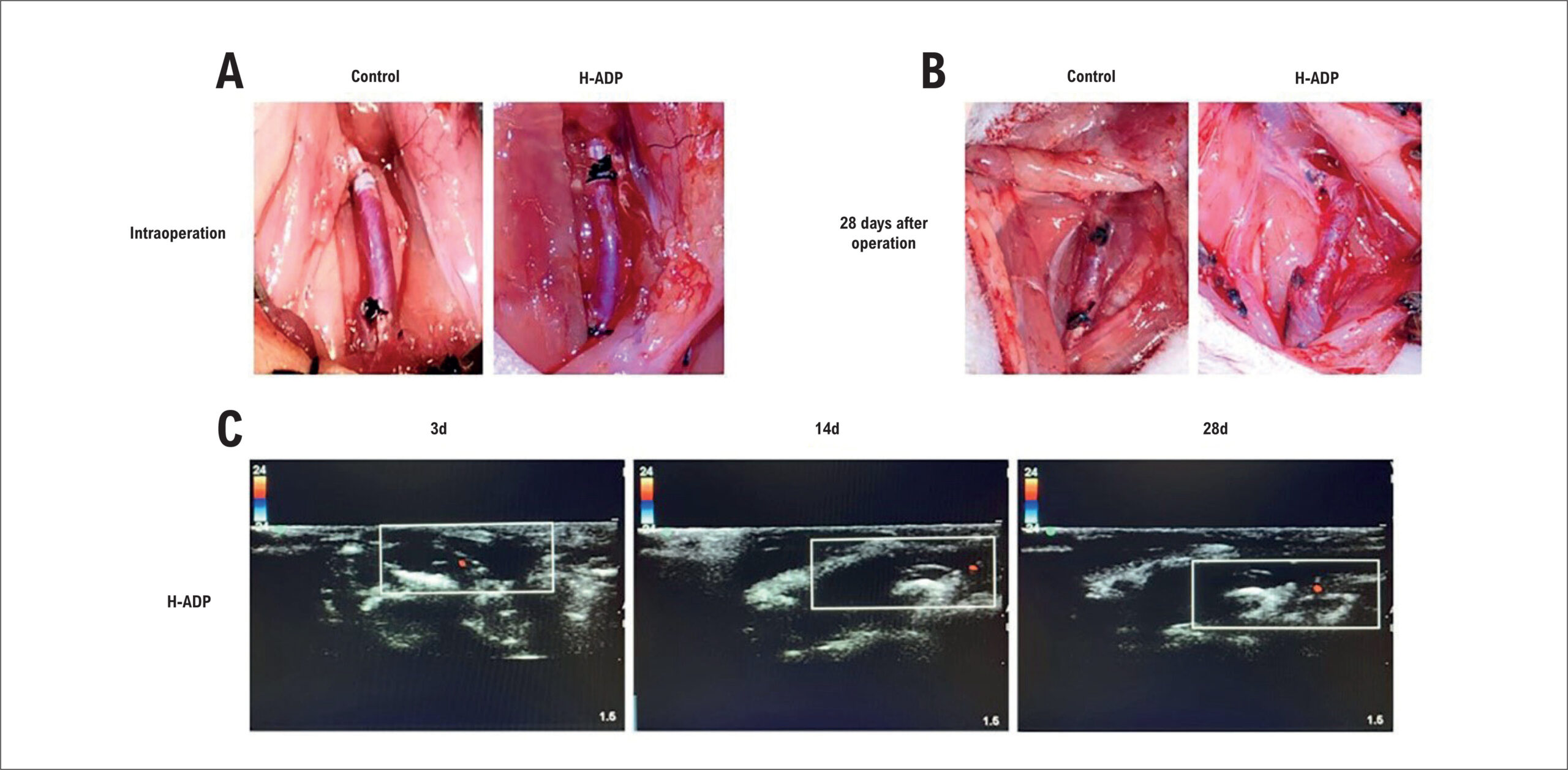
Autologous jugular veins were implanted as carotid interposition grafts through the anastomotic cuff technique in Sprague Dawley rats. Adiponectin (2.5 μg and 7.5 μg) was delivered to the vein bypass grafts in a perivascular fashion, suspended in a 30% Pluronic-F127 gel. No treatment (bypass only) and vehicle loaded Pluronic gel served as controls. Comparisons were made with one-way analysis of variance and a post-hoc test, with p < 0.05 considered significant.

Results:

Cell proliferation (PCNA index) was significantly low in adiponectin-treated versus control and vehicle-gel-treated grafts, both in intima and adventitia, as of day 3 (p < 0.01). VCAM-1 and ICAM-1 evaluated by immunohistochemistry significantly down-regulated in the adiponectin-treated vein grafts in the fourth week (p <0.01). Treatment of vein grafts with adiponectin-loaded gels reduced intimal, media, and adventitia thickness when compared with the control and vehicle-gel-treated vein grafts at day 28 (p < 0.01).

Conclusions:

Our studies provide further support for the potential therapeutic role of adiponectin in modulating vascular injury and repair.
  • Adiponectin
  • Cell Proliferation
  • Hyperplasia
Read Full Article
Creative Commons Attribution (CC BY) Creative Commons license
03/12/2021 DOI: 10.36660/abc.20200761
Figure 1
ABC
Original Article

Atorvastatin Reduces Accumulation of Vascular Smooth Muscle Cells to Inhibit Intimal Hyperplasia via p38 MAPK Pathway Inhibition in a Rat Model of Vein Graft

Tianshu Chu et al. Molin Huang Zhiwei Zhao Fei Ling … Jing Cao Jianjun Ge

Abstract

Background:

The rate of saphenous vein graft failure one year after coronary artery bypass grafting ranges from 10% to 25%. The aim of this study was to explore whether atorvastatin can reduce accumulation of vascular smooth muscle cells to inhibit intimal hyperplasia via p38 MAPK pathway inhibition.

Methods:

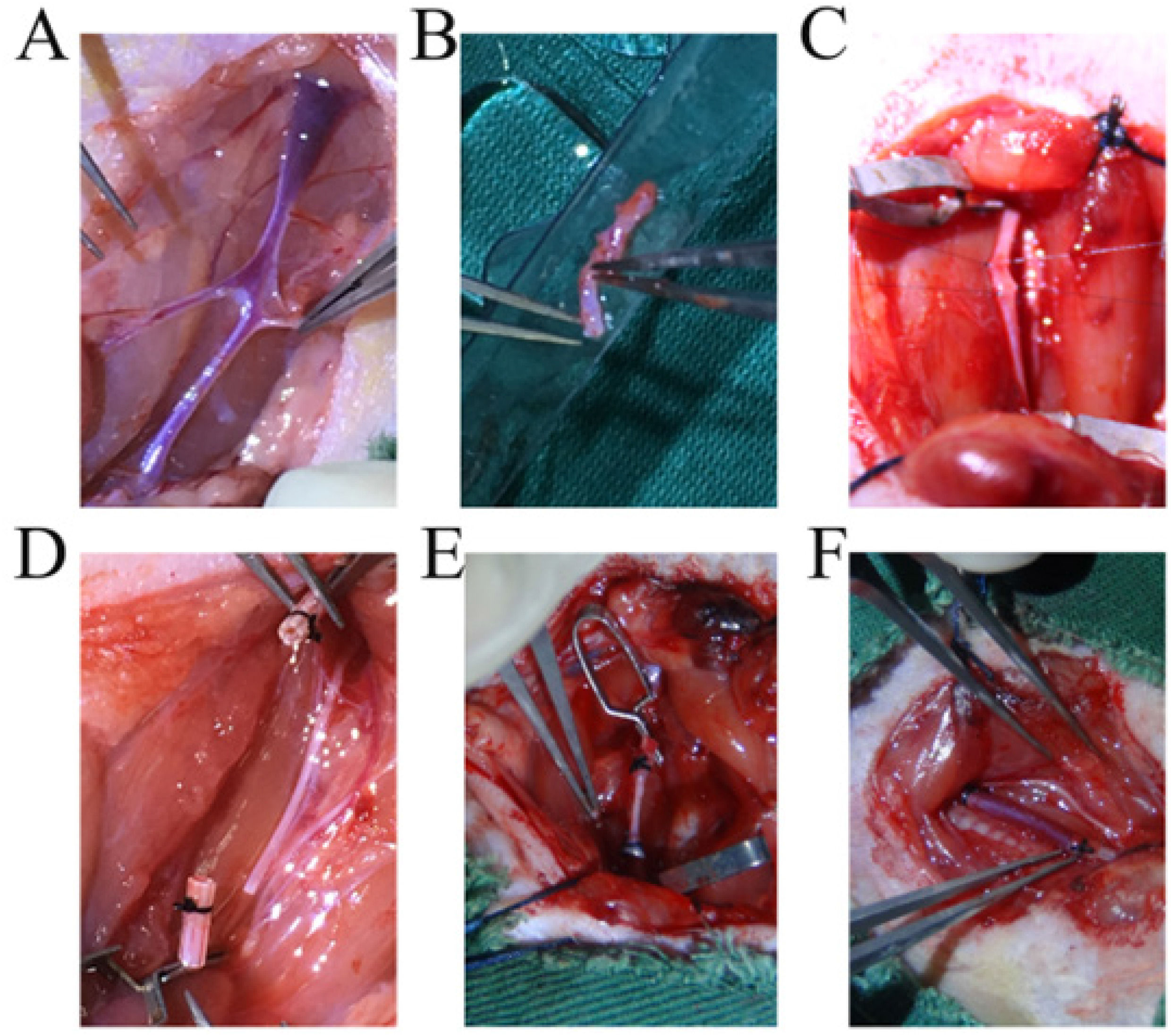
Forty-five Sprague-Dawley rats were randomized to three groups. Thirty rats received a vein graft operation, and they were randomized to be treated with vehicle or atorvastatin; fifteen rats received a sham operation. We detected intimal hyperplasia by hematoxylin-eosin staining and related protein expression by immunohistochemical and Western blot analysis. Comparisons were analyzed by single-factor analysis of variance and Fisher’s least significant difference test, with p < 0.05 considered significant.

Results:

The intima analyzed by hematoxylin-eosin staining was dramatically thicker in the control group than in the atorvastatin group and sham group (p < 0.01). The outcomes of immunohistochemical staining of α-SMA demonstrated that the percentage of α-SMA-positive cells in the control group was higher than in the atorvastatin group (p < 0.01). We also evaluated α-SMA, PCNA, p38 MAPK, and phosphorylation of p38 MAPK after statin treatment by Western blot analysis, and the results indicated that atorvastatin did not lead to p38 MAPK reduction (p < 0.05); it did, however, result in inhibition of p38 MAPK phosphorylation (p < 0.01), and it significantly reduced α-SMA and PCNA levels, in comparison with the control group (p < 0.01).

Conclusion:

We have demonstrated that atorvastatin can inhibit accumulation of vascular smooth muscle cells by inhibiting the p38 MAPK pathway, and it is capable of inhibiting intimal hyperplasia in a rat vein graft model.

  • Atorvastatin
  • Hyperplasia
  • Mitogen Activated Protein Kinases
  • Models, Animal
  • Myocardial Revascularization, Rats
  • Myocytes Smooth Muscle
Read Full Article
Creative Commons Attribution (CC BY) Creative Commons license
23/10/2020 DOI: 10.36660/abc.20190231 Views 1
ABC
Editorial

Synergy of Rapamycin and Cyanoacrylate in Reducing Intimal Hyperplasia

Marcia Kiyomi Koike

Myocardial revascularization (CABG) surgery remains one of the main therapies for coronary disease. However, vascular disease that follows CABG remains a challenge to medicine. The mechanical, molecular and cellular changes undergone by the venous vascular graft when inserted into the coronary artery flow culminate in thrombosis, intimal hyperplasia, and atherosclerotic process, and end with restenosis.,

CABG experimental models were crucial to the understanding of mechanisms present in the course of vascular disease. The vascular graft model with anastomosis of the external jugular vein with the carotid artery represents an experimental model of vascular disease similar to that occurring after CABG. Pigs, rabbits, and rats may be used in this model because of protocol reproducibility, cost, and benefit.,

[…]

  • Cianoacrilates
  • Coronary Artery Diseases
  • Hyperplasia
  • Imunosupressive Agents
  • Myocardial Revascularization
  • Rats
  • Vascular Diseases
Read Full Article
Creative Commons Attribution (CC BY) Creative Commons license
01/01/2019 DOI: 10.5935/abc.20180269
Figure 1
ABC
Original Article

Rapamycin Combined with α-Cyanoacrylate Contributes to Inhibiting Intimal Hyperplasia in Rat Models

Jianjun Ge

Abstract

Background:

Vein graft restenosis has an adverse impact on bridge vessel circulation and patient prognosis after coronary artery bypass grafting.

Objectives:

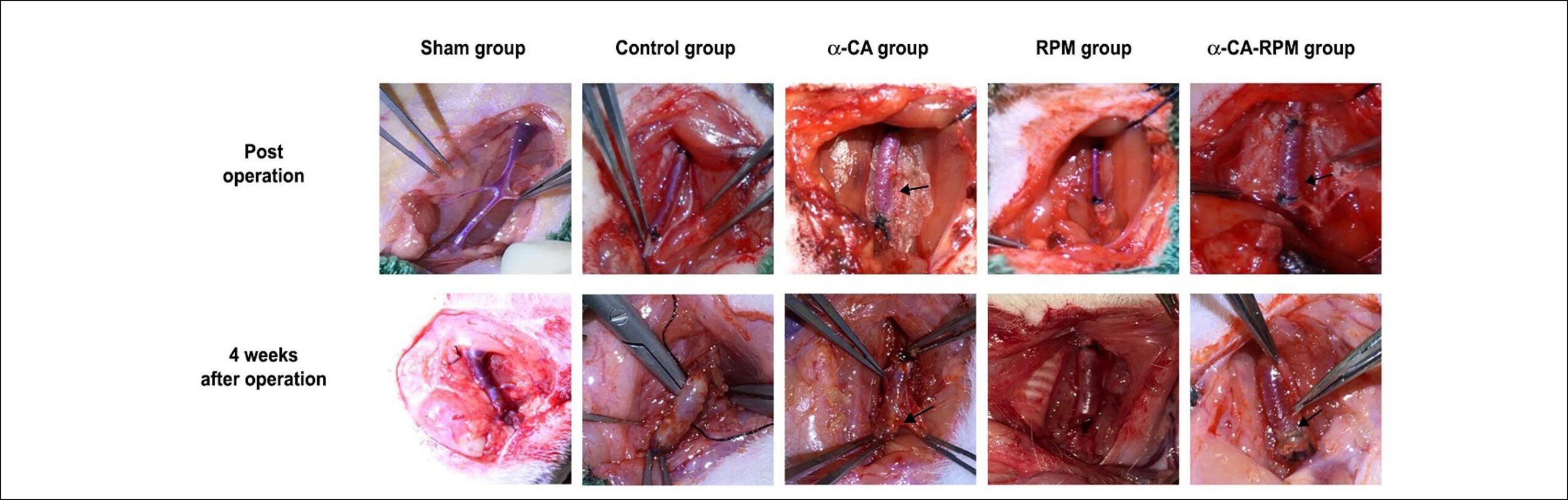
We used the extravascular supporter α-cyanoacrylate (α-CA), the local application rapamycin/sirolimus (RPM), and a combination of the two (α-CA-RPM) in rat models of autogenous vein graft to stimulate vein graft change. The aim of our study was to observe the effect of α-CA, RPM, and α-CA-RPM on vein hyperplasia.

Methods:

Fifty healthy Sprague Dawley (SD) rats were randomized into the following 5 groups: sham, control, α-CA, RPM, and α-CA-RPM. Operating procedure as subsequently described was used to build models of grafted rat jugular vein on carotid artery on one side. The level of endothelin-1 (ET-1) was determined by enzyme-linked immunosorbent assay (ELISA). Grafted veins were observed via naked eye 4 weeks later; fresh veins were observed via microscope and image-processing software in hematoxylin-eosin (HE) staining and immunohistochemistry after having been fixed and stored” (i.e. First they were fixed and stored, and second they were observed); α-Smooth Muscle Actin (αSMA) and von Willebrand factor (vWF) were measured with reverse transcription-polymerase chain reaction (RT-PCR). Comparisons were made with single-factor analysis of variance and Fisher’s least significant difference test, with p < 0.05 considered significant.

Results:

We found that intimal thickness of the α-CA, RPM, and α-CA-RPM groups was lower than that of the control group (p < 0.01), and the thickness of the α-CA-RPM group was notably lower than that of the α-CA and RPM groups (p < 0.05).

Conclusion:

RPM combined with α-CA contributes to inhibiting intimal hyperplasia in rat models and is more effective for vascular patency than individual use of either α-CA or RPM.

  • Cyanocrylates
  • Graft Occlusion, Vascular
  • Hyperplasia
  • Myocardial Revascularization/surgery
  • Rats
  • Sirolimus
  • Vascular Patency
Read Full Article
Creative Commons Attribution (CC BY) Creative Commons license
17/12/2018 DOI: 10.5935/abc.20180247 Views 1

How to cite this article

EndNote RIS

Electronic Document Format (Vancouver)

Zhou Y, Dai C, Zhang B, Ge J. Adiponectin Prevents Restenosis Through Inhibiting Cell Proliferation in a Rat Vein Graft Model. Arquivos Brasileiros de Cardiologia 2021;117(6):1179-88.

Electronic Document Format (ABNT)

Zhou, Yang; Dai, Chun; Zhang, Bing; Ge, Jianjun. Adiponectin Prevents Restenosis Through Inhibiting Cell Proliferation in a Rat Vein Graft Model. Arquivos Brasileiros de Cardiologia, v. 117, n. 6, p. 1179-1188, Dec. 2021.

Electronic Document Format (APA)

Zhou, Y., Dai, C., Zhang, B., & Ge, J. (2021). Adiponectin Prevents Restenosis Through Inhibiting Cell Proliferation in a Rat Vein Graft Model. Arquivos Brasileiros de Cardiologia, 117(6), 1179-1188.

Electronic Document Format (ISO)

Zhou, Yang and Dai, Chun and Zhang, Bing and Ge, Jianjun. Adiponectin Prevents Restenosis Through Inhibiting Cell Proliferation in a Rat Vein Graft Model. Arquivos Brasileiros de Cardiologia [online]. 2021, vol. 117, n. 6, [cited 2026-10-14], pp. 1179-1188. Available from: <https://journals.cardiol.br/en/article/adiponectin-prevents-restenosis-through-inhibiting-cell-proliferation-in-a-rat-vein-graft-model/>. ISSN 0066-782X

EndNote RIS

Electronic Document Format (Vancouver)

Chu T, Huang M, Zhao Z, Ling F, Cao J, Ge J. Atorvastatin Reduces Accumulation of Vascular Smooth Muscle Cells to Inhibit Intimal Hyperplasia via p38 MAPK Pathway Inhibition in a Rat Model of Vein Graft. Arquivos Brasileiros de Cardiologia 2020;115(4):630-6.

Electronic Document Format (ABNT)

Chu, Tianshu; Huang, Molin; Zhao, Zhiwei; Ling, Fei; Cao, Jing; Ge, Jianjun. Atorvastatin Reduces Accumulation of Vascular Smooth Muscle Cells to Inhibit Intimal Hyperplasia via p38 MAPK Pathway Inhibition in a Rat Model of Vein Graft. Arquivos Brasileiros de Cardiologia, v. 115, n. 4, p. 630-636, Oct. 2020.

Electronic Document Format (APA)

Chu, T., Huang, M., Zhao, Z., Ling, F., Cao, J., & Ge, J. (2020). Atorvastatin Reduces Accumulation of Vascular Smooth Muscle Cells to Inhibit Intimal Hyperplasia via p38 MAPK Pathway Inhibition in a Rat Model of Vein Graft. Arquivos Brasileiros de Cardiologia, 115(4), 630-636.

Electronic Document Format (ISO)

Chu, Tianshu and Huang, Molin and Zhao, Zhiwei and Ling, Fei and Cao, Jing and Ge, Jianjun. Atorvastatin Reduces Accumulation of Vascular Smooth Muscle Cells to Inhibit Intimal Hyperplasia via p38 MAPK Pathway Inhibition in a Rat Model of Vein Graft. Arquivos Brasileiros de Cardiologia [online]. 2020, vol. 115, n. 4, [cited 2026-10-14], pp. 630-636. Available from: <https://journals.cardiol.br/en/article/atorvastatin-reduces-accumulation-of-vascular-smooth-muscle-cells-to-inhibit-intimal-hyperplasia-via-p38-mapk-pathway-inhibition-in-a-rat-model-of-vein-graft/>. ISSN 0066-782X

EndNote RIS

Electronic Document Format (Vancouver)

Koike MK. Synergy of Rapamycin and Cyanoacrylate in Reducing Intimal Hyperplasia. Arquivos Brasileiros de Cardiologia 2019;112(1):11.

Electronic Document Format (ABNT)

Koike, Marcia Kiyomi. Synergy of Rapamycin and Cyanoacrylate in Reducing Intimal Hyperplasia. Arquivos Brasileiros de Cardiologia, v. 112, n. 1, p. 11-11, Dec. 2018.

Electronic Document Format (APA)

Koike, M. K. (2019). Synergy of Rapamycin and Cyanoacrylate in Reducing Intimal Hyperplasia. Arquivos Brasileiros de Cardiologia, 112(1), 11-11.

Electronic Document Format (ISO)

Koike, Marcia Kiyomi. Synergy of Rapamycin and Cyanoacrylate in Reducing Intimal Hyperplasia. Arquivos Brasileiros de Cardiologia [online]. 2019, vol. 112, n. 1, [cited 2026-10-14], pp. 11-11. Available from: <https://journals.cardiol.br/en/article/synergy-of-rapamycin-and-cyanoacrylate-in-reducing-intimal-hyperplasia/>. ISSN 0066-782X

EndNote RIS

Electronic Document Format (Vancouver)

Ge J. Rapamycin Combined with α-Cyanoacrylate Contributes to Inhibiting Intimal Hyperplasia in Rat Models. Arquivos Brasileiros de Cardiologia 2018;112(1):3-10.

Electronic Document Format (ABNT)

Ge, Jianjun. Rapamycin Combined with α-Cyanoacrylate Contributes to Inhibiting Intimal Hyperplasia in Rat Models. Arquivos Brasileiros de Cardiologia, v. 112, n. 1, p. 3-10, Dec. 2018.

Electronic Document Format (APA)

Ge, J. (2018). Rapamycin Combined with α-Cyanoacrylate Contributes to Inhibiting Intimal Hyperplasia in Rat Models. Arquivos Brasileiros de Cardiologia, 112(1), 3-10.

Electronic Document Format (ISO)

Ge, Jianjun. Rapamycin Combined with α-Cyanoacrylate Contributes to Inhibiting Intimal Hyperplasia in Rat Models. Arquivos Brasileiros de Cardiologia [online]. 2018, vol. 112, n. 1, [cited 2026-10-14], pp. 3-10. Available from: <https://journals.cardiol.br/en/article/rapamycin-combined-with-%ce%b1-cyanoacrylate-contributes-to-inhibiting-intimal-hyperplasia-in-rat-models/>. ISSN 0066-782X

  • About ABC Family
  • Internal Regulation
  • Editorial Board
  • Brazilian Society of Cardiology (SBC)

Issues

SBC Guidelines

  • Videos
  • Podcasts
  • News