ABC Family Arquivos Brasileiros de Cardiologia International Journal of Cardiovascular Sciences ABC Heart Failure & Cardiomyopathy ABC Imagem Cardiovascular
Português English
ABC Family
Português English
  • About
    • About ABC Family
    • Internal Regulation
    • Editorial Board
    • Brazilian Society of Cardiology (SBC)
  • Issues
  • SBC Guidelines
  • Content
    • Videos
    • Podcasts
    • News
  • About
    • About ABC Family
    • Internal Regulation
    • Editorial Board
    • Brazilian Society of Cardiology (SBC)
  • Issues
  • SBC Guidelines
  • Content
    • Videos
    • Podcasts
    • News

ABC Family

  • ABC Family
  • Arquivos Brasileiros de Cardiologia
  • International Journal of Cardiovascular Sciences
  • ABC Heart Failure & Cardiomyopathy
  • ABC Imagem Cardiovascular
Search in

No content found.

Journals
Ordering
Article types
Others

  1. Home
  2. Keyword: Graft Occlusion, Vascular
Figure 1
ABC
Original Article

Rapamycin Combined with α-Cyanoacrylate Contributes to Inhibiting Intimal Hyperplasia in Rat Models

Jianjun Ge

Abstract

Background:

Vein graft restenosis has an adverse impact on bridge vessel circulation and patient prognosis after coronary artery bypass grafting.

Objectives:

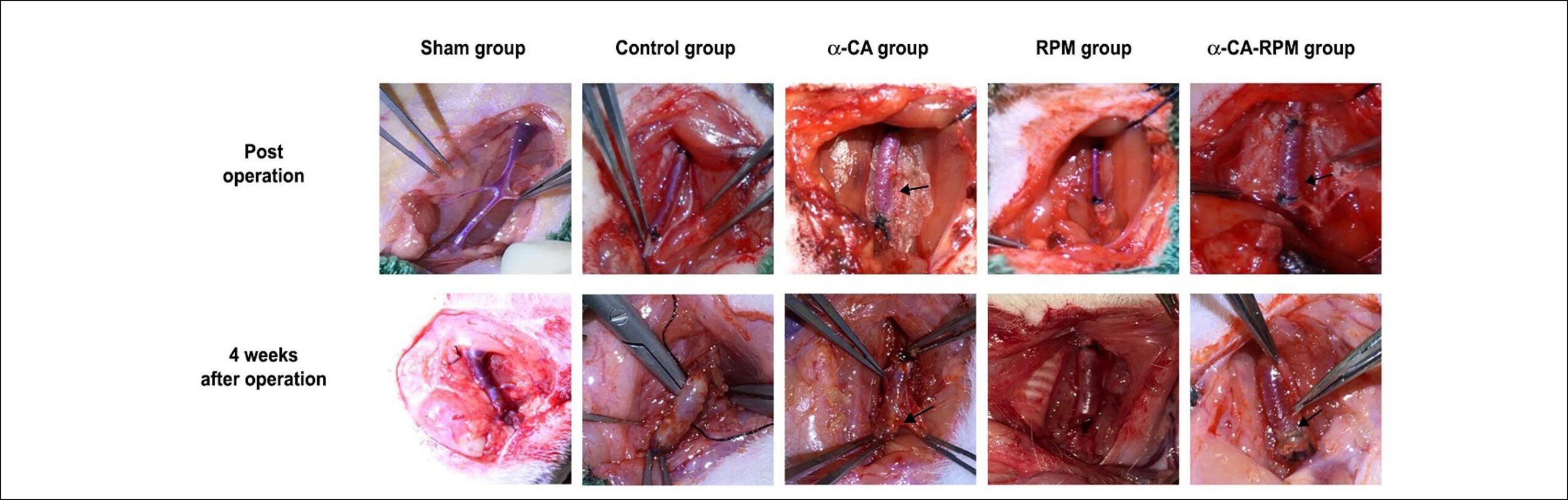
We used the extravascular supporter α-cyanoacrylate (α-CA), the local application rapamycin/sirolimus (RPM), and a combination of the two (α-CA-RPM) in rat models of autogenous vein graft to stimulate vein graft change. The aim of our study was to observe the effect of α-CA, RPM, and α-CA-RPM on vein hyperplasia.

Methods:

Fifty healthy Sprague Dawley (SD) rats were randomized into the following 5 groups: sham, control, α-CA, RPM, and α-CA-RPM. Operating procedure as subsequently described was used to build models of grafted rat jugular vein on carotid artery on one side. The level of endothelin-1 (ET-1) was determined by enzyme-linked immunosorbent assay (ELISA). Grafted veins were observed via naked eye 4 weeks later; fresh veins were observed via microscope and image-processing software in hematoxylin-eosin (HE) staining and immunohistochemistry after having been fixed and stored” (i.e. First they were fixed and stored, and second they were observed); α-Smooth Muscle Actin (αSMA) and von Willebrand factor (vWF) were measured with reverse transcription-polymerase chain reaction (RT-PCR). Comparisons were made with single-factor analysis of variance and Fisher’s least significant difference test, with p < 0.05 considered significant.

Results:

We found that intimal thickness of the α-CA, RPM, and α-CA-RPM groups was lower than that of the control group (p < 0.01), and the thickness of the α-CA-RPM group was notably lower than that of the α-CA and RPM groups (p < 0.05).

Conclusion:

RPM combined with α-CA contributes to inhibiting intimal hyperplasia in rat models and is more effective for vascular patency than individual use of either α-CA or RPM.

  • Cyanocrylates
  • Graft Occlusion, Vascular
  • Hyperplasia
  • Myocardial Revascularization/surgery
  • Rats
  • Sirolimus
  • Vascular Patency
Read Full Article
Creative Commons Attribution (CC BY) Creative Commons license
17/12/2018 DOI: 10.5935/abc.20180247 Views 1
Graph 1
ABC
Original Article

Clinical Coronary In-Stent Restenosis Follow-Up after Treatment and Analyses of Clinical Outcomes

Barbara Campos Abreu Marino et al. Guilherme Abreu Nascimento Walter Rabelo Marcos Antônio Marino … Roberto Luiz Marino Antonio Luiz Pinho Ribeiro

Background:

Clinical in-stent restenosis (CISR) is the main limitation of coronary angioplasty with stent implantation.

Objective:

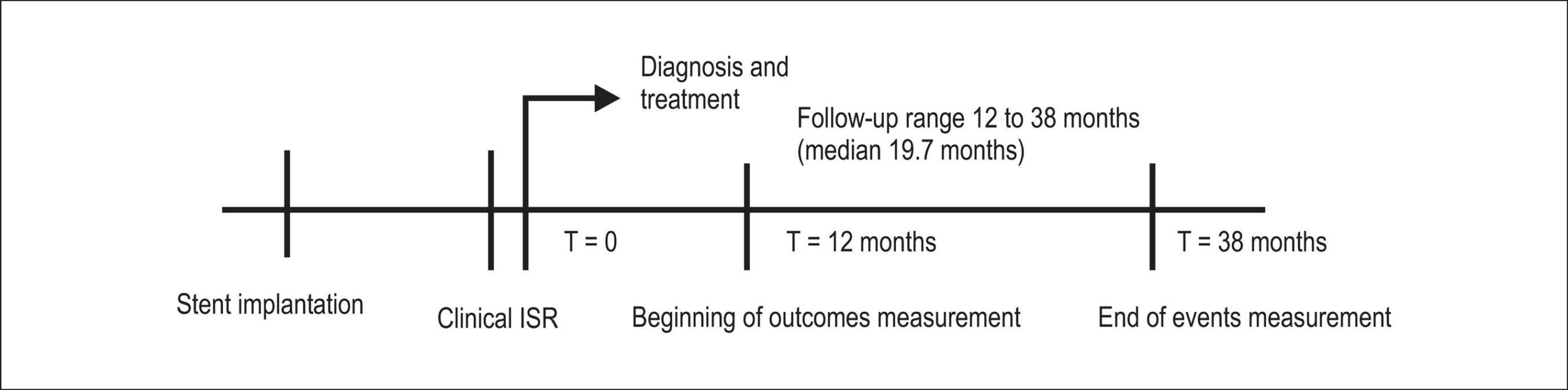
Describe the clinical and angiographic characteristics of CISR and the outcomes over a minimum follow-up of 12 months after its diagnosis and treatment.

Methods:

We analyzed in 110 consecutive patients with CISR the clinical presentation, angiographic characteristics, treatment and combined primary outcomes (cardiovascular death, nonfatal acute myocardial infarction [AMI]) and combined secondary (unstable angina with hospitalization, target vessel revascularization and target lesion revascularization) during a minimal follow-up of one year.

Results:

Mean age was 61 ± 11 years (68.2% males). Clinical presentations included acute coronary syndrome (ACS) in 62.7% and proliferative ISR in 34.5%. CISR was treated with implantation of drug-eluting stents (DES) in 36.4%, Bare Metal Stent (BMS) in 23.6%, myocardial revascularization surgery in 18.2%, balloon angioplasty in 15.5% and clinical treatment in 6.4%. During a median follow-up of 19.7 months, the primary outcome occurred in 18 patients, including 6 (5.5%) deaths and 13 (11.8%) AMI events. Twenty-four patients presented a secondary outcome. Predictors of the primary outcome were CISR with DES (HR = 4.36 [1.44–12.85]; p = 0.009) and clinical treatment for CISR (HR = 10.66 [2.53–44.87]; p = 0.001). Treatment of CISR with BMS (HR = 4.08 [1.75–9.48]; p = 0.001) and clinical therapy (HR = 6.29 [1.35–29.38]; p = 0.019) emerged as predictors of a secondary outcome.

Conclusion:

Patients with CISR present in most cases with ACS and with a high frequency of adverse events during a medium-term follow-up.

  • Coronary Restenosis
  • Graft Occlusion, Vascular
  • Myocardial Infarction
  • Myocardial Ischemia
  • Stents
Read Full Article
Creative Commons Attribution (CC BY) Creative Commons license
03/02/2015 DOI: 10.5935/abc.20140216 Views 2

How to cite this article

EndNote RIS

Electronic Document Format (Vancouver)

Ge J. Rapamycin Combined with α-Cyanoacrylate Contributes to Inhibiting Intimal Hyperplasia in Rat Models. Arquivos Brasileiros de Cardiologia 2018;112(1):3-10.

Electronic Document Format (ABNT)

Ge, Jianjun. Rapamycin Combined with α-Cyanoacrylate Contributes to Inhibiting Intimal Hyperplasia in Rat Models. Arquivos Brasileiros de Cardiologia, v. 112, n. 1, p. 3-10, Dec. 2018.

Electronic Document Format (APA)

Ge, J. (2018). Rapamycin Combined with α-Cyanoacrylate Contributes to Inhibiting Intimal Hyperplasia in Rat Models. Arquivos Brasileiros de Cardiologia, 112(1), 3-10.

Electronic Document Format (ISO)

Ge, Jianjun. Rapamycin Combined with α-Cyanoacrylate Contributes to Inhibiting Intimal Hyperplasia in Rat Models. Arquivos Brasileiros de Cardiologia [online]. 2018, vol. 112, n. 1, [cited 2026-10-14], pp. 3-10. Available from: <https://journals.cardiol.br/en/article/rapamycin-combined-with-%ce%b1-cyanoacrylate-contributes-to-inhibiting-intimal-hyperplasia-in-rat-models/>. ISSN 0066-782X

EndNote RIS

Electronic Document Format (Vancouver)

Marino BCA, Nascimento GA, Rabelo W, Marino MA, Marino RL, Ribeiro ALP. Clinical Coronary In-Stent Restenosis Follow-Up after Treatment and Analyses of Clinical Outcomes. Arquivos Brasileiros de Cardiologia 2015;104(5):375-86.

Electronic Document Format (ABNT)

Marino, Barbara Campos Abreu; Nascimento, Guilherme Abreu; Rabelo, Walter; Marino, Marcos Antônio; Marino, Roberto Luiz; Ribeiro, Antonio Luiz Pinho. Clinical Coronary In-Stent Restenosis Follow-Up after Treatment and Analyses of Clinical Outcomes. Arquivos Brasileiros de Cardiologia, v. 104, n. 5, p. 375-386, Feb. 2015.

Electronic Document Format (APA)

Marino, B. C. A., Nascimento, G. A., Rabelo, W., Marino, M. A., Marino, R. L., & Ribeiro, A. L. P. (2015). Clinical Coronary In-Stent Restenosis Follow-Up after Treatment and Analyses of Clinical Outcomes. Arquivos Brasileiros de Cardiologia, 104(5), 375-386.

Electronic Document Format (ISO)

Marino, Barbara Campos Abreu and Nascimento, Guilherme Abreu and Rabelo, Walter and Marino, Marcos Antônio and Marino, Roberto Luiz and Ribeiro, Antonio Luiz Pinho. Clinical Coronary In-Stent Restenosis Follow-Up after Treatment and Analyses of Clinical Outcomes. Arquivos Brasileiros de Cardiologia [online]. 2015, vol. 104, n. 5, [cited 2026-10-14], pp. 375-386. Available from: <https://journals.cardiol.br/en/article/clinical-coronary-in-stent-restenosis-follow-up-after-treatment-and-analyses-of-clinical-outcomes/>. ISSN 0066-782X

  • About ABC Family
  • Internal Regulation
  • Editorial Board
  • Brazilian Society of Cardiology (SBC)

Issues

SBC Guidelines

  • Videos
  • Podcasts
  • News