ABC Family Arquivos Brasileiros de Cardiologia International Journal of Cardiovascular Sciences ABC Heart Failure & Cardiomyopathy ABC Imagem Cardiovascular
Português English
ABC Family
Português English
  • About
    • About ABC Family
    • Internal Regulation
    • Editorial Board
    • Brazilian Society of Cardiology (SBC)
  • Issues
  • SBC Guidelines
  • Content
    • Videos
    • Podcasts
    • News
  • About
    • About ABC Family
    • Internal Regulation
    • Editorial Board
    • Brazilian Society of Cardiology (SBC)
  • Issues
  • SBC Guidelines
  • Content
    • Videos
    • Podcasts
    • News

ABC Family

  • ABC Family
  • Arquivos Brasileiros de Cardiologia
  • International Journal of Cardiovascular Sciences
  • ABC Heart Failure & Cardiomyopathy
  • ABC Imagem Cardiovascular
Search in

No content found.

Journals
Ordering
Article types
Others

  1. Home
  2. Keyword: Hypereosinophilic Syndrome
Figure 1
ABCIC
Case Report

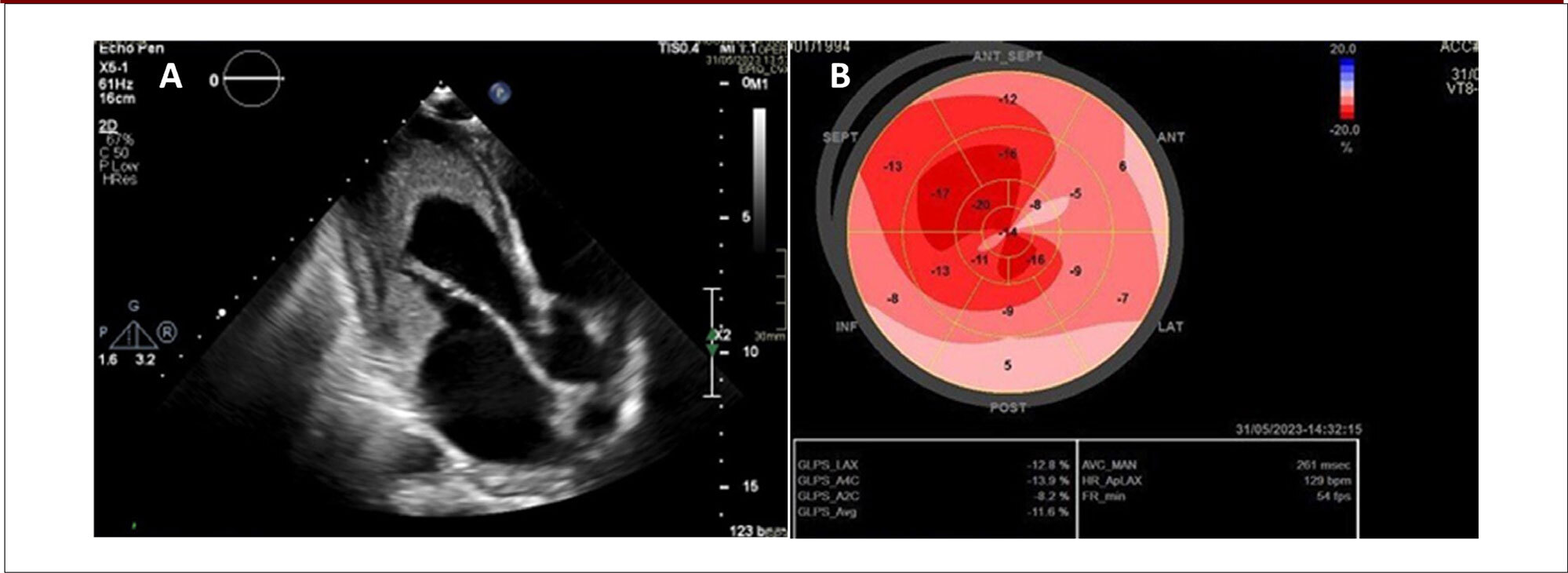
Important Mitral Regurgitation and Ventricular Dysfunction in Hypereosinophilic Syndrome: A Case Report

Marcel Pina Ciuffo et al. Lucas Mori Tais Araújo Ingrid Kowatsch Ana Clara Tude Rodrigues

Introduction

Hypereosinophilic syndrome (HES) represents a group of rare hematologic diseases characterized by an increased number of eosinophils in the peripheral blood. Once activated, these eosinophils can cause damage to host tissues and organs. Patients with HES generally present with dermatological, respiratory, and gastrointestinal signs and symptoms. Involvement of the cardiovascular system is uncommon and can lead to serious consequences such as heart failure, arrhythmias, and thromboembolic phenomena.

This article describes a case of eosinophilic endomyocardial disease, also known as Loeffler syndrome, a manifestation of HES characterized by eosinophil-mediated cardiac damage. Despite adequate treatment and control of the hematologic disease, the patient developed biventricular systolic dysfunction and important mitral regurgitation (MR).

[…]
  • Heart Failure
  • Hypereosinophilic Syndrome
  • Mitral Valve Insufficiency
Read Full Article
Creative Commons Attribution (CC BY) Creative Commons license
27/06/2025 DOI: 10.36660/abcimg.20250029i
Cardiac Abnormalities in Hypereosinophilic Syndromes
ABC
Review Article

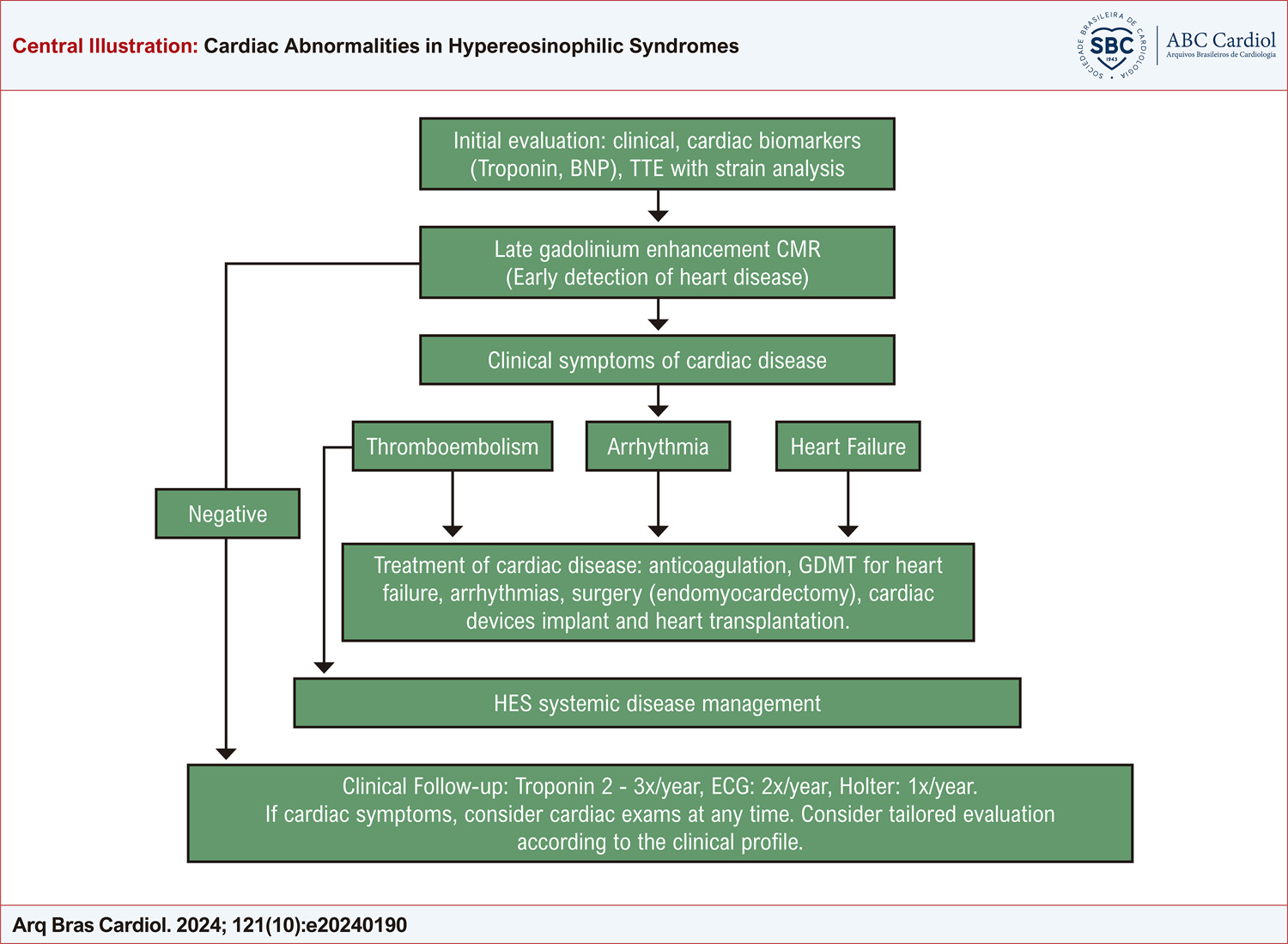
Cardiac Abnormalities in Hypereosinophilic Syndromes

Viviane Tiemi Hotta et al. Rafael Ruas Nastari Gardênia da Silva Lobo Oishi Alexandre Eiji Kayano … Juliana Alzira Gonzales Oliveira Ruiza Gonçalves Rocha Ana Olga Mocumbi Fernanda Salles Seguro José Eduardo Krieger Fábio Fernandes Vera Maria Cury Salemi

Abstract

Hypereosinophilia (HE) is defined as an eosinophil count exceeding 1500 cells/microL in peripheral blood in two tests, performed with an interval of at least one month and/or anatomopathological confirmation of HE, with eosinophils comprising more than 20% of all nucleated cells in the bone marrow. Hypereosinophilic syndrome (HES) indicates the presence of HE with organ involvement due to eosinophil action, which can be classified as primary (or neoplastic), secondary (or reactive), and idiopathic. Cardiac involvement occurs in up to 5% of cases in the acute phase and 20% of the chronic phase of the disease, ranging from oligosymptomatic cases to fulminant acute myocarditis or chronic restrictive cardiomyopathy (Loeffler endomyocarditis). However, the degree of cardiac dysfunction does not directly correlate with the degree of eosinophilia. The cardiac involvement of HES occurs in three phases: initial necrotic, thrombotic, and finally necrotic. It can manifest as heart failure, arrhythmias, and thromboembolic phenomena. The diagnosis of cardiopathy is based on multimodality imaging, with an emphasis on the importance of echocardiography (echo) as the primary examination. TTE with enhanced ultrasound agents can be used for better visualization, allowing greater accuracy in assessing ventricular apex, and myocardial deformation indices, such as longitudinal strain, may be reduced, especially in the ventricular apex (reverse apical sparing). Cardiac magnetic resonance imaging allows the characterization of subendocardial late gadolinium enhancement, and endomyocardial biopsy is considered the gold standard in diagnosing cardiopathy. Treatment is based on the etiology of HES.

  • eosinophils
  • Heart Failure
  • Hypereosinophilic Syndrome
  • Restrictive cardiomyopathy
Read Full Article
Creative Commons Attribution (CC BY) Creative Commons license
25/11/2024 DOI: 10.36660/abc.20240190i Views 1
Figure 1
ABCIC
Case Report

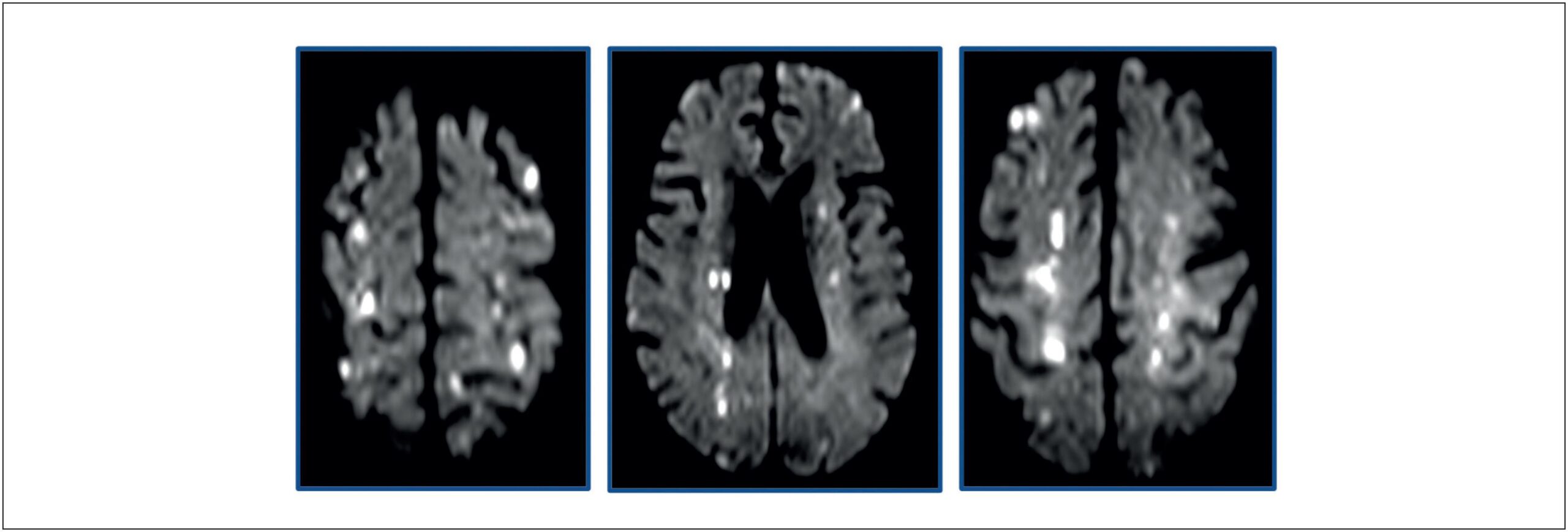
Aortic Valvulitis in Hypereosinophilic Syndrome: A Case Report

Mariano Gaston Bergier et al. Rocío Blanco Santiago Decotto Anibal Arias

Introduction

Hypereosinophilic syndromes are characterized by the sustained overproduction of eosinophils, which can infiltrate various organs and release toxins that damage tissues. Causes of increased eosinophils include 1) primary or neoplastic causes (e.g., stem cell, myeloid, or eosinophil neoplasia, and clonal disorders); 2) secondary or reactive causes (e.g., parasitic infections, solid tumors, and T-cell lymphomas); 3) idiopathic causes: part of specific syndromes (e.g., Churg-Strauss); and 4) hypereosinophilia of unknown significance, when there is no organic damage.

When specifically discussing rheumatic syndromes, the most common one is eosinophilic granulomatosis with polyangiitis, formerly known as Churg-Strauss disease. This vasculitis affects small and medium-sized arteries, primarily affecting the skin and lungs. However, it is a multisystem disorder that can affect kidneys, heart, and nervous system as well. This condition is often associated with chronic rhinosinusitis, asthma, and eosinophilia. ANCA antibodies are usually present, except in cases where the heart is involved. In such cases, ANCA antibodies are usually negative, but eosinophil counts remain elevated. Whenever possible, confirmatory diagnosis should be confirmed through an endomyocardial biopsy.,

[…]

  • Aortic Valve Disease
  • Hypereosinophilic Syndrome
  • Stroke
Read Full Article
Creative Commons Attribution (CC BY) Creative Commons license
20/09/2024 DOI: 10.36660/abcimg.20240055i Views 1

How to cite this article

EndNote RIS

Electronic Document Format (Vancouver)

Ciuffo MP, Mori L, Araújo T, Kowatsch I, Rodrigues ACT. Important Mitral Regurgitation and Ventricular Dysfunction in Hypereosinophilic Syndrome: A Case Report. ABC Imagem Cardiovascular 2025;38(2):e20250029.

Electronic Document Format (ABNT)

Ciuffo, Marcel Pina; Mori, Lucas; Araújo, Tais; Kowatsch, Ingrid; Rodrigues, Ana Clara Tude. Important Mitral Regurgitation and Ventricular Dysfunction in Hypereosinophilic Syndrome: A Case Report. ABC Imagem Cardiovascular, v. 38, n. 2, e20250029, Jun. 2025.

Electronic Document Format (APA)

Ciuffo, M. P., Mori, L., Araújo, T., Kowatsch, I., & Rodrigues, A. C. T. (2025). Important Mitral Regurgitation and Ventricular Dysfunction in Hypereosinophilic Syndrome: A Case Report. ABC Imagem Cardiovascular, 38(2), e20250029.

Electronic Document Format (ISO)

Ciuffo, Marcel Pina and Mori, Lucas and Araújo, Tais and Kowatsch, Ingrid and Rodrigues, Ana Clara Tude. Important Mitral Regurgitation and Ventricular Dysfunction in Hypereosinophilic Syndrome: A Case Report. ABC Imagem Cardiovascular [online]. 2025, vol. 38, n. 2, [cited 2026-10-14], e20250029. Available from: <https://journals.cardiol.br/en/article/important-mitral-regurgitation-and-ventricular-dysfunction-in-hypereosinophilic-syndrome-a-case-report/>. ISSN 2318-8219

EndNote RIS

Electronic Document Format (Vancouver)

Hotta VT, Nastari RR, Oishi GSL, Kayano AE, Oliveira JAG, Rocha RG, Mocumbi AO, et al. Cardiac Abnormalities in Hypereosinophilic Syndromes. Arquivos Brasileiros de Cardiologia 2024;121(10):e20240190.

Electronic Document Format (ABNT)

Hotta, Viviane Tiemi; Nastari, Rafael Ruas; Oishi, Gardênia da Silva Lobo; Kayano, Alexandre Eiji; Oliveira, Juliana Alzira Gonzales; Rocha, Ruiza Gonçalves; Mocumbi, Ana Olga; Seguro, Fernanda Salles; Krieger, José Eduardo; Fernandes, Fábio; Salemi, Vera Maria Cury. Cardiac Abnormalities in Hypereosinophilic Syndromes. Arquivos Brasileiros de Cardiologia, v. 121, n. 10, e20240190, Nov. 2024.

Electronic Document Format (APA)

Hotta, V. T., Nastari, R. R., Oishi, G. S. L., Kayano, A. E., Oliveira, J. A. G., Rocha, R. G., Mocumbi, A. O., Seguro, F. S., Krieger, J. E., Fernandes, F., & Salemi, V. M. C. (2024). Cardiac Abnormalities in Hypereosinophilic Syndromes. Arquivos Brasileiros de Cardiologia, 121(10), e20240190.

Electronic Document Format (ISO)

Hotta, Viviane Tiemi and Nastari, Rafael Ruas and Oishi, Gardênia da Silva Lobo and Kayano, Alexandre Eiji and Oliveira, Juliana Alzira Gonzales and Rocha, Ruiza Gonçalves and Mocumbi, Ana Olga and Seguro, Fernanda Salles and Krieger, José Eduardo and Fernandes, Fábio and Salemi, Vera Maria Cury. Cardiac Abnormalities in Hypereosinophilic Syndromes. Arquivos Brasileiros de Cardiologia [online]. 2024, vol. 121, n. 10, [cited 2026-10-14], e20240190. Available from: <https://journals.cardiol.br/en/article/cardiac-abnormalities-in-hypereosinophilic-syndromes/>. ISSN 0066-782X

EndNote RIS

Electronic Document Format (Vancouver)

Bergier MG, Blanco R, Decotto S, Arias A. Aortic Valvulitis in Hypereosinophilic Syndrome: A Case Report. ABC Imagem Cardiovascular 2024;37(3):e20240055.

Electronic Document Format (ABNT)

Bergier, Mariano Gaston; Blanco, Rocío; Decotto, Santiago; Arias, Anibal. Aortic Valvulitis in Hypereosinophilic Syndrome: A Case Report. ABC Imagem Cardiovascular, v. 37, n. 3, e20240055, Sep. 2024.

Electronic Document Format (APA)

Bergier, M. G., Blanco, R., Decotto, S., & Arias, A. (2024). Aortic Valvulitis in Hypereosinophilic Syndrome: A Case Report. ABC Imagem Cardiovascular, 37(3), e20240055.

Electronic Document Format (ISO)

Bergier, Mariano Gaston and Blanco, Rocío and Decotto, Santiago and Arias, Anibal. Aortic Valvulitis in Hypereosinophilic Syndrome: A Case Report. ABC Imagem Cardiovascular [online]. 2024, vol. 37, n. 3, [cited 2026-10-14], e20240055. Available from: <https://journals.cardiol.br/en/article/aortic-valvulitis-in-hypereosinophilic-syndrome-a-case-report/>. ISSN 2318-8219

  • About ABC Family
  • Internal Regulation
  • Editorial Board
  • Brazilian Society of Cardiology (SBC)

Issues

SBC Guidelines

  • Videos
  • Podcasts
  • News