ABC Family Arquivos Brasileiros de Cardiologia International Journal of Cardiovascular Sciences ABC Heart Failure & Cardiomyopathy ABC Imagem Cardiovascular
Português English
ABC Family
Português English
  • About
    • About ABC Family
    • Internal Regulation
    • Editorial Board
    • Brazilian Society of Cardiology (SBC)
  • Issues
  • SBC Guidelines
  • Content
    • Videos
    • Podcasts
    • News
  • About
    • About ABC Family
    • Internal Regulation
    • Editorial Board
    • Brazilian Society of Cardiology (SBC)
  • Issues
  • SBC Guidelines
  • Content
    • Videos
    • Podcasts
    • News

ABC Family

  • ABC Family
  • Arquivos Brasileiros de Cardiologia
  • International Journal of Cardiovascular Sciences
  • ABC Heart Failure & Cardiomyopathy
  • ABC Imagem Cardiovascular
Search in

No content found.

Journals
Ordering
Article types
Others

  1. Home
  2. Keyword: HIV Infection
ABC
Editorial

For which HIV Patients Aspirin and Statins are Good?

Théo Pezel et al. Layde R. Paim Otávio R. Coelho-Filho

While advances in antiretroviral treatment have revolutionized the prognosis of human immunodeficiency (HIV)-infected patients, cardiovascular complications remain the leading cause of death in these patients mainly due to an increased cardiovascular risk compared to the general population. Cardiovascular prevention programs have highlighted the importance of controlling traditional risk factors in risk evaluation strategies. However, HIV-infected individuals at low cardiovascular risk have a considerable residual cardiovascular risk for events that may justify additional preventive treatment. Indeed, compared with non-HIV-infected individuals, inflammation levels are higher in HIV-infected patients, even those with viral control, and this inflammation is an important factor in the genesis of atherosclerosis. Therefore, effective cardiovascular prevention strategies targeting HIV population are needed. In the therapeutic arsenal of cardiovascular prevention, aspirin and statins are the cornerstones of the management of HIV-infected patients. Both drugs have pleiotropic effects, including immunomodulatory, anti-thrombogenic, and anti-inflammatory effects, that improve endothelial function and prevent the progression of carotid thickening in these patients. However, the prescription of aspirin and statins in HIV-infected patients remains largely suboptimal, with only 50% of patients adequately treated. Although several studies have investigated the effects of statins and aspirin in decreasing inflammation, the results of these studies are contradictory.,

In this issue of the Arquivos Brasileiros de Cardiologia, Santos Jr et al. report the effect of the use of a combination of atorvastatin and aspirin for six months regarding the endothelial function improvement and carotid thickness in a cohort of 38 patients with HIV infection with viral control. Improvement in endothelial function was assessed using the brachial artery flow-mediated dilation. The authors have shown a relationship between treatment response and age; a stronger response was observed in individuals older than 40 years. This result may be explained by the fact that probably older individuals had a longer exposure to inflammation caused by HIV. Several studies have shown that these same patients also have a higher cardiovascular risk due to chronic inflammation. Therefore, this study supports the prescription of a combination of atorvastatin and aspirin for the primary prevention of cardiovascular events in HIV-infected patients, particularly for those over 40 years of age. In addition, some of the findings of this study suggest that HIV-positive women may have a better response to this drug combination than men. Considering that the currently used triple therapy has a significant effect on inflammation, a mechanism intrinsically linked to the progression of atherosclerosis could explain the greater response in women than in men.

[…]
  • Anti-HIV Agents/therapeutic use
  • Aspirin
  • Atherosclerosis
  • Cardiovascular Diseases/complications
  • Endothelium
  • HIV
  • HIV Infection
  • Mortality
  • Risk Factors
  • Statins
Read Full Article
Creative Commons Attribution (CC BY) Creative Commons license
06/09/2021 DOI: 10.36660/abc.20210560
Figure 1
ABC
Brief Communication

HIV-Infected Naïve Patients Exhibit Endothelial Dysfunction Concomitant with Decreased Natural Antibodies Against Defined Apolipoprotein B Autoantigens

Henrique Andrade R. Fonseca et al. Magnus Gidlund Viviane Rodrigues Sant’Anna Esteferson Rodrigues Fernandes … Francisco A. H. Fonseca Maria Cristina Izar

Abstract

Backgorund:

Traditional and HIV-defined risk factors may be associated with an increase in cardiovascular events. Recent studies have suggested that the humoral immune response to modified LDL may be associated with the process of atherosclerosis.

Objectives:

To evaluate the presence of anti-oxLDL and apolipoprotein B-derived peptides in the blood, and their association with the endothelial function in HIV-infection.

Methods:

This study consecutively included subjects matched for age, gender, and demographic data in two groups: (1) HIV-infected and naïve for antiviral therapy and (2) uninfected individuals. Subclinical atherosclerosis was assessed by intimal-media thickness, using ultrasonography of the carotid arteries. Endothelial function was determined by flow-mediated dilatation (FMD) of the brachial artery by ultrasonography. Autoantibodies (IgM, IgG) anti-oxidized low-density lipoprotein (oxLDL), anti-apolipoprotein B-peptide fragments (ApoB-D and 0033G-Cys peptides), and cytokine levels were evaluated by ELISA.

Results:

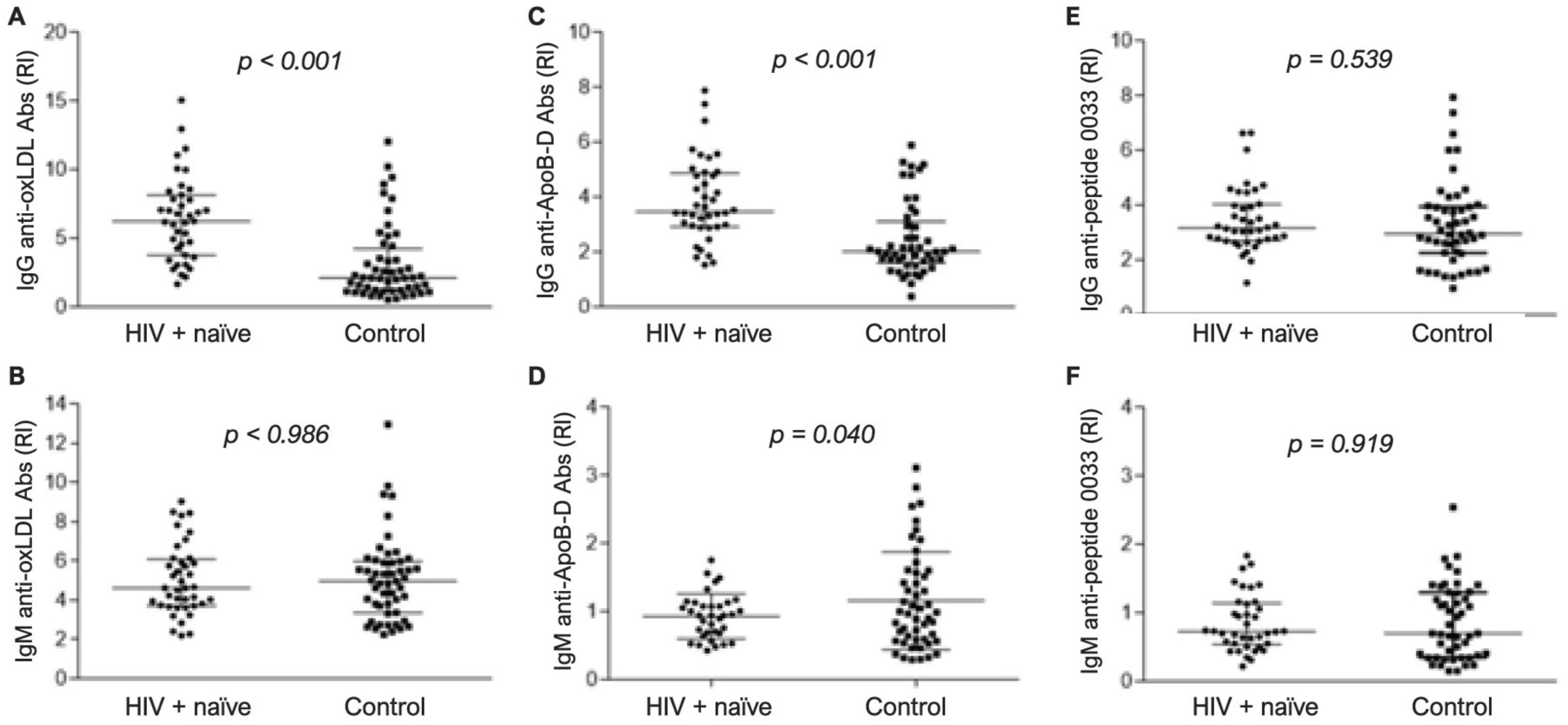
This study’s results showed no difference in subclinical atherosclerosis between groups; however, HIV-infected subjects showed a lower FMD, when compared to non-infected subjects. Therefore, HIV-infected subjects showed higher levels of inflammatory cytokines, titers of IgG anti-oxLDL, and IgG anti-ApoB-D. In contrast, titers of IgM anti-ApoB-D were lower in HIV-infected individuals and associated with reduced endothelial functions.

Conclusions:

This study’s results show that HIV infection, in naïve subjects, is associated with endothelial dysfunction and a decline of natural antibodies to apo-B antigens.

  • Apolipoproteunes B, Carotid Arteries/ultrasonography
  • Atherosclerosis
  • Endothelium, Vascular
  • HIV Infection
Read Full Article
Creative Commons Attribution (CC BY) Creative Commons license
16/04/2021 DOI: 10.36660/abc.20200062 Views 1

How to cite this article

EndNote RIS

Electronic Document Format (Vancouver)

Pezel T, Paim LR, Coelho-Filho OR. For which HIV Patients Aspirin and Statins are Good?. Arquivos Brasileiros de Cardiologia 2021;117(2):376-7.

Electronic Document Format (ABNT)

Pezel, Théo; Paim, Layde R.; Coelho-Filho, Otávio R.. For which HIV Patients Aspirin and Statins are Good?. Arquivos Brasileiros de Cardiologia, v. 117, n. 2, p. 376-377, Sep. 2021.

Electronic Document Format (APA)

Pezel, T., Paim, L. R., & Coelho-Filho, O. R. (2021). For which HIV Patients Aspirin and Statins are Good?. Arquivos Brasileiros de Cardiologia, 117(2), 376-377.

Electronic Document Format (ISO)

Pezel, Théo and Paim, Layde R. and Coelho-Filho, Otávio R.. For which HIV Patients Aspirin and Statins are Good?. Arquivos Brasileiros de Cardiologia [online]. 2021, vol. 117, n. 2, [cited 2026-10-14], pp. 376-377. Available from: <https://journals.cardiol.br/en/article/for-which-hiv-patients-aspirin-and-statins-are-good/>. ISSN 0066-782X

EndNote RIS

Electronic Document Format (Vancouver)

Fonseca HAR, Gidlund M, Sant’Anna VR, Fernandes ER, Fonseca FAH, Izar MC. HIV-Infected Naïve Patients Exhibit Endothelial Dysfunction Concomitant with Decreased Natural Antibodies Against Defined Apolipoprotein B Autoantigens. Arquivos Brasileiros de Cardiologia 2021;116(4):844-9.

Electronic Document Format (ABNT)

Fonseca, Henrique Andrade R.; Gidlund, Magnus; Sant’Anna, Viviane Rodrigues; Fernandes, Esteferson Rodrigues; Fonseca, Francisco A. H.; Izar, Maria Cristina. HIV-Infected Naïve Patients Exhibit Endothelial Dysfunction Concomitant with Decreased Natural Antibodies Against Defined Apolipoprotein B Autoantigens. Arquivos Brasileiros de Cardiologia, v. 116, n. 4, p. 844-849, Apr. 2021.

Electronic Document Format (APA)

Fonseca, H. A. R., Gidlund, M., Sant’Anna, V. R., Fernandes, E. R., Fonseca, F. A. H., & Izar, M. C. (2021). HIV-Infected Naïve Patients Exhibit Endothelial Dysfunction Concomitant with Decreased Natural Antibodies Against Defined Apolipoprotein B Autoantigens. Arquivos Brasileiros de Cardiologia, 116(4), 844-849.

Electronic Document Format (ISO)

Fonseca, Henrique Andrade R. and Gidlund, Magnus and Sant’Anna, Viviane Rodrigues and Fernandes, Esteferson Rodrigues and Fonseca, Francisco A. H. and Izar, Maria Cristina. HIV-Infected Naïve Patients Exhibit Endothelial Dysfunction Concomitant with Decreased Natural Antibodies Against Defined Apolipoprotein B Autoantigens. Arquivos Brasileiros de Cardiologia [online]. 2021, vol. 116, n. 4, [cited 2026-10-14], pp. 844-849. Available from: <https://journals.cardiol.br/en/article/hiv-infected-naive-patients-exhibit-endothelial-dysfunction-concomitant-with-decreased-natural-antibodies-against-defined-apolipoprotein-b-autoantigens/>. ISSN 0066-782X

  • About ABC Family
  • Internal Regulation
  • Editorial Board
  • Brazilian Society of Cardiology (SBC)

Issues

SBC Guidelines

  • Videos
  • Podcasts
  • News