ABC Family Arquivos Brasileiros de Cardiologia International Journal of Cardiovascular Sciences ABC Heart Failure & Cardiomyopathy ABC Imagem Cardiovascular
Português English
ABC Family
Português English
  • About
    • About ABC Family
    • Internal Regulation
    • Editorial Board
    • Brazilian Society of Cardiology (SBC)
  • Issues
  • SBC Guidelines
  • Content
    • Videos
    • Podcasts
    • News
  • About
    • About ABC Family
    • Internal Regulation
    • Editorial Board
    • Brazilian Society of Cardiology (SBC)
  • Issues
  • SBC Guidelines
  • Content
    • Videos
    • Podcasts
    • News

ABC Family

  • ABC Family
  • Arquivos Brasileiros de Cardiologia
  • International Journal of Cardiovascular Sciences
  • ABC Heart Failure & Cardiomyopathy
  • ABC Imagem Cardiovascular
Search in

No content found.

Journals
Ordering
Article types
Others

  1. Home
  2. Keyword: Heart Septum
Figure 1
ABCHF
Case Report

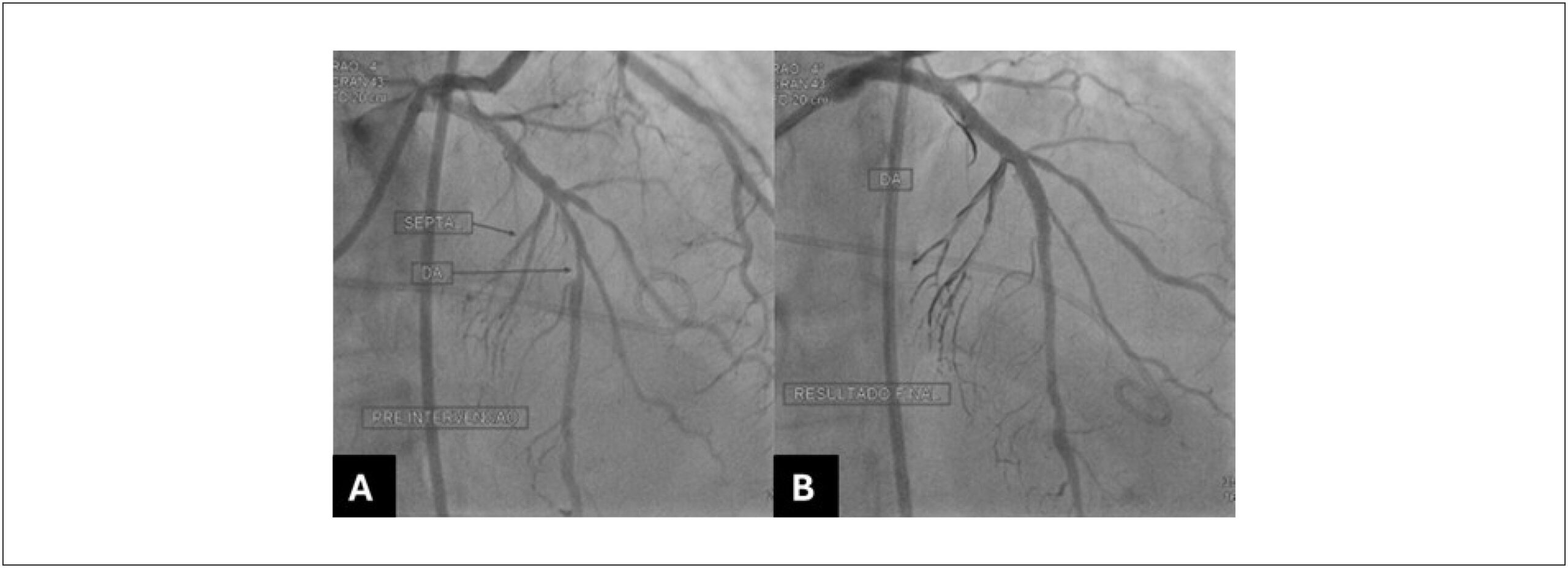
Septal Artery Embolization with EVOH in Obstructive Hypertrophic Cardiomyopathy Associated with Percutaneous Treatment of Coronary Disease

Victor Tavares Trindade et al. Núbia Andrade Silva Nassandro Machado Garcia Júnior Anna Luiza Souza … Maurício Lopes Prudente Giulliano Gardenghi

Introduction

Hypertrophic cardiomyopathy (HCM) is the most common genetic heart disease. It has an autosomal dominant inheritance pattern, and to date, 11 genes have been identified among the 1400 mutations involved in its pathogenesis. The most common are the β-myosin heavy chain (MYH7), myosin-binding protein C (MYBPC3), and troponin T (TNNT2), which encode cardiac sarcomeric proteins. Three mutations are involved in its pathophysiology: missense, insertions, and deletions. The most common mutation is missense, which causes a punctual exchange between two nucleic acids, resulting in a change in the nucleotide conformation, leading to the formation of a codon that codes for a different amino acid.,

HCM promotes changes in cardiac structure, with left ventricular hypertrophy (LVH) without another underlying etiology being the most common anatomical alteration. Its symptomatology varies according to the HCM profiles, and can present asymptomatically, with minor symptoms such as dyspnea on exertion, precordialgia, fatigue, presyncope and syncope, or in a severe form, evolving with advanced heart failure (HF), ventricular and atrial arrhythmias, and even sudden cardiac death.,

[…]
  • Angioplasty
  • Coronary Artery Disease
  • Heart Septum
  • Hypertrophic Cardiomyopathy
  • Therapeutic Embolization
Read Full Article
Creative Commons Attribution (CC BY) Creative Commons license
22/12/2025 DOI: 10.36660/abchf.20250019i
Morphological basis for the study of the interatrial septum in the human fetus
ABC
Artigo Original

Morphological basis for the study of the interatrial septum in the human fetus

Hugo Becker Amaral et al. Paulo Zielinsky Aron Ferreira da Silveira Ijoni Costabeber … Luiz Henrique Nicoloso Olmiro Cezimbra de Souza Filho Marcelo Salum João Luiz Manica Juliana Silveira Zanettini Ane Micheli Costabeber

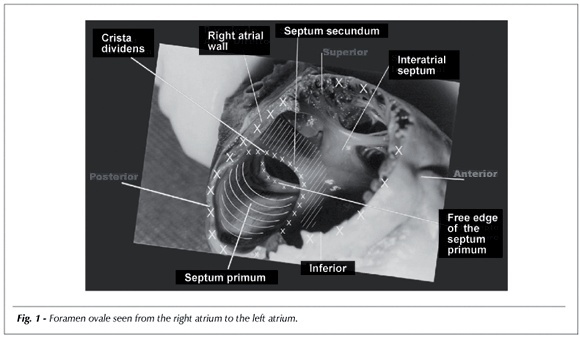
OBJECTIVE: To describe morphological features of the interatrial septum in normal fetuses, especially foramen ovale (FO) and septum primum (SP), in order to compare septum primum excursion with foramen ovale diameter. METHODS: Septum primum excursion (SPE) toward the left atrium (LA) and foramen ovale diameter (FOD) were measured in the hearts of ten formaldehyde-fixed human fetuses ranging from 28 to 36 weeks of gestation. Histological sections were obtained from the foramen ovale (FO), septum primum (SP), septum secundum (SS), left atrium (LA), and right atrium (RA). RESULTS: FOD and SPE measurements were the following: FOD 3.1-3.5 mm and SPE 2.8-3.1 mm in three fetuses with presumed gestational age (GA) of 28 weeks; FOD 3.3-3.5 mm, and SP excursion 4.0-5.0 mm in four fetuses with presumed GA of 34 weeks, plus FOD 3.3-4.5 mm and SPE 6.0-9.0 in three fetuses with presumed GA of 36 weeks. Cardiac muscular fibers were identified in both the septum primum and secundum. CONCLUSION: Based on its muscular components, it may be suggested that SP is active in character, influencing blood flow through the FO, SP mobility, and its excursion into the LA.

  • fetal heart
  • Heart Septal Defects, Atrial
  • Heart Septum
Read Full Article
Creative Commons Attribution (CC BY) Creative Commons license
15/06/2007 DOI: 10.1590/S0066-782X2007000500010 Views 2
Radiofrequency catheter ablation of left accessory pathways by transeptal approach
ABC
Artigo Original

Radiofrequency catheter ablation of left accessory pathways by transeptal approach

Márcio Augusto Silva et al. Elenir Nadalin Alessandro Kraemmer Gel Roberto Marmitt Berardi … José Carlos Moura Jorge Cláudio L. Pereira da Cunha

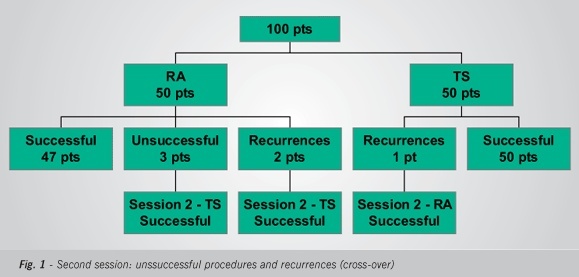
OBJECTIVE: To study a series of patients submitted to radiofrequency catheter ablation (RFA) of left accessory pathways (AP) using the transeptal approach (TSA) as compared to the conventional retrograde arterial approach (RAA). METHODS: One hundred consecutive patients (56 male; mean age of 34.3 ± 11 years) with 100 left APs (62 overt and 38 concealed) underwent catheter ablation using the TS method (50 patients) and the RA method (50 patients) in an alternate fashion. The analysis was performed according to the intention-to-treat principle. RESULTS: The transeptal puncture was successfully performed in 48 patients (96%). This access allowed primary success in the ablation in all the patients without any complication. When we compared this approach with the RAA there was no difference as regards the primary success (p = 0.2), recurrence rate (p = 1.0), fluoroscopy time (p = 0.63) and total time (p = 0.47). One patient in the RAA group presented a vascular complication. The TSA allowed shorter ablation times (p=0.01) and smaller number of radiofrequency applications (p = 0.003) as compared to the conventional RAA. The patients who had recurrence and unsuccessful ablation in the first session in each approach underwent another session with the opposite technique (cross-over), with a final ablation success rate of 100%. CONCLUSION: The TS and RA approaches showed similar efficacy and safety for the ablation of left accessory pathways. The TSA allowed shorter ablation times and smaller number of radiofrequency applications. When the techniques were used in a complementary fashion, they increased the final efficacy of the ablation.

  • Catheter Ablation
  • Heart Septum
  • Radio Waves
  • Tachycardia, Supraventricular
Read Full Article
Creative Commons Attribution (CC BY) Creative Commons license
29/05/2006 DOI: 10.1590/S0066-782X2006000500002 Views 1

How to cite this article

EndNote RIS

Electronic Document Format (Vancouver)

Trindade VT, Silva NA, Garcia Júnior NM, Souza AL, Prudente ML, Gardenghi G. Septal Artery Embolization with EVOH in Obstructive Hypertrophic Cardiomyopathy Associated with Percutaneous Treatment of Coronary Disease. ABC Heart Fail Cardiomyop 2025;5(3):e20250019.

Electronic Document Format (ABNT)

Trindade, Victor Tavares; Silva, Núbia Andrade; Garcia Júnior, Nassandro Machado; Souza, Anna Luiza; Prudente, Maurício Lopes; Gardenghi, Giulliano. Septal Artery Embolization with EVOH in Obstructive Hypertrophic Cardiomyopathy Associated with Percutaneous Treatment of Coronary Disease. ABC Heart Fail Cardiomyop, v. 5, n. 3, e20250019, Dec. 2025.

Electronic Document Format (APA)

Trindade, V. T., Silva, N. A., Garcia Júnior, N. M., Souza, A. L., Prudente, M. L., & Gardenghi, G. (2025). Septal Artery Embolization with EVOH in Obstructive Hypertrophic Cardiomyopathy Associated with Percutaneous Treatment of Coronary Disease. ABC Heart Fail Cardiomyop, 5(3), e20250019.

Electronic Document Format (ISO)

Trindade, Victor Tavares and Silva, Núbia Andrade and Garcia Júnior, Nassandro Machado and Souza, Anna Luiza and Prudente, Maurício Lopes and Gardenghi, Giulliano. Septal Artery Embolization with EVOH in Obstructive Hypertrophic Cardiomyopathy Associated with Percutaneous Treatment of Coronary Disease. ABC Heart Fail Cardiomyop [online]. 2025, vol. 5, n. 3, [cited 2026-10-14], e20250019. Available from: <https://journals.cardiol.br/en/article/septal-artery-embolization-with-evoh-in-obstructive-hypertrophic-cardiomyopathy-associated-with-percutaneous-treatment-of-coronary-disease/>

EndNote RIS

Electronic Document Format (Vancouver)

Amaral HB, Zielinsky P, Silveira AF, Costabeber I, Nicoloso LH, Souza Filho OC, Salum M, et al. Morphological basis for the study of the interatrial septum in the human fetus. Arquivos Brasileiros de Cardiologia 2007;88(5):559-64.

Electronic Document Format (ABNT)

Amaral, Hugo Becker; Zielinsky, Paulo; Silveira, Aron Ferreira da; Costabeber, Ijoni; Nicoloso, Luiz Henrique; Souza Filho, Olmiro Cezimbra de; Salum, Marcelo; Manica, João Luiz; Zanettini, Juliana Silveira; Costabeber, Ane Micheli. Morphological basis for the study of the interatrial septum in the human fetus. Arquivos Brasileiros de Cardiologia, v. 88, n. 5, p. 559-564, Jun. 2007.

Electronic Document Format (APA)

Amaral, H. B., Zielinsky, P., Silveira, A. F. , Costabeber, I., Nicoloso, L. H., Souza Filho, O. C. , Salum, M., Manica, J. L., Zanettini, J. S., & Costabeber, A. M. (2007). Morphological basis for the study of the interatrial septum in the human fetus. Arquivos Brasileiros de Cardiologia, 88(5), 559-564.

Electronic Document Format (ISO)

Amaral, Hugo Becker and Zielinsky, Paulo and Silveira, Aron Ferreira da and Costabeber, Ijoni and Nicoloso, Luiz Henrique and Souza Filho, Olmiro Cezimbra de and Salum, Marcelo and Manica, João Luiz and Zanettini, Juliana Silveira and Costabeber, Ane Micheli. Morphological basis for the study of the interatrial septum in the human fetus. Arquivos Brasileiros de Cardiologia [online]. 2007, vol. 88, n. 5, [cited 2026-10-14], pp. 559-564. Available from: <https://journals.cardiol.br/en/article/morphological-basis-for-the-study-of-the-interatrial-septum-in-the-human-fetus/>. ISSN 0066-782X

EndNote RIS

Electronic Document Format (Vancouver)

Silva MA, Nadalin E, Kraemmer A, Berardi GRM, Jorge JCM, Cunha CLP. Radiofrequency catheter ablation of left accessory pathways by transeptal approach. Arquivos Brasileiros de Cardiologia 2006;86(5):331-6.

Electronic Document Format (ABNT)

Silva, Márcio Augusto; Nadalin, Elenir; Kraemmer, Alessandro; Berardi, Gel Roberto Marmitt; Jorge, José Carlos Moura; Cunha, Cláudio L. Pereira da. Radiofrequency catheter ablation of left accessory pathways by transeptal approach. Arquivos Brasileiros de Cardiologia, v. 86, n. 5, p. 331-336, May. 2006.

Electronic Document Format (APA)

Silva, M. A., Nadalin, E., Kraemmer, A., Berardi, G. R. M., Jorge, J. C. M., & Cunha, C. L. P. (2006). Radiofrequency catheter ablation of left accessory pathways by transeptal approach. Arquivos Brasileiros de Cardiologia, 86(5), 331-336.

Electronic Document Format (ISO)

Silva, Márcio Augusto and Nadalin, Elenir and Kraemmer, Alessandro and Berardi, Gel Roberto Marmitt and Jorge, José Carlos Moura and Cunha, Cláudio L. Pereira da. Radiofrequency catheter ablation of left accessory pathways by transeptal approach. Arquivos Brasileiros de Cardiologia [online]. 2006, vol. 86, n. 5, [cited 2026-10-14], pp. 331-336. Available from: <https://journals.cardiol.br/en/article/radiofrequency-catheter-ablation-of-left-accessory-pathways-by-transeptal-approach/>. ISSN 0066-782X

  • About ABC Family
  • Internal Regulation
  • Editorial Board
  • Brazilian Society of Cardiology (SBC)

Issues

SBC Guidelines

  • Videos
  • Podcasts
  • News