ABC Family Arquivos Brasileiros de Cardiologia International Journal of Cardiovascular Sciences ABC Heart Failure & Cardiomyopathy ABC Imagem Cardiovascular
Português English
ABC Family
Português English
  • About
    • About ABC Family
    • Internal Regulation
    • Editorial Board
    • Brazilian Society of Cardiology (SBC)
  • Issues
  • SBC Guidelines
  • Content
    • Videos
    • Podcasts
    • News
  • About
    • About ABC Family
    • Internal Regulation
    • Editorial Board
    • Brazilian Society of Cardiology (SBC)
  • Issues
  • SBC Guidelines
  • Content
    • Videos
    • Podcasts
    • News

ABC Family

  • ABC Family
  • Arquivos Brasileiros de Cardiologia
  • International Journal of Cardiovascular Sciences
  • ABC Heart Failure & Cardiomyopathy
  • ABC Imagem Cardiovascular
Search in

No content found.

Journals
Ordering
Article types
Others

  1. Home
  2. Keyword: Heart Rate Variability
Cardiac Autonomic Neuropathy: An Emerging Cardiovascular Risk to Hemodialysis and Non-Hemodialysis Chronic Kidney Disease Patients of Primary Renal Diagnosis
IJCS
Original Article

Cardiac Autonomic Neuropathy: An Emerging Cardiovascular Risk to Hemodialysis and Non-Hemodialysis Chronic Kidney Disease Patients of Primary Renal Diagnosis

Aswin PR et al. Sandip Kumar Panda Manisha Kar Pranati Nanda Balakrishnan Kannan

Abstract

Background:

Patients with chronic kidney disease (CKD) are at higher risk of cardiovascular disease. A dysfunctional autonomic nervous system may be the underlying cause. However, very few studies have determined the status of cardiac autonomic neuropathy (CAN) in both non-hemodialysis and hemodialysis CKD patients.

Objectives:

The present study intended to determine and compare CAN in both non-hemodialysis and hemodialysis CKD patients of primary renal diagnosis only and its correlation with the progression of the disease.

Methods:

Non-hemodialysis and hemodialysis CKD patients (n = 23 in each group) of both sexes of 18 to 50 years were recruited in this cross-sectional, observational study. Resting blood pressure and heart rate (HR) were measured, and lead II ECG was recorded for analysis of time- and frequency-domain measures of heart rate variability (HRV). Mann-Whitney U test was applied to compare the variables between the two groups. Spearman correlation was conducted to examine the relationship between variables and the stage of the disease (non-hemodialysis and hemodialysis CKD). A 2-tailed p value < 0.05 was taken as the cutoff level of significance.

Results:

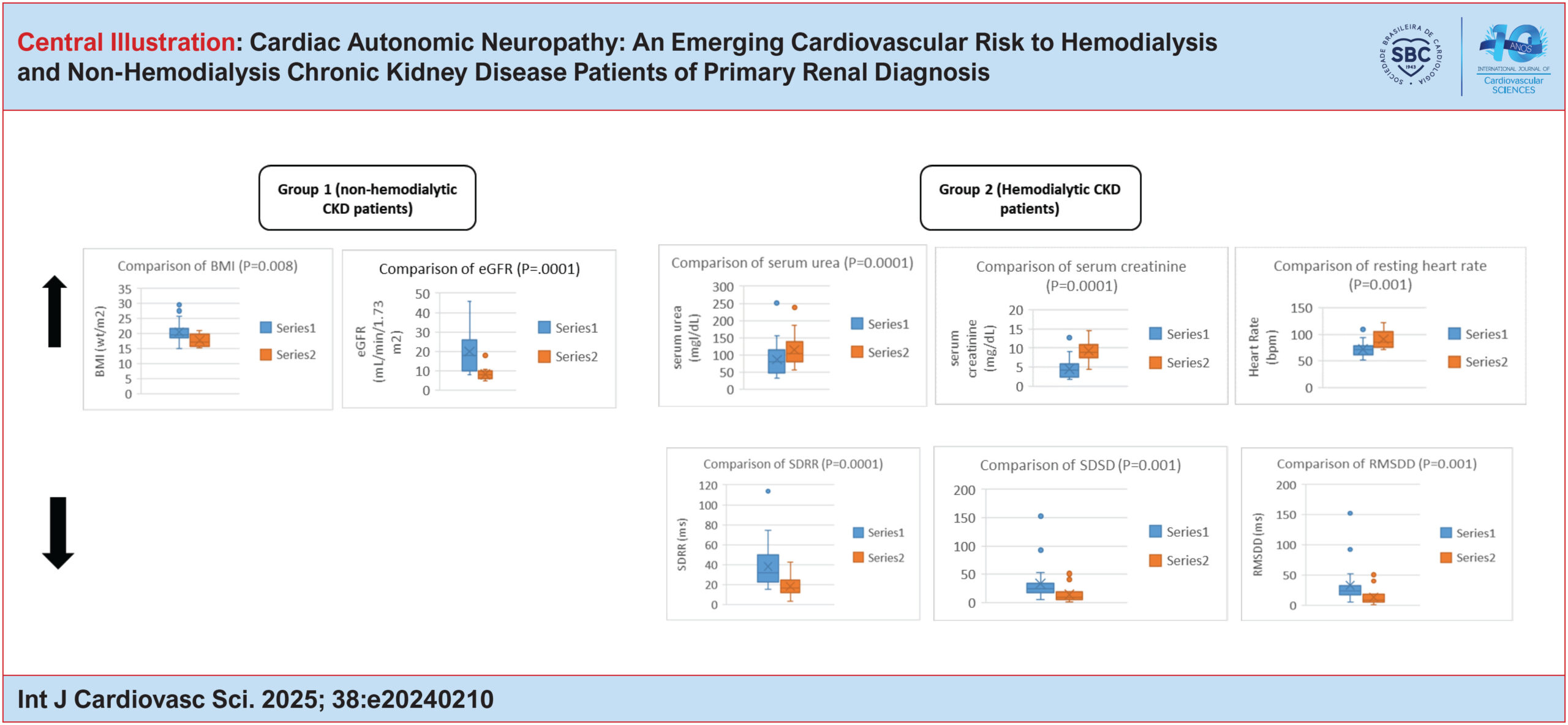
Body mass index (BMI) was significantly higher in non-hemodialysis patients (p = 0.008). Resting HR was significantly higher in the hemodialysis group (p = 0.001). Among HRV measures, standard deviation of RR intervals (SDRR; p = 0.0001), standard deviation of successive differences (SDSD; p = 0.001), and root mean square of successive RR intervals (RMSSD; p = 0.001) were significantly lower in the hemodialysis group. Peripheral blood pressure was not significantly different between the two groups. Resting HR (r = 0.498, p = 0.001) was positively associated with the end-stage renal disease. However, SDRR (r = −0.507, p = 0.001), RMSSD (r = −0.507, p = 0.001), and BMI (r = −0.427, p = 0.004) were negatively associated with end-stage renal disease.

Conclusion:

Altered autonomic function was more profound in hemodialysis patients as evidenced by increased resting HR and decreased HRV measures (SDRR, SDSD, and RMSSD). Moreover, altered autonomic function was associated with end-stage renal disease. Therefore, CKD patients may be screened for CAN for early detection of cardiovascular disease.
  • Cardiac Autonomic Neuropathy
  • chronic renal insufficiency
  • Heart Rate Variability
  • renal dialysis
Read Full Article
Creative Commons Attribution (CC BY) Creative Commons license
16/06/2025 DOI: 10.36660/ijcs.20240210 Views 1
ABC
Editorial

Understanding the Link between Visceral Fat and Heart Health

Nuno Bettencourt

Cardiovascular disease (CVD) remains a significant global health concern, with obesity and its associated metabolic abnormalities contributing substantially to CVD risk. In recent years, research has increasingly focused on the role of visceral adipose tissue (VAT) in cardiovascular health, recognizing its unique contribution to metabolic dysfunction and cardiovascular risk.,

Heart rate variability (HRV) is a measure of the variation in the time intervals between consecutive heartbeats, reflecting the balance between the sympathetic and parasympathetic nervous systems – and, therefore, serving as a valuable indicator of autonomic function and cardiovascular health. Reduced HRV is associated with increased cardiovascular risk, making it a potentially useful tool for risk assessment and monitoring in different clinical scenarios.–

[…]

  • Heart Rate Variability
  • Visceral Adipose Tissue
Read Full Article
Creative Commons Attribution (CC BY) Creative Commons license
15/07/2024 DOI: 10.36660/abc.20240288i
Heart rate recovery after treadmill electrocardiographic exercise stress test and 24-hour heart rate variability in healthy individuals
ABC
Artigo Original

Heart rate recovery after treadmill electrocardiographic exercise stress test and 24-hour heart rate variability in healthy individuals

Ivana Antelmi et al. Eliseu Yung Chuang Cesar José Grupi Maria do Rosário Dias de Oliveira Latorre Alfredo José Mansur

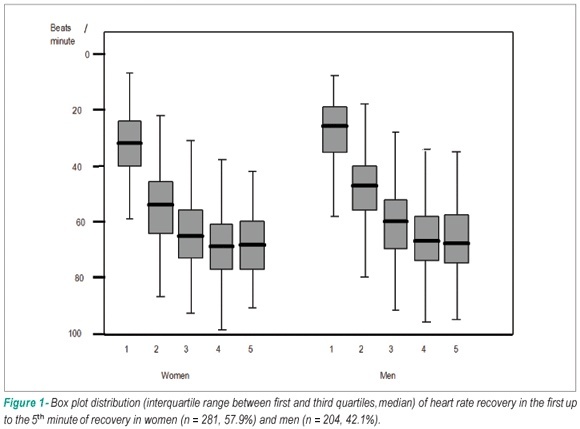
BACKGROUND: Heart rate recovery after treadmill electrocardiographic exercise stress test is modulated by the autonomic nervous system. Analysis of heart rate variability can provide useful information about autonomic control of the cardiovascular system. OBJECTIVE: The aim of the study was to test the hypothesis of association between heart recovery after treadmill electrocardiographic exercise test and heart rate variability. METHODS: We studied 485 healthy individuals aged 42± 12.1 (range 15-82) years, 281(57.9%) women, submitted to treadmill electrocardiographic exercise stress tests and heart rate variability evaluations over time (SDNN, SDANN, SDNNi, rMSSD, pNN50) and frequency (LF, HF, VLF, LF/HF ratio) domains in 24-hour ambulatory electrocardiographic monitoring. RESULTS: Heart rate recovery was 30± 12 beats in the 1st minute and 52± 13 beats in the 2nd minute after exercise. Younger individuals recovered faster from the 2nd to the 5th minute after exercise (r= 0.19-0.35, P< 0.05). Recovery was faster in women than in men (4± 1.1 beats lower in the 1st minute, p<0.001; 5.7± 1.2 beats lower in the 2nd minute, p<0.01; 4.1± 1.1 beats lower in the 3rd minute, p<0.001). There was no significant correlation between heart rate recovery and heart rate variability in 1st and 2nd minutes after exercise. SDNN, SDANN, SDNNi, rMSSD, and pNN50 indices demonstrated a significant correlation with heart rate recovery only at the 3rd and 4th minutes. CONCLUSION: The hypothesis of association between heart rate recovery and 24-hour heart rate variability in the first two minutes after exercise was not substantiated in this study. Heart rate recovery after exercise was associated with age and gender.

  • Exercise
  • Exercise Test
  • Heart Rate Variability
Read Full Article
Creative Commons Attribution (CC BY) Creative Commons license
25/06/2008 DOI: 10.1590/S0066-782X2008000600005
Diabetic cardiovascular autonomic neuropathy: risk factors, clinical impact and early diagnosis
ABC
Clinical Update

Diabetic cardiovascular autonomic neuropathy: risk factors, clinical impact and early diagnosis

Luiz Clemente de Souza Pereira Rolim et al. João Roberto de Sá Antonio Roberto Chacra Sérgio Atala Dib

Cardiovascular autonomic neuropathy (CAN) is one of the most clinically significant complications of diabetes mellitus (DM), but one of the least frequently diagnosed. In this review, we discuss the major risk factors for the development and progression of CAN in patients with DM, the natural history of autonomic neuropathy and its impact on cardiovascular disease in DM, as well as the tests for the early diagnosis and staging of CAN in the clinical practice. The bibliographic research was based on two databases: Medline and Tripdatabase, with the following descriptors: diabetic cardiovascular autonomic neuropathy and cardiovascular autonomic neuropathy and diabetes. We selected English and German articles, written between 1998 and 2007. In its initial stages (early and intermediate), CAN may be diagnosed and reversed. However, in advanced cases (severe stage), the only treatment that remains is a symptomatic one. CAN is associated with higher cardiovascular morbidity and mortality rates and poor quality of life in diabetic individuals.

  • Autonomic Nervous System
  • Cardiovascular Diseases
  • Diabetes Mellitus
  • Heart Rate Variability
  • Mortality
  • Risk Factors
Read Full Article
Creative Commons Attribution (CC BY) Creative Commons license
29/05/2008 DOI: 10.1590/S0066-782X2008000400014
Autonomic Modulation of the Heart in Systemic Arterial Hypertension
ABC
Original Article

Autonomic Modulation of the Heart in Systemic Arterial Hypertension

José Barbosa Filho et al. P. R. Benchimol-Barbosa Ivan Cordovil

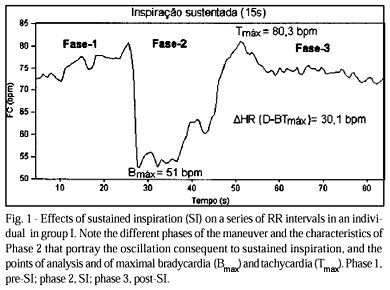
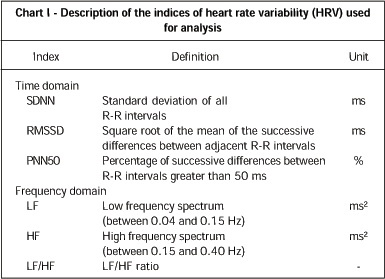
OBJECTIVE: To analyze the heart rate variability in patients with mild to moderate systemic arterial hypertension. METHODS: Thirty-two healthy (group I) and 70 systemic arterial hypertensive (group II) individuals, divided according to age (40 to 59 and 60 to 80 years old, respectively) and with a similar distribution by sex were studied. Thirty-one had left ventricular hypertrophy (LVH), 22 were overweight, and 16 had Type II diabetes mellitus. Smoking, alcohol ingestion, and sedentary habits were the same between groups. Variability in heart rate was analyzed in the time domain, using standard deviations of normal RR intervals (SDNN) and the differences between maximal brady- and tachycardia (D-BTmax) during sustained inspiration. Analysis of the frequency band of the power spectrum between 0.05 and 0.40 Hz at rest and during controlled respiration was chosen for analysis of the frequency domain. RESULTS: In both time and frequency domains, variables were lower in group II than in group I. Within groups, statistically significant variables were only found for individuals in the 40 to 59 year old group. The presence of LVH, overweight, or diabetes mellitus did not influence the variability in heart rate to a significant extent. CONCLUSION: Variability in heart rate was a valuable instrument for analyzing autonomic modulation of the heart in arterial hypertension. The autonomic system undergoes significant losses in cardio-modulatory capacity, more evident in subjects between 40 and 59 years old. In those over 60 years old, reduced variability in heart rate imposed by aging was not significantly influenced by the presence of systemic arterial hypertension.

  • autonomic cardiac modulation
  • Heart Rate Variability
  • systemic arterial hypertension
Read Full Article
Creative Commons Attribution (CC BY) Creative Commons license
31/01/2007 DOI: 10.1590/S0066-782X2002000200007 Views 1
Analysis of heart rate variability in hypertensive patients before and after treatment with angiotensin II-converting enzyme inhibitors
ABC
Artigo Original

Analysis of heart rate variability in hypertensive patients before and after treatment with angiotensin II-converting enzyme inhibitors

Antônio da Silva Menezes Júnior et al. Humberto Graner Moreira Murilo Tavares Daher

OBJECTIVE: To compare heart rate variability in normotensive and hypertensive individuals and to observe the behavior of the autonomic nervous system after treatment with angiotensin II-converting enzyme inhibitors. METHOD: The study comprised 286 patients diagnosed with arterial hypertension (AH) for the first time and divided into 4 groups according to diastolic blood pressure (DBP) levels: group A – DBP110 mmHg. Group A (110 healthy individuals) and group C (79 patients with moderate AH) underwent 24-hour Holter-ECG with analysis of heart rate variability in time domain (TD) and frequency domain (FD). The group C patients were treated with ACE inhibitors for 3 months, and, after this period, they underwent a new 24-hour Holter-ECG study for assessing heart rate variability, the values being compared with those of normotensive individuals. RESULTS: The SDNN and PNN50 parameters (TD), and the LF spectrum (FD) were significantly different in the 2 groups, with clearly reduced values in hypertensive individuals (P<0.05). Group C patients, after treatment with ACE inhibitors, showed a recovery in all variables of heart rate variability, achieving values close to those of normotensive individuals. CONCLUSION: Heart rate variability was reduced in hypertensive patients when compared with that in normotensive individuals, indicating a decrease in the baroreceptor reflex. A functional autonomic adjustment after the antihypertensive treatment with ACEI was observed, indicating recovery of parasympathetic tonus.

  • ACE inhibitors
  • arterial hypertension
  • Autonomic Nervous System
  • Heart Rate Variability
Read Full Article
Creative Commons Attribution (CC BY) Creative Commons license
18/08/2004 DOI: 10.1590/S0066-782X2004001400008 Views 1
ABC
Artigo Original

Heart rate response and its variability during different phases of maximal graded exercise

Denise de Oliveira Alonso et al. Claudia Lucia de Moraes Forjaz Liliane Onda Rezende Ana Maria F. W. Braga … Antonio Carlos Pereira Barretto Carlos Eduardo Negrão Maria Urbana Pinto Brandão Rondon

PURPOSE: Heart rate variability (HRV) has been studied at rest as a non-invasive tool for the assessment of cardiac autonomic control and, its attenuation is related to cardiovascular risk. However, during exercise, when important neural changes take place, HRV behaviour is not well established. The aim of this investigation was to study the heart rate (HR) and HRV responses during the different metabolic phases of maximal graded exercise in young men. METHODS: Seventeen men (age 28±6 years) were submitted to a graded cardiopulmonary exercise test in a cycloergometer (30W/3min). To study HR and HRV (standard-deviation), the eletrocardiographic signal was amplified and acquired beat-to-beat in a computer at a frequency of 125 Hz (AT/Codas). RESULTS: The HR increases concomitantly to the increase in exercise intensity. The HRV was significantly lower than rest values after exercise intensities of 60% of peak exercise oxygen uptake, 45-60% of maximal power and, after anaerobic threshold intensity. CONCLUSION: This results suggest that HRV measured by standard deviation of HR decreases during exercise phases when HR increment is determined mainly due to vagal withdrawal.

  • Exercise
  • Heart Rate
  • Heart Rate Variability
Read Full Article
Creative Commons Attribution (CC BY) Creative Commons license
08/01/2002 DOI: 10.1590/S0066-782X1998001200008 Views 2

How to cite this article

EndNote RIS

Electronic Document Format (Vancouver)

PR A, Panda SK, Kar M, Nanda P, Kannan B. Cardiac Autonomic Neuropathy: An Emerging Cardiovascular Risk to Hemodialysis and Non-Hemodialysis Chronic Kidney Disease Patients of Primary Renal Diagnosis. International Journal of Cardiovascular Sciences 2025;38:e20240210.

Electronic Document Format (ABNT)

PR, Aswin; Panda, Sandip Kumar; Kar, Manisha; Nanda, Pranati; Kannan, Balakrishnan. Cardiac Autonomic Neuropathy: An Emerging Cardiovascular Risk to Hemodialysis and Non-Hemodialysis Chronic Kidney Disease Patients of Primary Renal Diagnosis. International Journal of Cardiovascular Sciences, v. 38, e20240210, Jun. 2025.

Electronic Document Format (APA)

PR, A., Panda, S. K., Kar, M., Nanda, P., & Kannan, B. (2025). Cardiac Autonomic Neuropathy: An Emerging Cardiovascular Risk to Hemodialysis and Non-Hemodialysis Chronic Kidney Disease Patients of Primary Renal Diagnosis. International Journal of Cardiovascular Sciences, 38, e20240210.

Electronic Document Format (ISO)

PR, Aswin and Panda, Sandip Kumar and Kar, Manisha and Nanda, Pranati and Kannan, Balakrishnan. Cardiac Autonomic Neuropathy: An Emerging Cardiovascular Risk to Hemodialysis and Non-Hemodialysis Chronic Kidney Disease Patients of Primary Renal Diagnosis. International Journal of Cardiovascular Sciences [online]. 2025, vol. 38, [cited 2026-10-14], e20240210. Available from: <https://journals.cardiol.br/en/article/cardiac-autonomic-neuropathy-an-emerging-cardiovascular-risk-to-hemodialysis-and-non-hemodialysis-chronic-kidney-disease-patients-of-primary-renal-diagnosis/>. ISSN 2359-4802

EndNote RIS

Electronic Document Format (Vancouver)

Bettencourt N. Understanding the Link between Visceral Fat and Heart Health. Arquivos Brasileiros de Cardiologia 2024;121(5):e20240288.

Electronic Document Format (ABNT)

Bettencourt, Nuno. Understanding the Link between Visceral Fat and Heart Health. Arquivos Brasileiros de Cardiologia, v. 121, n. 5, e20240288, Jul. 2024.

Electronic Document Format (APA)

Bettencourt, N. (2024). Understanding the Link between Visceral Fat and Heart Health. Arquivos Brasileiros de Cardiologia, 121(5), e20240288.

Electronic Document Format (ISO)

Bettencourt, Nuno. Understanding the Link between Visceral Fat and Heart Health. Arquivos Brasileiros de Cardiologia [online]. 2024, vol. 121, n. 5, [cited 2026-10-14], e20240288. Available from: <https://journals.cardiol.br/en/article/understanding-the-link-between-visceral-fat-and-heart-health/>. ISSN 0066-782X

EndNote RIS

Electronic Document Format (Vancouver)

Antelmi I, Chuang EY, Grupi CJ, Latorre MRDO, Mansur AJ. Heart rate recovery after treadmill electrocardiographic exercise stress test and 24-hour heart rate variability in healthy individuals. Arquivos Brasileiros de Cardiologia 2008;90(6):413-8.

Electronic Document Format (ABNT)

Antelmi, Ivana; Chuang, Eliseu Yung; Grupi, Cesar José; Latorre, Maria do Rosário Dias de Oliveira; Mansur, Alfredo José. Heart rate recovery after treadmill electrocardiographic exercise stress test and 24-hour heart rate variability in healthy individuals. Arquivos Brasileiros de Cardiologia, v. 90, n. 6, p. 413-418, Jun. 2008.

Electronic Document Format (APA)

Antelmi, I., Chuang, E. Y., Grupi, C. J., Latorre, M. R. D. O., & Mansur, A. J. (2008). Heart rate recovery after treadmill electrocardiographic exercise stress test and 24-hour heart rate variability in healthy individuals. Arquivos Brasileiros de Cardiologia, 90(6), 413-418.

Electronic Document Format (ISO)

Antelmi, Ivana and Chuang, Eliseu Yung and Grupi, Cesar José and Latorre, Maria do Rosário Dias de Oliveira and Mansur, Alfredo José. Heart rate recovery after treadmill electrocardiographic exercise stress test and 24-hour heart rate variability in healthy individuals. Arquivos Brasileiros de Cardiologia [online]. 2008, vol. 90, n. 6, [cited 2026-10-14], pp. 413-418. Available from: <https://journals.cardiol.br/en/article/heart-rate-recovery-after-treadmill-electrocardiographic-exercise-stress-test-and-24-hour-heart-rate-variability-in-healthy-individuals/>. ISSN 0066-782X

EndNote RIS

Electronic Document Format (Vancouver)

Rolim LCSP, Sá JR, Chacra AR, Dib SA. Diabetic cardiovascular autonomic neuropathy: risk factors, clinical impact and early diagnosis. Arquivos Brasileiros de Cardiologia 2008;90(4):e24-32.

Electronic Document Format (ABNT)

Rolim, Luiz Clemente de Souza Pereira; Sá, João Roberto de; Chacra, Antonio Roberto; Dib, Sérgio Atala. Diabetic cardiovascular autonomic neuropathy: risk factors, clinical impact and early diagnosis. Arquivos Brasileiros de Cardiologia, v. 90, n. 4, p. e24-e32, May. 2008.

Electronic Document Format (APA)

Rolim, L. C. S. P., Sá, J. R. , Chacra, A. R., & Dib, S. A. (2008). Diabetic cardiovascular autonomic neuropathy: risk factors, clinical impact and early diagnosis. Arquivos Brasileiros de Cardiologia, 90(4), e24-e32.

Electronic Document Format (ISO)

Rolim, Luiz Clemente de Souza Pereira and Sá, João Roberto de and Chacra, Antonio Roberto and Dib, Sérgio Atala. Diabetic cardiovascular autonomic neuropathy: risk factors, clinical impact and early diagnosis. Arquivos Brasileiros de Cardiologia [online]. 2008, vol. 90, n. 4, [cited 2026-10-14], pp. e24-e32. Available from: <https://journals.cardiol.br/en/article/diabetic-cardiovascular-autonomic-neuropathy-risk-factors-clinical-impact-and-early-diagnosis/>. ISSN 0066-782X

EndNote RIS

Electronic Document Format (Vancouver)

Barbosa Filho J, Benchimol-Barbosa PR, Cordovil I. Autonomic Modulation of the Heart in Systemic Arterial Hypertension. Arquivos Brasileiros de Cardiologia 2007;78(2):189-95.

Electronic Document Format (ABNT)

Barbosa Filho, José; Benchimol-Barbosa, P. R.; Cordovil, Ivan. Autonomic Modulation of the Heart in Systemic Arterial Hypertension. Arquivos Brasileiros de Cardiologia, v. 78, n. 2, p. 189-195, Jan. 2007.

Electronic Document Format (APA)

Barbosa Filho, J., Benchimol-Barbosa, P. R., & Cordovil, I. (2007). Autonomic Modulation of the Heart in Systemic Arterial Hypertension. Arquivos Brasileiros de Cardiologia, 78(2), 189-195.

Electronic Document Format (ISO)

Barbosa Filho, José and Benchimol-Barbosa, P. R. and Cordovil, Ivan. Autonomic Modulation of the Heart in Systemic Arterial Hypertension. Arquivos Brasileiros de Cardiologia [online]. 2007, vol. 78, n. 2, [cited 2026-10-14], pp. 189-195. Available from: <https://journals.cardiol.br/en/article/autonomic-modulation-of-the-heart-in-systemic-arterial-hypertension/>. ISSN 0066-782X

EndNote RIS

Electronic Document Format (Vancouver)

Menezes Júnior AS, Moreira HG, Daher MT. Analysis of heart rate variability in hypertensive patients before and after treatment with angiotensin II-converting enzyme inhibitors. Arquivos Brasileiros de Cardiologia 2004;83(2):165-8.

Electronic Document Format (ABNT)

Menezes Júnior, Antônio da Silva; Moreira, Humberto Graner; Daher, Murilo Tavares. Analysis of heart rate variability in hypertensive patients before and after treatment with angiotensin II-converting enzyme inhibitors. Arquivos Brasileiros de Cardiologia, v. 83, n. 2, p. 165-168, Aug. 2004.

Electronic Document Format (APA)

Menezes Júnior, A. S., Moreira, H. G., & Daher, M. T. (2004). Analysis of heart rate variability in hypertensive patients before and after treatment with angiotensin II-converting enzyme inhibitors. Arquivos Brasileiros de Cardiologia, 83(2), 165-168.

Electronic Document Format (ISO)

Menezes Júnior, Antônio da Silva and Moreira, Humberto Graner and Daher, Murilo Tavares. Analysis of heart rate variability in hypertensive patients before and after treatment with angiotensin II-converting enzyme inhibitors. Arquivos Brasileiros de Cardiologia [online]. 2004, vol. 83, n. 2, [cited 2026-10-14], pp. 165-168. Available from: <https://journals.cardiol.br/en/article/analysis-of-heart-rate-variability-in-hypertensive-patients-before-and-after-treatment-with-angiotensin-ii-converting-enzyme-inhibitors/>. ISSN 0066-782X

EndNote RIS

Electronic Document Format (Vancouver)

Alonso DO, Forjaz CLM, Rezende LO, Braga AMFW, Barretto ACP, Negrão CE, Rondon MUPB, et al. Heart rate response and its variability during different phases of maximal graded exercise. Arquivos Brasileiros de Cardiologia 2002;71(6):787-92.

Electronic Document Format (ABNT)

Alonso, Denise de Oliveira; Forjaz, Claudia Lucia de Moraes; Rezende, Liliane Onda; Braga, Ana Maria F. W.; Barretto, Antonio Carlos Pereira; Negrão, Carlos Eduardo; Rondon, Maria Urbana Pinto Brandão. Heart rate response and its variability during different phases of maximal graded exercise. Arquivos Brasileiros de Cardiologia, v. 71, n. 6, p. 787-792, Jan. 2002.

Electronic Document Format (APA)

Alonso, D. O., Forjaz, C. L. M., Rezende, L. O., Braga, A. M. F. W., Barretto, A. C. P., Negrão, C. E., & Rondon, M. U. P. B. (2002). Heart rate response and its variability during different phases of maximal graded exercise. Arquivos Brasileiros de Cardiologia, 71(6), 787-792.

Electronic Document Format (ISO)

Alonso, Denise de Oliveira and Forjaz, Claudia Lucia de Moraes and Rezende, Liliane Onda and Braga, Ana Maria F. W. and Barretto, Antonio Carlos Pereira and Negrão, Carlos Eduardo and Rondon, Maria Urbana Pinto Brandão. Heart rate response and its variability during different phases of maximal graded exercise. Arquivos Brasileiros de Cardiologia [online]. 2002, vol. 71, n. 6, [cited 2026-10-14], pp. 787-792. Available from: <https://journals.cardiol.br/en/article/heart-rate-response-and-its-variability-during-different-phases-of-maximal-graded-exercise/>. ISSN 0066-782X

  • About ABC Family
  • Internal Regulation
  • Editorial Board
  • Brazilian Society of Cardiology (SBC)

Issues

SBC Guidelines

  • Videos
  • Podcasts
  • News