ABC Family Arquivos Brasileiros de Cardiologia International Journal of Cardiovascular Sciences ABC Heart Failure & Cardiomyopathy ABC Imagem Cardiovascular
Português English
ABC Family
Português English
  • About
    • About ABC Family
    • Internal Regulation
    • Editorial Board
    • Brazilian Society of Cardiology (SBC)
  • Issues
  • SBC Guidelines
  • Content
    • Videos
    • Podcasts
    • News
  • About
    • About ABC Family
    • Internal Regulation
    • Editorial Board
    • Brazilian Society of Cardiology (SBC)
  • Issues
  • SBC Guidelines
  • Content
    • Videos
    • Podcasts
    • News

ABC Family

  • ABC Family
  • Arquivos Brasileiros de Cardiologia
  • International Journal of Cardiovascular Sciences
  • ABC Heart Failure & Cardiomyopathy
  • ABC Imagem Cardiovascular
Search in

No content found.

Journals
Ordering
Article types
Others

  1. Home
  2. Keyword: exertion
Heart rate variability, blood lipids and physical capacity of obese and non-obese children
ABC
Artigo Original

Heart rate variability, blood lipids and physical capacity of obese and non-obese children

Mário Augusto Paschoal et al. Patrícia Fernandes Trevizan Natália Folco Scodeler

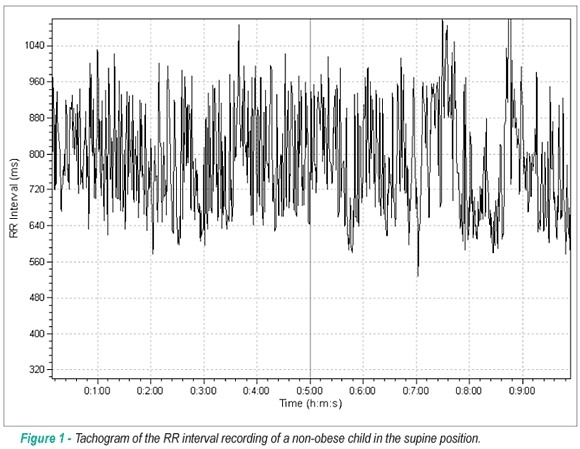
BACKGROUND: Obesity can affect the cardiac autonomic modulation, blood lipid levels and the physical capacity. OBJECTIVE: To study the effect of obesity on the heart rate variability (HRV), blood lipid levels and physical capacity of obese children. METHODS: Thirty children aged 9 to 11 years were studied, divided in two groups: a) 15 obese children (O) aged 10.2 ± 0.7 years and body mass index (BMI) between the 95th and the 97th percentiles; b) 15 non-obese children (NO) aged 9.8 ± 0.7 years and BMI between the 5th and 85th percentiles. All children were submitted to an anthropometric and clinical assessment, analysis of the HRV at rest and a physical exercise protocol (PEP). Non-parametric tests were used to compare the variables between the groups. The level of significance was set at p < 0.05. RESULTS: The waist circumference and levels of triglycerides were higher in O. The cardiac sympathetic activity in the standing position in normalized units (LF n.u.) was higher in O, 71.4%, when compared to NO, 56.3%. The low frequency/high frequency ratio (LF/HF) was 3.8 in O and 1.7 in NO. The PEP showed differences between the groups, with higher values observed in NO children regarding the total distance, time of exposure to PEP, peak oxygen consumption (VO2 peak) and metabolic equivalent (MET). CONCLUSION: Obesity in children resulted in alterations in cardiac autonomic control in the standing position and decreased the physical capacity.

  • Autonomic Nervous System
  • exertion
  • Heart Rate
  • Obesity
Read Full Article
Creative Commons Attribution (CC BY) Creative Commons license
22/10/2009 DOI: 10.1590/S0066-782X2009000900007 Views 1
ABC
Artigo Original

Blood pressure response to physical exertion in adolescents: influence of overweight and obesity

Luciana Carletti et al. Anabel Nunes Rodrigues Anselmo José Perez Dalton Valentim Vassallo

BACKGROUND: The acute blood pressure response to physical exertion has been used as an indicator of the risk of developing hypertension. The factors associated with this response need to be clarified for timely intervention in preventing hypertensive disease. OBJECTIVE: To describe the response of cardiovascular variables to acute physical exertion in overweight adolescents using cardiopulmonary exercise testing. METHODS: The sample consisted of 104 adolescents (56 boys and 48 girls), divided into two groups: the obese/overweight group (OOG) and the eutrophic group (EG). The following variables were measured: anthropometric (weight, height, and BMI), body composition (skin fold thickness), as well as hemodynamic variables such as systolic arterial pressure (SAP), diastolic arterial pressure (DAP), and heart rate (HR), at rest and at maximal physical exertion during the cardiopulmonary test. RESULTS: In the male group, the greatest values of systolic arterial pressure at rest were recorded in the OOG as compared to the EG (113 ± 13 vs 106 ± 8 mmHg; p = 0.009), pre-exertion SAP (120 ± 14 vs 109 ± 10 mmHg; p = 0.003), and SAP during maximal exertion conditions (156 ± 20 vs 146 ± 14 mmHg; p = 0.03). In the female group, only pre-exertion SAP was higher in the overweight group as compared to the eutrophic girls (114 ± 11 vs 106 ± 10 mmHg; p = 0.009). CONCLUSION: The response of arterial blood pressure during physical exercise was most exacerbated in obese adolescents as compared to eutrophic teens, suggesting greater reactivity to physical exertion.

  • Adolescent
  • Blood Pressure
  • calorimetry
  • exertion
  • Obesity
  • Overweight
Read Full Article
Creative Commons Attribution (CC BY) Creative Commons license
25/07/2008 DOI: 10.1590/S0066-782X2008001300004
Maximum heart rate in Brazilian elderly women: comparing measured and predicted values
ABC
Artigo Original

Maximum heart rate in Brazilian elderly women: comparing measured and predicted values

Valter Abrantes Pereira da Silva et al. Martim Bottaro Marco Aurélio Justino Maurício Maltez Ribeiro … Ricardo Moreno Lima Ricardo Jacó de Oliveira

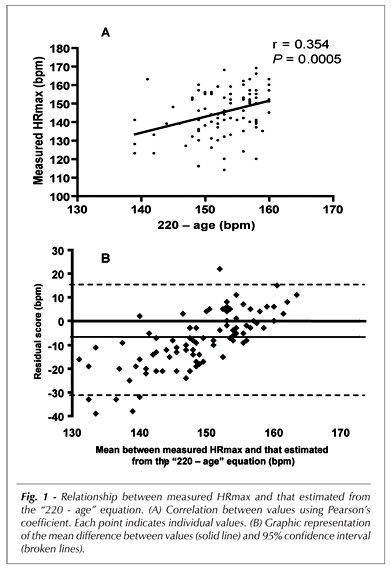
OBJECTIVE: This study sought to compare maximum heart rate (HRmax) values measured during a graded exercise test (GXT) with those calculated from prediction equations in Brazilian elderly women. METHODS: A treadmill maximal graded exercise test in accordance with the modified Bruce protocol was used to obtain reference values for maximum heart rate (HRmax) in 93 elderly women (mean age 67.1 ± 5.16). Measured values were compared with those estimated from the “220 – age” and Tanaka et al formulas using repeated-measures ANOVA. Correlation and agreement between measured and estimated values were tested. Also evaluated was the correlation between measured HRmax and volunteers’ age. RESULTS: Results were as follows: 1) mean HRmax reached during GXT was 145.5 ± 12,5 beats per minute (bpm); 2) both the “220 – age” and Tanaka et al (2001) equations significantly overestimated (p < 0.001) HRmax by a mean difference of 7.4 and 15.5 bpm, respectively; 3) age was significantly (p < 0,001) and inversely related to measured HRmax. CONCLUSION: Based on these results, it can be concluded that both prediction equations significantly overestimated HRmax measured during maximal GXT in Brazilian elderly women, a finding that may have important implications when prescribing exercise intensity for this population. In addition, HRmax was inversely related to the volunteers’ age, suggesting that the chronotropic reserve continues to decline after age 60.

  • Aged
  • Exercise Test
  • exertion
  • Heart Rate
  • Women
Read Full Article
Creative Commons Attribution (CC BY) Creative Commons license
21/05/2007 DOI: 10.1590/S0066-782X2007000300010 Views 2

How to cite this article

EndNote RIS

Electronic Document Format (Vancouver)

Paschoal MA, Trevizan PF, Scodeler NF. Heart rate variability, blood lipids and physical capacity of obese and non-obese children. Arquivos Brasileiros de Cardiologia 2009;93(3):239-46.

Electronic Document Format (ABNT)

Paschoal, Mário Augusto; Trevizan, Patrícia Fernandes; Scodeler, Natália Folco. Heart rate variability, blood lipids and physical capacity of obese and non-obese children. Arquivos Brasileiros de Cardiologia, v. 93, n. 3, p. 239-246, Oct. 2009.

Electronic Document Format (APA)

Paschoal, M. A., Trevizan, P. F., & Scodeler, N. F. (2009). Heart rate variability, blood lipids and physical capacity of obese and non-obese children. Arquivos Brasileiros de Cardiologia, 93(3), 239-246.

Electronic Document Format (ISO)

Paschoal, Mário Augusto and Trevizan, Patrícia Fernandes and Scodeler, Natália Folco. Heart rate variability, blood lipids and physical capacity of obese and non-obese children. Arquivos Brasileiros de Cardiologia [online]. 2009, vol. 93, n. 3, [cited 2026-10-14], pp. 239-246. Available from: <https://journals.cardiol.br/en/article/heart-rate-variability-blood-lipids-and-physical-capacity-of-obese-and-non-obese-children/>. ISSN 0066-782X

EndNote RIS

Electronic Document Format (Vancouver)

Carletti L, Rodrigues AN, Perez AJ, Vassallo DV. Blood pressure response to physical exertion in adolescents: influence of overweight and obesity. Arquivos Brasileiros de Cardiologia 2008;91(1):25-30.

Electronic Document Format (ABNT)

Carletti, Luciana; Rodrigues, Anabel Nunes; Perez, Anselmo José; Vassallo, Dalton Valentim. Blood pressure response to physical exertion in adolescents: influence of overweight and obesity. Arquivos Brasileiros de Cardiologia, v. 91, n. 1, p. 25-30, Jul. 2008.

Electronic Document Format (APA)

Carletti, L., Rodrigues, A. N., Perez, A. J., & Vassallo, D. V. (2008). Blood pressure response to physical exertion in adolescents: influence of overweight and obesity. Arquivos Brasileiros de Cardiologia, 91(1), 25-30.

Electronic Document Format (ISO)

Carletti, Luciana and Rodrigues, Anabel Nunes and Perez, Anselmo José and Vassallo, Dalton Valentim. Blood pressure response to physical exertion in adolescents: influence of overweight and obesity. Arquivos Brasileiros de Cardiologia [online]. 2008, vol. 91, n. 1, [cited 2026-10-14], pp. 25-30. Available from: <https://journals.cardiol.br/en/article/blood-pressure-response-to-physical-exertion-in-adolescents-influence-of-overweight-and-obesity/>. ISSN 0066-782X

EndNote RIS

Electronic Document Format (Vancouver)

Silva VAP, Bottaro M, Justino MA, Ribeiro MM, Lima RM, Oliveira RJ. Maximum heart rate in Brazilian elderly women: comparing measured and predicted values. Arquivos Brasileiros de Cardiologia 2007;88(3):314-20.

Electronic Document Format (ABNT)

Silva, Valter Abrantes Pereira da; Bottaro, Martim; Justino, Marco Aurélio; Ribeiro, Maurício Maltez; Lima, Ricardo Moreno; Oliveira, Ricardo Jacó de. Maximum heart rate in Brazilian elderly women: comparing measured and predicted values. Arquivos Brasileiros de Cardiologia, v. 88, n. 3, p. 314-320, May. 2007.

Electronic Document Format (APA)

Silva, V. A. P. , Bottaro, M., Justino, M. A., Ribeiro, M. M., Lima, R. M., & Oliveira, R. J. (2007). Maximum heart rate in Brazilian elderly women: comparing measured and predicted values. Arquivos Brasileiros de Cardiologia, 88(3), 314-320.

Electronic Document Format (ISO)

Silva, Valter Abrantes Pereira da and Bottaro, Martim and Justino, Marco Aurélio and Ribeiro, Maurício Maltez and Lima, Ricardo Moreno and Oliveira, Ricardo Jacó de. Maximum heart rate in Brazilian elderly women: comparing measured and predicted values. Arquivos Brasileiros de Cardiologia [online]. 2007, vol. 88, n. 3, [cited 2026-10-14], pp. 314-320. Available from: <https://journals.cardiol.br/en/article/maximum-heart-rate-in-brazilian-elderly-women-comparing-measured-and-predicted-values/>. ISSN 0066-782X

  • About ABC Family
  • Internal Regulation
  • Editorial Board
  • Brazilian Society of Cardiology (SBC)

Issues

SBC Guidelines

  • Videos
  • Podcasts
  • News