ABC Family Arquivos Brasileiros de Cardiologia International Journal of Cardiovascular Sciences ABC Heart Failure & Cardiomyopathy ABC Imagem Cardiovascular
Português English
ABC Family
Português English
  • About
    • About ABC Family
    • Internal Regulation
    • Editorial Board
    • Brazilian Society of Cardiology (SBC)
  • Issues
  • SBC Guidelines
  • Content
    • Videos
    • Podcasts
    • News
  • About
    • About ABC Family
    • Internal Regulation
    • Editorial Board
    • Brazilian Society of Cardiology (SBC)
  • Issues
  • SBC Guidelines
  • Content
    • Videos
    • Podcasts
    • News

ABC Family

  • ABC Family
  • Arquivos Brasileiros de Cardiologia
  • International Journal of Cardiovascular Sciences
  • ABC Heart Failure & Cardiomyopathy
  • ABC Imagem Cardiovascular
Search in

No content found.

Journals
Ordering
Article types
Others

  1. Home
  2. Keyword: Dietary Fats
ABC
Editorial

Role of Omega-3 and Omega-6 on Cardiovascular Risk Factors: Importance of Dietary Sources and Lipid Structure

Victória Moralez Soares et al. Thais Caroline da Silva Priscila Portugal dos Santos

Omega-3 (α-linolenic acid – ALA, C18:3n-3) and omega-6 (linoleic acid – LA, C18:2n-6) are essential polyunsaturated fatty acids (PUFAs) as they cannot be synthesized by humans or other higher animals. These PUFAs play an important role in maintaining cardiovascular health, being extensively studied. Mediterranean diet has been repeatedly associated with lower cardiovascular risk, largely due to the abundance of omega-3.

In the human body, ALA and LA are converted to other forms of PUFAs, important for human health including eicosapentaenoic acid (EPA, C20:5n-3), docosapentaenoic acid (DPA, C22:5n-3), docosahexaenoic acid (DHA, C22:6n-3) from the omega-3 family, and γ-linolenic acid (GLA, 18:3n-6), dihomo-γ-linolenic acid (DGLA, 20:3n-6) and arachidonic acid (AA, C20: 4n-6) from the omega-6 family.

[…]

  • Die, Mediterranean
  • Dietary Fats
  • Fatty Acids, Omega-3
  • Fatty Acids, Omega-6
  • Receptors, Eicosanoid
  • Risk Factors
Read Full Article
Creative Commons Attribution (CC BY) Creative Commons license
22/12/2023 DOI: 10.36660/abc.20230753 Views 1
Figure 1
ABC
Original Article

High-Lard and High-Cholesterol Diet, but not High-Lard Diet, Leads to Metabolic Disorders in a Modified Dyslipidemia Model

Lidiane B. Muniz et al. Aline M. Alves-Santos Fabricio Camargo Danieli Brolo Martins … Mara Rubia N. Celes Maria Margareth V. Naves

Abstract

Background:

In view of the increased global prevalence of cardiovascular and hepatic diseases, the diet lipid content and its relationship with the accumulation of fat in hepatocytes have been investigated as key factors in preventing these diseases.

Objective:

To evaluate the metabolic effects of a high-lard diet supplemented or not with cholesterol on a modified dyslipidemia model.

Methods:

We divided 24 adult male Wistar rats into three groups: standard diet (STD – 4% lipids), high-lard diet (HLD – 21% lard), and high-lard and high-cholesterol diet (HL/HCD – 20% lard, 1% cholesterol, 0.1% cholic acid). After six weeks of treatment, blood and liver were collected for biochemical (serum lipid profile and liver enzymes) and morphological analyses. Statistical analysis included one-way analysis of variance (ANOVA), followed by Tukey test for mean comparisons, and a 5% probability was considered statistically significant.

Results:

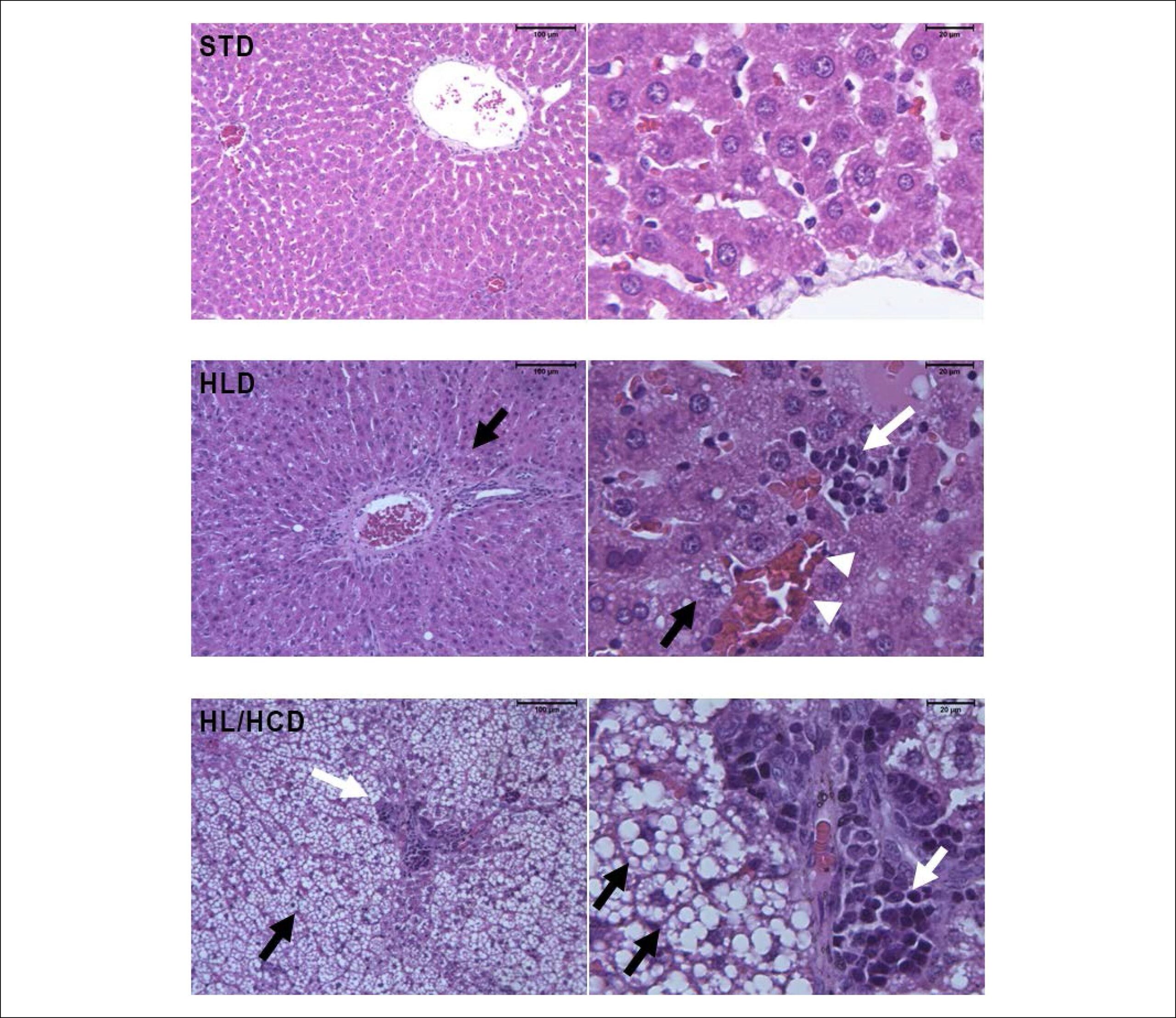
Animals fed HL/HCD showed increased total cholesterol, triacylglycerol, LDL-c, non-HDL-c, alanine aminotransferase (ALT), and aspartate aminotransferase (AST) serum levels compared to those fed STD. In addition, the HL/HCD animals presented higher relative liver weight, with moderate macrovesicular hepatic steatosis and inflammatory infiltrate.

Conclusion:

A high-fat diet with lard (20%) and cholesterol (1%) triggered dyslipidemia with severe liver damage in rats in a shorter experimental time than the previously reported models. The high-lard diet without supplementation of cholesterol led to body weight gain, but not to dyslipidemia.

  • Cholesterol
  • Dietary Fats
  • Fatty Liver
  • Inflammation
  • Lipid Metabolism
  • Rats
Read Full Article
Creative Commons Attribution (CC BY) Creative Commons license
29/08/2019 DOI: 10.5935/abc.20190149 Views 1
Vascular alterations in high-fat diet-obese rats: role of Endothelial L-arginine/NO Pathway
ABC
Artigo Original

Vascular alterations in high-fat diet-obese rats: role of Endothelial L-arginine/NO Pathway

Thiago Bruder Nascimento et al. Rafaela de Fátima Ferreira Baptista Priscila Cristina Pereira Dijon Henrique Salomé Campos … André Soares Leopoldo Ana Paula Lima Leopoldo Silvio A. Oliveira Júnior Carlos Roberto Padovani Antônio Carlos Cicogna Sandra Cordellini

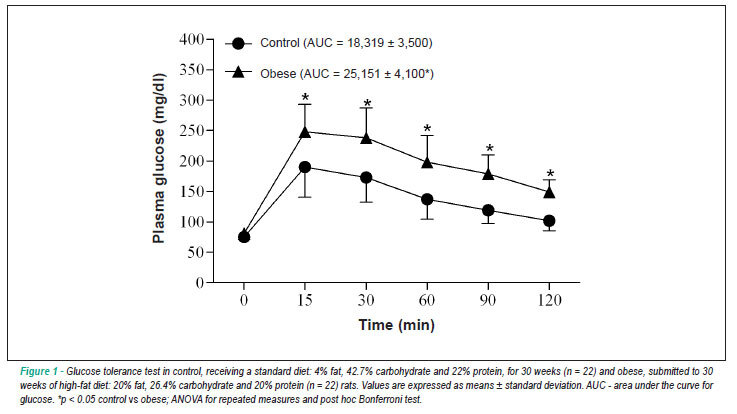
BACKGROUND: Mechanisms underlying vascular abnormalities in obesity remain to be completely clarified. OBJECTIVE: L-arginine/nitric oxide pathway was evaluated on vascular response of high-fat diet-obese rats, focusing on endothelial and smooth muscle cells. METHODS: 30-day-old rats were divided in two groups: control (C) and obese (OB, high-fat diet for 30 weeks). After 30 weeks, body weight, adiposity index, blood pressure, and metabolic and endocrine profiles of the animals were recorded. Curves to noradrenaline were obtained in absence and presence of nitric oxide synthase inhibitor (L-NAME, 3×10⁻⁴M) on intact and denuded thoracic aorta from C and OB rats. RESULTS: Body weight, adiposity index, leptin and insulin levels were increased in OB, while blood pressure was unchanged. Obesity also produced glucose tolerance and insulin resistance. Reactivity to noradrenaline of intact aorta was similar in C and OB rats. L-NAME presence produced a similar increase in maximal responses, but a higher leftward shift of noradrenaline responses in intact aorta from C than in OB rats [EC50 (x10-7M): C = 1.84 (0.83-4.07), O = 2.49 (1.41-4.38); L-NAME presence C = 0.02 (0.01-0.04)*, O = 0.21 (0.11-0.40)*†,*p < 0.05 vs respective control, †p < 0.05 vs control plus L-NAME, n = 6-7]. None of the protocols altered the reactivity to noradrenaline of denuded aortas. CONCLUSION: High-fat diet-induced obesity promotes metabolic and vascular alterations. The vascular alteration involved an endothelial L-arginine/NO pathway improvement was probably correlated to diet-induced hyperinsulinemia and hyperleptinemia. The greater resistance to L-NAME effects in aorta of obese rats raises concerns about the lower cardiovascular vulnerability of obese individuals in the presence of associated pathologies that impair NO-system activity.

  • Dietary Fats
  • Endothelium, Vascular
  • Nitric Oxide
  • Obesity
  • Rats
Read Full Article
Creative Commons Attribution (CC BY) Creative Commons license
20/05/2011 DOI: 10.1590/S0066-782X2011005000063

How to cite this article

EndNote RIS

Electronic Document Format (Vancouver)

Soares VM, Silva TC, Santos PP. Role of Omega-3 and Omega-6 on Cardiovascular Risk Factors: Importance of Dietary Sources and Lipid Structure. Arquivos Brasileiros de Cardiologia 2023;120(11):e20230753.

Electronic Document Format (ABNT)

Soares, Victória Moralez; Silva, Thais Caroline da; Santos, Priscila Portugal dos. Role of Omega-3 and Omega-6 on Cardiovascular Risk Factors: Importance of Dietary Sources and Lipid Structure. Arquivos Brasileiros de Cardiologia, v. 120, n. 11, e20230753, Dec. 2023.

Electronic Document Format (APA)

Soares, V. M., Silva, T. C. , & Santos, P. P. (2023). Role of Omega-3 and Omega-6 on Cardiovascular Risk Factors: Importance of Dietary Sources and Lipid Structure. Arquivos Brasileiros de Cardiologia, 120(11), e20230753.

Electronic Document Format (ISO)

Soares, Victória Moralez and Silva, Thais Caroline da and Santos, Priscila Portugal dos. Role of Omega-3 and Omega-6 on Cardiovascular Risk Factors: Importance of Dietary Sources and Lipid Structure. Arquivos Brasileiros de Cardiologia [online]. 2023, vol. 120, n. 11, [cited 2026-10-14], e20230753. Available from: <https://journals.cardiol.br/en/article/role-of-omega-3-and-omega-6-on-cardiovascular-risk-factors-importance-of-dietary-sources-and-lipid-structure/>. ISSN 0066-782X

EndNote RIS

Electronic Document Format (Vancouver)

Muniz LB, Alves-Santos AM, Camargo F, Martins DB, Celes MRN, Naves MMV. High-Lard and High-Cholesterol Diet, but not High-Lard Diet, Leads to Metabolic Disorders in a Modified Dyslipidemia Model. Arquivos Brasileiros de Cardiologia 2019;113(5):896-902.

Electronic Document Format (ABNT)

Muniz, Lidiane B.; Alves-Santos, Aline M.; Camargo, Fabricio; Martins, Danieli Brolo; Celes, Mara Rubia N.; Naves, Maria Margareth V.. High-Lard and High-Cholesterol Diet, but not High-Lard Diet, Leads to Metabolic Disorders in a Modified Dyslipidemia Model. Arquivos Brasileiros de Cardiologia, v. 113, n. 5, p. 896-902, Aug. 2019.

Electronic Document Format (APA)

Muniz, L. B., Alves-Santos, A. M., Camargo, F., Martins, D. B., Celes, M. R. N., & Naves, M. M. V. (2019). High-Lard and High-Cholesterol Diet, but not High-Lard Diet, Leads to Metabolic Disorders in a Modified Dyslipidemia Model. Arquivos Brasileiros de Cardiologia, 113(5), 896-902.

Electronic Document Format (ISO)

Muniz, Lidiane B. and Alves-Santos, Aline M. and Camargo, Fabricio and Martins, Danieli Brolo and Celes, Mara Rubia N. and Naves, Maria Margareth V.. High-Lard and High-Cholesterol Diet, but not High-Lard Diet, Leads to Metabolic Disorders in a Modified Dyslipidemia Model. Arquivos Brasileiros de Cardiologia [online]. 2019, vol. 113, n. 5, [cited 2026-10-14], pp. 896-902. Available from: <https://journals.cardiol.br/en/article/high-lard-and-high-cholesterol-diet-but-not-high-lard-diet-leads-to-metabolic-disorders-in-a-modified-dyslipidemia-model/>. ISSN 0066-782X

EndNote RIS

Electronic Document Format (Vancouver)

Nascimento TB, Baptista RFF, Pereira PC, Campos DHS, Leopoldo AS, Leopoldo APL, Oliveira Júnior SA, et al. Vascular alterations in high-fat diet-obese rats: role of Endothelial L-arginine/NO Pathway. Arquivos Brasileiros de Cardiologia 2011;97(1):40-5.

Electronic Document Format (ABNT)

Nascimento, Thiago Bruder; Baptista, Rafaela de Fátima Ferreira; Pereira, Priscila Cristina; Campos, Dijon Henrique Salomé; Leopoldo, André Soares; Leopoldo, Ana Paula Lima; Oliveira Júnior, Silvio A.; Padovani, Carlos Roberto; Cicogna, Antônio Carlos; Cordellini, Sandra. Vascular alterations in high-fat diet-obese rats: role of Endothelial L-arginine/NO Pathway. Arquivos Brasileiros de Cardiologia, v. 97, n. 1, p. 40-45, May. 2011.

Electronic Document Format (APA)

Nascimento, T. B., Baptista, R. F. F., Pereira, P. C., Campos, D. H. S., Leopoldo, A. S., Leopoldo, A. P. L., Oliveira Júnior, S. A., Padovani, C. R., Cicogna, A. C., & Cordellini, S. (2011). Vascular alterations in high-fat diet-obese rats: role of Endothelial L-arginine/NO Pathway. Arquivos Brasileiros de Cardiologia, 97(1), 40-45.

Electronic Document Format (ISO)

Nascimento, Thiago Bruder and Baptista, Rafaela de Fátima Ferreira and Pereira, Priscila Cristina and Campos, Dijon Henrique Salomé and Leopoldo, André Soares and Leopoldo, Ana Paula Lima and Oliveira Júnior, Silvio A. and Padovani, Carlos Roberto and Cicogna, Antônio Carlos and Cordellini, Sandra. Vascular alterations in high-fat diet-obese rats: role of Endothelial L-arginine/NO Pathway. Arquivos Brasileiros de Cardiologia [online]. 2011, vol. 97, n. 1, [cited 2026-10-14], pp. 40-45. Available from: <https://journals.cardiol.br/en/article/vascular-alterations-in-high-fat-diet-obese-rats-role-of-endothelial-l-arginine-no-pathway/>. ISSN 0066-782X

  • About ABC Family
  • Internal Regulation
  • Editorial Board
  • Brazilian Society of Cardiology (SBC)

Issues

SBC Guidelines

  • Videos
  • Podcasts
  • News