ABC Family Arquivos Brasileiros de Cardiologia International Journal of Cardiovascular Sciences ABC Heart Failure & Cardiomyopathy ABC Imagem Cardiovascular
Português English
ABC Family
Português English
  • About
    • About ABC Family
    • Internal Regulation
    • Editorial Board
    • Brazilian Society of Cardiology (SBC)
  • Issues
  • SBC Guidelines
  • Content
    • Videos
    • Podcasts
    • News
  • About
    • About ABC Family
    • Internal Regulation
    • Editorial Board
    • Brazilian Society of Cardiology (SBC)
  • Issues
  • SBC Guidelines
  • Content
    • Videos
    • Podcasts
    • News

ABC Family

  • ABC Family
  • Arquivos Brasileiros de Cardiologia
  • International Journal of Cardiovascular Sciences
  • ABC Heart Failure & Cardiomyopathy
  • ABC Imagem Cardiovascular
Search in

No content found.

Journals
Ordering
Article types
Others

  1. Home
  2. Keyword: Cardiac resynchronization Therapy/methods
ABC
Editorial

Measurement of PETCO2 at Anaerobic Threshold: A Best Prognostic Marker in Patients with Cardiac Resynchronization Therapy?

Anderson Donelli da Silveira et al. Maurício Pimentel

The cardiopulmonary exercise test (CPET) is a consolidated tool in the functional and prognostic assessment of patients with heart failure with reduced ejection fraction (HFrRF), being a cornerstone in the evaluation for the indication of advanced therapies in HFrEF. , Cardiac resynchronization therapy (CRT), in addition to reducing mortality, can improve cardiorespiratory fitness, leading to an increase in peak oxygen consumption (VO2peak) and a reduction in the slope of the respiratory equivalent CO2 ratio (VE /VCO2 slope). – In recent years, with the evolution of treatments, general mortality and the risk of the sudden death of patients with HFpEF have been reduced. , In this context, reviewing the prognosis and the values associated with a higher risk among the CPET variables in patients undergoing CRT becomes important.

The measurement of end-tidal carbon dioxide pressure (PETCO2) during CPET, both at rest, and at the first ventilatory threshold or anaerobic threshold (PETCO2LA), has a well-established prognostic value in heart failure. , The increase of dead space ventilation, caused by the impairment of the ventilation/perfusion (V/Q) ratio, for example, in patients with left ventricular dysfunction, leads to a reduction in alveolar CO2 and, consequently, in PETCO2. It is expected that there will be an increase in its measurement up to the anaerobic threshold, which is correlated with an increase in cardiac output.

[…]

  • Cardiac Output, High
  • Cardiac resynchronization Therapy/methods
  • Ergoespyrometry/methods
  • Heart Failure
  • Prognosis
  • Stroke Volume
Read Full Article
Creative Commons Attribution (CC BY) Creative Commons license
05/09/2022 DOI: 10.36660/abc.20220477 Views 1
Figure 1
ABC
Original Article

Predictive Ability of Cardiopulmonary Exercise Test Parameters in Heart Failure Patients with Cardiac Resynchronization Therapy

João Ferreira Reis et al. António Valentim Gonçalves Pedro Garcia Brás Rita Ilhão Moreira … Pedro Rio Ana Teresa Timóteo Rui M. Soares Rui Cruz Ferreira

Abstract

Background

There is evidence suggesting that a peak oxygen uptake (pVO2) cut-off of 10ml/kg/min provides a more precise risk stratification in cardiac resynchronization therapy (CRT) patients.

Objective

To compare the prognostic power of several cardiopulmonary exercise testing (CPET) parameters in this population and assess the discriminative ability of the guideline-recommended pVO2cut-off values.

Methods

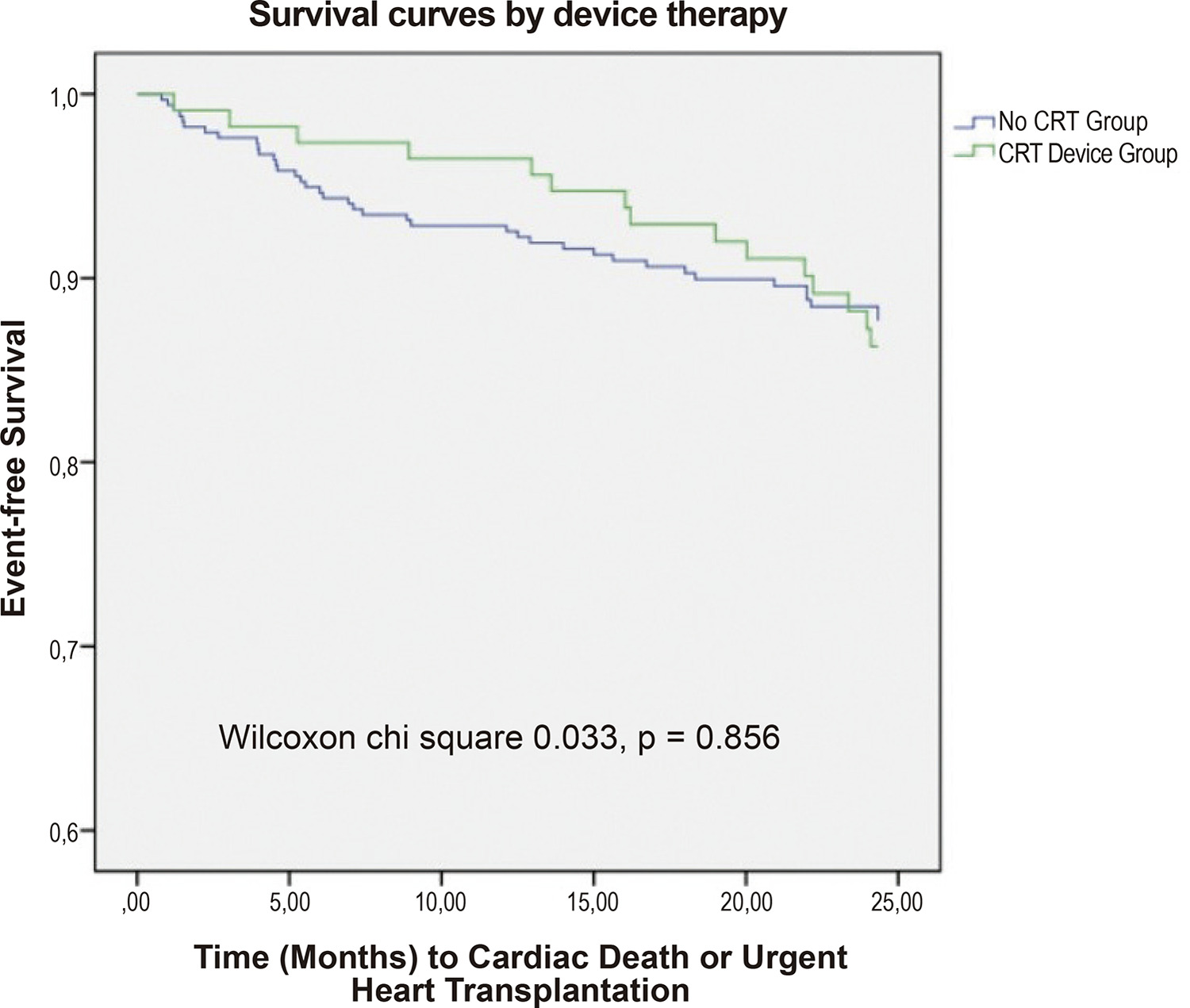
Prospective evaluation of consecutive heart failure (HF) patients with left ventricular ejection fraction ≤40%. The primary endpoint was a composite of cardiac death and urgent heart transplantation (HT) in the first 24 follow-up months, and was analysed by several CPET parameters for the highest area under the curve (AUC) in the CRT group. A survival analysis was performed to evaluate the risk stratification provided by several different cut-offs. p values <0.05 were considered significant.

Results

A total of 450 HF patients, of which 114 had a CRT device. These patients had a higher baseline risk profile, but there was no difference regarding the primary outcome (13.2% vs 11.6%, p =0.660). End-tidal carbon dioxide pressure at anaerobic threshold (PETCO2AT)had the highest AUC value, which was significantly higher than that of pVO2in the CRT group (0.951 vs 0.778, p =0.046). The currently recommended pVO2cut-off provided accurate risk stratification in this setting (p <0.001), and the suggested cut-off value of 10 ml/min/kg did not improve risk discrimination in device patients (p =0.772).

Conclusion

PETCO2ATmay outperform pVO2’s prognostic power for adverse events in CRT patients. The current guideline-recommended pVO2 cut-off can precisely risk-stratify this population.

  • Cardiac resynchronization Therapy/methods
  • Exercise Test/methods
  • Heart Failure
  • Heart Transplantation
  • Oxygen Consumption
Read Full Article
Creative Commons Attribution (CC BY) Creative Commons license
18/07/2022 DOI: 10.36660/abc.20210620 Views 1
ABC
Letter to the Editor

Prolonged PR Interval and Outcome in Cardiac Resynchronization Therapy

Jakrin Kewcharoen et al. Chanavuth Kanitsoraphan

Dear Editor

We read the article “Baseline Prolonged PR Interval and Outcome of Cardiac Resynchronization Therapy: A Systematic Review and Meta-analysis” by Rattanawong et al. with great interest. The authors investigated the effect of prolonged PR interval on composite outcome among patients who received cardio resynchronized therapy. The authors conclude that prolonged PR is associated with worse outcome in this population.

[…]

  • Atrioventricular block
  • Cardiac resynchronization Therapy/methods
  • Heart Conduction, System
  • Heart Failure
  • Meta-Analysis
Read Full Article
Creative Commons Attribution (CC BY) Creative Commons license
08/08/2019 DOI: 10.5935/abc.20190101 Views 1

How to cite this article

EndNote RIS

Electronic Document Format (Vancouver)

Silveira AD, Pimentel M. Measurement of PETCO2 at Anaerobic Threshold: A Best Prognostic Marker in Patients with Cardiac Resynchronization Therapy?. Arquivos Brasileiros de Cardiologia 2022;119(3):424-5.

Electronic Document Format (ABNT)

Silveira, Anderson Donelli da; Pimentel, Maurício. Measurement of PETCO2 at Anaerobic Threshold: A Best Prognostic Marker in Patients with Cardiac Resynchronization Therapy?. Arquivos Brasileiros de Cardiologia, v. 119, n. 3, p. 424-425, Sep. 2022.

Electronic Document Format (APA)

Silveira, A. D. , & Pimentel, M. (2022). Measurement of PETCO2 at Anaerobic Threshold: A Best Prognostic Marker in Patients with Cardiac Resynchronization Therapy?. Arquivos Brasileiros de Cardiologia, 119(3), 424-425.

Electronic Document Format (ISO)

Silveira, Anderson Donelli da and Pimentel, Maurício. Measurement of PETCO2 at Anaerobic Threshold: A Best Prognostic Marker in Patients with Cardiac Resynchronization Therapy?. Arquivos Brasileiros de Cardiologia [online]. 2022, vol. 119, n. 3, [cited 2026-10-14], pp. 424-425. Available from: <https://journals.cardiol.br/en/article/measurement-of-petco2-at-anaerobic-threshold-a-best-prognostic-marker-in-patients-with-cardiac-resynchronization-therapy/>. ISSN 0066-782X

EndNote RIS

Electronic Document Format (Vancouver)

Reis JF, Gonçalves AV, Brás PG, Moreira RI, Rio P, Timóteo AT, Soares RM, et al. Predictive Ability of Cardiopulmonary Exercise Test Parameters in Heart Failure Patients with Cardiac Resynchronization Therapy. Arquivos Brasileiros de Cardiologia 2022;119(3):413-2.

Electronic Document Format (ABNT)

Reis, João Ferreira; Gonçalves, António Valentim; Brás, Pedro Garcia; Moreira, Rita Ilhão; Rio, Pedro; Timóteo, Ana Teresa; Soares, Rui M.; Ferreira, Rui Cruz. Predictive Ability of Cardiopulmonary Exercise Test Parameters in Heart Failure Patients with Cardiac Resynchronization Therapy. Arquivos Brasileiros de Cardiologia, v. 119, n. 3, p. 413-423, Jul. 2022.

Electronic Document Format (APA)

Reis, J. F., Gonçalves, A. V., Brás, P. G., Moreira, R. I., Rio, P., Timóteo, A. T., Soares, R. M., & Ferreira, R. C. (2022). Predictive Ability of Cardiopulmonary Exercise Test Parameters in Heart Failure Patients with Cardiac Resynchronization Therapy. Arquivos Brasileiros de Cardiologia, 119(3), 413-423.

Electronic Document Format (ISO)

Reis, João Ferreira and Gonçalves, António Valentim and Brás, Pedro Garcia and Moreira, Rita Ilhão and Rio, Pedro and Timóteo, Ana Teresa and Soares, Rui M. and Ferreira, Rui Cruz. Predictive Ability of Cardiopulmonary Exercise Test Parameters in Heart Failure Patients with Cardiac Resynchronization Therapy. Arquivos Brasileiros de Cardiologia [online]. 2022, vol. 119, n. 3, [cited 2026-10-14], pp. 413-423. Available from: <https://journals.cardiol.br/en/article/predictive-ability-of-cardiopulmonary-exercise-test-parameters-in-heart-failure-patients-with-cardiac-resynchronization-therapy/>. ISSN 0066-782X

EndNote RIS

Electronic Document Format (Vancouver)

Kewcharoen J, Kanitsoraphan C. Prolonged PR Interval and Outcome in Cardiac Resynchronization Therapy. Arquivos Brasileiros de Cardiologia 2019;113(1):109-10.

Electronic Document Format (ABNT)

Kewcharoen, Jakrin; Kanitsoraphan, Chanavuth. Prolonged PR Interval and Outcome in Cardiac Resynchronization Therapy. Arquivos Brasileiros de Cardiologia, v. 113, n. 1, p. 109-110, Aug. 2019.

Electronic Document Format (APA)

Kewcharoen, J., & Kanitsoraphan, C. (2019). Prolonged PR Interval and Outcome in Cardiac Resynchronization Therapy. Arquivos Brasileiros de Cardiologia, 113(1), 109-110.

Electronic Document Format (ISO)

Kewcharoen, Jakrin and Kanitsoraphan, Chanavuth. Prolonged PR Interval and Outcome in Cardiac Resynchronization Therapy. Arquivos Brasileiros de Cardiologia [online]. 2019, vol. 113, n. 1, [cited 2026-10-14], pp. 109-110. Available from: <https://journals.cardiol.br/en/article/prolonged-pr-interval-and-outcome-in-cardiac-resynchronization-therapy/>. ISSN 0066-782X

  • About ABC Family
  • Internal Regulation
  • Editorial Board
  • Brazilian Society of Cardiology (SBC)

Issues

SBC Guidelines

  • Videos
  • Podcasts
  • News