ABC Family Arquivos Brasileiros de Cardiologia International Journal of Cardiovascular Sciences ABC Heart Failure & Cardiomyopathy ABC Imagem Cardiovascular
Português English
ABC Family
Português English
  • About
    • About ABC Family
    • Internal Regulation
    • Editorial Board
    • Brazilian Society of Cardiology (SBC)
  • Issues
  • SBC Guidelines
  • Content
    • Videos
    • Podcasts
    • News
  • About
    • About ABC Family
    • Internal Regulation
    • Editorial Board
    • Brazilian Society of Cardiology (SBC)
  • Issues
  • SBC Guidelines
  • Content
    • Videos
    • Podcasts
    • News

ABC Family

  • ABC Family
  • Arquivos Brasileiros de Cardiologia
  • International Journal of Cardiovascular Sciences
  • ABC Heart Failure & Cardiomyopathy
  • ABC Imagem Cardiovascular
Search in

No content found.

Journals
Ordering
Article types
Others

  1. Home
  2. Keyword: Biomarkers, Pharmacological
ABC
Editorial

Biomarker-based Inflammatory Score in Obese Patients with Resistant Hypertension

Cibele Isaac Saad Rodrigues

Resistant arterial hypertension (RAH) is defined, according to the American Heart Association Scientific Position of 2018, as well as observed in the I Brazilian Position of RAH in 2012, when an individual’s blood pressure (BP) remains elevated above the blood pressure target, in spite of the use of three antihypertensive drugs of different therapeutic classes, commonly a long-acting dihydropyridine slow-calcium-channel antagonist drug; a renin-angiotensin-aldosterone system (RAAS) blocker, which may be an angiotensin II converting-enzyme inhibitor or angiotensin II AT1 receptor blocker; and an appropriate diuretic, all administered at the maximum doses or at the highest possible tolerated doses, and in accordance with the prescribed administration intervals. These patients are considered to be at greater risk of cardiovascular and renal morbidity and mortality; more likely to have adverse events in response to drug therapy, usually dose-related; a secondary cause of hypertension should be ruled out in this group of individuals, because its prevalence is significantly higher than in the nonresistant hypertensive population., The controlled RAH is also currently recognized as that in which patients using four or more medications reached the blood pressure target; and refractory AH, an entity that has a different pathophysiology from RAH, when even the four drugs are not enough to control it. According to this new classification, patients with pseudohypertension should be excluded, that is, it is mandatory for diagnostic confirmation to verify adherence and tolerance to medication; to rule out white-coat hypertension; and thus, it is crucial to perform systematized blood pressure measurements outside the office environment through Ambulatory BP Monitoring (ABPM) or Home BP Measurement (HBPM); and finally, the use of a correct and reliable BP measurement technique.,,,

Even in primary AH, the existence of a systemic inflammatory process, albeit a subclinical one, is recognized and this condition has been identified with higher intensity in cardiovascular and renal diseases, such as RAH and chronic kidney disease. Specifically in the case of RAH, which is a multifactorial and polygenic entity, often associated with metabolic diseases that occur with insulin resistance, such as diabetes and obesity, inflammatory processes promoted by mediators may be involved, leading to the important endothelial dysfunction of the microvasculature and increased oxidative stress.

[…]
  • AdipoKynes
  • Biomarkers, Pharmacological
  • CitoKyines
  • Hypertension/adverse effects
  • Hypertension/physiopathology
  • Obesity
Read Full Article
Creative Commons Attribution (CC BY) Creative Commons license
15/04/2019 DOI: 10.5935/abc.20190051
Figure 1
ABC
Review Article

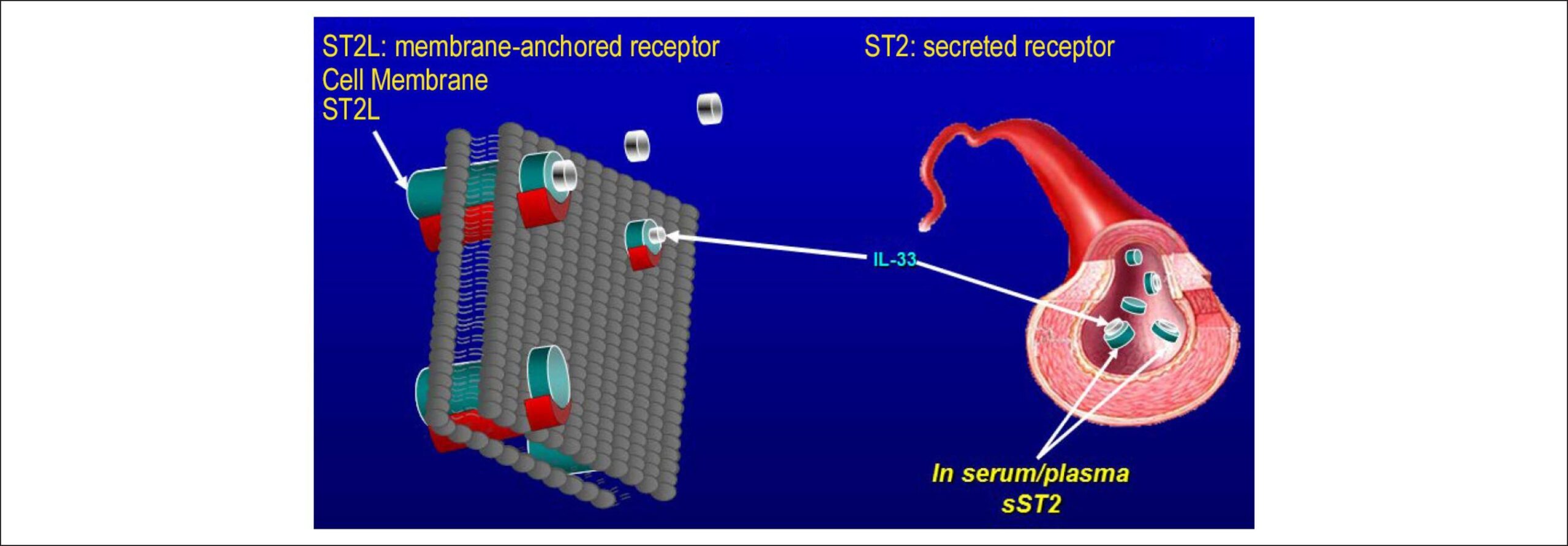
Soluble ST2 Testing: A Promising Biomarker in the Management of Heart Failure

Humberto Villacorta et al. Alan S. Maisel

Abstract

ST2 is a member of the interleukin-1 receptor family biomarker and circulating soluble ST2 concentrations are believed to reflect cardiovascular stress and fibrosis. Recent studies have demonstrated soluble ST2 to be a strong predictor of cardiovascular outcomes in both chronic and acute heart failure. It is a new biomarker that meets all required criteria for a useful biomarker. Of note, it adds information to natriuretic peptides (NPs) and some studies have shown it is even superior in terms of risk stratification. Since the introduction of NPs, this has been the most promising biomarker in the field of heart failure and might be particularly useful as therapy guide.

  • Biomarkers, Pharmacological
  • Heart Failure /therapy
  • Prognosis
  • Receptors, Interleukin
Read Full Article
Creative Commons Attribution (CC BY) Creative Commons license
15/01/2016 DOI: 10.5935/abc.20150151
ABC
Original Article

Galectin-3: A Link between Myocardial and Arterial Stiffening in Patients with Acute Decompensated Heart Failure?

Radu Ioan Lala et al. Dan Darabantiu Luminita Pilat Maria Puschita

Abstract

Background:

Heart failure is accompanied by abnormalities in ventricular-vascular interaction due to increased myocardial and arterial stiffness. Galectin-3 is a recently discovered biomarker that plays an important role in myocardial and vascular fibrosis and heart failure progression.

Objectives:

The aim of this study was to determine whether galectin-3 is correlated with arterial stiffening markers and impaired ventricular-arterial coupling in decompensated heart failure patients.

Methods:

A total of 79 inpatients with acute decompensated heart failure were evaluated. Serum galectin-3 was determined at baseline, and during admission, transthoracic echocardiography and measurements of vascular indices by Doppler ultrasonography were performed.

Results:

Elevated pulse wave velocity and low arterial carotid distensibility are associated with heart failure in patients with preserved ejection fraction (p = 0.04, p = 0.009). Pulse wave velocity, carotid distensibility and Young’s modulus did not correlate with serum galectin-3 levels. Conversely, raised galectin-3 levels correlated with an increased ventricular-arterial coupling ratio (Ea/Elv) p = 0.047, OR = 1.9, 95% CI (1.0‑3.6). Increased galectin-3 levels were associated with lower rates of left ventricular pressure rise in early systole (dp/dt) (p=0.018) and raised pulmonary artery pressure (p = 0.046). High galectin-3 levels (p = 0.038, HR = 3.07) and arterial pulmonary pressure (p = 0.007, HR = 1.06) were found to be independent risk factors for all-cause mortality and readmissions.

Conclusions:

This study showed no significant correlation between serum galectin-3 levels and arterial stiffening markers. Instead, high galectin-3 levels predicted impaired ventricular-arterial coupling. Galectin-3 may be predictive of raised pulmonary artery pressures. Elevated galectin-3 levels correlate with severe systolic dysfunction and together with pulmonary hypertension are independent markers of outcome.

  • Biomarkers, Pharmacological
  • Echocardiography
  • Galectin 3/analysis
  • Heart Failure/pathology
  • Heart Ventricles/physiopathology
  • Vascular Stiffness
Read Full Article
Creative Commons Attribution (CC BY) Creative Commons license
12/01/2016 DOI: 10.5935/abc.20150149

How to cite this article

EndNote RIS

Electronic Document Format (Vancouver)

Rodrigues CIS. Biomarker-based Inflammatory Score in Obese Patients with Resistant Hypertension. Arquivos Brasileiros de Cardiologia 2019;112(4):390-1.

Electronic Document Format (ABNT)

Rodrigues, Cibele Isaac Saad. Biomarker-based Inflammatory Score in Obese Patients with Resistant Hypertension. Arquivos Brasileiros de Cardiologia, v. 112, n. 4, p. 390-391, Apr. 2019.

Electronic Document Format (APA)

Rodrigues, C. I. S. (2019). Biomarker-based Inflammatory Score in Obese Patients with Resistant Hypertension. Arquivos Brasileiros de Cardiologia, 112(4), 390-391.

Electronic Document Format (ISO)

Rodrigues, Cibele Isaac Saad. Biomarker-based Inflammatory Score in Obese Patients with Resistant Hypertension. Arquivos Brasileiros de Cardiologia [online]. 2019, vol. 112, n. 4, [cited 2026-10-14], pp. 390-391. Available from: <https://journals.cardiol.br/en/article/biomarker-based-inflammatory-score-in-obese-patients-with-resistant-hypertension/>. ISSN 0066-782X

EndNote RIS

Electronic Document Format (Vancouver)

Villacorta H, Maisel AS. Soluble ST2 Testing: A Promising Biomarker in the Management of Heart Failure. Arquivos Brasileiros de Cardiologia 2016;106(2):145-52.

Electronic Document Format (ABNT)

Villacorta, Humberto; Maisel, Alan S.. Soluble ST2 Testing: A Promising Biomarker in the Management of Heart Failure. Arquivos Brasileiros de Cardiologia, v. 106, n. 2, p. 145-152, Jan. 2016.

Electronic Document Format (APA)

Villacorta, H., & Maisel, A. S. (2016). Soluble ST2 Testing: A Promising Biomarker in the Management of Heart Failure. Arquivos Brasileiros de Cardiologia, 106(2), 145-152.

Electronic Document Format (ISO)

Villacorta, Humberto and Maisel, Alan S.. Soluble ST2 Testing: A Promising Biomarker in the Management of Heart Failure. Arquivos Brasileiros de Cardiologia [online]. 2016, vol. 106, n. 2, [cited 2026-10-14], pp. 145-152. Available from: <https://journals.cardiol.br/en/article/soluble-st2-testing-a-promising-biomarker-in-the-management-of-heart-failure/>. ISSN 0066-782X

EndNote RIS

Electronic Document Format (Vancouver)

Lala RI, Darabantiu D, Pilat L, Puschita M. Galectin-3: A Link between Myocardial and Arterial Stiffening in Patients with Acute Decompensated Heart Failure?. Arquivos Brasileiros de Cardiologia 2016;106(2):121-9.

Electronic Document Format (ABNT)

Lala, Radu Ioan; Darabantiu, Dan; Pilat, Luminita; Puschita, Maria. Galectin-3: A Link between Myocardial and Arterial Stiffening in Patients with Acute Decompensated Heart Failure?. Arquivos Brasileiros de Cardiologia, v. 106, n. 2, p. 121-129, Jan. 2016.

Electronic Document Format (APA)

Lala, R. I., Darabantiu, D., Pilat, L., & Puschita, M. (2016). Galectin-3: A Link between Myocardial and Arterial Stiffening in Patients with Acute Decompensated Heart Failure?. Arquivos Brasileiros de Cardiologia, 106(2), 121-129.

Electronic Document Format (ISO)

Lala, Radu Ioan and Darabantiu, Dan and Pilat, Luminita and Puschita, Maria. Galectin-3: A Link between Myocardial and Arterial Stiffening in Patients with Acute Decompensated Heart Failure?. Arquivos Brasileiros de Cardiologia [online]. 2016, vol. 106, n. 2, [cited 2026-10-14], pp. 121-129. Available from: <https://journals.cardiol.br/en/article/galectin-3-a-link-between-myocardial-and-arterial-stiffening-in-patients-with-acute-decompensated-heart-failure/>. ISSN 0066-782X

  • About ABC Family
  • Internal Regulation
  • Editorial Board
  • Brazilian Society of Cardiology (SBC)

Issues

SBC Guidelines

  • Videos
  • Podcasts
  • News