ABC Family Arquivos Brasileiros de Cardiologia International Journal of Cardiovascular Sciences ABC Heart Failure & Cardiomyopathy ABC Imagem Cardiovascular
Português English
ABC Family
Português English
  • About
    • About ABC Family
    • Internal Regulation
    • Editorial Board
    • Brazilian Society of Cardiology (SBC)
  • Issues
  • SBC Guidelines
  • Content
    • Videos
    • Podcasts
    • News
  • About
    • About ABC Family
    • Internal Regulation
    • Editorial Board
    • Brazilian Society of Cardiology (SBC)
  • Issues
  • SBC Guidelines
  • Content
    • Videos
    • Podcasts
    • News

ABC Family

  • ABC Family
  • Arquivos Brasileiros de Cardiologia
  • International Journal of Cardiovascular Sciences
  • ABC Heart Failure & Cardiomyopathy
  • ABC Imagem Cardiovascular
Search in

No content found.

Journals
Ordering
Article types
Others

  1. Home
  2. Keyword: Antineoplastic Agents
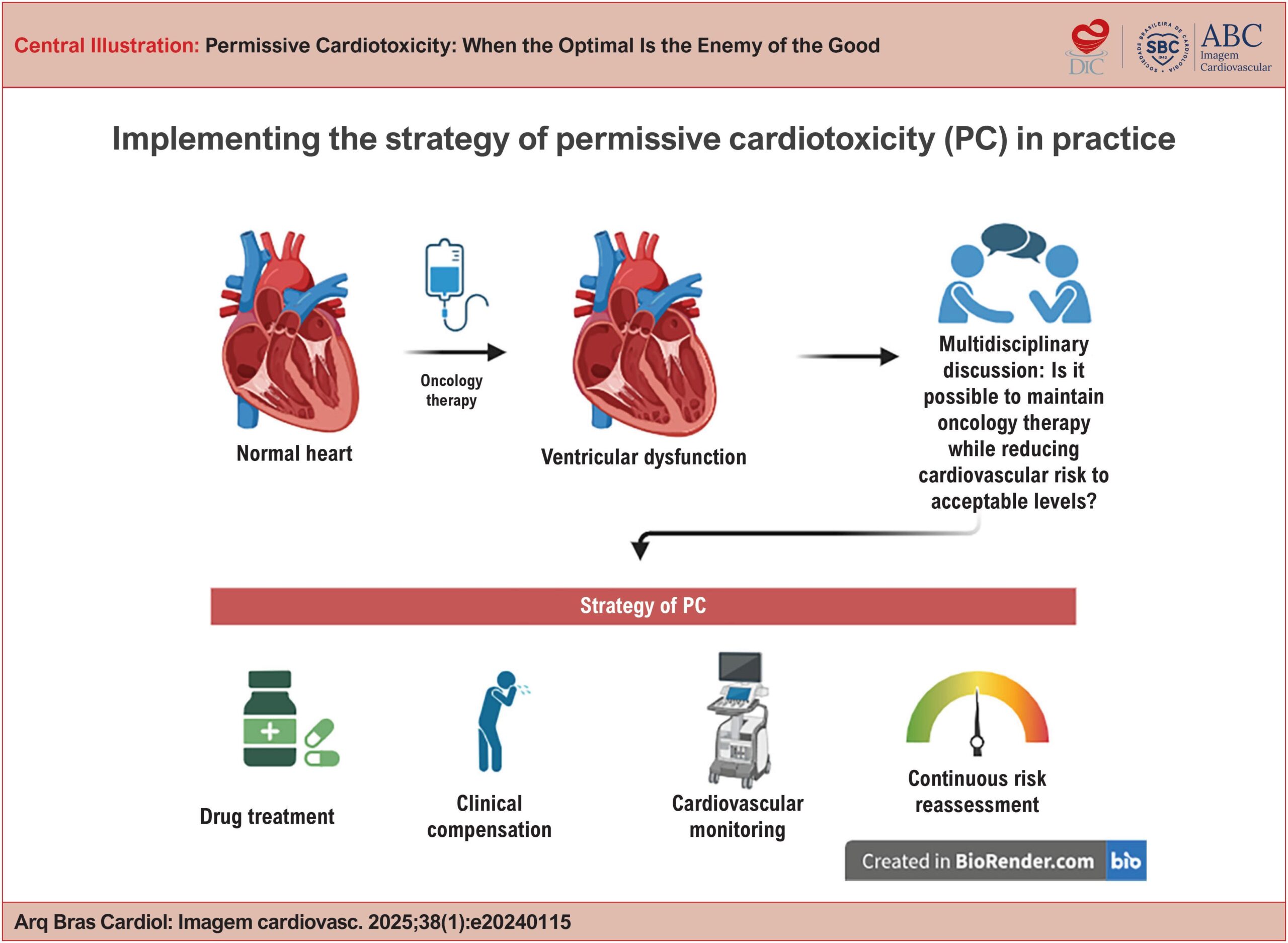
Central Illustration
ABCIC
Review Article

Permissive Cardiotoxicity: When the Optimal Is the Enemy of the Good

Carolina Maria Pinto Domingues Carvalho Silva et al. Juliane Dantas Seabra-Garcez Ana Palmira Lima Neves Ariane Vieira Scarlatelli Macedo

Abstract

Cancer and cardiovascular diseases are the leading causes of mortality worldwide. As these diseases share common metabolic pathways, patients with cancer are currently seen as having subclinical alterations with great potential for developing cardiovascular diseases (and vice versa). This tenuous interrelationship has led to the emergence of cardio-oncology (CO) as an area of study and discussion, with a major impact on the management of these cases.

In clinical practice, CO is dominated by the dilemma of how to best manage cardiovascular toxicity during cancer treatment. The management of these cases focuses not only on restoring cardiovascular balance, but also on ensuring that the best oncological treatment will be offered, without suspensions or interruptions.

Within this context, the concept of permissive cardiotoxicity (PC) has emerged, proposing the idea of maintaining antitumor treatment in the event that ventricular dysfunction is detected, with no pauses or interruptions, provided that certain premises are respected.

This review aims to examine the concept of PC in depth, contextualizing its emergence, reviewing definitions, and analyzing the evidence from experimental clinical studies. Furthermore, management strategies are detailed, discussing the central role of cardiovascular imaging in guiding this management. Finally, limitations and gaps in the literature in the area are discussed.

  • Antineoplastic Agents
  • Cardio-Oncology
  • Cardiotoxicity
  • Neoplasms
  • Ventricular Dysfunction
Read Full Article
Creative Commons Attribution (CC BY) Creative Commons license
28/03/2025 DOI: 10.36660/abcimg.20240115i
Strain in Monitoring Cancer Therapy-Induced Cardiotoxicity: Where are We After the SUCCOUR Study?
ABCIC
Editorial

Strain in Monitoring Cancer Therapy-Induced Cardiotoxicity: Where are We After the SUCCOUR Study?

Silvio Henrique Barberato et al. Ludhmila Abrão Hajjar

In recent decades, advances in cancer treatment have led to a significantly increased survival rate for several types of cancer. On the other hand, cancer survival increases patients’ vulnerability to cardiovascular complications induced by potentially cardiotoxic cancer therapy., Cardiovascular diseases are currently recognized as a main cause of morbidity and mortality in cancer survivors depending on the type of therapeutic approach used, patient age, and the presence of preexisting cardiovascular risk factors. Due to the high incidence of breast cancer in women, anthracyclines and monoclonal antibodies against human epidermal growth factor receptor type 2 (HER2) are the drugs most well-known as potential cardiotoxicity (CTX) inducers. However, other medications such as vascular endothelial growth factor inhibitors, tyrosine kinase inhibitors, proteasome inhibitors, and immunological checkpoint inhibitors, in addition to mediastinal radiotherapy, are also recognized for having a possible deleterious effect on the cardiovascular system. It is worth mentioning that CTX can express not only as myocardial dysfunction but also as acute coronary syndrome, arrhythmia, valve disease, pericardial disease, systemic arterial hypertension, and pulmonary hypertension. Thus, although left ventricular (LV) systolic dysfunction secondary to anticancer therapy is not the only CTX presentation, its development is among the most worrisome in clinical cardio-oncology practice, and the terms are often used interchangeably.

The diagnosis of LV dysfunction in a CTX setting is traditionally based on the serial evaluation of the LV ejection fraction (LVEF) using the Simpson method on two-dimensional echocardiography. Despite variation between international guidelines and cancer trials, the most commonly used CTX definition is a decrease of at least ten absolute points for a LVEF below the lower limit of normal after cancer treatment (considered below 53% by the cardiovascular imaging consensus of the European Association of Cardiovascular Imaging/American Society of Echocardiography [EACVI/ASE], or below 50% by the European Society of Cardiology [ESC]). However, LVEF measurements have important limitations, which include significant inter- and intra-observer variability, dependence on loading conditions, and low sensitivity to small LV function changes. Therefore, it was postulated that LVEF changes would occur later, when myocardial damage is severe enough to determine an irreversible cardiomyopathy.

[…]

  • Antineoplastic Agents
  • Cardiotoxicity
  • Doppler
  • Echocardiography
Read Full Article
Creative Commons Attribution (CC BY) Creative Commons license
26/11/2021 DOI: 10.47593/2675-312X/20213403eabc247
ABC
Editorial

Usefulness of Myocardial Deformation Indices in Preventing Cardiotoxicity in Breast Cancer Patients

Marcelo Dantas Tavares de Melo et al. Vera Maria Cury Salemi

The first description of chemotherapy-induced heart failure (Stage C) was published in 1967. There has been a therapeutic evolution in oncological treatment since then, as shown by the fact that, as of 2005, the survival rate exceeded that of mortality. This has resulted in a new epidemiological problem for these survivors, since at least 30% of them will show some degree of cardiotoxicity, which can occur up to decades after the end of the chemotherapy. Moreover, cardiovascular mortality is already considered the second most common cause of death, second only to cancer.–

The classically accepted definition for cardiotoxicity during treatment was proposed in 2014, which described it as an absolute decrease in left ventricular (LV) ejection fraction of 10 percentage points to values below 53%, with its re-evaluation being recommended after 2 to 3 weeks. Additionally, the subclinical lesion is based on the relative decrease in global LV longitudinal strain by 15% in relation to the baseline. The major concern is that systolic dysfunction can lead to a therapeutic dose adjustment, less effective alternative therapy regimens, or, in the worst-case scenario, to chemotherapy discontinuation.

[…]

  • Antineoplastic Agents
  • Breast Cancer
  • Cardiotoxicity
  • Drug Therapy
  • Ventricular Dysfunction
Read Full Article
Creative Commons Attribution (CC BY) Creative Commons license
01/01/2019 DOI: 10.5935/abc.20190009
ABC
Artigo Original

Detection of early sub-clinical trastuzumab-induced cardiotoxicity in breast cancer patients

Helder Dores et al. João Abecasis Maria João Correia Filipa Gândara … Cândida Fonseca José Azevedo Isabel Arroja Ana Martins Miguel Mendes

BACKGROUND: Trastuzumab (TZB) is a recombinant humanized monoclonal antibody, used for the treatment of HER2-positive breast cancer, with recognized associated-cardiotoxicity. The methods for its early sub-clinical detection are not well defined. OBJECTIVE: To evaluate TZB-induced cardiotoxicity in patients (pts) with breast cancer followed for a 3-month period of treatment. METHODS: Prospective study of consecutive pts treated with TZB for advanced HER2-positive breast cancer enrolled between May-September/2010. A comparison of clinical, laboratory and echocardiographic data, prior to and at the 3rd month after starting TZB was performed. Left ventricular systolic function deterioration (Cardiac Review and Evaluation Committee criteria) and diastolic function (American Society of Echocardiography classification) were studied. RESULTS: Data were available for 51 women, mean age = 55.4 ± 14.0y. At the 3rd month, no patient had symptomatic heart failure. Left ventricular ejection fraction (LVEF) did not differ at 3 months (69.3 ± 7.4 vs. 67.1 ± 6.5%, p > 0.05), decreasing in 57.9% pts (only one to LVEF < 55%). There was a significant increase in the E/e' ratio (3.9 ± 0.8 vs. 8.0 ± 1.9, p < 0,001) due to an e' velocity reduction (0.19 ± 0.02 vs. 0.10 ± 0.03, p < 0.001). Other diastolic parameters remained unchanged. Both the left atrial and the left ventricular volumes remained unchanged. N-terminal pro-B type natriuretic peptide levels did not increase. During the follow up period two pts died and two were admitted to the hospital, all for non-cardiovascular causes. CONCLUSIONS: During the first 3 months of TZB treatment none of the pts presented overt heart failure or significant LVEF deterioration. A significant reduction in the E/e' ratio was detected, but neither the loading parameters nor LVEF changed significantly .

  • Antineoplastic Agents
  • Breast Neoplasms
  • Heart Failure
  • Immunosuppresive Agents
  • Ventricular Dysfunction
Read Full Article
Creative Commons Attribution (CC BY) Creative Commons license
22/03/2013 DOI: 10.5935/abc.20130050

How to cite this article

EndNote RIS

Electronic Document Format (Vancouver)

Silva CMPDC, Seabra-Garcez JD, Neves APL, Macedo AVS. Permissive Cardiotoxicity: When the Optimal Is the Enemy of the Good. ABC Imagem Cardiovascular 2025;38(1):e20240115.

Electronic Document Format (ABNT)

Silva, Carolina Maria Pinto Domingues Carvalho; Seabra-Garcez, Juliane Dantas; Neves, Ana Palmira Lima; Macedo, Ariane Vieira Scarlatelli. Permissive Cardiotoxicity: When the Optimal Is the Enemy of the Good. ABC Imagem Cardiovascular, v. 38, n. 1, e20240115, Mar. 2025.

Electronic Document Format (APA)

Silva, C. M. P. D. C., Seabra-Garcez, J. D., Neves, A. P. L., & Macedo, A. V. S. (2025). Permissive Cardiotoxicity: When the Optimal Is the Enemy of the Good. ABC Imagem Cardiovascular, 38(1), e20240115.

Electronic Document Format (ISO)

Silva, Carolina Maria Pinto Domingues Carvalho and Seabra-Garcez, Juliane Dantas and Neves, Ana Palmira Lima and Macedo, Ariane Vieira Scarlatelli. Permissive Cardiotoxicity: When the Optimal Is the Enemy of the Good. ABC Imagem Cardiovascular [online]. 2025, vol. 38, n. 1, [cited 2026-10-14], e20240115. Available from: <https://journals.cardiol.br/en/article/permissive-cardiotoxicity-when-the-optimal-is-the-enemy-of-the-good/>. ISSN 2318-8219

EndNote RIS

Electronic Document Format (Vancouver)

Barberato SH, Hajjar LA. Strain in Monitoring Cancer Therapy-Induced Cardiotoxicity: Where are We After the SUCCOUR Study?. ABC Imagem Cardiovascular 2021;34(3):eabc247.

Electronic Document Format (ABNT)

Barberato, Silvio Henrique; Hajjar, Ludhmila Abrão. Strain in Monitoring Cancer Therapy-Induced Cardiotoxicity: Where are We After the SUCCOUR Study?. ABC Imagem Cardiovascular, v. 34, n. 3, eabc247, Nov. 2021.

Electronic Document Format (APA)

Barberato, S. H., & Hajjar, L. A. (2021). Strain in Monitoring Cancer Therapy-Induced Cardiotoxicity: Where are We After the SUCCOUR Study?. ABC Imagem Cardiovascular, 34(3), eabc247.

Electronic Document Format (ISO)

Barberato, Silvio Henrique and Hajjar, Ludhmila Abrão. Strain in Monitoring Cancer Therapy-Induced Cardiotoxicity: Where are We After the SUCCOUR Study?. ABC Imagem Cardiovascular [online]. 2021, vol. 34, n. 3, [cited 2026-10-14], eabc247. Available from: <https://journals.cardiol.br/en/article/strain-in-monitoring-cancer-therapy-induced-cardiotoxicity-where-are-we-after-the-succour-study/>. ISSN 2318-8219

EndNote RIS

Electronic Document Format (Vancouver)

Melo MDT, Salemi VMC. Usefulness of Myocardial Deformation Indices in Preventing Cardiotoxicity in Breast Cancer Patients. Arquivos Brasileiros de Cardiologia 2019;112(1):57-8.

Electronic Document Format (ABNT)

Melo, Marcelo Dantas Tavares de; Salemi, Vera Maria Cury. Usefulness of Myocardial Deformation Indices in Preventing Cardiotoxicity in Breast Cancer Patients. Arquivos Brasileiros de Cardiologia, v. 112, n. 1, p. 57-58, Dec. 2018.

Electronic Document Format (APA)

Melo, M. D. T. , & Salemi, V. M. C. (2019). Usefulness of Myocardial Deformation Indices in Preventing Cardiotoxicity in Breast Cancer Patients. Arquivos Brasileiros de Cardiologia, 112(1), 57-58.

Electronic Document Format (ISO)

Melo, Marcelo Dantas Tavares de and Salemi, Vera Maria Cury. Usefulness of Myocardial Deformation Indices in Preventing Cardiotoxicity in Breast Cancer Patients. Arquivos Brasileiros de Cardiologia [online]. 2019, vol. 112, n. 1, [cited 2026-10-14], pp. 57-58. Available from: <https://journals.cardiol.br/en/article/usefulness-of-myocardial-deformation-indices-in-preventing-cardiotoxicity-in-breast-cancer-patients/>. ISSN 0066-782X

EndNote RIS

Electronic Document Format (Vancouver)

Dores H, Abecasis J, Correia MJ, Gândara F, Fonseca C, Azevedo J, Arroja I, et al. Detection of early sub-clinical trastuzumab-induced cardiotoxicity in breast cancer patients. Arquivos Brasileiros de Cardiologia 2013;100(4):328-32.

Electronic Document Format (ABNT)

Dores, Helder; Abecasis, João; Correia, Maria João; Gândara, Filipa; Fonseca, Cândida; Azevedo, José; Arroja, Isabel; Martins, Ana; Mendes, Miguel. Detection of early sub-clinical trastuzumab-induced cardiotoxicity in breast cancer patients. Arquivos Brasileiros de Cardiologia, v. 100, n. 4, p. 328-332, Mar. 2013.

Electronic Document Format (APA)

Dores, H., Abecasis, J., Correia, M. J., Gândara, F., Fonseca, C., Azevedo, J., Arroja, I., Martins, A., & Mendes, M. (2013). Detection of early sub-clinical trastuzumab-induced cardiotoxicity in breast cancer patients. Arquivos Brasileiros de Cardiologia, 100(4), 328-332.

Electronic Document Format (ISO)

Dores, Helder and Abecasis, João and Correia, Maria João and Gândara, Filipa and Fonseca, Cândida and Azevedo, José and Arroja, Isabel and Martins, Ana and Mendes, Miguel. Detection of early sub-clinical trastuzumab-induced cardiotoxicity in breast cancer patients. Arquivos Brasileiros de Cardiologia [online]. 2013, vol. 100, n. 4, [cited 2026-10-14], pp. 328-332. Available from: <https://journals.cardiol.br/en/article/detection-of-early-sub-clinical-trastuzumab-induced-cardiotoxicity-in-breast-cancer-patients/>. ISSN 0066-782X

  • About ABC Family
  • Internal Regulation
  • Editorial Board
  • Brazilian Society of Cardiology (SBC)

Issues

SBC Guidelines

  • Videos
  • Podcasts
  • News