ABC Family Arquivos Brasileiros de Cardiologia International Journal of Cardiovascular Sciences ABC Heart Failure & Cardiomyopathy ABC Imagem Cardiovascular
Português English
ABC Family
Português English
  • About
    • About ABC Family
    • Internal Regulation
    • Editorial Board
    • Brazilian Society of Cardiology (SBC)
  • Issues
  • SBC Guidelines
  • Content
    • Videos
    • Podcasts
    • News
  • About
    • About ABC Family
    • Internal Regulation
    • Editorial Board
    • Brazilian Society of Cardiology (SBC)
  • Issues
  • SBC Guidelines
  • Content
    • Videos
    • Podcasts
    • News

ABC Family

  • ABC Family
  • Arquivos Brasileiros de Cardiologia
  • International Journal of Cardiovascular Sciences
  • ABC Heart Failure & Cardiomyopathy
  • ABC Imagem Cardiovascular
Search in

No content found.

Journals
Ordering
Article types
Others

  1. Home
  2. Keyword: angiotensin II
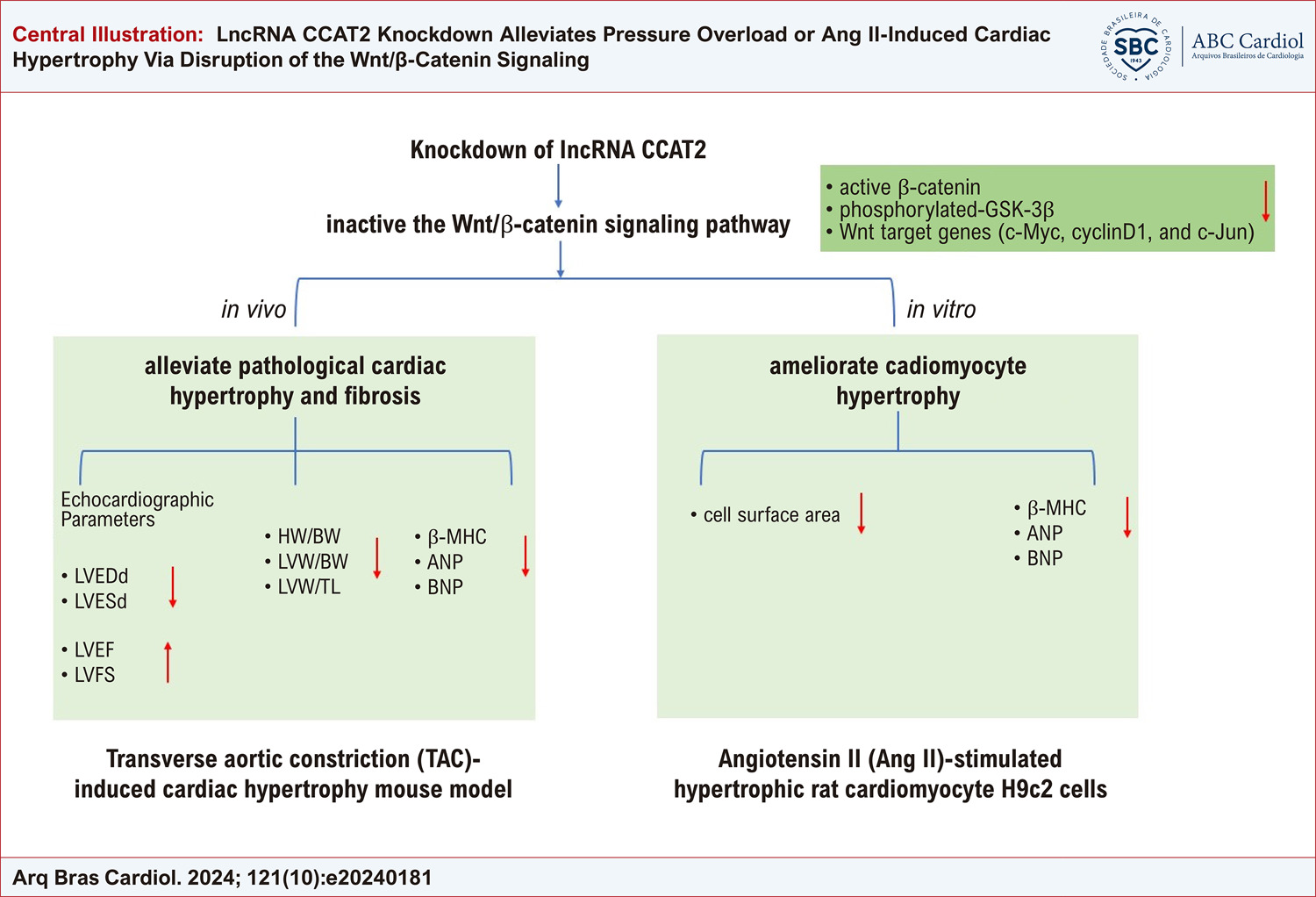
LncRNA CCAT2 Knockdown Alleviates Pressure Overload or Ang II-Induced Cardiac Hypertrophy Via Disruption of the Wnt/β-Catenin Signaling
ABC
Original Article

LncRNA CCAT2 Knockdown Alleviates Pressure Overload or Ang II-Induced Cardiac Hypertrophy Via Disruption of the Wnt/β-Catenin Signaling

Xiaojun Zhang et al. Zhen Chen Ning Zhang Bo Yu … Wei Li Mengli Zhang Xian Wu Ganzhe Liu Meizhen Dong

Abstract

Background

Sustained pathological cardiac hypertrophy (CH) is an independent risk factor for increased incidence and mortality of cardiovascular events.

Objectives

This research was designed to unravel the role of long non-coding RNA (LncRNA) CCAT2 in CH progression.

Methods

Transverse aortic constriction (TAC) procedures were conducted to construct a pressure overload-induced in vivo CH model. Angiotensin II (Ang II) treatment was utilized to induce hypertrophic rat cardiomyocyte H9c2 cells.

Results

In vivo results showed that silencing of CCAT2 reduced cardiomyocyte surface area, alleviated cardiac fibrosis, and decreased β-MHC, ANP, and BNP levels in CH mouse models. In vitro results revealed that CCAT2 knockdown reduced cell surface area and attenuated β-MHC, ANP, and BNP levels in hypertrophic H9c2 cells. Besides, CCAT2 silencing decreased the levels of active β-catenin, phosphorylated-GSK-3β, and Wnt target genes (c-Myc, cyclinD1, and c-Jun) in CH mice and hypertrophic H9c2 cells. Importantly, treatment with the Wnt/β-catenin pathway activator LiCl reversed the suppression of CCAT2 knockdown on H9c2 cell surface area and MHC, ANP, and BNP levels.

Conclusions

Collectively, CCAT2 silencing plays a protective role against CH through inactivating the Wnt/β-catenin signaling, which suggests that CCAT2 might become a promising therapeutic target for CH.
  • angiotensin II
  • Cardiomegaly
  • Catenins
Read Full Article
Creative Commons Attribution (CC BY) Creative Commons license
11/11/2024 DOI: 10.36660/abc.20240181i Views 1
The A1166C polymorphism of the angiotensin II type-1 receptor in acute myocardial infarction
ABC
Artigo Original

The A1166C polymorphism of the angiotensin II type-1 receptor in acute myocardial infarction

Messias Antônio de Araújo et al. Bruno Soares Menezes Clauber Lourenço Elisângela Rosa Cordeiro … Renata Rispoli Gatti Luiz Ricardo Goulart

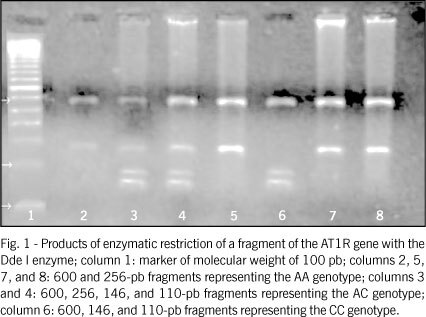
OBJECTIVE: To assess the association of the A1166C polymorphism of the angiotensin II type-1 receptor (AT1R) gene with acute myocardial infarction and also with the severity of coronary artery disease. METHODS: A prospective, cross-sectional study was carried out with 110 patients with acute myocardial infarction, who, on coronary angiography, had significant lesions (> 50%) assessed according to 3 criteria of severity: number of vessels affected, morphology of the atherosclerotic plaque, and coronary risk score. The control group comprised 104 individuals with no coronary lesions. The A1166C polymorphism of AT1R gene was determined by polymerase chain reaction in the DNA of leukocytes in peripheral blood. The classic coronary risk factors were analyzed in all individuals. RESULTS: When stratifying the genotypes in regard to risk factors, only smoking predominated in the AC heterozygous patients (P = 0.02). The genotypic frequency in the infarcted patients was as follows: AA = 54.5%; AC = 35.5%; and CC = 10%, which was similar and nonsignificant in regard to that in the control group (P = 0.83). No risk increase occurred for acute myocardial infarction when comparing the genotypes as follows: CC vs AA (OR = 1.35; 95% CI = 0.50 – 3.59); AC vs AA (OR = 1.03; 95% CI = 0.58 – 1.84); and AA+AC vs AA (OR = 1.33; 95% CI = 0.51 – 3.45). None of the severity criteria showed a significant correlation with the genotypes. CONCLUSION: According to our results, no correlation exists between the A1166C polymorphism of the angiotensin II type-1 receptor (AT1R) gene and acute myocardial infarction or the severity of coronary artery disease.

  • A1166C polymorphism
  • Acute Myocardial Infarction
  • angiotensin II
  • Coronary Artery Disease
Read Full Article
Creative Commons Attribution (CC BY) Creative Commons license
11/11/2004 DOI: 10.1590/S0066-782X2004001700007
Effects of losartan on ventricular remodeling in experimental infarction in rats
ABC
Original Article

Effects of losartan on ventricular remodeling in experimental infarction in rats

Leonardo A. M. Zornoff et al. Luiz S. Matsubara Beatriz B. Matsubara Sergio A. R. Paiva Joel Spadaro

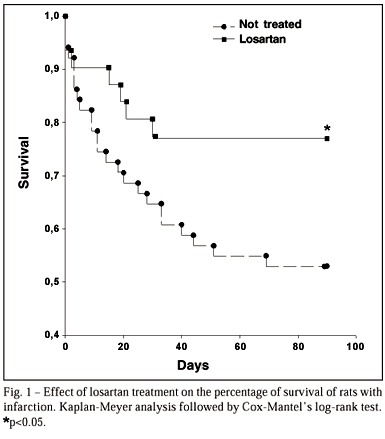
OBJECTIVE: To evaluate the effects of losartan on ventricular remodeling and on survival after myocardial infarction in rats. METHODS: After surgical occlusion of left coronary artery, 84 surviving male Wistar rats were divided into two groups: LO treated with losartan (20mg/kg/day, n=33) and NT (n=51), without medication. After 3 months, we analyzed mortality; ventricular to body mass ratio (VM /BM); myocardial hydroxyproline concentration (HOP); isovolumetric pressure, +dp/dt, -dp/dt, and diastolic volume/left ventricle mass ratio (VO/LV). RESULTS: Mortality was: LO = 22%, and NT = 47% (p<0.05). Ventricular mass,(VM/BM, mg/g) was 4.14 ± 0.76 and 3.54±0.48, in the NT and LO groups, respectively (p0.05). The V0/LV values (median) were 0.24 mL/g in group LO and 0.31 mL/g in group NT (p<0.05) compared to NT group. There were no differences between the groups for +dp/dt and -dp/dt parameters. CONCLUSION: 1- The use of losartan myocardial infarction causes an attenuation of ventricular remodeling, bringing about an increased survival, an attenuation of ventricular hypertrophy and dilation, and an improvement of the isovolumetric pressure; 2- the treatment does not modify the myocardial collagen concentration.

  • angiotensin II
  • Fibrosis
  • Ventricular Function
Read Full Article
Creative Commons Attribution (CC BY) Creative Commons license
08/01/2002 DOI: 10.1590/S0066-782X2000001200001
ABC
Artigo Original

Activation of the cardiac angiotensin-converting enzime after infarction in rats and its role in ventricular remodeling

José Geraldo Mill et al. Maria da Conceição Milanez Vera Cristina W. Busatto Andréa Cruz de Moraes Maria da Glória S. Gomes

PURPOSE: To determine angiotensin converting enzyme (ACE) activity in the heart of infarcted rats and to investigate the effects of captopril and losartan on the post- infarction remodeling process. METHODS: Myocardial infarction (MI) was produced in Wistar rats by ligature of the left coronary artery. Control rats (Con) underwent a sham surgery. MI and Con rats remained untreated or were treated with captopril (30mg/kg/day) or losartan (15mg/kg/day) for 30 days. ACE activity was determined in right (RV) and left ventricular (LV) muscles and in the scar tissue. The effects of captopril therapy was also investigated in the hydroxiproline (OH-Pro) and protein in RV and LV . RESULTS: ACE activity increased 25% in the RV and 70% in the remaining LV muscle. The highest ACE activity was found in the scar tissue, where it was 4.5 times the value of the LV muscle (420±68 vs 94±8nmoles/g/min; P<0.01). An increase of the end-diastolic pressure and of the muscle mass was found in the RV and LV of MI rats. Captopril and losartan treatments were equally efficient to attenuate these parameters in both ventricles. Captopril also reduced the total OH-Pro content in the RV and LV muscles. The Prot concentration was significantly reduced in the myocardium of MI rats, an effect enhanced by captopril therapy. CONCLUSION: The AII concentration in the blood draining from the scar to the surrounding muscle is probably high. It is likely that this elevated local generation of AII contributes to hypertrophy and to collagen deposition. The effects of ACE inhibitors on remodeling are likely to depend on the reduction of the locally generated AII.

  • angiotensin II
  • Angiotensin-Converting Enzyme Inhibitors
  • Myocardial Infarction
  • Ventricular Remodeling
Read Full Article
Creative Commons Attribution (CC BY) Creative Commons license
14/02/2001 DOI: 10.1590/S0066-782X1997000800005 Views 3

How to cite this article

EndNote RIS

Electronic Document Format (Vancouver)

Zhang X, Chen Z, Zhang N, Yu B, Li W, Zhang M, Wu X, et al. LncRNA CCAT2 Knockdown Alleviates Pressure Overload or Ang II-Induced Cardiac Hypertrophy Via Disruption of the Wnt/β-Catenin Signaling. Arquivos Brasileiros de Cardiologia 2024;121(10):e20240181.

Electronic Document Format (ABNT)

Zhang, Xiaojun; Chen, Zhen; Zhang, Ning; Yu, Bo; Li, Wei; Zhang, Mengli; Wu, Xian; Liu, Ganzhe; Dong, Meizhen. LncRNA CCAT2 Knockdown Alleviates Pressure Overload or Ang II-Induced Cardiac Hypertrophy Via Disruption of the Wnt/β-Catenin Signaling. Arquivos Brasileiros de Cardiologia, v. 121, n. 10, e20240181, Nov. 2024.

Electronic Document Format (APA)

Zhang, X., Chen, Z., Zhang, N., Yu, B., Li, W., Zhang, M., Wu, X., Liu, G., & Dong, M. (2024). LncRNA CCAT2 Knockdown Alleviates Pressure Overload or Ang II-Induced Cardiac Hypertrophy Via Disruption of the Wnt/β-Catenin Signaling. Arquivos Brasileiros de Cardiologia, 121(10), e20240181.

Electronic Document Format (ISO)

Zhang, Xiaojun and Chen, Zhen and Zhang, Ning and Yu, Bo and Li, Wei and Zhang, Mengli and Wu, Xian and Liu, Ganzhe and Dong, Meizhen. LncRNA CCAT2 Knockdown Alleviates Pressure Overload or Ang II-Induced Cardiac Hypertrophy Via Disruption of the Wnt/β-Catenin Signaling. Arquivos Brasileiros de Cardiologia [online]. 2024, vol. 121, n. 10, [cited 2026-10-14], e20240181. Available from: <https://journals.cardiol.br/en/article/lncrna-ccat2-knockdown-alleviates-pressure-overload-or-ang-ii-induced-cardiac-hypertrophy-via-disruption-of-the-wnt-%ce%b2-catenin-signaling/>. ISSN 0066-782X

EndNote RIS

Electronic Document Format (Vancouver)

Araújo MA, Menezes BS, Lourenço C, Cordeiro ER, Gatti RR, Goulart LR. The A1166C polymorphism of the angiotensin II type-1 receptor in acute myocardial infarction. Arquivos Brasileiros de Cardiologia 2004;83(5):404-8.

Electronic Document Format (ABNT)

Araújo, Messias Antônio de; Menezes, Bruno Soares; Lourenço, Clauber; Cordeiro, Elisângela Rosa; Gatti, Renata Rispoli; Goulart, Luiz Ricardo. The A1166C polymorphism of the angiotensin II type-1 receptor in acute myocardial infarction. Arquivos Brasileiros de Cardiologia, v. 83, n. 5, p. 404-408, Nov. 2004.

Electronic Document Format (APA)

Araújo, M. A. , Menezes, B. S., Lourenço, C., Cordeiro, E. R., Gatti, R. R., & Goulart, L. R. (2004). The A1166C polymorphism of the angiotensin II type-1 receptor in acute myocardial infarction. Arquivos Brasileiros de Cardiologia, 83(5), 404-408.

Electronic Document Format (ISO)

Araújo, Messias Antônio de and Menezes, Bruno Soares and Lourenço, Clauber and Cordeiro, Elisângela Rosa and Gatti, Renata Rispoli and Goulart, Luiz Ricardo. The A1166C polymorphism of the angiotensin II type-1 receptor in acute myocardial infarction. Arquivos Brasileiros de Cardiologia [online]. 2004, vol. 83, n. 5, [cited 2026-10-14], pp. 404-408. Available from: <https://journals.cardiol.br/en/article/the-a1166c-polymorphism-of-the-angiotensin-ii-type-1-receptor-in-acute-myocardial-infarction/>. ISSN 0066-782X

EndNote RIS

Electronic Document Format (Vancouver)

Zornoff LAM, Matsubara LS, Matsubara BB, Paiva SAR, Spadaro J. Effects of losartan on ventricular remodeling in experimental infarction in rats. Arquivos Brasileiros de Cardiologia 2002;75(6):465-70.

Electronic Document Format (ABNT)

Zornoff, Leonardo A. M.; Matsubara, Luiz S.; Matsubara, Beatriz B.; Paiva, Sergio A. R.; Spadaro, Joel. Effects of losartan on ventricular remodeling in experimental infarction in rats. Arquivos Brasileiros de Cardiologia, v. 75, n. 6, p. 465-470, Jan. 2002.

Electronic Document Format (APA)

Zornoff, L. A. M., Matsubara, L. S., Matsubara, B. B., Paiva, S. A. R., & Spadaro, J. (2002). Effects of losartan on ventricular remodeling in experimental infarction in rats. Arquivos Brasileiros de Cardiologia, 75(6), 465-470.

Electronic Document Format (ISO)

Zornoff, Leonardo A. M. and Matsubara, Luiz S. and Matsubara, Beatriz B. and Paiva, Sergio A. R. and Spadaro, Joel. Effects of losartan on ventricular remodeling in experimental infarction in rats. Arquivos Brasileiros de Cardiologia [online]. 2002, vol. 75, n. 6, [cited 2026-10-14], pp. 465-470. Available from: <https://journals.cardiol.br/en/article/effects-of-losartan-on-ventricular-remodeling-in-experimental-infarction-in-rats/>. ISSN 0066-782X

EndNote RIS

Electronic Document Format (Vancouver)

Mill JG, Milanez MC, Busatto VCW, Moraes AC, Gomes MGS. Activation of the cardiac angiotensin-converting enzime after infarction in rats and its role in ventricular remodeling. Arquivos Brasileiros de Cardiologia 2001;69(2):101-10.

Electronic Document Format (ABNT)

Mill, José Geraldo; Milanez, Maria da Conceição; Busatto, Vera Cristina W.; Moraes, Andréa Cruz de; Gomes, Maria da Glória S.. Activation of the cardiac angiotensin-converting enzime after infarction in rats and its role in ventricular remodeling. Arquivos Brasileiros de Cardiologia, v. 69, n. 2, p. 101-110, Feb. 2001.

Electronic Document Format (APA)

Mill, J. G., Milanez, M. C., Busatto, V. C. W., Moraes, A. C. , & Gomes, M. G. S. (2001). Activation of the cardiac angiotensin-converting enzime after infarction in rats and its role in ventricular remodeling. Arquivos Brasileiros de Cardiologia, 69(2), 101-110.

Electronic Document Format (ISO)

Mill, José Geraldo and Milanez, Maria da Conceição and Busatto, Vera Cristina W. and Moraes, Andréa Cruz de and Gomes, Maria da Glória S.. Activation of the cardiac angiotensin-converting enzime after infarction in rats and its role in ventricular remodeling. Arquivos Brasileiros de Cardiologia [online]. 2001, vol. 69, n. 2, [cited 2026-10-14], pp. 101-110. Available from: <https://journals.cardiol.br/en/article/activation-of-the-cardiac-angiotensin-converting-enzime-after-infarction-in-rats-and-its-role-in-ventricular-remodeling/>. ISSN 0066-782X

  • About ABC Family
  • Internal Regulation
  • Editorial Board
  • Brazilian Society of Cardiology (SBC)

Issues

SBC Guidelines

  • Videos
  • Podcasts
  • News