ABC Family Arquivos Brasileiros de Cardiologia International Journal of Cardiovascular Sciences ABC Heart Failure & Cardiomyopathy ABC Imagem Cardiovascular
Português English
ABC Family
Português English
  • About
    • About ABC Family
    • Internal Regulation
    • Editorial Board
    • Brazilian Society of Cardiology (SBC)
  • Issues
  • SBC Guidelines
  • Content
    • Videos
    • Podcasts
    • News
  • About
    • About ABC Family
    • Internal Regulation
    • Editorial Board
    • Brazilian Society of Cardiology (SBC)
  • Issues
  • SBC Guidelines
  • Content
    • Videos
    • Podcasts
    • News

ABC Family

  • ABC Family
  • Arquivos Brasileiros de Cardiologia
  • International Journal of Cardiovascular Sciences
  • ABC Heart Failure & Cardiomyopathy
  • ABC Imagem Cardiovascular
Search in

No content found.

Journals
Ordering
Article types
Others

  1. Home
  2. Keyword: acute coronary syndromes
Association between the Use of Fondaparinux Plus Radial Access and Clinical Outcomes in Patients with Non-ST Elevation Acute Coronary Syndrome
ABC
Original Article

Association between the Use of Fondaparinux Plus Radial Access and Clinical Outcomes in Patients with Non-ST Elevation Acute Coronary Syndrome

Luiz Eduardo Fonteles Ritt et al. Eduardo Sahade Darze Pedro Gabriel Melo de Barros e Silva Gilson Soares Feitosa-Filho … João Victor Santos Pereira Ramos Márcia A. Viana Priscila Neri Lacerda Emanoela Lima Freitas Queila Oliveira Borges Adriano Oliveira Martins Renato Delascio Lopes

Abstract

Background:

Both fondaparinux and radial access have been associated with lower rates of major adverse cardiovascular events (MACE) in acute coronary syndrome (ACS).

Objective:

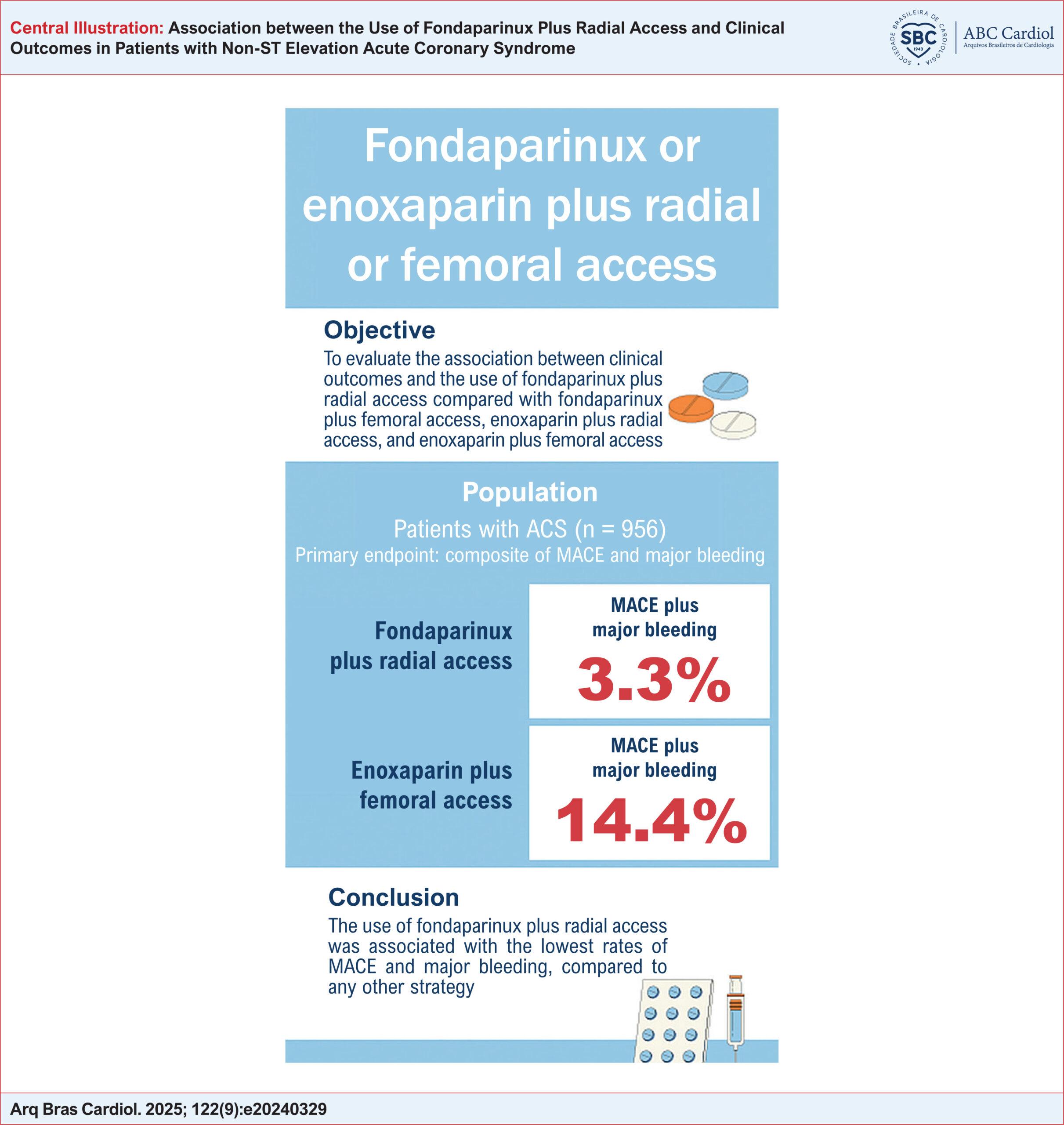
To evaluate the association between the use of fondaparinux plus radial access and clinical outcomes.

Methods:

In this study, 956 patients admitted with ACS and treated with an invasive strategy were analyzed. The primary outcome — a composite of major bleeding (according to OASIS-5 criteria) and MACE — was compared across groups defined by anticoagulation regimen (fondaparinux or enoxaparin) plus arterial access site (femoral vs. radial). A p-value < 0.05 was considered statistically significant.

Results:

The mean age of the study population was 65 ± 12.4 years, and 49.5% presented with non-ST segment elevation myocardial infarction (NSTEMI). Fondaparinux and radial access were used concurrently in 366 patients. The primary endpoint occurred in 78 patients (8.1%): MACE in 50 (5.2%) and major bleeding in 32 (3.3%). The event rate was lowest in the fondaparinux plus radial access group (3.3%), compared with enoxaparin plus radial access (9.8%), fondaparinux plus femoral access (8.6%), and enoxaparin plus femoral access (14.4%) (p < 0.001). Multivariable analysis showed that the use of fondaparinux was associated with a 43% reduction in the primary outcome (OR, 0.57; 95% CI, 0.34-0.96; p < 0.05), and radial access was independently associated with a 54% reduction (OR, 0.46; 95% CI, 0.26-0.83; p = 0.01).

Conclusion:

The combination of fondaparinux and radial access was associated with the lowest rates of MACE and major bleeding, compared to either strategy alone.
  • acute coronary syndromes
  • Cardiac Catheterization
  • Prognosis
Read Full Article
Creative Commons Attribution (CC BY) Creative Commons license
01/12/2025 DOI: 10.36660/abc.20240329i Views 1
ABC
Editorial

Reducing Sex Disparities in STEMI Care and Outcomes: Turning the Tide for Women

F. Aaysha Cader et al. Cristina Gavina

Despite improvements in acute coronary syndromes (ACS) care, globally, sex disparities remain.Women with ST-segment elevation myocardial infarction (STEMI) present later, receive suboptimal care, and have worse outcomes than men. –

In a single-center retrospective analysis of 809 STEMI patients undergoing primary PCI in Braga, Portugal, Oliveira et al. reported sex disparities in presentation, management, and outcomes.Although ischemic heart disease and coronary death incidence are lower in Portugal than in other European countries,cardiovascular death remains the main cause of mortality.

[…]

  • acute coronary syndromes
  • Sex Disparities
  • ST Elevation Myocardial Infarction
  • Women
Read Full Article
Creative Commons Attribution (CC BY) Creative Commons license
13/02/2023 DOI: 10.36660/abc.20220884 Views 1
ABC
Artigo Original

Thyroid hormone profile in acute coronary syndromes

Rodrigo Caetano Pimentel et al. Gilberto Perez Cardoso Claudia Caminha Escosteguy Luiz Maurino Abreu

OBJECTIVE: To describe thyroid hormone profile in patients with acute coronary syndromes (ACS), divided into two groups: 1) unstable angina and/or non-ST-segment elevation acute myocardial infarction (UA/NSTEMI); 2) ST-segment elevation acute myocardial infarction (STEMI), as well as in patients that progressed or not to death, according to the groups. METHODS: Seventy ACS patients admitted to the coronary care unit of the Hospital dos Servidores do Estado, Rio de Janeiro, were prospectively studied. Blood samples were collected on day 1 and on days 4 and 7 following admission. Clinical evaluation and electrocardiograms were performed during hospitalization. RESULTS: Of the 70 patients admitted, 13 (18.6%) had “euthyroid sick syndrome” (ESS), a condition characterized by decreased serum T3 and/or free T3, increased serum reverse T3 (rT3), plus normal serum TSH, T4, and free T4. Patients belonging to the STEMI group showed early elevations, in addition to higher mean reverse T3 (rT3) and lower mean T3 and free T3 levels. In coronary heart disease patients that progressed to death, hormonal findings were consistent with those found in the ESS, with more expressive rT3 and T3 mean values. CONCLUSION: Our results show the importance of recognizing the “euthyroid sick syndrome” in coronary heart disease patients, suggesting an association with poorer prognosis in patients with acute coronary syndrome.

  • acute coronary syndromes
  • euthyroid sick syndrome
  • Thyroid Hormones
Read Full Article
Creative Commons Attribution (CC BY) Creative Commons license
18/01/2007 DOI: 10.1590/S0066-782X2006001900002
ABC
Artigo Original

Correlation between biochemical markers and coronary angiography in patients with non-ST elevation acute coronary syndromes

Cynthia Karla Magalhães et al. Aristarco Gonçalves de Siqueira Filho José Geraldo de Castro Amino Mônica Nolasco

OBJECTIVE: Investigate the correlation between biochemical markers (TNI, CRP and fibrinogen) and anatomical coronary angiographic findings in patients with non-ST elevation acute coronary syndromes (NSTE-ACS). METHODS: One blood sample was obtained to test for markers, and coronary angiography was performed within the first 72 hours after hospitalization. Univariate analysis was used to search for correlations between the 3 markers and the angiographic findings in the group of patients with an identified ischemia-related artery (IRA), and multivariate analysis was performed to investigate the correlation between these markers and the presence of unstable atherosclerotic lesions solely in the group with a coronary obstruction >50%. RESULTS: Prospective study conducted with 84 patients, 65.5% of whom were men. In the IRA-identified group, blood levels of the three markers were higher than in the groups with no IRA-identified or with normal coronary arteries. The analysis used to evaluate the IRA-identified group showed significant correlations between TIMI flow and TN-I (p = 0.006), unstable atherosclerotic lesions and TN-I and fibrinogen (p = 0.02 and p = 0.01, respectively), and multivessel disease and CRP (p = 0.0005). The multivariate analysis showed that CRP, fibrinogen and TN-I were independent predictors of unstable atherosclerotic lesions (p = 0.002; p = 0.003 and p = 0.007, respectively). CONCLUSION: In NSTE-ACS patients, TN-I, CRP and fibrinogen blood levels within the first 10 hours after hospitalization correlated with coronary angiographic findings.

  • acute coronary syndromes
  • Inflammation
  • Myocardial Injury
  • Thrombosis
Read Full Article
Creative Commons Attribution (CC BY) Creative Commons license
30/03/2006 DOI: 10.1590/S0066-782X2006000300011
Correlation between turbidimetric and nephelometric methods of measuring C-reactive protein in patients with unstable angina or non-ST elevation acute myocardial infarction
ABC
Original Article

Correlation between turbidimetric and nephelometric methods of measuring C-reactive protein in patients with unstable angina or non-ST elevation acute myocardial infarction

Luis C. L. Correia et al. José C. Lima Gary Gerstenblith Luis P. Magalhães … Agnaluce Moreira Octávio Barbosa Jr. Juliana Dumet Luiz Carlos S. Passos Argemiro D'Oliveira Júnior José Péricles Esteves

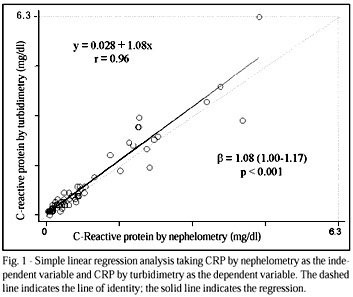
OBJECTIVE: To evaluate the performance of the turbidimetric method of C-reactive protein (CRP) as a measure of low-grade inflammation in patients admitted with non-ST elevation acute coronary syndromes (ACS). METHODS: Serum samples obtained at hospital arrival from 68 patients (66±11 years, 40 men), admitted with unstable angina or non-ST elevation acute myocardial infarction were used to measure CRP by the methods of nephelometry and turbidimetry. RESULTS: The medians of C-reactive protein by the turbidimetric and nephelometric methods were 0.5 mg/dL and 0.47 mg/dL, respectively. A strong linear association existed between the 2 methods, according to the regression coefficient (b=0.75; 95% C.I.=0.70-0.80) and correlation coefficient (r=0.96; P<0.001). The mean difference between the nephelometric and turbidimetric CRP was 0.02 ± 0.91 mg/dL, and 100% agreement between the methods in the detection of high CRP was observed. CONCLUSION: In patients with non-ST elevation ACS, CRP values obtained by turbidimetry show a strong linear association with the method of nephelometry and perfect agreement in the detection of high CRP.

  • acute coronary syndromes
  • C-Reactive Protein
  • turbidimetric method
Read Full Article
Creative Commons Attribution (CC BY) Creative Commons license
16/09/2003 DOI: 10.1590/S0066-782X2003001000002 Views 1

How to cite this article

EndNote RIS

Electronic Document Format (Vancouver)

Ritt LEF, Darze ES, Silva PGMB, Feitosa-Filho GS, Ramos JVSP, Viana MA, Lacerda PN, et al. Association between the Use of Fondaparinux Plus Radial Access and Clinical Outcomes in Patients with Non-ST Elevation Acute Coronary Syndrome. Arquivos Brasileiros de Cardiologia 2025;122(9):e20240329.

Electronic Document Format (ABNT)

Ritt, Luiz Eduardo Fonteles; Darze, Eduardo Sahade; Silva, Pedro Gabriel Melo de Barros e; Feitosa-Filho, Gilson Soares; Ramos, João Victor Santos Pereira; Viana, Márcia A.; Lacerda, Priscila Neri; Freitas, Emanoela Lima; Borges, Queila Oliveira; Martins, Adriano Oliveira; Lopes, Renato Delascio. Association between the Use of Fondaparinux Plus Radial Access and Clinical Outcomes in Patients with Non-ST Elevation Acute Coronary Syndrome. Arquivos Brasileiros de Cardiologia, v. 122, n. 9, e20240329, Nov. 2025.

Electronic Document Format (APA)

Ritt, L. E. F., Darze, E. S., Silva, P. G. M. B. , Feitosa-Filho, G. S., Ramos, J. V. S. P., Viana, M. A., Lacerda, P. N., Freitas, E. L., Borges, Q. O., Martins, A. O., & Lopes, R. D. (2025). Association between the Use of Fondaparinux Plus Radial Access and Clinical Outcomes in Patients with Non-ST Elevation Acute Coronary Syndrome. Arquivos Brasileiros de Cardiologia, 122(9), e20240329.

Electronic Document Format (ISO)

Ritt, Luiz Eduardo Fonteles and Darze, Eduardo Sahade and Silva, Pedro Gabriel Melo de Barros e and Feitosa-Filho, Gilson Soares and Ramos, João Victor Santos Pereira and Viana, Márcia A. and Lacerda, Priscila Neri and Freitas, Emanoela Lima and Borges, Queila Oliveira and Martins, Adriano Oliveira and Lopes, Renato Delascio. Association between the Use of Fondaparinux Plus Radial Access and Clinical Outcomes in Patients with Non-ST Elevation Acute Coronary Syndrome. Arquivos Brasileiros de Cardiologia [online]. 2025, vol. 122, n. 9, [cited 2026-10-14], e20240329. Available from: <https://journals.cardiol.br/en/article/association-between-the-use-of-fondaparinux-plus-radial-access-and-clinical-outcomes-in-patients-with-non-st-elevation-acute-coronary-syndrome/>. ISSN 0066-782X

EndNote RIS

Electronic Document Format (Vancouver)

Cader FA, Gavina C. Reducing Sex Disparities in STEMI Care and Outcomes: Turning the Tide for Women. Arquivos Brasileiros de Cardiologia 2023;120(1):e20220884.

Electronic Document Format (ABNT)

Cader, F. Aaysha; Gavina, Cristina. Reducing Sex Disparities in STEMI Care and Outcomes: Turning the Tide for Women. Arquivos Brasileiros de Cardiologia, v. 120, n. 1, e20220884, Feb. 2023.

Electronic Document Format (APA)

Cader, F. A., & Gavina, C. (2023). Reducing Sex Disparities in STEMI Care and Outcomes: Turning the Tide for Women. Arquivos Brasileiros de Cardiologia, 120(1), e20220884.

Electronic Document Format (ISO)

Cader, F. Aaysha and Gavina, Cristina. Reducing Sex Disparities in STEMI Care and Outcomes: Turning the Tide for Women. Arquivos Brasileiros de Cardiologia [online]. 2023, vol. 120, n. 1, [cited 2026-10-14], e20220884. Available from: <https://journals.cardiol.br/en/article/reducing-sex-disparities-in-stemi-care-and-outcomes-turning-the-tide-for-women/>. ISSN 0066-782X

EndNote RIS

Electronic Document Format (Vancouver)

Pimentel RC, Cardoso GP, Escosteguy CC, Abreu LM. Thyroid hormone profile in acute coronary syndromes. Arquivos Brasileiros de Cardiologia 2007;87(6):688-94.

Electronic Document Format (ABNT)

Pimentel, Rodrigo Caetano; Cardoso, Gilberto Perez; Escosteguy, Claudia Caminha; Abreu, Luiz Maurino. Thyroid hormone profile in acute coronary syndromes. Arquivos Brasileiros de Cardiologia, v. 87, n. 6, p. 688-694, Jan. 2007.

Electronic Document Format (APA)

Pimentel, R. C., Cardoso, G. P., Escosteguy, C. C., & Abreu, L. M. (2007). Thyroid hormone profile in acute coronary syndromes. Arquivos Brasileiros de Cardiologia, 87(6), 688-694.

Electronic Document Format (ISO)

Pimentel, Rodrigo Caetano and Cardoso, Gilberto Perez and Escosteguy, Claudia Caminha and Abreu, Luiz Maurino. Thyroid hormone profile in acute coronary syndromes. Arquivos Brasileiros de Cardiologia [online]. 2007, vol. 87, n. 6, [cited 2026-10-14], pp. 688-694. Available from: <https://journals.cardiol.br/en/article/thyroid-hormone-profile-in-acute-coronary-syndromes/>. ISSN 0066-782X

EndNote RIS

Electronic Document Format (Vancouver)

Magalhães CK, Siqueira Filho AG, Amino JGC, Nolasco M. Correlation between biochemical markers and coronary angiography in patients with non-ST elevation acute coronary syndromes. Arquivos Brasileiros de Cardiologia 2006;86(3):223-31.

Electronic Document Format (ABNT)

Magalhães, Cynthia Karla; Siqueira Filho, Aristarco Gonçalves de; Amino, José Geraldo de Castro; Nolasco, Mônica. Correlation between biochemical markers and coronary angiography in patients with non-ST elevation acute coronary syndromes. Arquivos Brasileiros de Cardiologia, v. 86, n. 3, p. 223-231, Mar. 2006.

Electronic Document Format (APA)

Magalhães, C. K., Siqueira Filho, A. G. , Amino, J. G. C., & Nolasco, M. (2006). Correlation between biochemical markers and coronary angiography in patients with non-ST elevation acute coronary syndromes. Arquivos Brasileiros de Cardiologia, 86(3), 223-231.

Electronic Document Format (ISO)

Magalhães, Cynthia Karla and Siqueira Filho, Aristarco Gonçalves de and Amino, José Geraldo de Castro and Nolasco, Mônica. Correlation between biochemical markers and coronary angiography in patients with non-ST elevation acute coronary syndromes. Arquivos Brasileiros de Cardiologia [online]. 2006, vol. 86, n. 3, [cited 2026-10-14], pp. 223-231. Available from: <https://journals.cardiol.br/en/article/correlation-between-biochemical-markers-and-coronary-angiography-in-patients-with-non-st-elevation-acute-coronary-syndromes/>. ISSN 0066-782X

EndNote RIS

Electronic Document Format (Vancouver)

Correia LCL, Lima JC, Gerstenblith G, Magalhães LP, Moreira A, Barbosa Jr. O, Dumet J, et al. Correlation between turbidimetric and nephelometric methods of measuring C-reactive protein in patients with unstable angina or non-ST elevation acute myocardial infarction. Arquivos Brasileiros de Cardiologia 2003;81(2):133-6.

Electronic Document Format (ABNT)

Correia, Luis C. L.; Lima, José C.; Gerstenblith, Gary; Magalhães, Luis P.; Moreira, Agnaluce; Barbosa Jr., Octávio; Dumet, Juliana; Passos, Luiz Carlos S.; D’Oliveira Júnior, Argemiro; Esteves, José Péricles. Correlation between turbidimetric and nephelometric methods of measuring C-reactive protein in patients with unstable angina or non-ST elevation acute myocardial infarction. Arquivos Brasileiros de Cardiologia, v. 81, n. 2, p. 133-136, Sep. 2003.

Electronic Document Format (APA)

Correia, L. C. L., Lima, J. C., Gerstenblith, G., Magalhães, L. P., Moreira, A., Barbosa Jr., O., Dumet, J., Passos, L. C. S., D’Oliveira Júnior, A., & Esteves, J. P. (2003). Correlation between turbidimetric and nephelometric methods of measuring C-reactive protein in patients with unstable angina or non-ST elevation acute myocardial infarction. Arquivos Brasileiros de Cardiologia, 81(2), 133-136.

Electronic Document Format (ISO)

Correia, Luis C. L. and Lima, José C. and Gerstenblith, Gary and Magalhães, Luis P. and Moreira, Agnaluce and Barbosa Jr., Octávio and Dumet, Juliana and Passos, Luiz Carlos S. and D’Oliveira Júnior, Argemiro and Esteves, José Péricles. Correlation between turbidimetric and nephelometric methods of measuring C-reactive protein in patients with unstable angina or non-ST elevation acute myocardial infarction. Arquivos Brasileiros de Cardiologia [online]. 2003, vol. 81, n. 2, [cited 2026-10-14], pp. 133-136. Available from: <https://journals.cardiol.br/en/article/correlation-between-turbidimetric-and-nephelometric-methods-of-measuring-c-reactive-protein-in-patients-with-unstable-angina-or-non-st-elevation-acute-myocardial-infarction/>. ISSN 0066-782X

  • About ABC Family
  • Internal Regulation
  • Editorial Board
  • Brazilian Society of Cardiology (SBC)

Issues

SBC Guidelines

  • Videos
  • Podcasts
  • News