ABC Family Arquivos Brasileiros de Cardiologia International Journal of Cardiovascular Sciences ABC Heart Failure & Cardiomyopathy ABC Imagem Cardiovascular
Português English
ABC Family
Português English
  • About
    • About ABC Family
    • Internal Regulation
    • Editorial Board
    • Brazilian Society of Cardiology (SBC)
  • Issues
  • SBC Guidelines
  • Content
    • Videos
    • Podcasts
    • News
  • About
    • About ABC Family
    • Internal Regulation
    • Editorial Board
    • Brazilian Society of Cardiology (SBC)
  • Issues
  • SBC Guidelines
  • Content
    • Videos
    • Podcasts
    • News

ABC Family

  • ABC Family
  • Arquivos Brasileiros de Cardiologia
  • International Journal of Cardiovascular Sciences
  • ABC Heart Failure & Cardiomyopathy
  • ABC Imagem Cardiovascular
Search in

No content found.

Journals
Ordering
Article types
Others

  1. Home
  2. Keyword: Abdominal Obesity
IJCS
Original Article

Association between Deep Subcutaneous Adipose Tissue Estimated by DAAT Index and Dietary Intake in Patients with Acute Coronary Syndrome

Elana Stein et al. Sandra Barbiero Vera Lucia Portal Victória da Luz Aline Marcadenti

Abstract

Background:

Abdominal obesity has been associated with cardiovascular disease and may be modulated by dietary intake. The deep abdominal subcutaneous adipose tissue (dSAT) is a body fat compartment that can be estimated by using mathematical formulas.

Objectives:

To evaluate the association between dSAT estimated by the Deep-Abdominal-Adipose-Tissue (DAAT) index and dietary intake in patients with acute coronary syndrome (ACS).

Methods:

This is a cross-sectional study conducted with patients ≥ 18 years of age admitted to a tertiary hospital. Sociodemographic, clinical, and anthropometric (body weight [kg], height [m], waist, hip and neck circumferences [cm]) data were evaluated. A food frequency questionnaire was applied to identify each patient’s nutrient intake. The DAAT index was calculated according to specific formulas for men and women. Possible association between food intake and the DAAT index was evaluated by multiple linear regression. The level of significance adopted was 0.05.

Results:

This study evaluated 138 patients, with a mean age of 61.2±10.8 years. Prevalence of obesity was 29.4% in men and 37.7% in women. Regarding waist circumference, 83% of the women showed values considered to be very high. The DAAT index was significantly higher in men when compared to woman (P < 0.0001) and proved to be positively correlated with proteins (r= 0.22, P= 0.01) and monounsaturated fatty acid (r= 0.18, P= 0.04) intake in the entire sample. After adjustment for sex, alcohol consumption, and levels of physical activity, the DAAT index was associated with the female sex (B= −129.84, P <0.001) and a sedentary lifestyle (B= 57.99, P <0.001).

Conclusion:

dSAT estimated by the DAAT index was not associated with dietary intake in patients with ACS.
  • Abdominal Obesity
  • Cardiovascular Diseases
  • Diet
  • Myocardial Infarction
  • subcutaneous fat
Read Full Article
Creative Commons Attribution (CC BY) Creative Commons license
26/07/2021 DOI: 10.36660/ijcs.20200334 Views 1
Figure 1
ABC
Original Article

Indicators of Abdominal Adiposity and Carotid Intima-Media Thickness: Results from the Longitudinal Study of Adult Health (ELSA-Brazil)

Michaela Eickemberg et al. Leila Denise Alves Ferreira Amorim Maria da Conceição Chagas de Almeida Estela Maria Leão de Aquino … Maria de Jesus Mendes da Fonseca Itamar de Souza Santos Dora Chor Maria de Fátima Sander Diniz Sandhi Maria Barreto Sheila Maria Alvim de Matos

Abstract

Background:

Abdominal adiposity is a risk factor for cardiovascular disease.

Objective:

To determine the magnitude of the association between abdominal adiposity, according to five different indicators, and the carotid intima-media thickness (CIMT).

Methods:

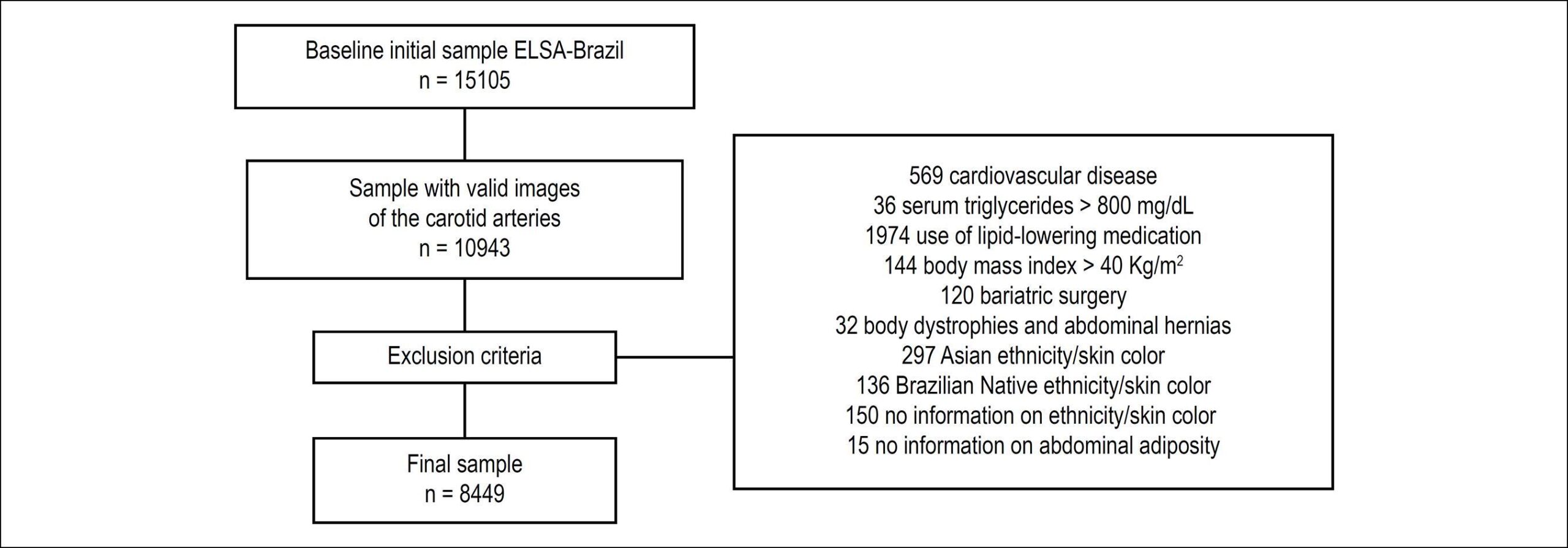
Data from 8,449 participants aged 35 to 74 years from the ELSA-Brazil study were used. The effect of waist circumference (WC), waist-to-hip ratio (WHR), conicity index (C index), lipid accumulation product (LAP) and visceral adiposity index (VAI) on CIMT were evaluated. Data were stratified by gender and analyzed using multivariate linear and logistic regressions. A significance level of 5% was considered.

Results:

Participants with CIMT > P75 showed a higher frequency of abdominal adiposity (men >72% and women >66%) compared to those with CIMT < P75. Abdominal adiposity was associated with the mean CIMT, mainly through WC in men (0.04; 95%CI: 0.033; 0.058). The abdominal adiposity identified by the WC, WHR, LAP, and VAI indicators in women showed an effect of 0.02 mm on the CIMT (WC: 0.025, 95%CI: 0.016, 0.035; WHR: 0.026, 95%CI: 0.016, 0.035; LAP: 0.024, 95%CI: 0.014; 0.034; VAI: 0.020, 95%CI: 0.010, 0.031). In the multiple logistic regression, the abdominal adiposity diagnosed by WC showed an important effect on the CIMT in both genders (men: OR = 1.47, 95%CI: 1.22-1.77, women: OR = 1.38; 95%CI: 1.17-1.64).

Conclusion:

Abdominal adiposity, identified through WC, WHR, LAP, and VAI, was associated with CIMT in both genders, mainly for the traditional anthropometric indicator, WC.

  • Abdominal Obesity
  • Atherosclerosis
  • Cardiovascular Diseases
  • Carotid Intima-Media Thickness
  • Metabolic Syndrome
  • Metabolism
  • Risk Factors
Read Full Article
Creative Commons Attribution (CC BY) Creative Commons license
07/01/2019 DOI: 10.5935/abc.20180273 Views 1
Anthropometric indexes of obesity as an instrument of screening for high coronary risk in adults in the city of Salvador - Bahia
ABC
Artigo Original

Anthropometric indexes of obesity as an instrument of screening for high coronary risk in adults in the city of Salvador – Bahia

Francisco José Gondim Pitanga et al. Ines Lessa

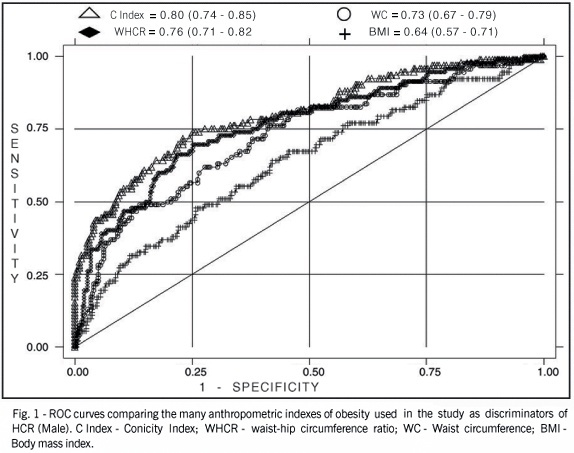
OBJECTIVE: To compare some anthropometric indexes of obesity and identify among them which one best discriminates the high coronary risk (HCR). METHODS: A cross-section study, with sample consisting of 968 adults, between 30 and 74 years old, being 391 (40.4%) men. Many Receiver Operating Characteristic (ROC) curves were obtained and compared to areas under them among the conicity index (C index), body mass index (BMI), waist-hip circumference ratio (WHCR), waist circumference (WC) and HCR. The sensitivity and specificity to identify and compare the best cut-off point among the many indexes of obesity to discriminate the HCR were also identified. A confidence interval of 95% was used. RESULTS: The largest area under ROC curve was found between the C index and the HCR, in individuals of male sex, 0.80 (0.74-0.85), significantly differing from the other indexes of obesity. In women, the largest area found under the ROC curve was 0.76 (0.71-0.81), being equal between C, WHCR and HCR indexes. CONCLUSION: Those results show that C and WHCR indexes are the best indexes of obesity to discriminate HCR. WC has intermediate discriminatory power and the BMI was the least suitable anthropometric index of obesity to discriminate HCR. Those data suggest that the indexes of abdominal obesity are better to discriminate HCR than the indexes of general obesity.

  • Abdominal Obesity
  • anthropometric indexes of obesity
  • coronary risk
Read Full Article
Creative Commons Attribution (CC BY) Creative Commons license
29/09/2005 DOI: 10.1590/S0066-782X2005001400006 Views 1

How to cite this article

EndNote RIS

Electronic Document Format (Vancouver)

Stein E, Barbiero S, Portal VL, Luz V, Marcadenti A. Association between Deep Subcutaneous Adipose Tissue Estimated by DAAT Index and Dietary Intake in Patients with Acute Coronary Syndrome. International Journal of Cardiovascular Sciences 2021;35(1):39-45.

Electronic Document Format (ABNT)

Stein, Elana; Barbiero, Sandra; Portal, Vera Lucia; Luz, Victória da; Marcadenti, Aline. Association between Deep Subcutaneous Adipose Tissue Estimated by DAAT Index and Dietary Intake in Patients with Acute Coronary Syndrome. International Journal of Cardiovascular Sciences, v. 35, n. 1, p. 39-45, Jul. 2021.

Electronic Document Format (APA)

Stein, E., Barbiero, S., Portal, V. L., Luz, V. , & Marcadenti, A. (2021). Association between Deep Subcutaneous Adipose Tissue Estimated by DAAT Index and Dietary Intake in Patients with Acute Coronary Syndrome. International Journal of Cardiovascular Sciences, 35(1), 39-45.

Electronic Document Format (ISO)

Stein, Elana and Barbiero, Sandra and Portal, Vera Lucia and Luz, Victória da and Marcadenti, Aline. Association between Deep Subcutaneous Adipose Tissue Estimated by DAAT Index and Dietary Intake in Patients with Acute Coronary Syndrome. International Journal of Cardiovascular Sciences [online]. 2021, vol. 35, n. 1, [cited 2026-10-14], pp. 39-45. Available from: <https://journals.cardiol.br/en/article/association-between-deep-subcutaneous-adipose-tissue-estimated-by-daat-index-and-dietary-intake-in-patients-with-acute-coronary-syndrome/>. ISSN 2359-4802

EndNote RIS

Electronic Document Format (Vancouver)

Eickemberg M, Amorim LDAF, Almeida MCC, Aquino EML, Fonseca MJM, Santos IS, Chor D, et al. Indicators of Abdominal Adiposity and Carotid Intima-Media Thickness: Results from the Longitudinal Study of Adult Health (ELSA-Brazil). Arquivos Brasileiros de Cardiologia 2019;112(3):220-7.

Electronic Document Format (ABNT)

Eickemberg, Michaela; Amorim, Leila Denise Alves Ferreira; Almeida, Maria da Conceição Chagas de; Aquino, Estela Maria Leão de; Fonseca, Maria de Jesus Mendes da; Santos, Itamar de Souza; Chor, Dora; Diniz, Maria de Fátima Sander; Barreto, Sandhi Maria; Matos, Sheila Maria Alvim de. Indicators of Abdominal Adiposity and Carotid Intima-Media Thickness: Results from the Longitudinal Study of Adult Health (ELSA-Brazil). Arquivos Brasileiros de Cardiologia, v. 112, n. 3, p. 220-227, Jan. 2019.

Electronic Document Format (APA)

Eickemberg, M., Amorim, L. D. A. F., Almeida, M. C. C. , Aquino, E. M. L. , Fonseca, M. J. M. , Santos, I. S., Chor, D., Diniz, M. F. S., Barreto, S. M., & Matos, S. M. A. (2019). Indicators of Abdominal Adiposity and Carotid Intima-Media Thickness: Results from the Longitudinal Study of Adult Health (ELSA-Brazil). Arquivos Brasileiros de Cardiologia, 112(3), 220-227.

Electronic Document Format (ISO)

Eickemberg, Michaela and Amorim, Leila Denise Alves Ferreira and Almeida, Maria da Conceição Chagas de and Aquino, Estela Maria Leão de and Fonseca, Maria de Jesus Mendes da and Santos, Itamar de Souza and Chor, Dora and Diniz, Maria de Fátima Sander and Barreto, Sandhi Maria and Matos, Sheila Maria Alvim de. Indicators of Abdominal Adiposity and Carotid Intima-Media Thickness: Results from the Longitudinal Study of Adult Health (ELSA-Brazil). Arquivos Brasileiros de Cardiologia [online]. 2019, vol. 112, n. 3, [cited 2026-10-14], pp. 220-227. Available from: <https://journals.cardiol.br/en/article/indicators-of-abdominal-adiposity-and-carotid-intima-media-thickness-results-from-the-longitudinal-study-of-adult-health-elsa-brazil/>. ISSN 0066-782X

EndNote RIS

Electronic Document Format (Vancouver)

Pitanga FJG, Lessa I. Anthropometric indexes of obesity as an instrument of screening for high coronary risk in adults in the city of Salvador – Bahia. Arquivos Brasileiros de Cardiologia 2005;85(1):26-31.

Electronic Document Format (ABNT)

Pitanga, Francisco José Gondim; Lessa, Ines. Anthropometric indexes of obesity as an instrument of screening for high coronary risk in adults in the city of Salvador – Bahia. Arquivos Brasileiros de Cardiologia, v. 85, n. 1, p. 26-31, Sep. 2005.

Electronic Document Format (APA)

Pitanga, F. J. G., & Lessa, I. (2005). Anthropometric indexes of obesity as an instrument of screening for high coronary risk in adults in the city of Salvador – Bahia. Arquivos Brasileiros de Cardiologia, 85(1), 26-31.

Electronic Document Format (ISO)

Pitanga, Francisco José Gondim and Lessa, Ines. Anthropometric indexes of obesity as an instrument of screening for high coronary risk in adults in the city of Salvador – Bahia. Arquivos Brasileiros de Cardiologia [online]. 2005, vol. 85, n. 1, [cited 2026-10-14], pp. 26-31. Available from: <https://journals.cardiol.br/en/article/anthropometric-indexes-of-obesity-as-an-instrument-of-screening-for-high-coronary-risk-in-adults-in-the-city-of-salvador-bahia/>. ISSN 0066-782X

  • About ABC Family
  • Internal Regulation
  • Editorial Board
  • Brazilian Society of Cardiology (SBC)

Issues

SBC Guidelines

  • Videos
  • Podcasts
  • News