ABC Family Arquivos Brasileiros de Cardiologia International Journal of Cardiovascular Sciences ABC Heart Failure & Cardiomyopathy ABC Imagem Cardiovascular
Português English
ABC Family
Português English
  • About
    • About ABC Family
    • Internal Regulation
    • Editorial Board
    • Brazilian Society of Cardiology (SBC)
  • Issues
  • SBC Guidelines
  • Content
    • Videos
    • Podcasts
    • News
  • About
    • About ABC Family
    • Internal Regulation
    • Editorial Board
    • Brazilian Society of Cardiology (SBC)
  • Issues
  • SBC Guidelines
  • Content
    • Videos
    • Podcasts
    • News

ABC Family

  • ABC Family
  • Arquivos Brasileiros de Cardiologia
  • International Journal of Cardiovascular Sciences
  • ABC Heart Failure & Cardiomyopathy
  • ABC Imagem Cardiovascular
Search in

No content found.

Journals
Ordering
Article types
Others

  1. Home
  2. Keyword: Transcatheter Aortic Valve Implantation
ABC
Editorial

Cost Implications and Perspectives of TAVI versus SAVR in the Hospital Setting

Renato Paladino Nemoto et al. Roney Orismar Sampaio

The article “Transcatheter Aortic Valve Implantation vs. Aortic Valve Surgery in a Brazilian Public Health System (SUS) Hospital: Periprocedural Outcomes and Costs” addresses a relevant topic, especially after the inclusion of transcatheter aortic valve implantation (TAVI) in the list of procedures available in the SUS. Patients undergoing TAVI are typically older, with more comorbidities, and are more frail. Conversely, surgical aortic valve replacement (SAVR) in elderly patients can result in increased morbidity and length of hospital stay.

In the study, surgical risk was low in both groups (STS 3.62±2.28 in the TAVI group vs 1.64±0.94 in SAVR, p<0.001), which may demonstrate the limitation of surgical risk stratification with current tools. Mortality was lower in the TAVI group (2.8% vs. 5.0%), but without reaching statistical significance. The minimally invasive strategy (without general anesthesia, with transthoracic echocardiography monitoring) resulted in a shorter hospital length of stay (2.0 [1.0; 4.0] days in the TAVI group vs. 8.0 [7.0; 12.0] days in the SAVR group, p<0.001). However, the costs were higher than those of SAVR. The high prices of materials (R$ 55,750.90 [52,345.30; 92,286.8] TAVI vs. R$ 22,518.10 [19,130.60; 25,875.10] SAVR, p<0.001) is a significant factor. Late complications, such as a higher rate of hospital infection, including surgical wound infection, are unfavorable to surgery, due to increased hospitalization for use of antimicrobials, hospital human resources, among other costs.

[…]

  • Costs and Cost Analysis
  • Therapeutics
  • Transcatheter Aortic Valve Implantation
  • Transcatheter Aortic Valve Replacement
Read Full Article
Creative Commons Attribution (CC BY) Creative Commons license
15/12/2025 DOI: 10.36660/abc.20250669i Views 1
ABC
Editorial

The Forgotten Valve is not to be Forgiven: Tricuspid Regurgitation Impact on Clinical Outcomes after Transcatheter Aortic Valve Implantation

Gabriel Kanhouche et al. Henrique B. Ribeiro

Severe aortic stenosis (AS) is a frequent and potentially severe disease if left untreated. Despite the widespread adoption of surgical aortic valve replacement (SAVR) and more recently transcatheter aortic valve implantation (TAVI), mortality rates in the mid- to long-term follow-up remain relatively high, especially for higher-risk patients. , Yet, transfemoral TAVI became the dominant approach for patients with age > 70 years, enabling a significant reduction in the all-cause and cardiac mortality rates with respect to SAVR, even though the prognosis of a certain subgroup of patients is still jeopardized. Therefore, prior studies in the TAVI field have focused on helping in risk stratifying such patients. For instance, Genereux et al. , have shown that the extent of cardiac damage among patients with AS undergoing TAVI could play an important role. Accordingly, a stepwise impact in the mortality at follow-up was demonstrated when patients with AS also had left chamber involvement, with or without mitral regurgitation, followed by pulmonary hypertension, with or without tricuspid regurgitation (TR), and finally with right ventricle dysfunction. Of note, the last two stages (with moderate or severe TR and right ventricle dysfunction) represent the highest mortality rate, up to 20% at 1 year. Apart from TR grade, there is controversy on whether the changes in TR grade in the follow-up might also affect the clinical outcomes.

In this journal issue, Erbano et al. evaluated the association between TR and mortality in a systematic review and meta-analysis of patients with AS undergoing TAVI and further assessed the changes in TR severity post-TAVI and its relationship with short and mid-term mortality. The primary endpoint was defined as the incidence of all-cause mortality according to TR grade at baseline. Secondary endpoints included cardiac mortality and heart failure hospitalization. The authors included 24 studies and more than 45.000 patients, whose mean age was 81.7±8.5 years; 52% were female, with a mean Society of Thoracic Surgeons (STS) score of 8.2±6.0. Approximately 22% of patients had moderate or severe TR at baseline. After a mean follow-up of 1.2 years, pooled analysis of 14 studies revealed that higher grades of TR were associated with a worse prognosis. Severe TR was associated with an 83% increased mortality compared to no/mild TR in the short-term and 56% in the mid-term. In the pooled analysis, the persistence of moderate/severe TR grades, after a mean follow-up of 21 months post-TAVI, was also associated with a 2-fold increase in all-cause mortality.

[…]

  • Aortic Stenosis
  • Extravalvular Cardiac Damage
  • TAVI
  • Transcatheter Aortic Valve Implantation
  • tricuspid regurgitation
Read Full Article
Creative Commons Attribution (CC BY) Creative Commons license
14/08/2023 DOI: 10.36660/abc.20230410
ABC
Editorial

Transcatheter Aortic Valve Implantation: What has Happened and What is Yet to Come

David Costa de Souza Le Bihan et al. Rodrigo Bellio de Mattos Barretto Wilson Mathias Junior

In April 2002, the first transcatheter aortic valve implantation (TAVI) was performed in humans, still as an experimental procedure, in a patient with aortic stenosis and cardiogenic shock, unable to undergo surgical intervention, with this compassionate procedure being his only possibility to survive. To get to this moment, much effort had already been taken into developing prototypes for almost 20 years previous, but probably Dr. Alain Cribier already had the idea, at that time of the first implant, of the revolution to come.

After 21 years of the first case, TAVI has now come of age. Today, it is part of the routine of clinical cardiologists, who have come to trust it as a real alternative to conventional surgical treatment. TAVI has revolutionized how we treat the most prevalent valve disease in developed countries, affecting up to 7% of the population over 65.

[…]

  • Aortic Valve Stenosis
  • systematic review
  • Transcatheter Aortic Valve Implantation
  • Transcatheter Aortic Valve Replacement
Read Full Article
Creative Commons Attribution (CC BY) Creative Commons license
14/08/2023 DOI: 10.36660/abc.20230401 Views 1
Figure 1
ABC
Brief Communication

Coronary Obstruction Following Transcatheter Aortic Valve Implantation

Henrique Barbosa Ribeiro et al. Rogério Sarmento-Leite Dimytri A. A. Siqueira Luiz Antônio Carvalho … José Armando Mangione Josep Rodés-Cabau Marco A. Perin Fábio Sandoli de Brito Jr.

Background:

Transcatheter aortic valve implantation (TAVI) was established as an important alternative for high-risk patients with severe aortic stenosis. However, there are few data in the literature regarding coronary obstruction, that although rare, is a potentially fatal complication.

Objective:

Evaluate this complication in Brazil.

Methods:

We evaluated all patients presenting coronary obstruction from the Brazilian Registry of TAVI. Main baseline and procedural characteristics, management of the complication, and clinical outcomes were collected from all patients.

Results:

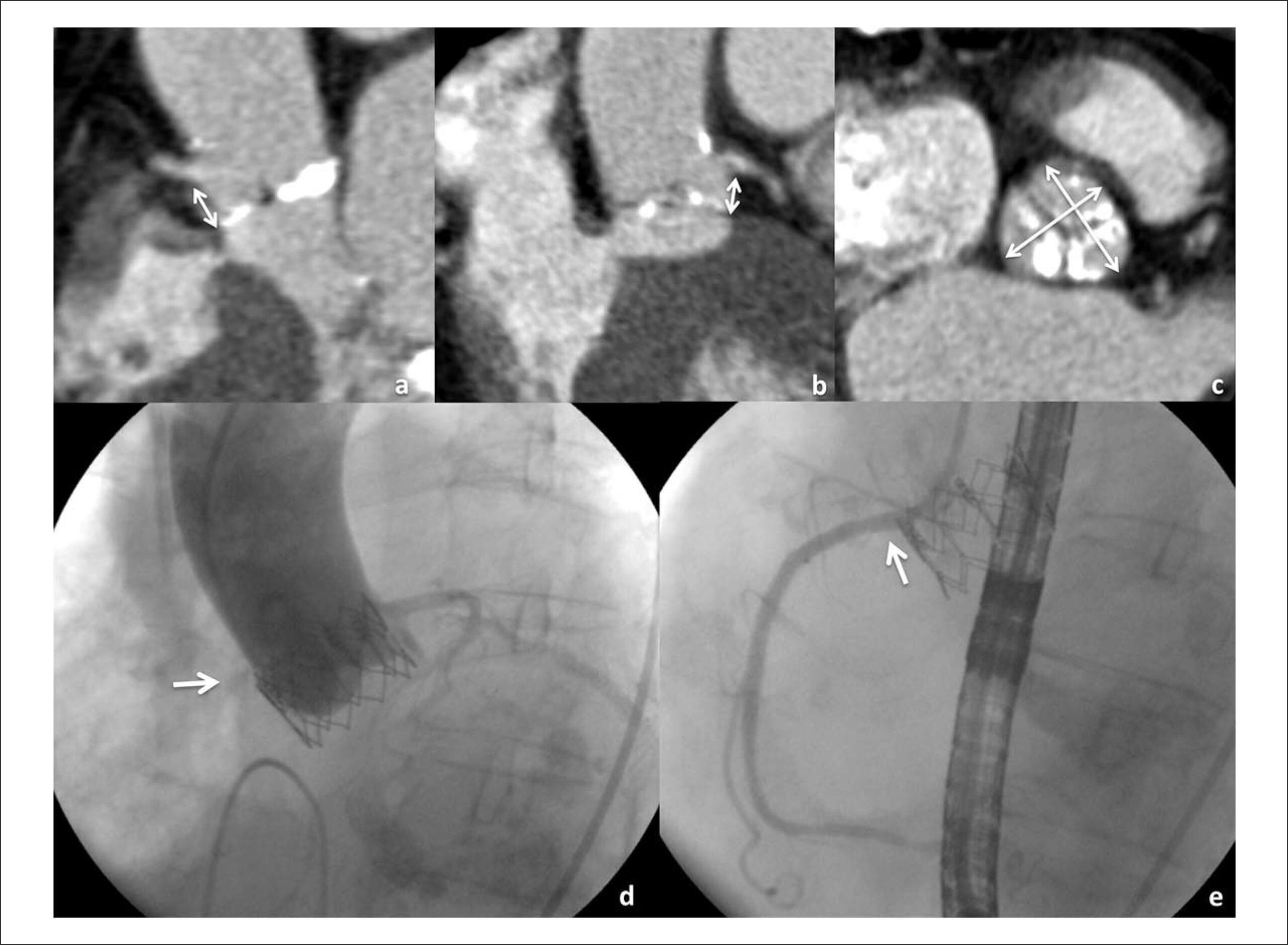
From 418 consecutive TAVI procedures, coronary obstruction occurred in 3 cases (incidence of 0.72%). All patients were women, without prior coronary artery bypass grafting (CABG), and with mean age of 85 ± 3 years, logistic EuroSCORE of 15 ± 6% and STS-PROM score of 9 ± 4%. All of the cases were performed with balloon-expandable Sapien XT prosthesis. In one patient, with pre-procedural computed tomography data, coronary arteries presented a low height and a narrow sinus of Valsalva. All patients presented with clinically significant severe maintained hypotension, immediately after valve implantation, and even though coronary angioplasty with stent implantation was successfully performed in all cases, patients died during hospitalization, being two periprocedurally.

Conclusion:

Coronary obstruction following TAVI is a rare but potentially fatal complication, being more frequent in women and with the balloon-expandable prosthesis. Anatomical factors might be related with its increased occurrence, highlighting the importance of a good pre-procedural evaluation of the patients in order to avoid this severe complication.

  • Aortic Valve Stenosis
  • Catheters
  • Coronary Obstruction
  • Transcatheter Aortic Valve Implantation
Read Full Article
Creative Commons Attribution (CC BY) Creative Commons license
01/01/2014 DOI: 10.5935/abc.20130252 Views 1

How to cite this article

EndNote RIS

Electronic Document Format (Vancouver)

Nemoto RP, Sampaio RO. Cost Implications and Perspectives of TAVI versus SAVR in the Hospital Setting. Arquivos Brasileiros de Cardiologia 2025;122(10):e20250669.

Electronic Document Format (ABNT)

Nemoto, Renato Paladino; Sampaio, Roney Orismar. Cost Implications and Perspectives of TAVI versus SAVR in the Hospital Setting. Arquivos Brasileiros de Cardiologia, v. 122, n. 10, e20250669, Dec. 2025.

Electronic Document Format (APA)

Nemoto, R. P., & Sampaio, R. O. (2025). Cost Implications and Perspectives of TAVI versus SAVR in the Hospital Setting. Arquivos Brasileiros de Cardiologia, 122(10), e20250669.

Electronic Document Format (ISO)

Nemoto, Renato Paladino and Sampaio, Roney Orismar. Cost Implications and Perspectives of TAVI versus SAVR in the Hospital Setting. Arquivos Brasileiros de Cardiologia [online]. 2025, vol. 122, n. 10, [cited 2026-10-14], e20250669. Available from: <https://journals.cardiol.br/en/article/cost-implications-and-perspectives-of-tavi-versus-savr-in-the-hospital-setting/>. ISSN 0066-782X

EndNote RIS

Electronic Document Format (Vancouver)

Kanhouche G, Ribeiro HB. The Forgotten Valve is not to be Forgiven: Tricuspid Regurgitation Impact on Clinical Outcomes after Transcatheter Aortic Valve Implantation. Arquivos Brasileiros de Cardiologia 2023;120(7):e20230410.

Electronic Document Format (ABNT)

Kanhouche, Gabriel; Ribeiro, Henrique B.. The Forgotten Valve is not to be Forgiven: Tricuspid Regurgitation Impact on Clinical Outcomes after Transcatheter Aortic Valve Implantation. Arquivos Brasileiros de Cardiologia, v. 120, n. 7, e20230410, Aug. 2023.

Electronic Document Format (APA)

Kanhouche, G., & Ribeiro, H. B. (2023). The Forgotten Valve is not to be Forgiven: Tricuspid Regurgitation Impact on Clinical Outcomes after Transcatheter Aortic Valve Implantation. Arquivos Brasileiros de Cardiologia, 120(7), e20230410.

Electronic Document Format (ISO)

Kanhouche, Gabriel and Ribeiro, Henrique B.. The Forgotten Valve is not to be Forgiven: Tricuspid Regurgitation Impact on Clinical Outcomes after Transcatheter Aortic Valve Implantation. Arquivos Brasileiros de Cardiologia [online]. 2023, vol. 120, n. 7, [cited 2026-10-14], e20230410. Available from: <https://journals.cardiol.br/en/article/the-forgotten-valve-is-not-to-be-forgiven-tricuspid-regurgitation-impact-on-clinical-outcomes-after-transcatheter-aortic-valve-implantation/>. ISSN 0066-782X

EndNote RIS

Electronic Document Format (Vancouver)

Bihan DCSL, Barretto RBM, Mathias Junior W. Transcatheter Aortic Valve Implantation: What has Happened and What is Yet to Come. Arquivos Brasileiros de Cardiologia 2023;120(7):e20230401.

Electronic Document Format (ABNT)

Bihan, David Costa de Souza Le; Barretto, Rodrigo Bellio de Mattos; Mathias Junior, Wilson. Transcatheter Aortic Valve Implantation: What has Happened and What is Yet to Come. Arquivos Brasileiros de Cardiologia, v. 120, n. 7, e20230401, Aug. 2023.

Electronic Document Format (APA)

Bihan, D. C. S. L., Barretto, R. B. M., & Mathias Junior, W. (2023). Transcatheter Aortic Valve Implantation: What has Happened and What is Yet to Come. Arquivos Brasileiros de Cardiologia, 120(7), e20230401.

Electronic Document Format (ISO)

Bihan, David Costa de Souza Le and Barretto, Rodrigo Bellio de Mattos and Mathias Junior, Wilson. Transcatheter Aortic Valve Implantation: What has Happened and What is Yet to Come. Arquivos Brasileiros de Cardiologia [online]. 2023, vol. 120, n. 7, [cited 2026-10-14], e20230401. Available from: <https://journals.cardiol.br/en/article/transcatheter-aortic-valve-implantation-what-has-happened-and-what-is-yet-to-come/>. ISSN 0066-782X

EndNote RIS

Electronic Document Format (Vancouver)

Ribeiro HB, Sarmento-Leite R, Siqueira DAA, Carvalho LA, Mangione JA, Rodés-Cabau J, Perin MA, et al. Coronary Obstruction Following Transcatheter Aortic Valve Implantation. Arquivos Brasileiros de Cardiologia 2014;102(1):93-6.

Electronic Document Format (ABNT)

Ribeiro, Henrique Barbosa; Sarmento-Leite, Rogério; Siqueira, Dimytri A. A.; Carvalho, Luiz Antônio; Mangione, José Armando; Rodés-Cabau, Josep; Perin, Marco A.; Brito Jr., Fábio Sandoli de. Coronary Obstruction Following Transcatheter Aortic Valve Implantation. Arquivos Brasileiros de Cardiologia, v. 102, n. 1, p. 93-96, Dec. 2013.

Electronic Document Format (APA)

Ribeiro, H. B., Sarmento-Leite, R., Siqueira, D. A. A., Carvalho, L. A., Mangione, J. A., Rodés-Cabau, J., Perin, M. A., & Brito Jr., F. S. (2014). Coronary Obstruction Following Transcatheter Aortic Valve Implantation. Arquivos Brasileiros de Cardiologia, 102(1), 93-96.

Electronic Document Format (ISO)

Ribeiro, Henrique Barbosa and Sarmento-Leite, Rogério and Siqueira, Dimytri A. A. and Carvalho, Luiz Antônio and Mangione, José Armando and Rodés-Cabau, Josep and Perin, Marco A. and Brito Jr., Fábio Sandoli de. Coronary Obstruction Following Transcatheter Aortic Valve Implantation. Arquivos Brasileiros de Cardiologia [online]. 2014, vol. 102, n. 1, [cited 2026-10-14], pp. 93-96. Available from: <https://journals.cardiol.br/en/article/coronary-obstruction-following-transcatheter-aortic-valve-implantation/>. ISSN 0066-782X

  • About ABC Family
  • Internal Regulation
  • Editorial Board
  • Brazilian Society of Cardiology (SBC)

Issues

SBC Guidelines

  • Videos
  • Podcasts
  • News