ABC Family Arquivos Brasileiros de Cardiologia International Journal of Cardiovascular Sciences ABC Heart Failure & Cardiomyopathy ABC Imagem Cardiovascular
Português English
ABC Family
Português English
  • About
    • About ABC Family
    • Internal Regulation
    • Editorial Board
    • Brazilian Society of Cardiology (SBC)
  • Issues
  • SBC Guidelines
  • Content
    • Videos
    • Podcasts
    • News
  • About
    • About ABC Family
    • Internal Regulation
    • Editorial Board
    • Brazilian Society of Cardiology (SBC)
  • Issues
  • SBC Guidelines
  • Content
    • Videos
    • Podcasts
    • News

ABC Family

  • ABC Family
  • Arquivos Brasileiros de Cardiologia
  • International Journal of Cardiovascular Sciences
  • ABC Heart Failure & Cardiomyopathy
  • ABC Imagem Cardiovascular
Search in

No content found.

Journals
Ordering
Article types
Others

  1. Home
  2. Keyword: TAVI
ABC
Editorial

The Forgotten Valve is not to be Forgiven: Tricuspid Regurgitation Impact on Clinical Outcomes after Transcatheter Aortic Valve Implantation

Gabriel Kanhouche et al. Henrique B. Ribeiro

Severe aortic stenosis (AS) is a frequent and potentially severe disease if left untreated. Despite the widespread adoption of surgical aortic valve replacement (SAVR) and more recently transcatheter aortic valve implantation (TAVI), mortality rates in the mid- to long-term follow-up remain relatively high, especially for higher-risk patients. , Yet, transfemoral TAVI became the dominant approach for patients with age > 70 years, enabling a significant reduction in the all-cause and cardiac mortality rates with respect to SAVR, even though the prognosis of a certain subgroup of patients is still jeopardized. Therefore, prior studies in the TAVI field have focused on helping in risk stratifying such patients. For instance, Genereux et al. , have shown that the extent of cardiac damage among patients with AS undergoing TAVI could play an important role. Accordingly, a stepwise impact in the mortality at follow-up was demonstrated when patients with AS also had left chamber involvement, with or without mitral regurgitation, followed by pulmonary hypertension, with or without tricuspid regurgitation (TR), and finally with right ventricle dysfunction. Of note, the last two stages (with moderate or severe TR and right ventricle dysfunction) represent the highest mortality rate, up to 20% at 1 year. Apart from TR grade, there is controversy on whether the changes in TR grade in the follow-up might also affect the clinical outcomes.

In this journal issue, Erbano et al. evaluated the association between TR and mortality in a systematic review and meta-analysis of patients with AS undergoing TAVI and further assessed the changes in TR severity post-TAVI and its relationship with short and mid-term mortality. The primary endpoint was defined as the incidence of all-cause mortality according to TR grade at baseline. Secondary endpoints included cardiac mortality and heart failure hospitalization. The authors included 24 studies and more than 45.000 patients, whose mean age was 81.7±8.5 years; 52% were female, with a mean Society of Thoracic Surgeons (STS) score of 8.2±6.0. Approximately 22% of patients had moderate or severe TR at baseline. After a mean follow-up of 1.2 years, pooled analysis of 14 studies revealed that higher grades of TR were associated with a worse prognosis. Severe TR was associated with an 83% increased mortality compared to no/mild TR in the short-term and 56% in the mid-term. In the pooled analysis, the persistence of moderate/severe TR grades, after a mean follow-up of 21 months post-TAVI, was also associated with a 2-fold increase in all-cause mortality.

[…]
  • Aortic Stenosis
  • Extravalvular Cardiac Damage
  • TAVI
  • Transcatheter Aortic Valve Implantation
  • tricuspid regurgitation
Read Full Article
Creative Commons Attribution (CC BY) Creative Commons license
14/08/2023 DOI: 10.36660/abc.20230410
ABC
Editorial

Conduction Disturbances Associated with Transcatheter Aortic Valve Implantation: Challenge for another 20 Years?

Antonio Hélio Pozetti et al. Henrique Barbosa Ribeiro

Transcatheter aortic valve implantation (TAVI) is a well-established procedure for treating severe aortic stenosis in elderly patients, regardless of the surgical risk. Since its introduction two decades ago, there have been major technological advances in devices, which, combined with new implantation techniques, have brought significant reductions in periprocedural complication rates, leading to their greater adoption worldwide. However, the incidence of conduction disorders showed a modest reduction, remaining the most frequent complication after TAVI, – which contributes to the increase in hospital stay, costs and the worsening of short and long-term clinical outcomes. In addition, the approach to conduction disorders still varies greatly between centers, especially regarding the management of new left bundle branch block (LBBB), post-procedure advanced atrioventricular block (AVB) and previous right bundle branch block (RBBB), translated into variable rates of permanent pacemaker (PM) implantation. Among patients who received PM after TAVI, there is also great variability regarding their dependence (ventricular pacing) at follow-up.

In this journal edition, Pinto et al. evaluated the incidence of conduction disorders, predictors and the rate of PM dependence in a population of 340 consecutive patients undergoing TAVI. Conduction disorders occurred in more than 50% of post-procedure patients, with LBBB being the most frequent (32%), showing spontaneous resolution in 56% of them after 6 months. The overall PM implant rate was 18.5%, with prior RBBB being its main predictor. Among the patients who required PM, the main reasons were advanced AVB (60.3%), followed by LBBB with low-degree AVB (22%). Interestingly, there was a wide variation in the percentage of ventricular pacing among patients who received PM, being 83% in patients with advanced AVB (Advanced AVB and Mobitz Type II) and only 2% in those implanted with LBBB and low-degree AVB (first-degree AVB and Mobitz type I). – However, some aspects of this study deserve reflection.

[…]

  • Conduction Disturbances
  • Pacemaker
  • TAVI
Read Full Article
Creative Commons Attribution (CC BY) Creative Commons license
21/10/2022 DOI: 10.36660/abc.20220619
Figure 1
IJCS
Original Article

Clinical Characteristics and Mid-Term follow-up of Elderly Patients with Severe Aortic Stenosis not Eligible for TAVI

Mariana Oliveira Rezende et al. Natasha Soares Simões dos Santos Alexandre Aguiar Andrade Mônica Serrano Francischini … Decarthon Vitor Dantas Targino Caio Simoes Souza Carolina de Paulo Maldi Dimytri Alexandre Alvim de Siqueira David Costa de Souza Le Bihan Ibraim Pinto Auristela Isabel de Oliveira Ramos

Abstract

Background:

The treatment for symptomatic severe aortic stenosis (AS) is the correction of valve stenosis by surgical valve replacement and more recently by transcatheter aortic valve implant (TAVI). However, in some high risk surgical patients, TAVI is not possible for technical or clinical reasons or due to the unavailability of the endoprosthesis.

Objective:

The aim of this study was to evaluate a mid-term follow-up of symptomatic severe AS patients who are not eligible for TAVI trials, as well as to identify the clinical features of these patients.

Methods:

This was an observational, retrospective study conducted with 475 symptomatic severe AS patients, evaluated by the Heart Team between 2000 and 2017. Inclusion criterias were: patients considered not to be eligible for TAVI. The Shapiro-Wilk test was applied to evaluate normality. Non-paired t and Mann-Whitney tests were applied for continuous variables, while the chi-squared and Fischer exact tests were applied for categorical variables, with a level of significance of p<0,05.

Results:

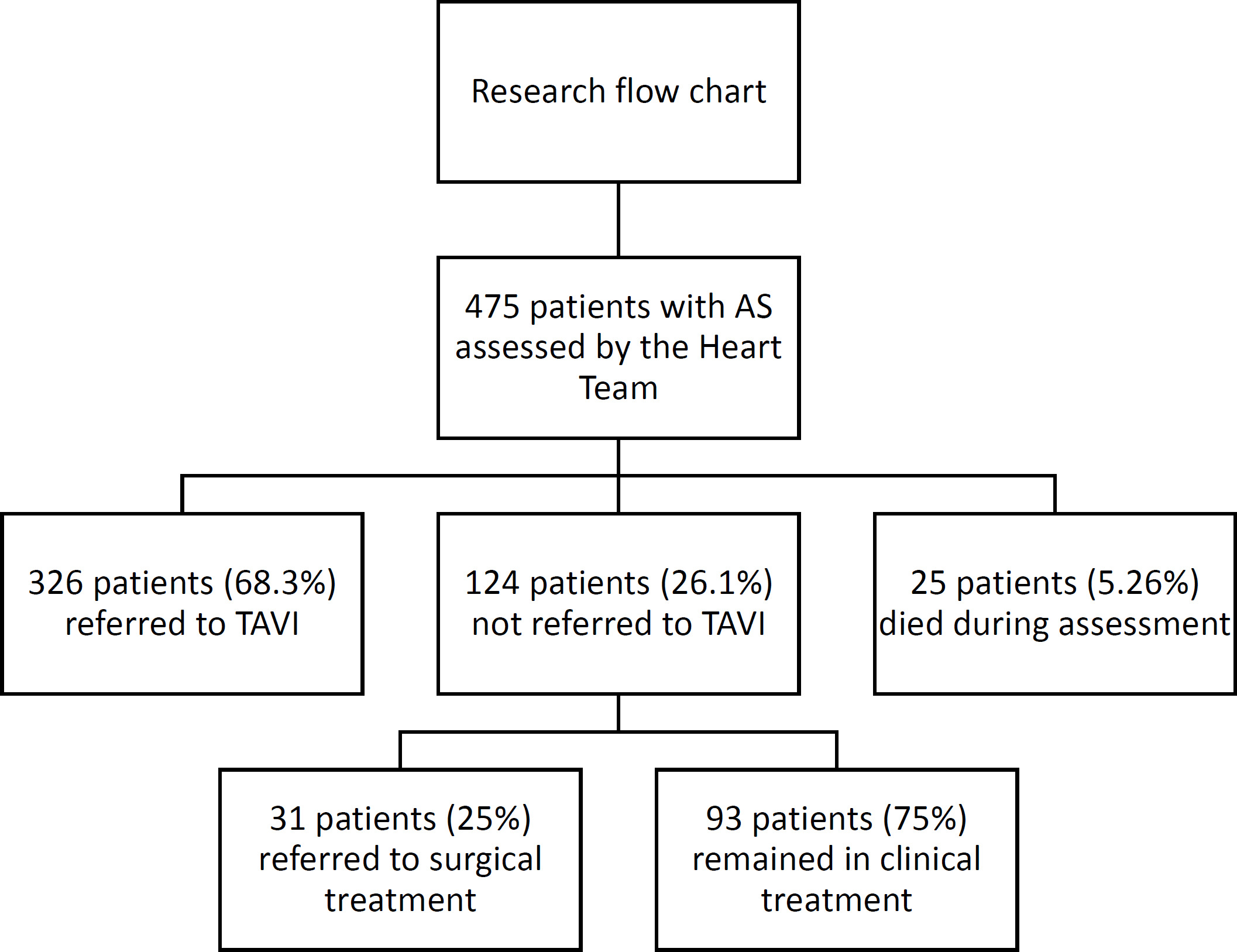
The heart team evaluated 475 patients: 25 (5.26%) died before any intervention could be proposed; 326 (68.3%) were submitted to TAVI, so the study population consisted of 124 patients not eligible for TAVI. Of these, 31 (25%) underwent surgery and 93 (75%) remained in clinical treatment. In a mean 56 months- follow-up the mortality in clinical group was 46.2%. In the surgical group the mortality was 23.9% (in-hospital 12.9% and late mortality 11% in a mean 47.4 months follow-up). The patients that died presented a significantly lower left ventricle ejection fraction (LVEF), a smaller valve area, and a larger end-systolic diameter of the LV.

Conclusion:

The mortality of the clinical group’s patients was significantly higher than the surgical mortality (46.2% vs. 12.9%; p=0.021). The patients of the clinical group were older, weighed less, and had a higher incidence of renal failure and a higher STS score.

  • aortic valve replacement
  • Aortic Valve Stenosis
  • TAVI
  • transcatheter prosthesis implant
Read Full Article
Creative Commons Attribution (CC BY) Creative Commons license
28/07/2021 DOI: 10.36660/ijcs.20200177

How to cite this article

EndNote RIS

Electronic Document Format (Vancouver)

Kanhouche G, Ribeiro HB. The Forgotten Valve is not to be Forgiven: Tricuspid Regurgitation Impact on Clinical Outcomes after Transcatheter Aortic Valve Implantation. Arquivos Brasileiros de Cardiologia 2023;120(7):e20230410.

Electronic Document Format (ABNT)

Kanhouche, Gabriel; Ribeiro, Henrique B.. The Forgotten Valve is not to be Forgiven: Tricuspid Regurgitation Impact on Clinical Outcomes after Transcatheter Aortic Valve Implantation. Arquivos Brasileiros de Cardiologia, v. 120, n. 7, e20230410, Aug. 2023.

Electronic Document Format (APA)

Kanhouche, G., & Ribeiro, H. B. (2023). The Forgotten Valve is not to be Forgiven: Tricuspid Regurgitation Impact on Clinical Outcomes after Transcatheter Aortic Valve Implantation. Arquivos Brasileiros de Cardiologia, 120(7), e20230410.

Electronic Document Format (ISO)

Kanhouche, Gabriel and Ribeiro, Henrique B.. The Forgotten Valve is not to be Forgiven: Tricuspid Regurgitation Impact on Clinical Outcomes after Transcatheter Aortic Valve Implantation. Arquivos Brasileiros de Cardiologia [online]. 2023, vol. 120, n. 7, [cited 2026-10-14], e20230410. Available from: <https://journals.cardiol.br/en/article/the-forgotten-valve-is-not-to-be-forgiven-tricuspid-regurgitation-impact-on-clinical-outcomes-after-transcatheter-aortic-valve-implantation/>. ISSN 0066-782X

EndNote RIS

Electronic Document Format (Vancouver)

Pozetti AH, Ribeiro HB. Conduction Disturbances Associated with Transcatheter Aortic Valve Implantation: Challenge for another 20 Years?. Arquivos Brasileiros de Cardiologia 2022;119(4):531-2.

Electronic Document Format (ABNT)

Pozetti, Antonio Hélio; Ribeiro, Henrique Barbosa. Conduction Disturbances Associated with Transcatheter Aortic Valve Implantation: Challenge for another 20 Years?. Arquivos Brasileiros de Cardiologia, v. 119, n. 4, p. 531-532, Oct. 2022.

Electronic Document Format (APA)

Pozetti, A. H., & Ribeiro, H. B. (2022). Conduction Disturbances Associated with Transcatheter Aortic Valve Implantation: Challenge for another 20 Years?. Arquivos Brasileiros de Cardiologia, 119(4), 531-532.

Electronic Document Format (ISO)

Pozetti, Antonio Hélio and Ribeiro, Henrique Barbosa. Conduction Disturbances Associated with Transcatheter Aortic Valve Implantation: Challenge for another 20 Years?. Arquivos Brasileiros de Cardiologia [online]. 2022, vol. 119, n. 4, [cited 2026-10-14], pp. 531-532. Available from: <https://journals.cardiol.br/en/article/conduction-disturbances-associated-with-transcatheter-aortic-valve-implantation-challenge-for-another-20-years/>. ISSN 0066-782X

EndNote RIS

Electronic Document Format (Vancouver)

Rezende MO, Santos NSS, Andrade AA, Francischini MS, Targino DVD, Souza CS, Maldi CP, et al. Clinical Characteristics and Mid-Term follow-up of Elderly Patients with Severe Aortic Stenosis not Eligible for TAVI. International Journal of Cardiovascular Sciences 2021;34(5 Supl 1):34-40.

Electronic Document Format (ABNT)

Rezende, Mariana Oliveira; Santos, Natasha Soares Simões dos; Andrade, Alexandre Aguiar; Francischini, Mônica Serrano; Targino, Decarthon Vitor Dantas; Souza, Caio Simoes; Maldi, Carolina de Paulo; Siqueira, Dimytri Alexandre Alvim de; Bihan, David Costa de Souza Le; Pinto, Ibraim; Ramos, Auristela Isabel de Oliveira. Clinical Characteristics and Mid-Term follow-up of Elderly Patients with Severe Aortic Stenosis not Eligible for TAVI. International Journal of Cardiovascular Sciences, v. 34, n. 5 Supl 1, p. 34-40, Jul. 2021.

Electronic Document Format (APA)

Rezende, M. O., Santos, N. S. S. , Andrade, A. A., Francischini, M. S., Targino, D. V. D., Souza, C. S., Maldi, C. P., Siqueira, D. A. A. , Bihan, D. C. S. L., Pinto, I., & Ramos, A. I. O. (2021). Clinical Characteristics and Mid-Term follow-up of Elderly Patients with Severe Aortic Stenosis not Eligible for TAVI. International Journal of Cardiovascular Sciences, 34(5 Supl 1), 34-40.

Electronic Document Format (ISO)

Rezende, Mariana Oliveira and Santos, Natasha Soares Simões dos and Andrade, Alexandre Aguiar and Francischini, Mônica Serrano and Targino, Decarthon Vitor Dantas and Souza, Caio Simoes and Maldi, Carolina de Paulo and Siqueira, Dimytri Alexandre Alvim de and Bihan, David Costa de Souza Le and Pinto, Ibraim and Ramos, Auristela Isabel de Oliveira. Clinical Characteristics and Mid-Term follow-up of Elderly Patients with Severe Aortic Stenosis not Eligible for TAVI. International Journal of Cardiovascular Sciences [online]. 2021, vol. 34, n. 5 Supl 1, [cited 2026-10-14], pp. 34-40. Available from: <https://journals.cardiol.br/en/article/clinical-characteristics-and-mid-term-follow-up-of-elderly-patients-with-severe-aortic-stenosis-not-eligible-for-tavi/>. ISSN 2359-4802

  • About ABC Family
  • Internal Regulation
  • Editorial Board
  • Brazilian Society of Cardiology (SBC)

Issues

SBC Guidelines

  • Videos
  • Podcasts
  • News