ABC Family Arquivos Brasileiros de Cardiologia International Journal of Cardiovascular Sciences ABC Heart Failure & Cardiomyopathy ABC Imagem Cardiovascular
Português English
ABC Family
Português English
  • About
    • About ABC Family
    • Internal Regulation
    • Editorial Board
    • Brazilian Society of Cardiology (SBC)
  • Issues
  • SBC Guidelines
  • Content
    • Videos
    • Podcasts
    • News
  • About
    • About ABC Family
    • Internal Regulation
    • Editorial Board
    • Brazilian Society of Cardiology (SBC)
  • Issues
  • SBC Guidelines
  • Content
    • Videos
    • Podcasts
    • News

ABC Family

  • ABC Family
  • Arquivos Brasileiros de Cardiologia
  • International Journal of Cardiovascular Sciences
  • ABC Heart Failure & Cardiomyopathy
  • ABC Imagem Cardiovascular
Search in

No content found.

Journals
Ordering
Article types
Others

  1. Home
  2. Keyword: Torsion Abnormality
Figure 1
ABC
Original Article

Global Longitudinal Strain Predicts Poor Functional Capacity in Patients with Systolic Heart Failure

Rafael José Coelho Maia et al. Simone Cristina Soares Brandão Jéssica Leite Giordano Bruno Parente … Filipe Pinheiro Bruna Thays Santana Araújo Maria Inês Remígio Aguiar Sílvia Marinho Martins Daniella Cunha Brandão Armele Dornelas de Andrade

Abstract

Background:

Left ventricular global longitudinal strain value (GLS) can predict functional capacity in patients with preserved left ventricular ejection fraction (LVEF) heart failure (HF) and to assess prognosis in reduced LVEF HF.

Objetive:

Correlate GLS with parameters of Cardiopulmonary Exercise Test (CPET) and to assess if they could predict systolic HF patients that are more appropriated to be referred to heart transplantation according to CPET criteria.

Methods:

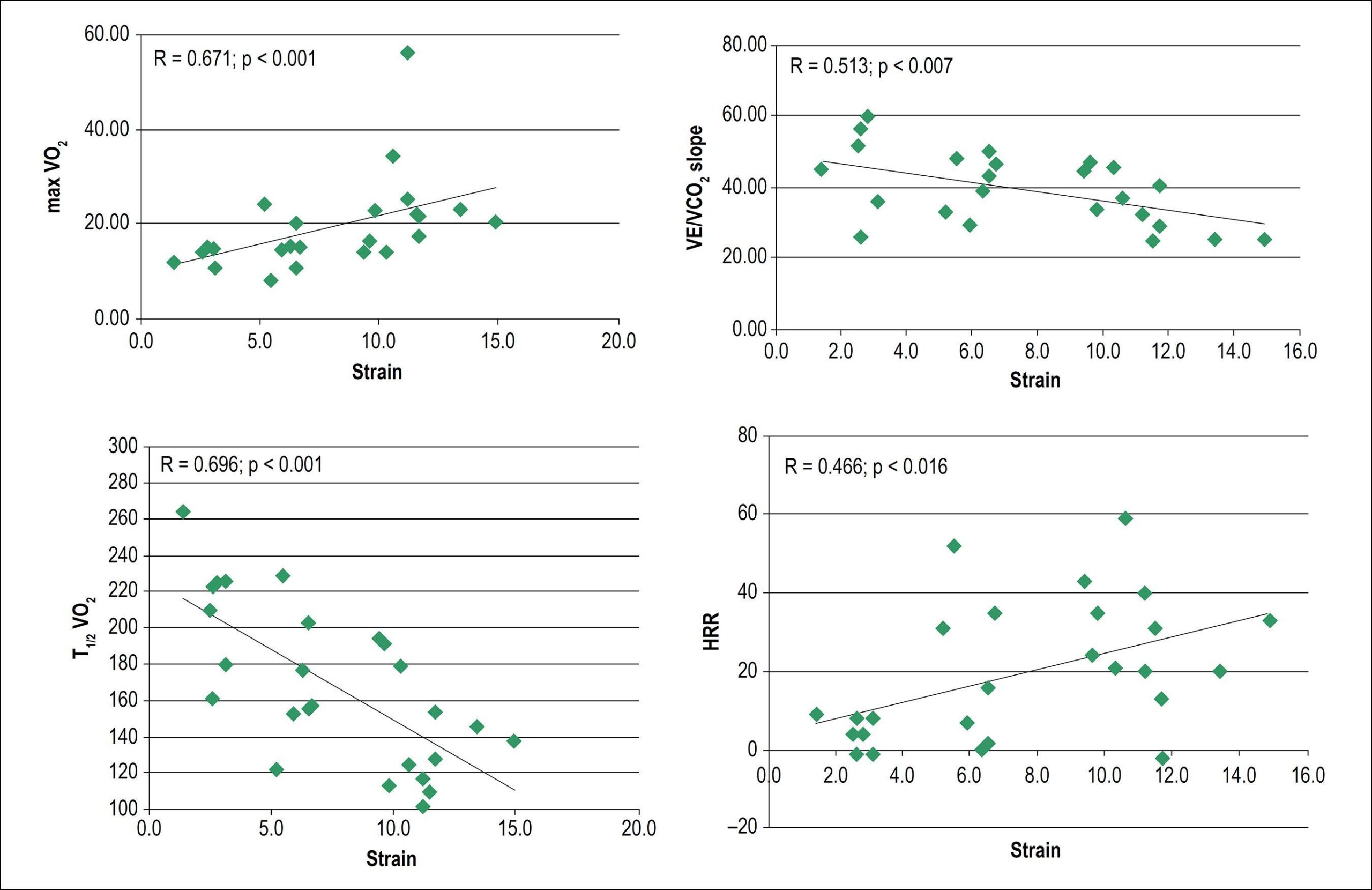
Systolic HF patients with LVEF < 45%, NYHA functional class II and III, underwent prospectively CPET and echocardiography with strain analysis. LVEF and GLS were correlated with the following CPET variables: maxVO2, VE/VCO2 slope, heart rate reduction during the first minute of recovery (HRR) and time needed to reduce maxVO2 in 50% after physical exercise (T1/2VO2). ROC curve analysis of GLS to predict VO2 < 14 mL/kg/min and VE/VCO2 slope > 35 (heart transplantation’s criteria) was performed.

Results:

Twenty six patients were selected (age, 47 ± 12 years, 58% men, mean LVEF = 28 ± 8%). LVEF correlated only with maxVO2 and T1/2VO2. GLS correlated to all CPET variables (maxVO2: r = 0.671, p = 0.001; VE/VCO2 slope: r = -0.513, p = 0.007; HRR: r = 0.466, p = 0.016, and T1/2VO2: r = -0.696, p = 0.001). GLS area under the ROC curve to predict heart transplantation’s criteria was 0.88 (sensitivity 75%, specificity 83%) for a cut-off value of -5.7%, p = 0.03.

Conclusion:

GLS was significantly associated with all functional CPET parameters. It could classify HF patients according to the functional capacity and may stratify which patients have a poor prognosis and therefore to deserve more differentiated treatment, such as heart transplantation.
  • Echocardiography, Doppler/methods
  • Heart Failure
  • Longitudinal Strain
  • Torsion Abnormality
  • Torsion, Mechanical
  • Ventricular Dysfunction, Left
Read Full Article
Creative Commons Attribution (CC BY) Creative Commons license
18/07/2019 DOI: 10.5935/abc.20190119
Figure 1
ABC
Original Article

Global Longitudinal Strain or Left Ventricular Twist and Torsion? Which Correlates Best with Ejection Fraction?

Marcio Silva Miguel Lima et al. Hector R Villarraga Maria Cristina Donadio Abduch Marta Fernandes Lima … Cecilia Beatriz Bittencourt Viana Cruz João Cesar Nunes Sbano Mariana Callil Voos Wilson Mathias Junior Jeane Mike Tsutsui

Abstract

Background:

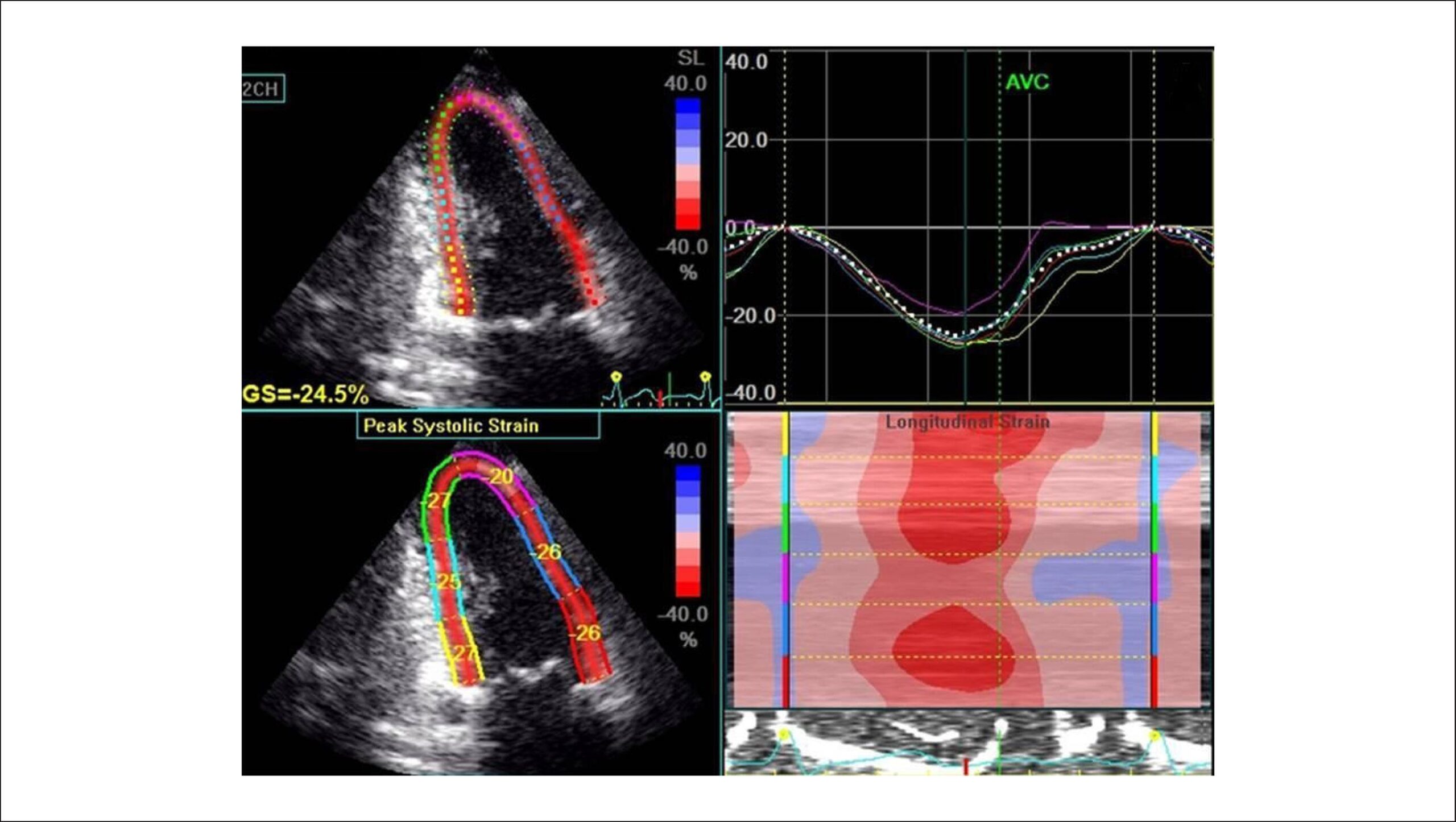
Estimative of left ventricular ejection fraction (LVEF) is a major indication for echocardiography. Speckle tracking echocardiography (STE) allows analysis of LV contraction mechanics which includes global longitudinal strain (GLS) and twist/torsion, both the most widely used. Direct comparison of correlations between these novel parameters and LVEF has never been done before.

Objective:

This study aims to check which one has the highest correlation with LVEF.

Methods:

Patients with normal LVEF (> 0,55) and systolic dysfunction (LVEF <0,55) were prospectively enrolled, and underwent echocardiogram with STE analysis. Correlation of variables was performed by linear regression analysis. In addition, correlation among levels of LV systolic impairment was also tested.

Results:

A total of 131 patients were included (mean age, 46 ± 14y; 43%, men). LVEF and GLS showed a strong correlation (r = 0.95; r2 = 0.89; p < 0.001), more evident in groups with LV systolic dysfunction than those with preserved LVEF. Good correlation was also found with global longitudinal strain rate (r = 0.85; r2 = 0.73; p < 0.001). Comparing to GLS, correlation of LVEF and torsional mechanics was weaker: twist (r = 0.78; r2 = 0.60; p < 0.001); torsion (r = 0.75; r2 = 0.56; p < 0.001).

Conclusion:

GLS of the left ventricle have highly strong positive correlation with the classical parameter of ejection fraction, especially in cases with LV systolic impairment. Longitudinal strain rate also demonstrated a good correlation. GLS increments analysis of LV systolic function. On the other hand, although being a cornerstone of LV mechanics, twist and torsion have a weaker correlation with LV ejection, comparing to GLS.

  • Echocardiography,Doppler
  • Strain
  • Stroke Volume
  • Torsion Abnormality
  • Torsion,Mechanical
  • Ventricular Dysfunction, Left
Read Full Article
Creative Commons Attribution (CC BY) Creative Commons license
29/06/2017 DOI: 10.5935/abc.20170085 Views 1

How to cite this article

EndNote RIS

Electronic Document Format (Vancouver)

Maia RJC, Brandão SCS, Leite J, Parente GB, Pinheiro F, Araújo BTS, Aguiar MIR, et al. Global Longitudinal Strain Predicts Poor Functional Capacity in Patients with Systolic Heart Failure. Arquivos Brasileiros de Cardiologia 2019;113(2):188-94.

Electronic Document Format (ABNT)

Maia, Rafael José Coelho; Brandão, Simone Cristina Soares; Leite, Jéssica; Parente, Giordano Bruno; Pinheiro, Filipe; Araújo, Bruna Thays Santana; Aguiar, Maria Inês Remígio; Martins, Sílvia Marinho; Brandão, Daniella Cunha; Andrade, Armele Dornelas de. Global Longitudinal Strain Predicts Poor Functional Capacity in Patients with Systolic Heart Failure. Arquivos Brasileiros de Cardiologia, v. 113, n. 2, p. 188-194, Jul. 2019.

Electronic Document Format (APA)

Maia, R. J. C., Brandão, S. C. S., Leite, J., Parente, G. B., Pinheiro, F., Araújo, B. T. S., Aguiar, M. I. R., Martins, S. M., Brandão, D. C., & Andrade, A. D. (2019). Global Longitudinal Strain Predicts Poor Functional Capacity in Patients with Systolic Heart Failure. Arquivos Brasileiros de Cardiologia, 113(2), 188-194.

Electronic Document Format (ISO)

Maia, Rafael José Coelho and Brandão, Simone Cristina Soares and Leite, Jéssica and Parente, Giordano Bruno and Pinheiro, Filipe and Araújo, Bruna Thays Santana and Aguiar, Maria Inês Remígio and Martins, Sílvia Marinho and Brandão, Daniella Cunha and Andrade, Armele Dornelas de. Global Longitudinal Strain Predicts Poor Functional Capacity in Patients with Systolic Heart Failure. Arquivos Brasileiros de Cardiologia [online]. 2019, vol. 113, n. 2, [cited 2026-10-14], pp. 188-194. Available from: <https://journals.cardiol.br/en/article/global-longitudinal-strain-predicts-poor-functional-capacity-in-patients-with-systolic-heart-failure/>. ISSN 0066-782X

EndNote RIS

Electronic Document Format (Vancouver)

Lima MSM, Villarraga HR, Abduch MCD, Lima MF, Cruz CBBV, Sbano JCN, Voos MC, et al. Global Longitudinal Strain or Left Ventricular Twist and Torsion? Which Correlates Best with Ejection Fraction?. Arquivos Brasileiros de Cardiologia 2017;109(1):23-9.

Electronic Document Format (ABNT)

Lima, Marcio Silva Miguel; Villarraga, Hector R; Abduch, Maria Cristina Donadio; Lima, Marta Fernandes; Cruz, Cecilia Beatriz Bittencourt Viana; Sbano, João Cesar Nunes; Voos, Mariana Callil; Mathias Junior, Wilson; Tsutsui, Jeane Mike. Global Longitudinal Strain or Left Ventricular Twist and Torsion? Which Correlates Best with Ejection Fraction?. Arquivos Brasileiros de Cardiologia, v. 109, n. 1, p. 23-29, Jun. 2017.

Electronic Document Format (APA)

Lima, M. S. M., Villarraga, H. R., Abduch, M. C. D., Lima, M. F., Cruz, C. B. B. V., Sbano, J. C. N., Voos, M. C., Mathias Junior, W., & Tsutsui, J. M. (2017). Global Longitudinal Strain or Left Ventricular Twist and Torsion? Which Correlates Best with Ejection Fraction?. Arquivos Brasileiros de Cardiologia, 109(1), 23-29.

Electronic Document Format (ISO)

Lima, Marcio Silva Miguel and Villarraga, Hector R and Abduch, Maria Cristina Donadio and Lima, Marta Fernandes and Cruz, Cecilia Beatriz Bittencourt Viana and Sbano, João Cesar Nunes and Voos, Mariana Callil and Mathias Junior, Wilson and Tsutsui, Jeane Mike. Global Longitudinal Strain or Left Ventricular Twist and Torsion? Which Correlates Best with Ejection Fraction?. Arquivos Brasileiros de Cardiologia [online]. 2017, vol. 109, n. 1, [cited 2026-10-14], pp. 23-29. Available from: <https://journals.cardiol.br/en/article/global-longitudinal-strain-or-left-ventricular-twist-and-torsion-which-correlates-best-with-ejection-fraction/>. ISSN 0066-782X

  • About ABC Family
  • Internal Regulation
  • Editorial Board
  • Brazilian Society of Cardiology (SBC)

Issues

SBC Guidelines

  • Videos
  • Podcasts
  • News