ABC Family Arquivos Brasileiros de Cardiologia International Journal of Cardiovascular Sciences ABC Heart Failure & Cardiomyopathy ABC Imagem Cardiovascular
Português English
ABC Family
Português English
  • About
    • About ABC Family
    • Internal Regulation
    • Editorial Board
    • Brazilian Society of Cardiology (SBC)
  • Issues
  • SBC Guidelines
  • Content
    • Videos
    • Podcasts
    • News
  • About
    • About ABC Family
    • Internal Regulation
    • Editorial Board
    • Brazilian Society of Cardiology (SBC)
  • Issues
  • SBC Guidelines
  • Content
    • Videos
    • Podcasts
    • News

ABC Family

  • ABC Family
  • Arquivos Brasileiros de Cardiologia
  • International Journal of Cardiovascular Sciences
  • ABC Heart Failure & Cardiomyopathy
  • ABC Imagem Cardiovascular
Search in

No content found.

Journals
Ordering
Article types
Others

  1. Home
  2. Keyword: Longitudinal Strain
ABC
Editorial

Do We Need New Echocardiographic Parameters for Transplant Recipients without Rejection?

Alberto Rodolpho Hüning et al. Vitor Emer Egypto Rosa

Introduction

Heart transplant represents the principal therapeutic modality for patients with end-stage heart failure unresponsive to maximized medical and surgical management. Brazil boasts one of the most extensive public health systems for organ transplantation globally, with nearly all procedures conducted under the Unified Health System (SUS). However, there is still a lack of studies validating normal echocardiographic parameters in this population, and this was the topic of the study conducted by Dall’Orto et al.

[…]

  • Echocardiography
  • Heart Transplant
  • Longitudinal Strain
Read Full Article
Creative Commons Attribution (CC BY) Creative Commons license
23/09/2024 DOI: 10.36660/abc.20240452i Views 1
ABCIC
Original Article

Echocardiographic Evaluation of Late Cardiac Abnormalities Caused by the Chikungunya Fever

José Maria Del Castillo et al. Gabriela Marques Pereira de Alencar Marcus Vinicius Dantas da Nóbrega Carlos Mazzarollo … Jonny Vitor Diniz Eugenio Soares de Albuquerque Antônia Dulcineide Medeiros Sena Carlos Antônio da Mota Silveira Oscar Francisco Sanchez Osella

Abstract

Background

Chicungunya fever causes highly debilitating joint pains. Complications are rare and may affect the cardiovascular system.

Objective

To evaluate, with echocardiography and two-dimensional strain, the cardiovascular changes in the chronic phase of the Chikungunya infection.

Methods

The study included 32 patients, mean age 56 ± 14 years divided into Group A, with < 12 months evolution (12 patients) and Group B, with ≥ 12 months evolution (20 patients). The cardiac dimensions, left ventricular end-diastolic volume indexed to body surface, left ventricular ejection fraction, left ventricular global longitudinal strain and left atrial longitudinal strain were determined. The groups were compared using unpaired analysis. The p significance was < 0.05.

Results

Most Group A patients presented diffuse hypocontratility and decreased left ventricular ejection fraction (45.5 ± 10.4%) with normal left ventricular diastolic indexed volume (58.7 ± 24.9 mL/m2). Most Group B patients presented diffuse hypocontratility (ejection fraction 38.2 ± 6.4%) and increased left ventricular diastolic indexed volume (88.3 ± 26.4 mL/m2). There was segmental changes in 22% of the patients, and hypertrophy or remodelling in seven cases of each Group. There was decreased global longitudinal strain in both Groups (-11.9 ± 4.4% in Group A and -10.3 ± 3.8% in Group B). Lef atrial longitudinal strain were 37.9 ± 17.3% in Group A and 27.5 ± 15.2% in Group B. Patients with pericarditis had normal left ventricular dimensions and function.

Conclusion

The cardiac complications of Chikungunya fever was diffuse hypocontratility with left ventricular normal size observed in the first year of chronic evolution and diffuse hypocontratility with left ventricular dilation observed in later evolution. Patients with pericardial thickening did not present myocardial issues. Echocardiography can be used as an important tool in patients with Chikungunya fever, since it can detects early abnormalities in the cardiovascular system. (Arq Bras Cardiol: Imagem cardiovasc. 2018;31(3):183-190)

  • Chikungunya fever
  • Echocardiography
  • Longitudinal Strain
Read Full Article
Creative Commons Attribution (CC BY) Creative Commons license
20/01/2022 DOI: 10.5935/2318-8219.20180027 Views 1
Figure 1
ABC
Original Article

Global Longitudinal Strain Predicts Poor Functional Capacity in Patients with Systolic Heart Failure

Rafael José Coelho Maia et al. Simone Cristina Soares Brandão Jéssica Leite Giordano Bruno Parente … Filipe Pinheiro Bruna Thays Santana Araújo Maria Inês Remígio Aguiar Sílvia Marinho Martins Daniella Cunha Brandão Armele Dornelas de Andrade

Abstract

Background:

Left ventricular global longitudinal strain value (GLS) can predict functional capacity in patients with preserved left ventricular ejection fraction (LVEF) heart failure (HF) and to assess prognosis in reduced LVEF HF.

Objetive:

Correlate GLS with parameters of Cardiopulmonary Exercise Test (CPET) and to assess if they could predict systolic HF patients that are more appropriated to be referred to heart transplantation according to CPET criteria.

Methods:

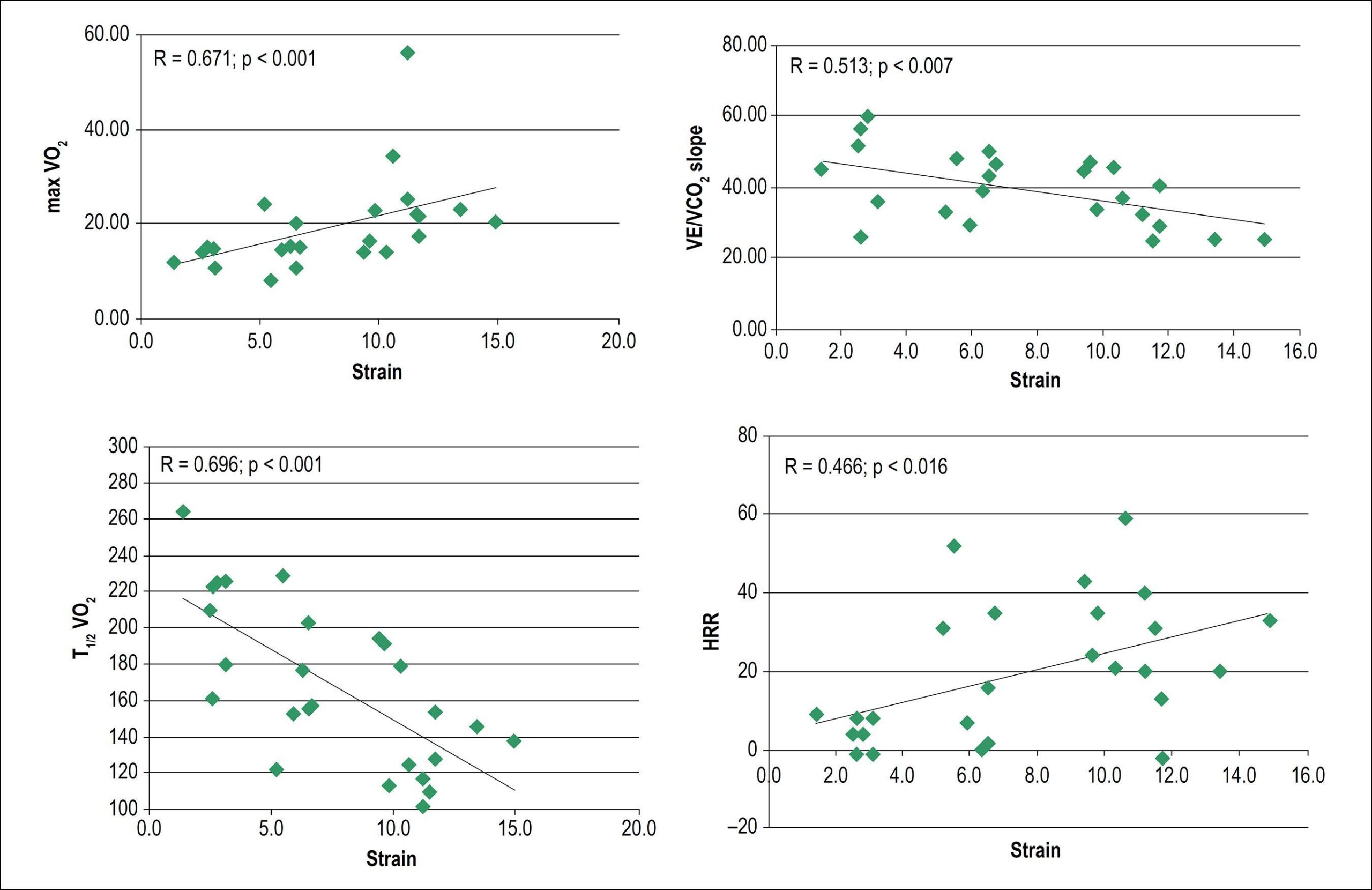
Systolic HF patients with LVEF < 45%, NYHA functional class II and III, underwent prospectively CPET and echocardiography with strain analysis. LVEF and GLS were correlated with the following CPET variables: maxVO2, VE/VCO2 slope, heart rate reduction during the first minute of recovery (HRR) and time needed to reduce maxVO2 in 50% after physical exercise (T1/2VO2). ROC curve analysis of GLS to predict VO2 < 14 mL/kg/min and VE/VCO2 slope > 35 (heart transplantation’s criteria) was performed.

Results:

Twenty six patients were selected (age, 47 ± 12 years, 58% men, mean LVEF = 28 ± 8%). LVEF correlated only with maxVO2 and T1/2VO2. GLS correlated to all CPET variables (maxVO2: r = 0.671, p = 0.001; VE/VCO2 slope: r = -0.513, p = 0.007; HRR: r = 0.466, p = 0.016, and T1/2VO2: r = -0.696, p = 0.001). GLS area under the ROC curve to predict heart transplantation’s criteria was 0.88 (sensitivity 75%, specificity 83%) for a cut-off value of -5.7%, p = 0.03.

Conclusion:

GLS was significantly associated with all functional CPET parameters. It could classify HF patients according to the functional capacity and may stratify which patients have a poor prognosis and therefore to deserve more differentiated treatment, such as heart transplantation.

  • Echocardiography, Doppler/methods
  • Heart Failure
  • Longitudinal Strain
  • Torsion Abnormality
  • Torsion, Mechanical
  • Ventricular Dysfunction, Left
Read Full Article
Creative Commons Attribution (CC BY) Creative Commons license
18/07/2019 DOI: 10.5935/abc.20190119

How to cite this article

EndNote RIS

Electronic Document Format (Vancouver)

Hüning AR, Rosa VEE. Do We Need New Echocardiographic Parameters for Transplant Recipients without Rejection?. Arquivos Brasileiros de Cardiologia 2024;121(8):e20240452.

Electronic Document Format (ABNT)

Hüning, Alberto Rodolpho; Rosa, Vitor Emer Egypto. Do We Need New Echocardiographic Parameters for Transplant Recipients without Rejection?. Arquivos Brasileiros de Cardiologia, v. 121, n. 8, e20240452, Sep. 2024.

Electronic Document Format (APA)

Hüning, A. R., & Rosa, V. E. E. (2024). Do We Need New Echocardiographic Parameters for Transplant Recipients without Rejection?. Arquivos Brasileiros de Cardiologia, 121(8), e20240452.

Electronic Document Format (ISO)

Hüning, Alberto Rodolpho and Rosa, Vitor Emer Egypto. Do We Need New Echocardiographic Parameters for Transplant Recipients without Rejection?. Arquivos Brasileiros de Cardiologia [online]. 2024, vol. 121, n. 8, [cited 2026-10-14], e20240452. Available from: <https://journals.cardiol.br/en/article/do-we-need-new-echocardiographic-parameters-for-transplant-recipients-without-rejection/>. ISSN 0066-782X

EndNote RIS

Electronic Document Format (Vancouver)

Castillo JMD, Alencar GMP, Nóbrega MVD, Mazzarollo C, Diniz JV, Albuquerque ES, Sena ADM, et al. Echocardiographic Evaluation of Late Cardiac Abnormalities Caused by the Chikungunya Fever. Arquivos Brasileiros de Cardiologia Imagem cardiovascular 2022;31(3):183-90.

Electronic Document Format (ABNT)

Castillo, José Maria Del; Alencar, Gabriela Marques Pereira de; Nóbrega, Marcus Vinicius Dantas da; Mazzarollo, Carlos; Diniz, Jonny Vitor; Albuquerque, Eugenio Soares de; Sena, Antônia Dulcineide Medeiros; Silveira, Carlos Antônio da Mota; Osella, Oscar Francisco Sanchez. Echocardiographic Evaluation of Late Cardiac Abnormalities Caused by the Chikungunya Fever. Arquivos Brasileiros de Cardiologia Imagem cardiovascular, v. 31, n. 3, p. 183-190, Jan. 2022.

Electronic Document Format (APA)

Castillo, J. M. D., Alencar, G. M. P. , Nóbrega, M. V. D. , Mazzarollo, C., Diniz, J. V., Albuquerque, E. S. , Sena, A. D. M., Silveira, C. A. M., & Osella, O. F. S. (2022). Echocardiographic Evaluation of Late Cardiac Abnormalities Caused by the Chikungunya Fever. Arquivos Brasileiros de Cardiologia Imagem cardiovascular, 31(3), 183-190.

Electronic Document Format (ISO)

Castillo, José Maria Del and Alencar, Gabriela Marques Pereira de and Nóbrega, Marcus Vinicius Dantas da and Mazzarollo, Carlos and Diniz, Jonny Vitor and Albuquerque, Eugenio Soares de and Sena, Antônia Dulcineide Medeiros and Silveira, Carlos Antônio da Mota and Osella, Oscar Francisco Sanchez. Echocardiographic Evaluation of Late Cardiac Abnormalities Caused by the Chikungunya Fever. Arquivos Brasileiros de Cardiologia Imagem cardiovascular [online]. 2022, vol. 31, n. 3, [cited 2026-10-14], pp. 183-190. Available from: <https://journals.cardiol.br/en/article/echocardiographic-evaluation-of-late-cardiac-abnormalities-caused-by-the-chikungunya-fever/>. ISSN 2318-8219

EndNote RIS

Electronic Document Format (Vancouver)

Maia RJC, Brandão SCS, Leite J, Parente GB, Pinheiro F, Araújo BTS, Aguiar MIR, et al. Global Longitudinal Strain Predicts Poor Functional Capacity in Patients with Systolic Heart Failure. Arquivos Brasileiros de Cardiologia 2019;113(2):188-94.

Electronic Document Format (ABNT)

Maia, Rafael José Coelho; Brandão, Simone Cristina Soares; Leite, Jéssica; Parente, Giordano Bruno; Pinheiro, Filipe; Araújo, Bruna Thays Santana; Aguiar, Maria Inês Remígio; Martins, Sílvia Marinho; Brandão, Daniella Cunha; Andrade, Armele Dornelas de. Global Longitudinal Strain Predicts Poor Functional Capacity in Patients with Systolic Heart Failure. Arquivos Brasileiros de Cardiologia, v. 113, n. 2, p. 188-194, Jul. 2019.

Electronic Document Format (APA)

Maia, R. J. C., Brandão, S. C. S., Leite, J., Parente, G. B., Pinheiro, F., Araújo, B. T. S., Aguiar, M. I. R., Martins, S. M., Brandão, D. C., & Andrade, A. D. (2019). Global Longitudinal Strain Predicts Poor Functional Capacity in Patients with Systolic Heart Failure. Arquivos Brasileiros de Cardiologia, 113(2), 188-194.

Electronic Document Format (ISO)

Maia, Rafael José Coelho and Brandão, Simone Cristina Soares and Leite, Jéssica and Parente, Giordano Bruno and Pinheiro, Filipe and Araújo, Bruna Thays Santana and Aguiar, Maria Inês Remígio and Martins, Sílvia Marinho and Brandão, Daniella Cunha and Andrade, Armele Dornelas de. Global Longitudinal Strain Predicts Poor Functional Capacity in Patients with Systolic Heart Failure. Arquivos Brasileiros de Cardiologia [online]. 2019, vol. 113, n. 2, [cited 2026-10-14], pp. 188-194. Available from: <https://journals.cardiol.br/en/article/global-longitudinal-strain-predicts-poor-functional-capacity-in-patients-with-systolic-heart-failure/>. ISSN 0066-782X

  • About ABC Family
  • Internal Regulation
  • Editorial Board
  • Brazilian Society of Cardiology (SBC)

Issues

SBC Guidelines

  • Videos
  • Podcasts
  • News