ABC Family Arquivos Brasileiros de Cardiologia International Journal of Cardiovascular Sciences ABC Heart Failure & Cardiomyopathy ABC Imagem Cardiovascular
Português English
ABC Family
Português English
  • About
    • About ABC Family
    • Internal Regulation
    • Editorial Board
    • Brazilian Society of Cardiology (SBC)
  • Issues
  • SBC Guidelines
  • Content
    • Videos
    • Podcasts
    • News
  • About
    • About ABC Family
    • Internal Regulation
    • Editorial Board
    • Brazilian Society of Cardiology (SBC)
  • Issues
  • SBC Guidelines
  • Content
    • Videos
    • Podcasts
    • News

ABC Family

  • ABC Family
  • Arquivos Brasileiros de Cardiologia
  • International Journal of Cardiovascular Sciences
  • ABC Heart Failure & Cardiomyopathy
  • ABC Imagem Cardiovascular
Search in

No content found.

Journals
Ordering
Article types
Others

  1. Home
  2. Keyword: SYNTAX score
ABC
Original Article

Interleukin-35 Levels in Patients with Stable Coronary Artery Disease

Ersan Oflar et al. Mustafa Hakan Sahin Bulent Demir Abdulcelil Sait Ertugrul … Didem Melis Oztas Metin Onur Beyaz Murat Ugurlucan Fatma Nihan Turhan Caglar

Abstract

Background

It has been shown that interleukin-35 (IL-35) subunits are strongly expressed in atherosclerotic plaques in humans. Therefore, it is considered to play a role in atherosclerosis.

Objectives

In this study, IL-35 levels were compared with the control group in patients with stable coronary artery disease (CAD), and the association between IL-35 levels and the lesion type, lesion severity and extension was investigated with the Gensini score (GS) and the Syntax score (SS) in the patient group.

Methods

Sixty patients (18 female and 42 male) with CAD diagnosed by coronary angiography, who presented with typical chest pain and positive noninvasive cardiac stress test, and 46 patients (18 female and 28 male) with normal coronary lumenogram, were included in this study. Gensini and Syntax scores were calculated in the patient group, and these values were compared with IL-35 levels. Non-normally distributed variables were analyzed by the Mann-Whitney U test, whereas normally distributed parameters were assessed by Student’s t-test. The difference between categorical variables were evaluated by the Chi-square or Fisher test. P-values<0.05 were considered as statistically significant.

Results

No significant differences were observed between patients and the control group in terms of demographic characteristics and laboratory findings. Compared to the control group, IL-35 levels of the CAD group were considerably lower (36.9±63.9 ng/ml vs. 33.2±13.2 ng/ml, p<0.008). Although not statistically significant, IL-35 levels were higher in patients with low SS than among those with high SS (33.2±13.7 vs. 31.8±8.9, p=0.51). The IL-35 values of the patients with high GS were significantly lower than in patients with low GS (35±17.4 vs. 30.7±8.6, p=0.043).

Conclusion

It has been shown that IL-35 levels can be a new biomarker for stable CAD, and IL-35 is associated with the extension of CAD.
  • Atherosclerosis
  • Coronary Artery Disease
  • Gensini score
  • Interleukin 35
  • SYNTAX score
Read Full Article
Creative Commons Attribution (CC BY) Creative Commons license
07/03/2022 DOI: 10.36660/abc.20200945
Figure 1
ABC
Original Article

Fragmented QRS for Risk Stratification in Patients Undergoing First Diagnostic Coronary Angiography

Mehmet Eyuboglu et al. Mehmet Akif Ekinci Suleyman Karakoyun Ugur kucuk … Omer Senarslan Bahri Akdeniz

Abstract

Background:

Only a small proportion of patients referred for coronary angiography with suspected coronary artery disease (CAD) have the diagnosis of obstructive CAD confirmed by the exam. For this reason, further strategies for risk stratification are necessary.

Objective:

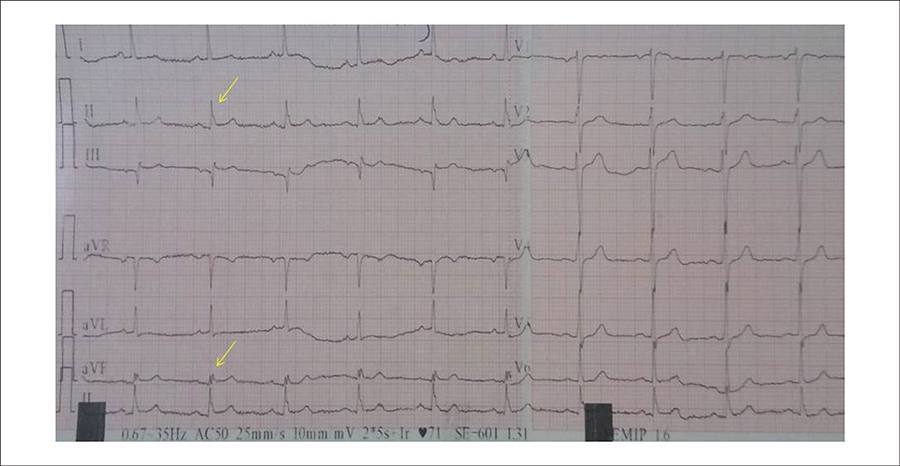
To investigate the relationship of the presence of fragmented QRS (fQRS) on admission electrocardiogram with angiographically detected CAD and CAD severity in patients without known vascular diseases and myocardial fibrosis, undergoing first diagnostic coronary angiography.

Methods:

We enrolled 336 consecutive patients undergoing coronary angiography for suspected CAD. The patients were divided into two groups according to the presence or absence of fQRS on admission. We compared the groups regarding the presence and severity of CAD.

Results:

Seventy-nine (23.5%) patients had fQRS on admission. There was not a statistically significant difference between patients with fQRS (41.8%) and non-fQRS (30.4%), regarding the presence of CAD (p = 0.059). However, there was a statistically significant difference between patients with fQRS and non-fQRS regarding the presence of stenotic CAD (40.5% vs. 10.5%, p<0.001) and multi vessel disease (25,3% vs. 5.1%, p22 compared to patients with SYNTAX score ≤22.

Conclusions:

Our findings suggest that fQRS may be an indicator of early-stage myocardial damage preceding the appearance of fibrosis and scar, and may be used for risk stratification in patients undergoing first diagnostic coronary angiography

  • Coronary Angiography
  • Coronary Artery Disease
  • Electrocardiography
  • Fragmented QRS
  • SYNTAX score
Read Full Article
Creative Commons Attribution (CC BY) Creative Commons license
01/10/2016 DOI: 10.5935/abc.20160139 Views 2
Figure 1
ABC
Original Article

Syntax Score and Major Adverse Cardiac Events in Patients with Suspected Coronary Artery Disease: Results from a Cohort Study in a University-Affiliated Hospital in Southern Brazil

Felipe C. Fuchs et al. Jorge P. Ribeiro Flávio D. Fuchs Marco V. Wainstein … Luis C. Bergoli Rodrigo V. Wainstein Vanessa Zen Alessandra C. Kerkhoff Leila B. Moreira Sandra C. Fuchs

Abstract

Background:

The importance of coronary anatomy in predicting cardiovascular events is well known. The use of traditional anatomical scores in routine angiography, however, has not been incorporated to clinical practice. SYNTAX score (SXscore) is a scoring system that estimates the anatomical extent of coronary artery disease (CAD). Its ability to predict outcomes based on a baseline diagnostic angiography has not been tested to date.

Objective:

To evaluate the performance of the SXscore in predicting major adverse cardiac events (MACE) in patients referred for diagnostic angiography.

Methods:

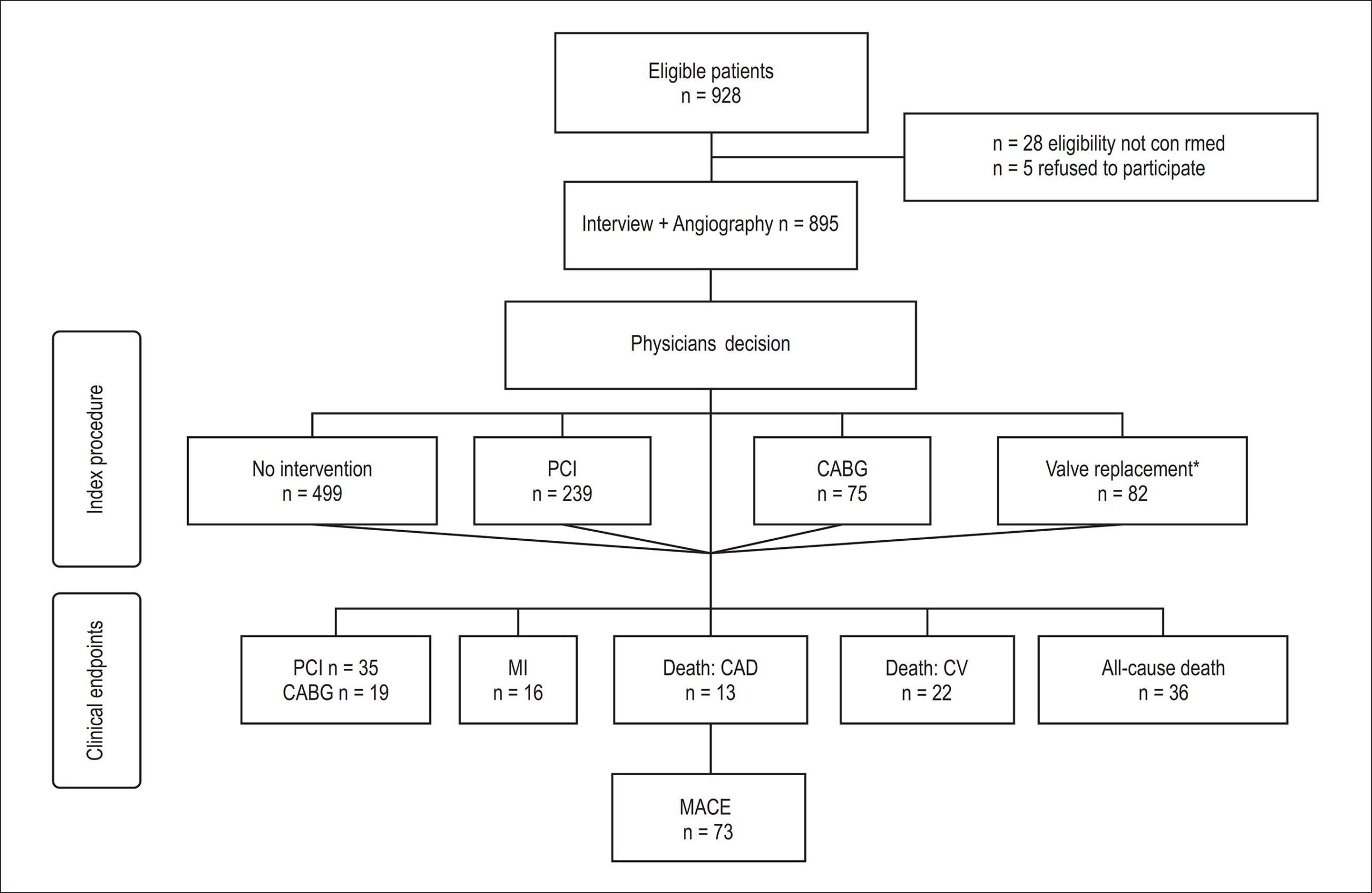
Prospective cohort of 895 patients with suspected CAD referred for elective diagnostic coronary angiography from 2008 to 2011, at a university-affiliated hospital in Brazil. They had their SXscores calculated and were stratified in three categories: no significant CAD (n = 495), SXscoreLOW-INTERMEDIATE: < 23 (n = 346), and SXscoreHIGH: ≥ 23 (n = 54). Primary outcome was a composite of cardiac death, myocardial infarction, and late revascularization. Secondary endpoints were the components of MACE and death from any cause.

Results:

On average, patients were followed up for 1.8 ± 1.4 years. The primary outcome occurred in 2.2%, 15.3%, and 20.4% in groups with no significant CAD, SXscoreLOW-INTERMEDIATE, and SXscoreHIGH, respectively (p < 0.001). All-cause death was significantly higher in the SXscoreHIGH compared with the ‘no significant CAD’ group, 16.7% and 3.8% (p < 0.001), respectively. After adjustment for confounding factors, all outcomes remained associated with the SXscore.

Conclusions:

SXscore independently predicts MACE in patients submitted to diagnostic coronary angiography. Its routine use in this setting could identify patients with worse prognosis.

  • Cineangiography
  • Cohort Studies
  • Coronary Artery Disease / epidemiology
  • Probability
  • SYNTAX score
Read Full Article
Creative Commons Attribution (CC BY) Creative Commons license
08/08/2016 DOI: 10.5935/abc.20160111 Views 1
Figure 1
ABC
Artigo Original

Value of coronary artery calcium score to predict severity or complexity of coronary artery disease

Tayyar Gökdeniz et al. Ezgi Kalaycıoğlu Ahmet Çağrı Aykan Faruk Boyacı … Turan Turhan İlker Gül Gökhan Çavuşoğlu İhsan Dursun

BACKGROUND:

Prediction of severity or complexity of coronary artery disease (CAD) is valuable owing to increased risk for cardiovascular events. Although the association between total coronary artery calcium (CAC) score and severity of CAD, Gensini score was not used, it has been previously demonstrated. There is no information about the association between total CAC score and complexity of CAD.

OBJECTIVES:

To investigate the association between severity or complexity of coronary artery disease (CAD) assessed by Gensini score and SYNTAX score (SS), respectively, and coronary artery calcium (CAC) score, which is a noninvasive method for CAD evaluation in symptomatic patients with accompanying significant CAD.

METHODS:

Two-hundred-fourteen patients were enrolled. Total CAC score was obtained before angiography. Severity and complexity of CAD was assessed by Gensini score and SS, respectively. Associations between clinical and angiographic parameters and total CAC score were analyzed.

RESULTS:

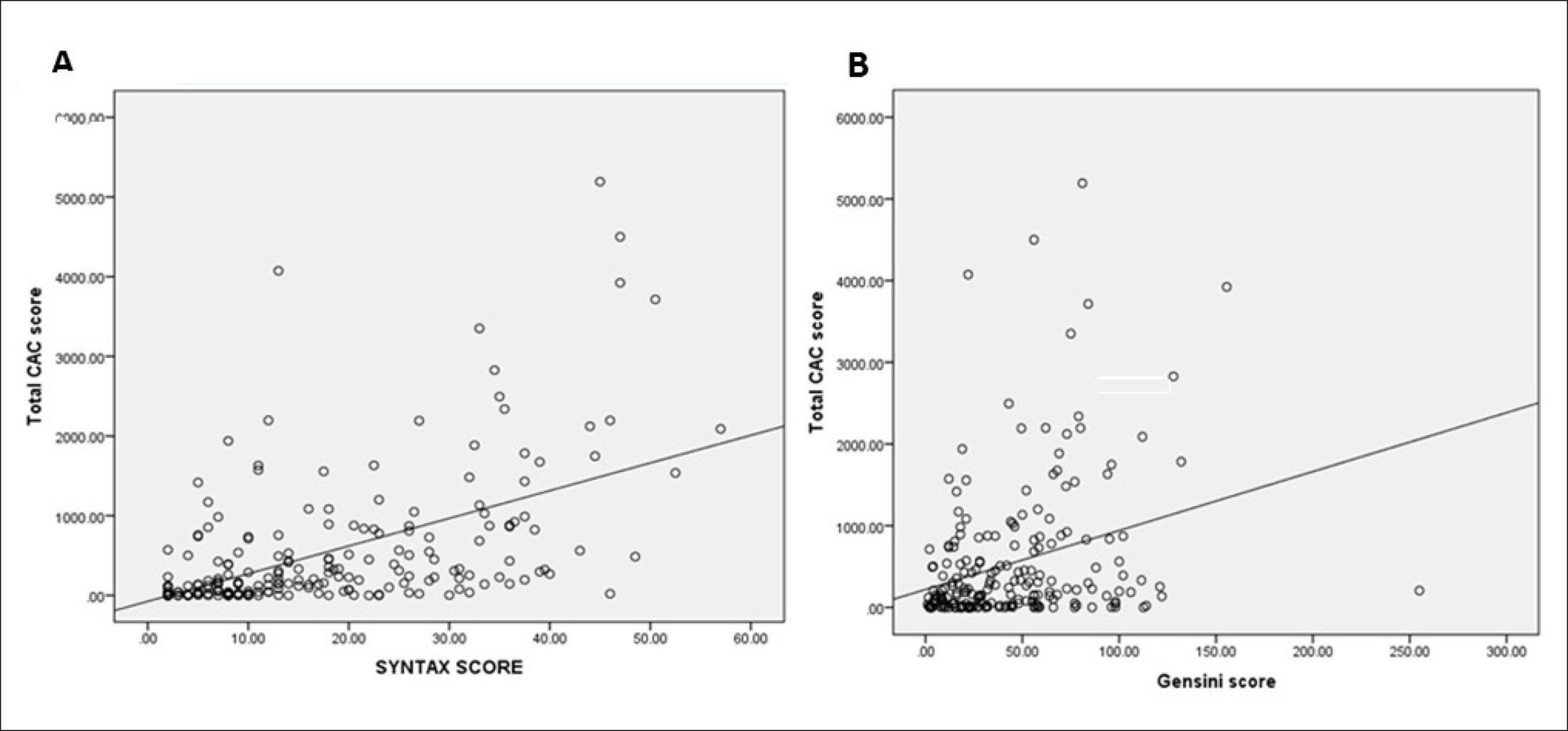
Median total CAC score was 192 (23.0-729.8), and this was positively correlated with both Gensini score (r: 0.299, p<0.001) and SS (r: 0.577, p<0.001). At multivariate analysis, it was independently associated with age (ß: 0.154, p: 0.027), male gender (ß: 0.126, p: 0.035) and SS (ß: 0.481, p 809 for SS >32 (high SS tertile).

CONCLUSION:

In symptomatic patients with accompanying significant CAD, total CAC score was independently associated with SS and patients with SS >32 may be detected through high Agatston score.

  • Coronary Artery Disease
  • Gensini score
  • SYNTAX score
  • Total coronary calcium score
Read Full Article
Creative Commons Attribution (CC BY) Creative Commons license
14/12/2013 DOI: 10.5935/abc.20130241 Views 2

How to cite this article

EndNote RIS

Electronic Document Format (Vancouver)

Oflar E, Sahin MH, Demir B, Ertugrul AS, Oztas DM, Beyaz MO, Ugurlucan M, et al. Interleukin-35 Levels in Patients with Stable Coronary Artery Disease. Arquivos Brasileiros de Cardiologia 2022;118(2):400-8.

Electronic Document Format (ABNT)

Oflar, Ersan; Sahin, Mustafa Hakan; Demir, Bulent; Ertugrul, Abdulcelil Sait; Oztas, Didem Melis; Beyaz, Metin Onur; Ugurlucan, Murat; Caglar, Fatma Nihan Turhan. Interleukin-35 Levels in Patients with Stable Coronary Artery Disease. Arquivos Brasileiros de Cardiologia, v. 118, n. 2, p. 400-408, Mar. 2022.

Electronic Document Format (APA)

Oflar, E., Sahin, M. H., Demir, B., Ertugrul, A. S., Oztas, D. M., Beyaz, M. O., Ugurlucan, M., & Caglar, F. N. T. (2022). Interleukin-35 Levels in Patients with Stable Coronary Artery Disease. Arquivos Brasileiros de Cardiologia, 118(2), 400-408.

Electronic Document Format (ISO)

Oflar, Ersan and Sahin, Mustafa Hakan and Demir, Bulent and Ertugrul, Abdulcelil Sait and Oztas, Didem Melis and Beyaz, Metin Onur and Ugurlucan, Murat and Caglar, Fatma Nihan Turhan. Interleukin-35 Levels in Patients with Stable Coronary Artery Disease. Arquivos Brasileiros de Cardiologia [online]. 2022, vol. 118, n. 2, [cited 2026-10-14], pp. 400-408. Available from: <https://journals.cardiol.br/en/article/interleukin-35-levels-in-patients-with-stable-coronary-artery-disease/>. ISSN 0066-782X

EndNote RIS

Electronic Document Format (Vancouver)

Eyuboglu M, Ekinci MA, Karakoyun S, kucuk U, Senarslan O, Akdeniz B. Fragmented QRS for Risk Stratification in Patients Undergoing First Diagnostic Coronary Angiography. Arquivos Brasileiros de Cardiologia 2016;107(4):299-304.

Electronic Document Format (ABNT)

Eyuboglu, Mehmet; Ekinci, Mehmet Akif; Karakoyun, Suleyman; kucuk, Ugur; Senarslan, Omer; Akdeniz, Bahri. Fragmented QRS for Risk Stratification in Patients Undergoing First Diagnostic Coronary Angiography. Arquivos Brasileiros de Cardiologia, v. 107, n. 4, p. 299-304, Sep. 2016.

Electronic Document Format (APA)

Eyuboglu, M., Ekinci, M. A., Karakoyun, S., kucuk, U., Senarslan, O., & Akdeniz, B. (2016). Fragmented QRS for Risk Stratification in Patients Undergoing First Diagnostic Coronary Angiography. Arquivos Brasileiros de Cardiologia, 107(4), 299-304.

Electronic Document Format (ISO)

Eyuboglu, Mehmet and Ekinci, Mehmet Akif and Karakoyun, Suleyman and kucuk, Ugur and Senarslan, Omer and Akdeniz, Bahri. Fragmented QRS for Risk Stratification in Patients Undergoing First Diagnostic Coronary Angiography. Arquivos Brasileiros de Cardiologia [online]. 2016, vol. 107, n. 4, [cited 2026-10-14], pp. 299-304. Available from: <https://journals.cardiol.br/en/article/fragmented-qrs-for-risk-stratification-in-patients-undergoing-first-diagnostic-coronary-angiography/>. ISSN 0066-782X

EndNote RIS

Electronic Document Format (Vancouver)

Fuchs FC, Ribeiro JP, Fuchs FD, Wainstein MV, Bergoli LC, Wainstein RV, Zen V, et al. Syntax Score and Major Adverse Cardiac Events in Patients with Suspected Coronary Artery Disease: Results from a Cohort Study in a University-Affiliated Hospital in Southern Brazil. Arquivos Brasileiros de Cardiologia 2016;107(3):207-15.

Electronic Document Format (ABNT)

Fuchs, Felipe C.; Ribeiro, Jorge P.; Fuchs, Flávio D.; Wainstein, Marco V.; Bergoli, Luis C.; Wainstein, Rodrigo V.; Zen, Vanessa; Kerkhoff, Alessandra C.; Moreira, Leila B.; Fuchs, Sandra C.. Syntax Score and Major Adverse Cardiac Events in Patients with Suspected Coronary Artery Disease: Results from a Cohort Study in a University-Affiliated Hospital in Southern Brazil. Arquivos Brasileiros de Cardiologia, v. 107, n. 3, p. 207-215, Aug. 2016.

Electronic Document Format (APA)

Fuchs, F. C., Ribeiro, J. P., Fuchs, F. D., Wainstein, M. V., Bergoli, L. C., Wainstein, R. V., Zen, V., Kerkhoff, A. C., Moreira, L. B., & Fuchs, S. C. (2016). Syntax Score and Major Adverse Cardiac Events in Patients with Suspected Coronary Artery Disease: Results from a Cohort Study in a University-Affiliated Hospital in Southern Brazil. Arquivos Brasileiros de Cardiologia, 107(3), 207-215.

Electronic Document Format (ISO)

Fuchs, Felipe C. and Ribeiro, Jorge P. and Fuchs, Flávio D. and Wainstein, Marco V. and Bergoli, Luis C. and Wainstein, Rodrigo V. and Zen, Vanessa and Kerkhoff, Alessandra C. and Moreira, Leila B. and Fuchs, Sandra C.. Syntax Score and Major Adverse Cardiac Events in Patients with Suspected Coronary Artery Disease: Results from a Cohort Study in a University-Affiliated Hospital in Southern Brazil. Arquivos Brasileiros de Cardiologia [online]. 2016, vol. 107, n. 3, [cited 2026-10-14], pp. 207-215. Available from: <https://journals.cardiol.br/en/article/syntax-score-and-major-adverse-cardiac-events-in-patients-with-suspected-coronary-artery-disease-results-from-a-cohort-study-in-a-university-affiliated-hospital-in-southern-brazil/>. ISSN 0066-782X

EndNote RIS

Electronic Document Format (Vancouver)

Gökdeniz T, Kalaycıoğlu E, Aykan A, Boyacı F, Turhan T, Gül , Çavuşoğlu G, et al. Value of coronary artery calcium score to predict severity or complexity of coronary artery disease. Arquivos Brasileiros de Cardiologia 2013;102(2):120-7.

Electronic Document Format (ABNT)

Gökdeniz, Tayyar; Kalaycıoğlu, Ezgi; Aykan, Ahmet Çağrı; Boyacı, Faruk; Turhan, Turan; Gül, İlker; Çavuşoğlu, Gökhan; Dursun, İhsan. Value of coronary artery calcium score to predict severity or complexity of coronary artery disease. Arquivos Brasileiros de Cardiologia, v. 102, n. 2, p. 120-127, Dec. 2013.

Electronic Document Format (APA)

Gökdeniz, T., Kalaycıoğlu, E., Aykan, A. , Boyacı, F., Turhan, T., Gül, , Çavuşoğlu, G., & Dursun, (2013). Value of coronary artery calcium score to predict severity or complexity of coronary artery disease. Arquivos Brasileiros de Cardiologia, 102(2), 120-127.

Electronic Document Format (ISO)

Gökdeniz, Tayyar and Kalaycıoğlu, Ezgi and Aykan, Ahmet Çağrı and Boyacı, Faruk and Turhan, Turan and Gül, İlker and Çavuşoğlu, Gökhan and Dursun, İhsan. Value of coronary artery calcium score to predict severity or complexity of coronary artery disease. Arquivos Brasileiros de Cardiologia [online]. 2013, vol. 102, n. 2, [cited 2026-10-14], pp. 120-127. Available from: <https://journals.cardiol.br/en/article/value-of-coronary-artery-calcium-score-to-predict-severity-or-complexity-of-coronary-artery-disease/>. ISSN 0066-782X

  • About ABC Family
  • Internal Regulation
  • Editorial Board
  • Brazilian Society of Cardiology (SBC)

Issues

SBC Guidelines

  • Videos
  • Podcasts
  • News