ABC Family Arquivos Brasileiros de Cardiologia International Journal of Cardiovascular Sciences ABC Heart Failure & Cardiomyopathy ABC Imagem Cardiovascular
Português English
ABC Family
Português English
  • About
    • About ABC Family
    • Internal Regulation
    • Editorial Board
    • Brazilian Society of Cardiology (SBC)
  • Issues
  • SBC Guidelines
  • Content
    • Videos
    • Podcasts
    • News
  • About
    • About ABC Family
    • Internal Regulation
    • Editorial Board
    • Brazilian Society of Cardiology (SBC)
  • Issues
  • SBC Guidelines
  • Content
    • Videos
    • Podcasts
    • News

ABC Family

  • ABC Family
  • Arquivos Brasileiros de Cardiologia
  • International Journal of Cardiovascular Sciences
  • ABC Heart Failure & Cardiomyopathy
  • ABC Imagem Cardiovascular
Search in

No content found.

Journals
Ordering
Article types
Others

  1. Home
  2. Keyword: Fragmented QRS
Figure 1
ABC
Original Article

Association Between Non-Dipping and Fragmented QRS Complexes in Prehypertensive Patients

Mehmet Eyuboglu et al. Bahri Akdeniz

Abstract

Background:

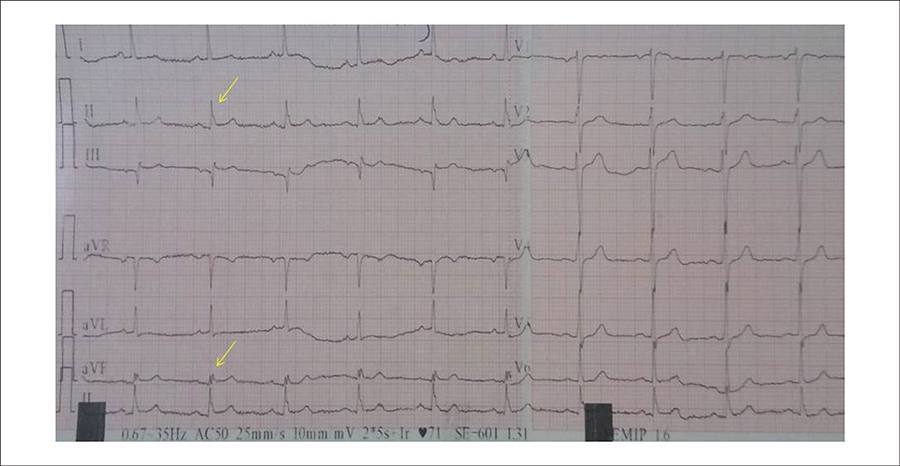
Fragmented QRS (fQRS) is a sign of adverse cardiovascular events in various cardiovascular diseases. It is also associated with increased blood pressure and non-dipping in hypertensive patients. However, no study has investigated the importance of fQRS in prehypertensive patients.

Objectives:

The aim of our study is to investigate the relationship between fQRS and non-dipper status in prehypertensive patients.

Methods:

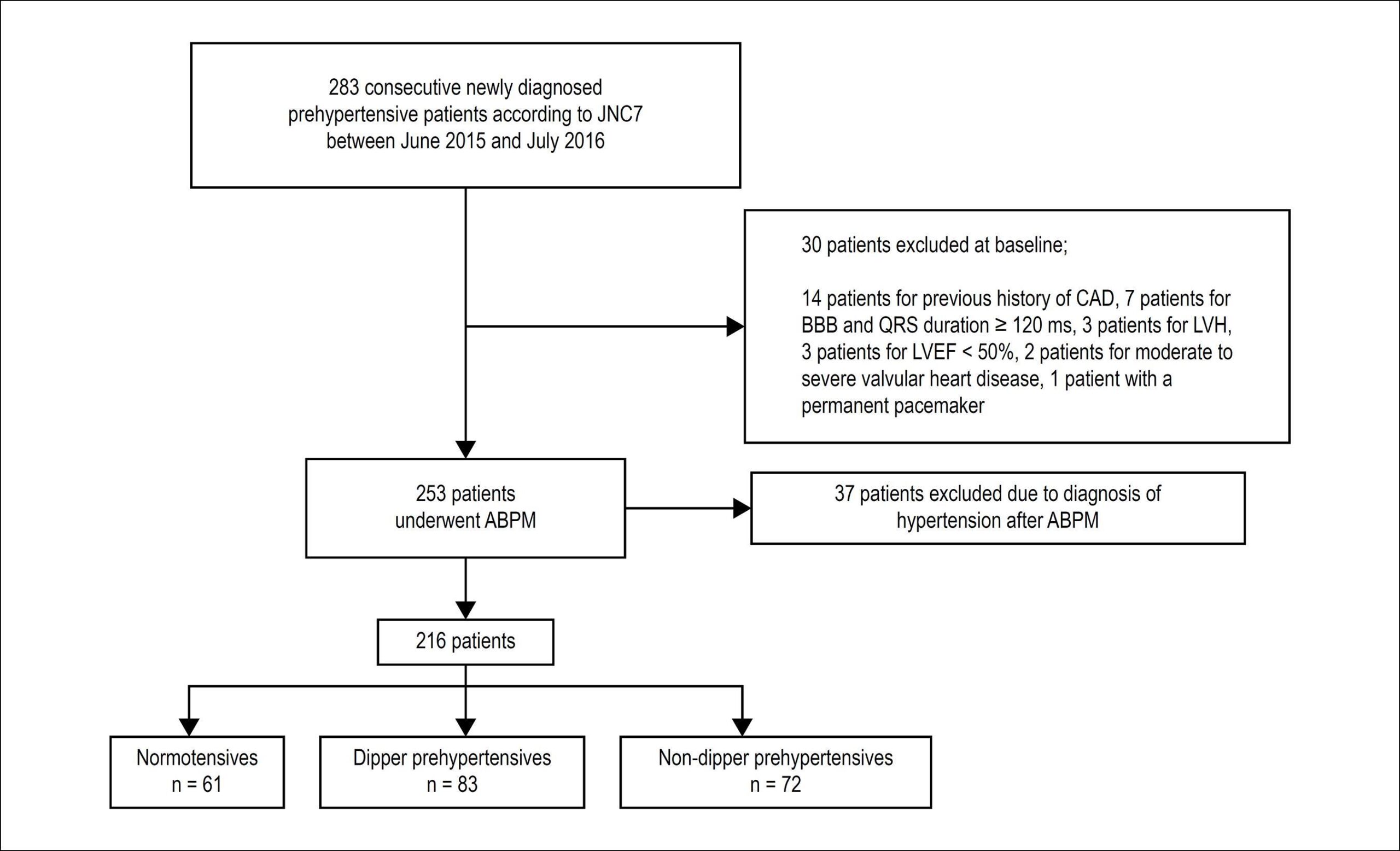
Two hundred and sixteen eligible, newly diagnosed prehypertensive patients who underwent 24-hour ambulatory blood pressure monitoring (ABPM) for further evaluation of blood pressure between June 2015 and July 2016 were included into the study. Patients were divided into three groups according to ABPM results: normotensives, dipper prehypertensives, and non-dipper prehypertensives. Groups were compared regarding presence of fQRS on electrocardiography. Additionally, multinomial logistic regression analysis was used to determine the relationship between fQRS and blood pressure pattern in prehypertensive patients.

Results:

According to ABPM recordings, 61 patients had normotensive blood pressure pattern (systolic blood pressure < 120 mmHg and diastolic blood pressure < 80 mmHg). Of the remaining 155 prehypertensive patients, 83 were dippers and 72 were non-dippers. Non-dipper prehypertensives had a significantly higher frequency of fQRS compared to normotensives (p = 0.048). Furthermore, multinomial logistic regression analysis revealed that fQRS is an independent predictor of non-dipping blood pressure pattern in prehypertensive patients (p = 0.017, OR: 4.071, 95% CI: 1.281-12.936).

Conclusions:

We found that fQRS is a predictor of non-dipping in prehypertensives. As a marker of fibrosis and higher fibrotic burden within myocardium, fQRS may be useful in identifying high-risk prehypertensive patients before the development of hypertension.
  • Ambulatory Blood Pressure Monitoring
  • Electrocardiography
  • Fragmented QRS
  • Hypertension
  • Non-dipping
  • Prehypertension
Read Full Article
Creative Commons Attribution (CC BY) Creative Commons license
17/12/2018 DOI: 10.5935/abc.20180242 Views 1
Figure 1
ABC
Original Article

Fragmented QRS for Risk Stratification in Patients Undergoing First Diagnostic Coronary Angiography

Mehmet Eyuboglu et al. Mehmet Akif Ekinci Suleyman Karakoyun Ugur kucuk … Omer Senarslan Bahri Akdeniz

Abstract

Background:

Only a small proportion of patients referred for coronary angiography with suspected coronary artery disease (CAD) have the diagnosis of obstructive CAD confirmed by the exam. For this reason, further strategies for risk stratification are necessary.

Objective:

To investigate the relationship of the presence of fragmented QRS (fQRS) on admission electrocardiogram with angiographically detected CAD and CAD severity in patients without known vascular diseases and myocardial fibrosis, undergoing first diagnostic coronary angiography.

Methods:

We enrolled 336 consecutive patients undergoing coronary angiography for suspected CAD. The patients were divided into two groups according to the presence or absence of fQRS on admission. We compared the groups regarding the presence and severity of CAD.

Results:

Seventy-nine (23.5%) patients had fQRS on admission. There was not a statistically significant difference between patients with fQRS (41.8%) and non-fQRS (30.4%), regarding the presence of CAD (p = 0.059). However, there was a statistically significant difference between patients with fQRS and non-fQRS regarding the presence of stenotic CAD (40.5% vs. 10.5%, p<0.001) and multi vessel disease (25,3% vs. 5.1%, p22 compared to patients with SYNTAX score ≤22.

Conclusions:

Our findings suggest that fQRS may be an indicator of early-stage myocardial damage preceding the appearance of fibrosis and scar, and may be used for risk stratification in patients undergoing first diagnostic coronary angiography

  • Coronary Angiography
  • Coronary Artery Disease
  • Electrocardiography
  • Fragmented QRS
  • SYNTAX score
Read Full Article
Creative Commons Attribution (CC BY) Creative Commons license
01/10/2016 DOI: 10.5935/abc.20160139 Views 2

How to cite this article

EndNote RIS

Electronic Document Format (Vancouver)

Eyuboglu M, Akdeniz B. Association Between Non-Dipping and Fragmented QRS Complexes in Prehypertensive Patients. Arquivos Brasileiros de Cardiologia 2018;112(1):59-64.

Electronic Document Format (ABNT)

Eyuboglu, Mehmet; Akdeniz, Bahri. Association Between Non-Dipping and Fragmented QRS Complexes in Prehypertensive Patients. Arquivos Brasileiros de Cardiologia, v. 112, n. 1, p. 59-64, Dec. 2018.

Electronic Document Format (APA)

Eyuboglu, M., & Akdeniz, B. (2018). Association Between Non-Dipping and Fragmented QRS Complexes in Prehypertensive Patients. Arquivos Brasileiros de Cardiologia, 112(1), 59-64.

Electronic Document Format (ISO)

Eyuboglu, Mehmet and Akdeniz, Bahri. Association Between Non-Dipping and Fragmented QRS Complexes in Prehypertensive Patients. Arquivos Brasileiros de Cardiologia [online]. 2018, vol. 112, n. 1, [cited 2026-10-14], pp. 59-64. Available from: <https://journals.cardiol.br/en/article/association-between-non-dipping-and-fragmented-qrs-complexes-in-prehypertensive-patients/>. ISSN 0066-782X

EndNote RIS

Electronic Document Format (Vancouver)

Eyuboglu M, Ekinci MA, Karakoyun S, kucuk U, Senarslan O, Akdeniz B. Fragmented QRS for Risk Stratification in Patients Undergoing First Diagnostic Coronary Angiography. Arquivos Brasileiros de Cardiologia 2016;107(4):299-304.

Electronic Document Format (ABNT)

Eyuboglu, Mehmet; Ekinci, Mehmet Akif; Karakoyun, Suleyman; kucuk, Ugur; Senarslan, Omer; Akdeniz, Bahri. Fragmented QRS for Risk Stratification in Patients Undergoing First Diagnostic Coronary Angiography. Arquivos Brasileiros de Cardiologia, v. 107, n. 4, p. 299-304, Sep. 2016.

Electronic Document Format (APA)

Eyuboglu, M., Ekinci, M. A., Karakoyun, S., kucuk, U., Senarslan, O., & Akdeniz, B. (2016). Fragmented QRS for Risk Stratification in Patients Undergoing First Diagnostic Coronary Angiography. Arquivos Brasileiros de Cardiologia, 107(4), 299-304.

Electronic Document Format (ISO)

Eyuboglu, Mehmet and Ekinci, Mehmet Akif and Karakoyun, Suleyman and kucuk, Ugur and Senarslan, Omer and Akdeniz, Bahri. Fragmented QRS for Risk Stratification in Patients Undergoing First Diagnostic Coronary Angiography. Arquivos Brasileiros de Cardiologia [online]. 2016, vol. 107, n. 4, [cited 2026-10-14], pp. 299-304. Available from: <https://journals.cardiol.br/en/article/fragmented-qrs-for-risk-stratification-in-patients-undergoing-first-diagnostic-coronary-angiography/>. ISSN 0066-782X

  • About ABC Family
  • Internal Regulation
  • Editorial Board
  • Brazilian Society of Cardiology (SBC)

Issues

SBC Guidelines

  • Videos
  • Podcasts
  • News