ABC Family Arquivos Brasileiros de Cardiologia International Journal of Cardiovascular Sciences ABC Heart Failure & Cardiomyopathy ABC Imagem Cardiovascular
Português English
ABC Family
Português English
  • About
    • About ABC Family
    • Internal Regulation
    • Editorial Board
    • Brazilian Society of Cardiology (SBC)
  • Issues
  • SBC Guidelines
  • Content
    • Videos
    • Podcasts
    • News
  • About
    • About ABC Family
    • Internal Regulation
    • Editorial Board
    • Brazilian Society of Cardiology (SBC)
  • Issues
  • SBC Guidelines
  • Content
    • Videos
    • Podcasts
    • News

ABC Family

  • ABC Family
  • Arquivos Brasileiros de Cardiologia
  • International Journal of Cardiovascular Sciences
  • ABC Heart Failure & Cardiomyopathy
  • ABC Imagem Cardiovascular
Search in

No content found.

Journals
Ordering
Article types
Others

  1. Home
  2. Keyword: Stroke Volume / physiology
IJCS
Editorial

The Ejection Fraction Returns to Hyde Park Session's Speakers' Corner

Wolney de Andrade Martins et al. Antonio José Lagoeiro Jorge

The ejection fraction returns to Hyde Park Session’s Speakers’ Corner

About two decades ago, the Heart Failure Society of America created the Hyde Park Session at its annual meeting. The analogy with the free and innovative proposals that took place in the historic London park were transposed to that scientific event. One of the first proposals made there was the extinction of the left ventricular ejection fraction (LVEF) as if it was an absolutist tyrant determining the life of his/her subjects. The proposition took no breath. The overwhelming majority of heart failure (HF) trials used LVEF as an inclusion criterion. The cutoff points varied. Magical numbers had little pathophysiological or clinical foundation. LVEF was measured by noninvasive methods, especially echocardiography, with high intra-and inter-examiner variability, dependent on preload and afterload changes.

Later, in 2001, a clinical entity was recognized, where acute pulmonary edema of cardiogenic cause occurred despite LVEF at levels above 50%. The following years saw incredulous initial acceptance until the epidemiological and clinical characterization of what we today call “heart failure with preserved ejection fraction (HFpEF).” From rare, it became frequent, especially in primary care. Considered benign, the prognosis became almost as reserved as heart failure with reduced ejection fraction (HFrEF). There were different proposals for diagnosis, prognostic scores, but such evolution in the knowledge of HFpEF resulted in a frustrating succession of negative therapeutic trials.

[…]

  • Heart Failure/physiopathology
  • Prognosis
  • Stroke Volume / physiology
  • Ventricular Dysfunction
Read Full Article
Creative Commons Attribution (CC BY) Creative Commons license
17/02/2020 DOI: 10.36660/ijcs.20190230
Chart 1
IJCS
Original Article

Decompensated Heart Failure with Mid-Range Ejection Fraction: Epidemiology and In-Hospital Mortality Risk Factors

Gabriela Paiva Cavalcanti et al. Camila Sarteschi Glory Eithne Sarinho Gomes Carolina de Araújo Medeiros … José Henrique Martins Pimentel André Rabelo Lafayette Maria Celita Almeida Paulo Sérgio Rodrigues Oliveira Silvia Marinho Martins

Abstract

Background:

Recently, a new HF entity, with LVEF between 40-49%, was presented to comprehend and seek better therapy for HF with preserved LVEF (HFpEF) and borderline, in the means that HF with reduced LVEF (HFrEF) already has well-defined therapy in the literature.

Objective:

To compare the clinical-therapeutic profile of patients with HF with mid-range LVEF (HFmrEF) with HFpEF and HFrEF and to verify predictors of hospital mortality.

Method:

Historical cohort of patients admitted with decompensated HF at a supplementary hospital in Recife/PE between April/2007 – August/2017, stratified by LVEF (< 40%/40 – 49/≥ 50%), based on the guideline of the European Society of Cardiology (ESC) 2016. The groups were compared and Logistic Regression was used to identify predictors of independent risk for in-hospital death.

Results:

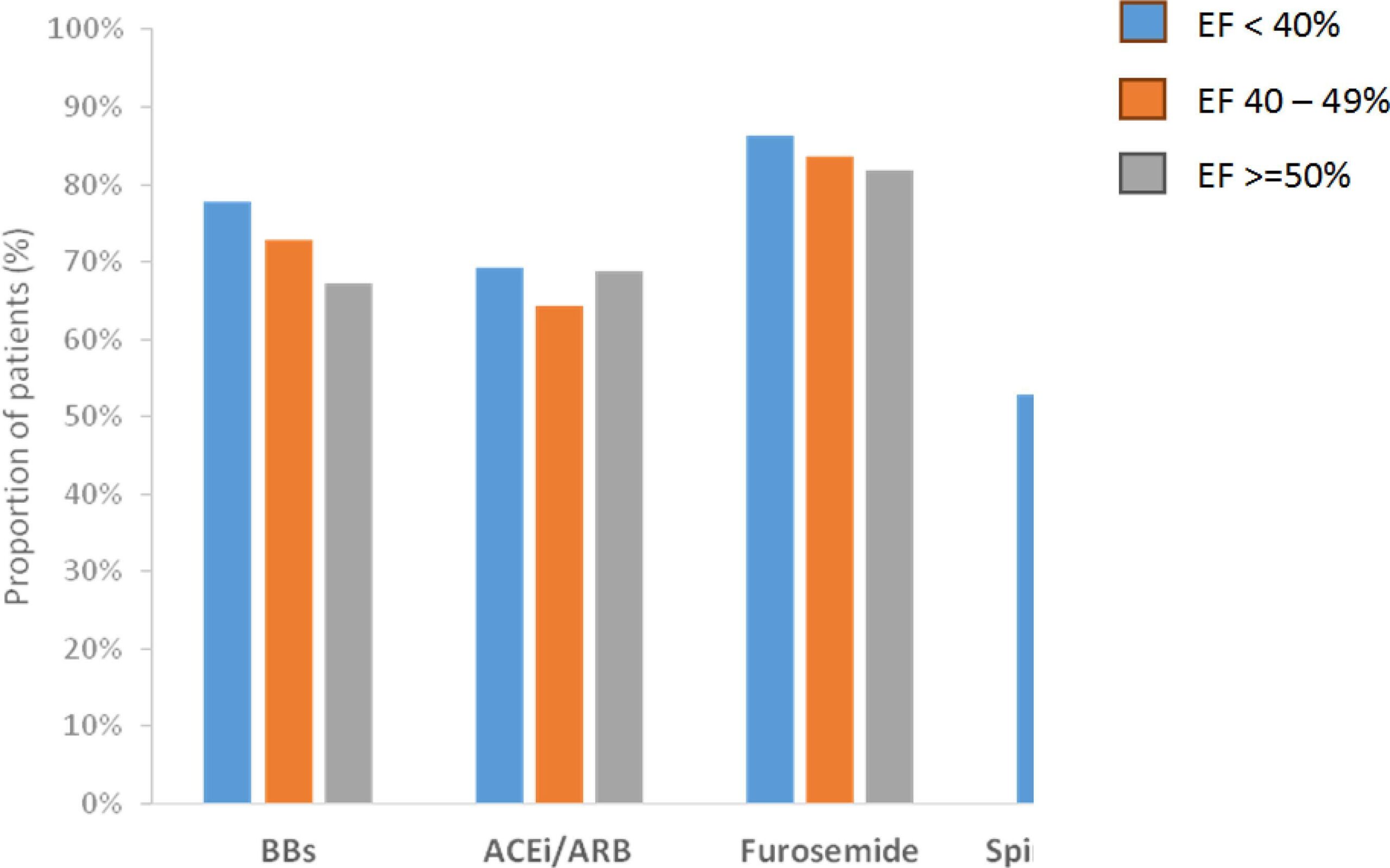
A sample of 493 patients, most with HFrEF (43%), HFpEF (30%) and HFmrEF (26%). Average age of 73 (± 14) years, 59% men. Hospital mortality 14%, readmission within 30 days 19%. In therapeutics, it presented statistical significance among the 3 groups, spironolactone, in HFrEF patients. Hospital death and readmission within 30 days did not make difference. In the HFmrEF group, factors independently associated with death were: valve disease (OR: 4.17, CI: 1.01-9.13), altered urea at admission (OR: 6.18, CI: 1.78-11.45) and beta-blocker hospitalization (OR: 0.29, CI: 0.08-0.97). In HFrEF, predictors were: prior renal disease (OR: 2.84, CI: 1.19-6.79), beta-blocker at admission (OR: 0.29, CI: 0.12-0.72) and ACEI/ ARB (OR: 0.21, CI: 0.09-0.49). In HFpEF, only valve disease (OR: 4.61, CI: 1.33-15.96) and kidney disease (OR: 5.18, CI: 1.68-11.98) were relevant.

Conclusion:

In general, HFmrEF presented intermediate characteristics between HFrEF and HFpEF. Independent predictors of mortality may support risk stratification and management of this group.

  • Epidemiology
  • Heart Failure/physiopatology
  • Hospital Mortality
  • Prognosis
  • Stroke Volume / physiology
Read Full Article
Creative Commons Attribution (CC BY) Creative Commons license
24/10/2019 DOI: 10.5935/2359-4802.20190075 Views 1
Figure 1
ABC
Review Article

Reverse Cardiac Remodeling: A Marker of Better Prognosis in Heart Failure

José Rosino de Araújo Rocha Reis Filho et al. Juliano Novaes Cardoso Cristina Martins dos Reis Cardoso Antonio Carlos Pereira-Barretto

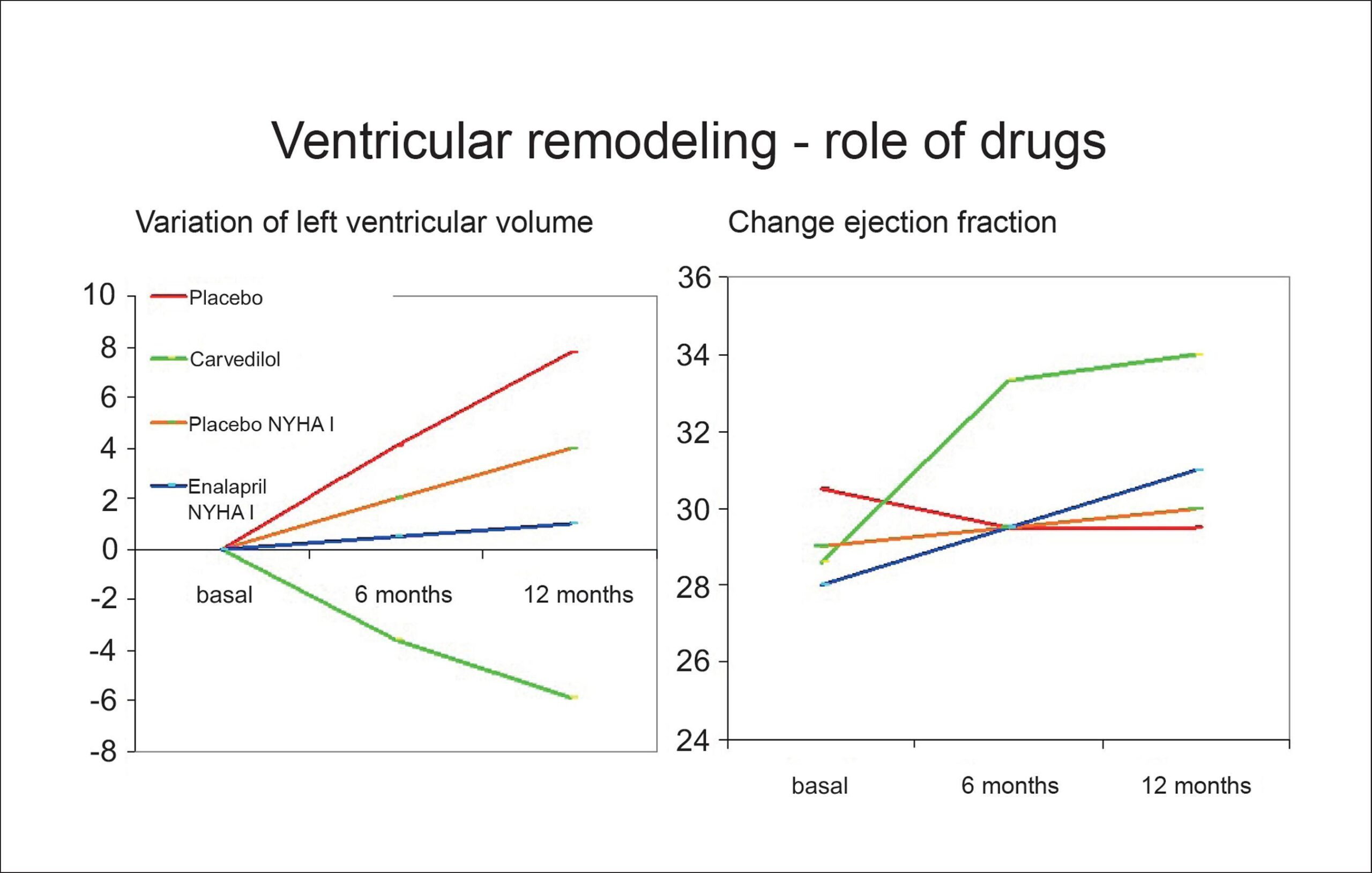
In heart failure syndrome, myocardial dysfunction causes an increase in neurohormonal activity, which is an adaptive and compensatory mechanism in response to the reduction in cardiac output. Neurohormonal activity is initially stimulated in an attempt to maintain compensation; however, when it remains increased, it contributes to the intensification of clinical manifestations and myocardial damage. Cardiac remodeling comprises changes in ventricular volume as well as the thickness and shape of the myocardial wall. With optimized treatment, such remodeling can be reversed, causing gradual improvement in cardiac function and consequently improved prognosis.

  • Heart Failure /therapy
  • Prognosis
  • Stroke Volume / physiology
  • Ventricular Remodeling
Read Full Article
Creative Commons Attribution (CC BY) Creative Commons license
27/03/2015 DOI: 10.5935/abc.20150025 Views 2

How to cite this article

EndNote RIS

Electronic Document Format (Vancouver)

Martins WA, Jorge AJL. The Ejection Fraction Returns to Hyde Park Session’s Speakers’ Corner. International Journal of Cardiovascular Sciences 2020;33(1):43-4.

Electronic Document Format (ABNT)

Martins, Wolney de Andrade; Jorge, Antonio José Lagoeiro. The Ejection Fraction Returns to Hyde Park Session’s Speakers’ Corner. International Journal of Cardiovascular Sciences, v. 33, n. 1, p. 43-44, Feb. 2020.

Electronic Document Format (APA)

Martins, W. A., & Jorge, A. J. L. (2020). The Ejection Fraction Returns to Hyde Park Session’s Speakers’ Corner. International Journal of Cardiovascular Sciences, 33(1), 43-44.

Electronic Document Format (ISO)

Martins, Wolney de Andrade and Jorge, Antonio José Lagoeiro. The Ejection Fraction Returns to Hyde Park Session’s Speakers’ Corner. International Journal of Cardiovascular Sciences [online]. 2020, vol. 33, n. 1, [cited 2026-10-14], pp. 43-44. Available from: <https://journals.cardiol.br/en/article/the-ejection-fraction-returns-to-hyde-park-sessions-speakers-corner/>. ISSN 2359-4802

EndNote RIS

Electronic Document Format (Vancouver)

Cavalcanti GP, Sarteschi C, Gomes GES, Medeiros CA, Pimentel JHM, Lafayette AR, Almeida MC, et al. Decompensated Heart Failure with Mid-Range Ejection Fraction: Epidemiology and In-Hospital Mortality Risk Factors. International Journal of Cardiovascular Sciences 2019;33(1):45-54.

Electronic Document Format (ABNT)

Cavalcanti, Gabriela Paiva; Sarteschi, Camila; Gomes, Glory Eithne Sarinho; Medeiros, Carolina de Araújo; Pimentel, José Henrique Martins; Lafayette, André Rabelo; Almeida, Maria Celita; Oliveira, Paulo Sérgio Rodrigues; Martins, Silvia Marinho. Decompensated Heart Failure with Mid-Range Ejection Fraction: Epidemiology and In-Hospital Mortality Risk Factors. International Journal of Cardiovascular Sciences, v. 33, n. 1, p. 45-54, Oct. 2019.

Electronic Document Format (APA)

Cavalcanti, G. P., Sarteschi, C., Gomes, G. E. S., Medeiros, C. A., Pimentel, J. H. M., Lafayette, A. R., Almeida, M. C., Oliveira, P. S. R., & Martins, S. M. (2019). Decompensated Heart Failure with Mid-Range Ejection Fraction: Epidemiology and In-Hospital Mortality Risk Factors. International Journal of Cardiovascular Sciences, 33(1), 45-54.

Electronic Document Format (ISO)

Cavalcanti, Gabriela Paiva and Sarteschi, Camila and Gomes, Glory Eithne Sarinho and Medeiros, Carolina de Araújo and Pimentel, José Henrique Martins and Lafayette, André Rabelo and Almeida, Maria Celita and Oliveira, Paulo Sérgio Rodrigues and Martins, Silvia Marinho. Decompensated Heart Failure with Mid-Range Ejection Fraction: Epidemiology and In-Hospital Mortality Risk Factors. International Journal of Cardiovascular Sciences [online]. 2019, vol. 33, n. 1, [cited 2026-10-14], pp. 45-54. Available from: <https://journals.cardiol.br/en/article/decompensated-heart-failure-with-mid-range-ejection-fraction-epidemiology-and-in-hospital-mortality-risk-factors/>. ISSN 2359-4802

EndNote RIS

Electronic Document Format (Vancouver)

Reis Filho JRAR, Cardoso JN, Cardoso CMR, Pereira-Barretto AC. Reverse Cardiac Remodeling: A Marker of Better Prognosis in Heart Failure. Arquivos Brasileiros de Cardiologia 2015;104(6):502-6.

Electronic Document Format (ABNT)

Reis Filho, José Rosino de Araújo Rocha; Cardoso, Juliano Novaes; Cardoso, Cristina Martins dos Reis; Pereira-Barretto, Antonio Carlos. Reverse Cardiac Remodeling: A Marker of Better Prognosis in Heart Failure. Arquivos Brasileiros de Cardiologia, v. 104, n. 6, p. 502-506, Mar. 2015.

Electronic Document Format (APA)

Reis Filho, J. R. A. R., Cardoso, J. N., Cardoso, C. M. R., & Pereira-Barretto, A. C. (2015). Reverse Cardiac Remodeling: A Marker of Better Prognosis in Heart Failure. Arquivos Brasileiros de Cardiologia, 104(6), 502-506.

Electronic Document Format (ISO)

Reis Filho, José Rosino de Araújo Rocha and Cardoso, Juliano Novaes and Cardoso, Cristina Martins dos Reis and Pereira-Barretto, Antonio Carlos. Reverse Cardiac Remodeling: A Marker of Better Prognosis in Heart Failure. Arquivos Brasileiros de Cardiologia [online]. 2015, vol. 104, n. 6, [cited 2026-10-14], pp. 502-506. Available from: <https://journals.cardiol.br/en/article/reverse-cardiac-remodeling-a-marker-of-better-prognosis-in-heart-failure/>. ISSN 0066-782X

  • About ABC Family
  • Internal Regulation
  • Editorial Board
  • Brazilian Society of Cardiology (SBC)

Issues

SBC Guidelines

  • Videos
  • Podcasts
  • News