ABC Family Arquivos Brasileiros de Cardiologia International Journal of Cardiovascular Sciences ABC Heart Failure & Cardiomyopathy ABC Imagem Cardiovascular
Português English
ABC Family
Português English
  • About
    • About ABC Family
    • Internal Regulation
    • Editorial Board
    • Brazilian Society of Cardiology (SBC)
  • Issues
  • SBC Guidelines
  • Content
    • Videos
    • Podcasts
    • News
  • About
    • About ABC Family
    • Internal Regulation
    • Editorial Board
    • Brazilian Society of Cardiology (SBC)
  • Issues
  • SBC Guidelines
  • Content
    • Videos
    • Podcasts
    • News

ABC Family

  • ABC Family
  • Arquivos Brasileiros de Cardiologia
  • International Journal of Cardiovascular Sciences
  • ABC Heart Failure & Cardiomyopathy
  • ABC Imagem Cardiovascular
Search in

No content found.

Journals
Ordering
Article types
Others

  1. Home
  2. Keyword: Social Media
ABC
Editorial

The Use of Twitter (X) by Brazilian Cardiologists: A Call to Action

Sergio Emanuel Kaiser

The prominently influential media outlet currently known as X (Formerly “Twitter”) was originally conceived as a microblogging platform intended to broadcast short status updates, amenable to immediate delivery to friends and followers. However, it has sparked a revolution in the way information is shared, opinions are expressed, and connections that are made in real-time. With its short-message format, the platform enables instant communication between individuals thousands of miles apart with just a few taps on a smartphone screen.

In the framework of machine-learning driven algorithms, highly emotional texts and images drive engagement, spread rapidly, and amplify visibility for embedded ads or sponsored messages. Profit expectations for the platform’s owners, therefore, rely on the efficiency of these algorithms to generate engagement, regardless of the accuracy and authenticity of the shared information. By 2023, sponsored (and tailored) ads accounted for 74% of the platform’s revenue.

[…]

  • Brazil
  • Cardiologists
  • Social Media
Read Full Article
Creative Commons Attribution (CC BY) Creative Commons license
20/01/2025 DOI: 10.36660/abc.20240711i
Figure 1
ABCIC
Editorial

The Use of X (Formerly Twitter) in Cardiovascular Imaging: Opportunities and Risks

Alex dos Santos Felix

Introduction

Social media has decisively transformed the way we disseminate medical information and knowledge, launching new digital tools to boost scientific debate and help redesign healthcare education. Globally, X, formerly Twitter, stands out in the medical field as a more scientific platform, with great interaction between peers, helping doctors and other healthcare professionals from all continents connect to discuss publications, debate scientific evidence, and share clinical experiences. X is also highly important as a channel for the dissemination of scientific events, courses and conferences. In a recent study involving healthcare professionals from 35 countries, Guerra et al. identified that X was the second most accessed social network (55.1%), second only to LinkedIn (60.8%). The speed of dissemination of information and interactivity are strong points of X, with the possibility of bringing together younger doctors, or those who work in institutions with lower complexity, with renowned professionals who work in large centers around the world. This valuable exchange of experiences creates a large virtual “grand round,” bringing other professionals into the debate and allowing for the discussion of controversial technical concepts and challenging clinical cases.

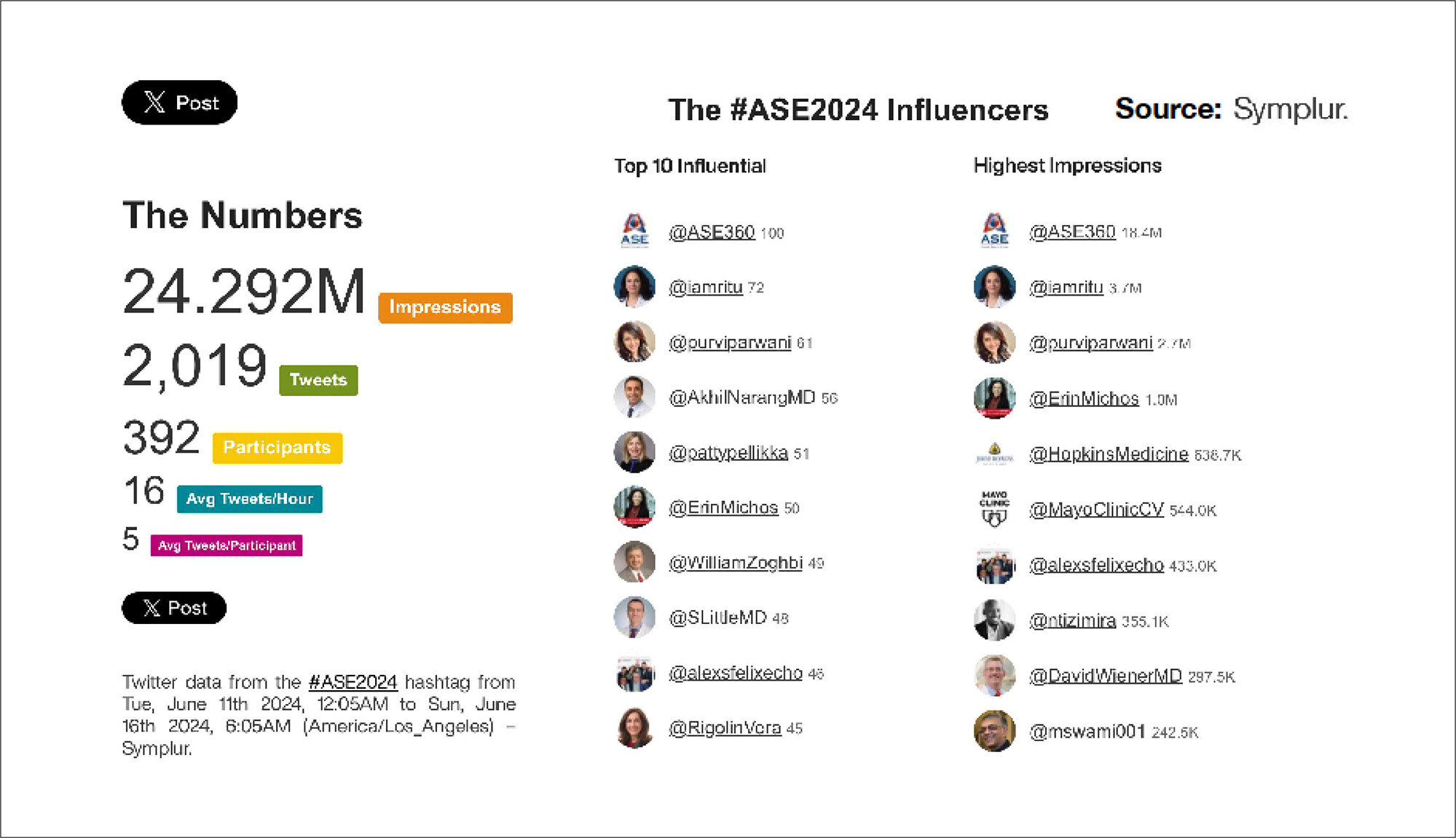
X was founded in 2006, still as Twitter, as an environment for the exchange of short messages, initially limited to 140 characters, having been extended to 280 characters in 2017, and recently relaxed to 25,000 characters for Premium users only. According to the Digital Report 2024, Brazil is the second country in the world where users spend the most time online. There are 245 million users on X, with more than 500 million posts per day, making Brazil the fourth largest user base of this platform in the world.

[…]

  • Cardiac Imaging Techniques
  • Echocardiography
  • Social Media
Read Full Article
Creative Commons Attribution (CC BY) Creative Commons license
09/12/2024 DOI: 10.36660/abcimg.20240109i
Figure 1
ABC
Letter to the Editor

The Other Side of the Coin: Risks of Media Discussions of Scientific Medical Data During the COVID-19 Pandemic

Caio Julio Fernandes et al. Fernando Ganem Fabio Gravina Olivieri Marcelo Fadul Vilibor Alfredo Salim Helito

The COVID-19 declared by the WHO in March 2020 has brought about a series of changes in the population’s daily life. Social isolation measures, quarantine, and lockdown have been implemented in diverse countries around the world. The elevated number of cases, currently close to 4 million worldwide, with more than 250,000 deaths due to the disease, has led to great interest in pathology; on account of this, a revolution has occurred in the production and publication of medical data. Numerous scientific articles evaluating all aspects of COVID-19, from epidemiology to clinical presentation and potential therapeutic options, have become available to the medical community. In a little over 4 months, more than 10,000 articles have been published on this topic, and, in a never-before-seen manner, the leading medical journals have made them available in real time, free of charge.

This speed of production and this immense quantity of available data do not come without a price. Many of these articles were not submitted to adequate review of methodology; much less were they evaluated by their peers or refined over time. The need to understand COVID-19 and to search for better alternative therapies has led to an avalanche of questionable studies. The chaff has been mixed with the wheat, and medical recommendations have started to change at frightening speeds. Data with higher degrees of reliability and evidence, derived from randomized, placebo-controlled studies, are now considered too time-consuming. Case series and expert opinions have begun to guide clinical conduct, with a direct impact on clinical management of patients. Instead of indicating solutions, the flood of studies has become a problem and begun to cause confusion regarding clinical practice for managing patients with COVID-19.

[…]

  • Communicable Diseases
  • Coronavirus
  • COVID-19
  • Diagnostic, Differencial
  • Information Technology/trends
  • Pandemics
  • Quarantine
  • Respiratory Diseases
  • Social Isolation
  • Social Media
Read Full Article
Creative Commons Attribution (CC BY) Creative Commons license
28/08/2020 DOI: 10.36660/abc.20200449
ABC
Editorial

Pandemonium During the Pandemic: What is the Role of Health and Science Professionals?

André d’Avila et al. Marco F. Vidal Melo Renato D. Lopes

The behavior of Brazilian sports commentators during the recent COVID-19 pandemic is noteworthy. Day after day, despite social distancing, they continued their television broadcasts to help ease their viewers’ discomfort. For hours, they discussed past games, current problems and the future of the sport. At no time, however, did they make comments on topics outside of their area of expertise. Although they most certainly had an opinion on the seriousness of COVID-19, the merits of social distancing or use of medications popularized by many without scientific evidence, they restricted their commentary to their areas of expertise – sports!

What has been hard to understand is the insistence of some physicians to provide opinions on unsubstantiated interventions for the treatment of COVID-19. Some simply choose medical proselytism. Others may not appreciate the need for proper scientific investigation. Many prefer to omit themselves from any debate. However, the most perplexing type of attitude is simply a reactionary behavior related to the fear of the unknown that is, the combination of desperation and need to provide care for patients, and bombardment of information from social media may bias many doctors to embrace any potential redemptive treatment. Unfortunately, the only disease treated with this approach is the anxiety shared by doctors and their patients.

[…]

  • Azythromicine/adverse effects
  • Coronavirus
  • COVID-19
  • Drug Approval
  • Ethics Committees, Research
  • Hydroxychloroquine/effects medication
  • Pandemics
  • Social Media
Read Full Article
Creative Commons Attribution (CC BY) Creative Commons license
01/06/2020 DOI: 10.36660/abc.20200320 Views 1

How to cite this article

EndNote RIS

Electronic Document Format (Vancouver)

Kaiser SE. The Use of Twitter (X) by Brazilian Cardiologists: A Call to Action. Arquivos Brasileiros de Cardiologia 2025;121(12):e20240711.

Electronic Document Format (ABNT)

Kaiser, Sergio Emanuel. The Use of Twitter (X) by Brazilian Cardiologists: A Call to Action. Arquivos Brasileiros de Cardiologia, v. 121, n. 12, e20240711, Jan. 2025.

Electronic Document Format (APA)

Kaiser, S. E. (2025). The Use of Twitter (X) by Brazilian Cardiologists: A Call to Action. Arquivos Brasileiros de Cardiologia, 121(12), e20240711.

Electronic Document Format (ISO)

Kaiser, Sergio Emanuel. The Use of Twitter (X) by Brazilian Cardiologists: A Call to Action. Arquivos Brasileiros de Cardiologia [online]. 2025, vol. 121, n. 12, [cited 2026-10-14], e20240711. Available from: <https://journals.cardiol.br/en/article/the-use-of-twitter-x-by-brazilian-cardiologists-a-call-to-action/>. ISSN 0066-782X

EndNote RIS

Electronic Document Format (Vancouver)

Felix AS. The Use of X (Formerly Twitter) in Cardiovascular Imaging: Opportunities and Risks. ABC Imagem Cardiovascular 2024;37(4):e20240109.

Electronic Document Format (ABNT)

Felix, Alex dos Santos. The Use of X (Formerly Twitter) in Cardiovascular Imaging: Opportunities and Risks. ABC Imagem Cardiovascular, v. 37, n. 4, e20240109, Dec. 2024.

Electronic Document Format (APA)

Felix, A. S. (2024). The Use of X (Formerly Twitter) in Cardiovascular Imaging: Opportunities and Risks. ABC Imagem Cardiovascular, 37(4), e20240109.

Electronic Document Format (ISO)

Felix, Alex dos Santos. The Use of X (Formerly Twitter) in Cardiovascular Imaging: Opportunities and Risks. ABC Imagem Cardiovascular [online]. 2024, vol. 37, n. 4, [cited 2026-10-14], e20240109. Available from: <https://journals.cardiol.br/en/article/the-use-of-x-formerly-twitter-in-cardiovascular-imaging-opportunities-and-risks/>. ISSN 2318-8219

EndNote RIS

Electronic Document Format (Vancouver)

Fernandes CJ, Ganem F, Olivieri FG, Vilibor MF, Helito AS. The Other Side of the Coin: Risks of Media Discussions of Scientific Medical Data During the COVID-19 Pandemic. Arquivos Brasileiros de Cardiologia 2020;115(2):278-80.

Electronic Document Format (ABNT)

Fernandes, Caio Julio; Ganem, Fernando; Olivieri, Fabio Gravina; Vilibor, Marcelo Fadul; Helito, Alfredo Salim. The Other Side of the Coin: Risks of Media Discussions of Scientific Medical Data During the COVID-19 Pandemic. Arquivos Brasileiros de Cardiologia, v. 115, n. 2, p. 278-280, Aug. 2020.

Electronic Document Format (APA)

Fernandes, C. J., Ganem, F., Olivieri, F. G., Vilibor, M. F., & Helito, A. S. (2020). The Other Side of the Coin: Risks of Media Discussions of Scientific Medical Data During the COVID-19 Pandemic. Arquivos Brasileiros de Cardiologia, 115(2), 278-280.

Electronic Document Format (ISO)

Fernandes, Caio Julio and Ganem, Fernando and Olivieri, Fabio Gravina and Vilibor, Marcelo Fadul and Helito, Alfredo Salim. The Other Side of the Coin: Risks of Media Discussions of Scientific Medical Data During the COVID-19 Pandemic. Arquivos Brasileiros de Cardiologia [online]. 2020, vol. 115, n. 2, [cited 2026-10-14], pp. 278-280. Available from: <https://journals.cardiol.br/en/article/the-other-side-of-the-coin-risks-of-media-discussions-of-scientific-medical-data-during-the-covid-19-pandemic/>. ISSN 0066-782X

EndNote RIS

Electronic Document Format (Vancouver)

d’Avila A, Melo MFV, Lopes RD. Pandemonium During the Pandemic: What is the Role of Health and Science Professionals?. Arquivos Brasileiros de Cardiologia 2020;114(5):753-4.

Electronic Document Format (ABNT)

d’Avila, André; Melo, Marco F. Vidal; Lopes, Renato D.. Pandemonium During the Pandemic: What is the Role of Health and Science Professionals?. Arquivos Brasileiros de Cardiologia, v. 114, n. 5, p. 753-754, May. 2020.

Electronic Document Format (APA)

d’Avila, A., Melo, M. F. V., & Lopes, R. D. (2020). Pandemonium During the Pandemic: What is the Role of Health and Science Professionals?. Arquivos Brasileiros de Cardiologia, 114(5), 753-754.

Electronic Document Format (ISO)

d’Avila, André and Melo, Marco F. Vidal and Lopes, Renato D.. Pandemonium During the Pandemic: What is the Role of Health and Science Professionals?. Arquivos Brasileiros de Cardiologia [online]. 2020, vol. 114, n. 5, [cited 2026-10-14], pp. 753-754. Available from: <https://journals.cardiol.br/en/article/pandemonium-during-the-pandemic-what-is-the-role-of-health-and-science-professionals/>. ISSN 0066-782X

  • About ABC Family
  • Internal Regulation
  • Editorial Board
  • Brazilian Society of Cardiology (SBC)

Issues

SBC Guidelines

  • Videos
  • Podcasts
  • News