ABC Family Arquivos Brasileiros de Cardiologia International Journal of Cardiovascular Sciences ABC Heart Failure & Cardiomyopathy ABC Imagem Cardiovascular
Português English
ABC Family
Português English
  • About
    • About ABC Family
    • Internal Regulation
    • Editorial Board
    • Brazilian Society of Cardiology (SBC)
  • Issues
  • SBC Guidelines
  • Content
    • Videos
    • Podcasts
    • News
  • About
    • About ABC Family
    • Internal Regulation
    • Editorial Board
    • Brazilian Society of Cardiology (SBC)
  • Issues
  • SBC Guidelines
  • Content
    • Videos
    • Podcasts
    • News

ABC Family

  • ABC Family
  • Arquivos Brasileiros de Cardiologia
  • International Journal of Cardiovascular Sciences
  • ABC Heart Failure & Cardiomyopathy
  • ABC Imagem Cardiovascular
Search in

No content found.

Journals
Ordering
Article types
Others

  1. Home
  2. Keyword: Reactive Oxygen Species
ABC
Editorial

Recent Advances in Oxidative Stress and Cardiovascular Diseases

Gabriela Brandão et al. Carolina R. Tonon Marina P. Okoshi

Cardiovascular diseases are the leading causes of morbidity and mortality worldwide. Oxidative stress plays an important role in the pathogenesis and progression of cardiovascular diseases such as atherosclerosis, myocardial ischemia, heart failure, and systemic and pulmonary arterial hypertension.,

Oxidative stress is characterized by an imbalance between free radical production and antioxidant defenses. Free radicals are molecules with an unpaired electron, making them highly reactive and capable of causing cellular damage. The most common free radicals are reactive oxygen species (ROS) and reactive nitrogen species (RNS). ROS include superoxide, hydroxyl radical, and hydrogen peroxide, whereas RNS comprise nitric oxide, peroxynitrite, and nitrogen dioxide. Free radicals can be produced in various cellular compartments, such as the cytoplasm, cell membrane, endoplasmic reticulum, mitochondria, and peroxisomes, mainly resulting from enzymatic reactions.

[…]

  • Antioxidants
  • Cardiovascular Diseases
  • Physiology
  • Reactive Oxygen Species
Read Full Article
Creative Commons Attribution (CC BY) Creative Commons license
29/09/2025 DOI: 10.36660/abc.20250478i Views 2
ABC
Editorial

New Method Improves the Evaluation of Subclinical Left Ventricular Dysfunction in Type 2 Diabetes Mellitus

Lutfu Askin et al. Okan Tanrıverdi Hakan Tibilli Serdar Turkmen

Tei et al. firstly described the myocardial performance index (MPI), which is showing both systolic and diastolic functions of the left ventricle. As a prognostic marker increased MPI has been shown to be an independent predictor of mortality and morbidity in various diseases such as myocardial infarction, hypertension, diabetes, and heart failure., Askin et al. showed that left ventricular (LV) diastolic and systolic functions were negatively affected in prediabetic patients. In addition, MPI can also be used in the assessment of abnormal cardiac function parameters in prediabetic patients. Furthermore, the most prominent feature of our method is that it can be obtained in a short period of time with easily available equipment. It is important to identify subclinical left ventricular diastolic dysfunction (LVDD) for clinical prevention before significant LVDD occurs. For this purpose, MPI is used to identify subclinical LVD in type 2 diabetes mellitus (DM).

Presystolic wave (PSW) measurement is obtained via doppler examination of LV outflow tract (LVOT)., Kul et al. found that the PSW is associated with subclinical LVDD in patients with type 2 diabetes. PSW is an easily measurable echocardiographic parameter obtained in late diastole and can predict subclinical left ventricular dysfunction in patients with type 2 diabetes. Possible causes of PSW formation are impaired LV compliance and increased LV stiffness, which are also leading causes of PSW in diabetic patients among others. Furthermore, the relationship between PSW and LVDD has been proven.

[…]

  • Antioxidants/pharmacology
  • Apoptosis/drug effects
  • Diabetes Mellitus
  • Dyastole
  • Heart Failure
  • Myocardial
  • Reactive Oxygen Species
  • Systole
Read Full Article
Creative Commons Attribution (CC BY) Creative Commons license
02/09/2019 DOI: 10.5935/abc.20190164 Views 2
Redox unbalance: NADPH oxidase as therapeutic target in blood pressure control
ABC
Review Article

Redox unbalance: NADPH oxidase as therapeutic target in blood pressure control

Luiza A. Rabêlo et al. Valéria Nunes de Souza Lucas José Sá da Fonseca Walkyria O. Sampaio

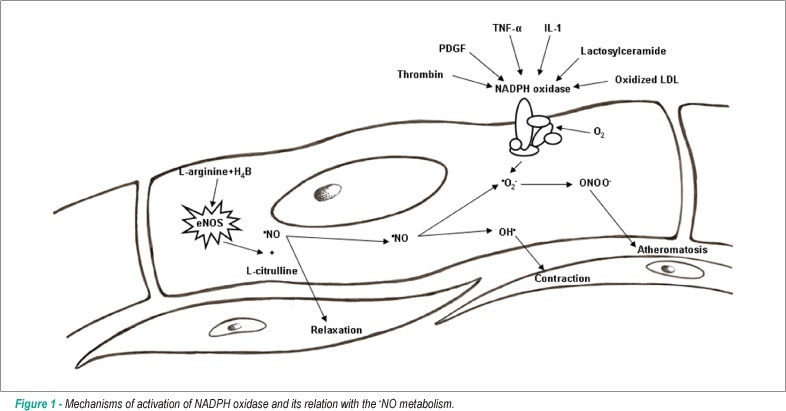
Several studies refer to reactive oxygen and nitrogen species (RONS) as important agents in the pathogenesis of a number of heart diseases, including high blood pressure, arteriosclerosis and heart failure. Such species are highly bioactive molecules and a short life due chiefly to reduction of molecular oxygen. The enzyme complex of NADPH oxidase is the main source of these reactive species in vascular system. Under physiological conditions, formation and elimination of these substances seem balanced in vascular wall. During redox Unbalance, nonetheless, there is increase in NADPH oxidase activity and predominance of pro-oxidizing agents, surpassing the anti-oxidant capacity of the organism self-defense. Besides this, such enzyme hyperactivity reduces the bioavailability of nitric oxide, capital for vasodilation and maintenance of normal vascular function. In spite of NADPH oxidase being directly connected to the endothelial dysfunction, it was firstly described as for its expression in phagocytes, where its activity determines efficiency of organism defense mechanisms against pathogens. Slight differences between structural units of NADPH oxidases, depending on the type of cell which expresses it, may create therapeutic implications, allowing to selectively inhibiting redox unbalance triggered by NADPH oxidase, without compromising, however, its participation in physiological cellular signaling which make sure protection against micro-organisms.

  • Cardiovascular Diseases
  • NADPH Oxidase
  • NADPH oxidase inhibitors
  • Oxidation-Reduction
  • reactive nitrogen species
  • Reactive Oxygen Species
Read Full Article
Creative Commons Attribution (CC BY) Creative Commons license
22/09/2010 DOI: 10.1590/S0066-782X2010000500018

How to cite this article

EndNote RIS

Electronic Document Format (Vancouver)

Brandão G, Tonon CR, Okoshi MP. Recent Advances in Oxidative Stress and Cardiovascular Diseases. Arquivos Brasileiros de Cardiologia 2025;122(8):e20250478.

Electronic Document Format (ABNT)

Brandão, Gabriela; Tonon, Carolina R.; Okoshi, Marina P.. Recent Advances in Oxidative Stress and Cardiovascular Diseases. Arquivos Brasileiros de Cardiologia, v. 122, n. 8, e20250478, Sep. 2025.

Electronic Document Format (APA)

Brandão, G., Tonon, C. R., & Okoshi, M. P. (2025). Recent Advances in Oxidative Stress and Cardiovascular Diseases. Arquivos Brasileiros de Cardiologia, 122(8), e20250478.

Electronic Document Format (ISO)

Brandão, Gabriela and Tonon, Carolina R. and Okoshi, Marina P.. Recent Advances in Oxidative Stress and Cardiovascular Diseases. Arquivos Brasileiros de Cardiologia [online]. 2025, vol. 122, n. 8, [cited 2026-10-14], e20250478. Available from: <https://journals.cardiol.br/en/article/recent-advances-in-oxidative-stress-and-cardiovascular-diseases/>. ISSN 0066-782X

EndNote RIS

Electronic Document Format (Vancouver)

Askin L, Tanrıverdi O, Tibilli H, Turkmen S. New Method Improves the Evaluation of Subclinical Left Ventricular Dysfunction in Type 2 Diabetes Mellitus. Arquivos Brasileiros de Cardiologia 2019;113(2):216-7.

Electronic Document Format (ABNT)

Askin, Lutfu; Tanrıverdi, Okan; Tibilli, Hakan; Turkmen, Serdar. New Method Improves the Evaluation of Subclinical Left Ventricular Dysfunction in Type 2 Diabetes Mellitus. Arquivos Brasileiros de Cardiologia, v. 113, n. 2, p. 216-217, Sep. 2019.

Electronic Document Format (APA)

Askin, L., Tanrıverdi, O., Tibilli, H., & Turkmen, S. (2019). New Method Improves the Evaluation of Subclinical Left Ventricular Dysfunction in Type 2 Diabetes Mellitus. Arquivos Brasileiros de Cardiologia, 113(2), 216-217.

Electronic Document Format (ISO)

Askin, Lutfu and Tanrıverdi, Okan and Tibilli, Hakan and Turkmen, Serdar. New Method Improves the Evaluation of Subclinical Left Ventricular Dysfunction in Type 2 Diabetes Mellitus. Arquivos Brasileiros de Cardiologia [online]. 2019, vol. 113, n. 2, [cited 2026-10-14], pp. 216-217. Available from: <https://journals.cardiol.br/en/article/new-method-improves-the-evaluation-of-subclinical-left-ventricular-dysfunction-in-type-2-diabetes-mellitus/>. ISSN 0066-782X

EndNote RIS

Electronic Document Format (Vancouver)

Rabêlo LA, Souza VN, Fonseca LJS, Sampaio WO. Redox unbalance: NADPH oxidase as therapeutic target in blood pressure control. Arquivos Brasileiros de Cardiologia 2010;94(5):684-93.

Electronic Document Format (ABNT)

Rabêlo, Luiza A.; Souza, Valéria Nunes de; Fonseca, Lucas José Sá da; Sampaio, Walkyria O.. Redox unbalance: NADPH oxidase as therapeutic target in blood pressure control. Arquivos Brasileiros de Cardiologia, v. 94, n. 5, p. 684-693, Sep. 2010.

Electronic Document Format (APA)

Rabêlo, L. A., Souza, V. N. , Fonseca, L. J. S. , & Sampaio, W. O. (2010). Redox unbalance: NADPH oxidase as therapeutic target in blood pressure control. Arquivos Brasileiros de Cardiologia, 94(5), 684-693.

Electronic Document Format (ISO)

Rabêlo, Luiza A. and Souza, Valéria Nunes de and Fonseca, Lucas José Sá da and Sampaio, Walkyria O.. Redox unbalance: NADPH oxidase as therapeutic target in blood pressure control. Arquivos Brasileiros de Cardiologia [online]. 2010, vol. 94, n. 5, [cited 2026-10-14], pp. 684-693. Available from: <https://journals.cardiol.br/en/article/redox-unbalance-nadph-oxidase-as-therapeutic-target-in-blood-pressure-control/>. ISSN 0066-782X

  • About ABC Family
  • Internal Regulation
  • Editorial Board
  • Brazilian Society of Cardiology (SBC)

Issues

SBC Guidelines

  • Videos
  • Podcasts
  • News