ABC Family Arquivos Brasileiros de Cardiologia International Journal of Cardiovascular Sciences ABC Heart Failure & Cardiomyopathy ABC Imagem Cardiovascular
Português English
ABC Family
Português English
  • About
    • About ABC Family
    • Internal Regulation
    • Editorial Board
    • Brazilian Society of Cardiology (SBC)
  • Issues
  • SBC Guidelines
  • Content
    • Videos
    • Podcasts
    • News
  • About
    • About ABC Family
    • Internal Regulation
    • Editorial Board
    • Brazilian Society of Cardiology (SBC)
  • Issues
  • SBC Guidelines
  • Content
    • Videos
    • Podcasts
    • News

ABC Family

  • ABC Family
  • Arquivos Brasileiros de Cardiologia
  • International Journal of Cardiovascular Sciences
  • ABC Heart Failure & Cardiomyopathy
  • ABC Imagem Cardiovascular
Search in

No content found.

Journals
Ordering
Article types
Others

  1. Home
  2. Keyword: Antioxidants/pharmacology
ABC
Editorial

New Method Improves the Evaluation of Subclinical Left Ventricular Dysfunction in Type 2 Diabetes Mellitus

Lutfu Askin et al. Okan Tanrıverdi Hakan Tibilli Serdar Turkmen

Tei et al. firstly described the myocardial performance index (MPI), which is showing both systolic and diastolic functions of the left ventricle. As a prognostic marker increased MPI has been shown to be an independent predictor of mortality and morbidity in various diseases such as myocardial infarction, hypertension, diabetes, and heart failure., Askin et al. showed that left ventricular (LV) diastolic and systolic functions were negatively affected in prediabetic patients. In addition, MPI can also be used in the assessment of abnormal cardiac function parameters in prediabetic patients. Furthermore, the most prominent feature of our method is that it can be obtained in a short period of time with easily available equipment. It is important to identify subclinical left ventricular diastolic dysfunction (LVDD) for clinical prevention before significant LVDD occurs. For this purpose, MPI is used to identify subclinical LVD in type 2 diabetes mellitus (DM).

Presystolic wave (PSW) measurement is obtained via doppler examination of LV outflow tract (LVOT)., Kul et al. found that the PSW is associated with subclinical LVDD in patients with type 2 diabetes. PSW is an easily measurable echocardiographic parameter obtained in late diastole and can predict subclinical left ventricular dysfunction in patients with type 2 diabetes. Possible causes of PSW formation are impaired LV compliance and increased LV stiffness, which are also leading causes of PSW in diabetic patients among others. Furthermore, the relationship between PSW and LVDD has been proven.

[…]

  • Antioxidants/pharmacology
  • Apoptosis/drug effects
  • Diabetes Mellitus
  • Dyastole
  • Heart Failure
  • Myocardial
  • Reactive Oxygen Species
  • Systole
Read Full Article
Creative Commons Attribution (CC BY) Creative Commons license
02/09/2019 DOI: 10.5935/abc.20190164 Views 2
Figure 1
IJCS
Original Article

Antioxidant and Vasodilatory Action of Grape Juices Produced in Different Regions of Brazil

José Britto Junior et al. Karla Carneiro Siqueira Leite Eric de Souza Gil Matheus Lavorenti Rocha

Abstract

Background:

Grapes and its derivatives (wines and juices) are rich in polyphenols that have high antioxidant and vasodilator capacity. These biological activities may vary in the juices marketed and produced in different regions of Brazil.

Objectives:

To determine the antioxidant and vasorelaxant effects of grape juice samples produced in different regions of Brazil.

Methods:

The content of phenolic compounds and antioxidant capacity were evaluated by the methods of Folin-Ciocalteau, DPPH, ABTS and a new electroanalytical approach (differential pulse voltammetry – DPV). Vasodilator effects were analyzed in isolated aorta from rats in an organ bath.

Results:

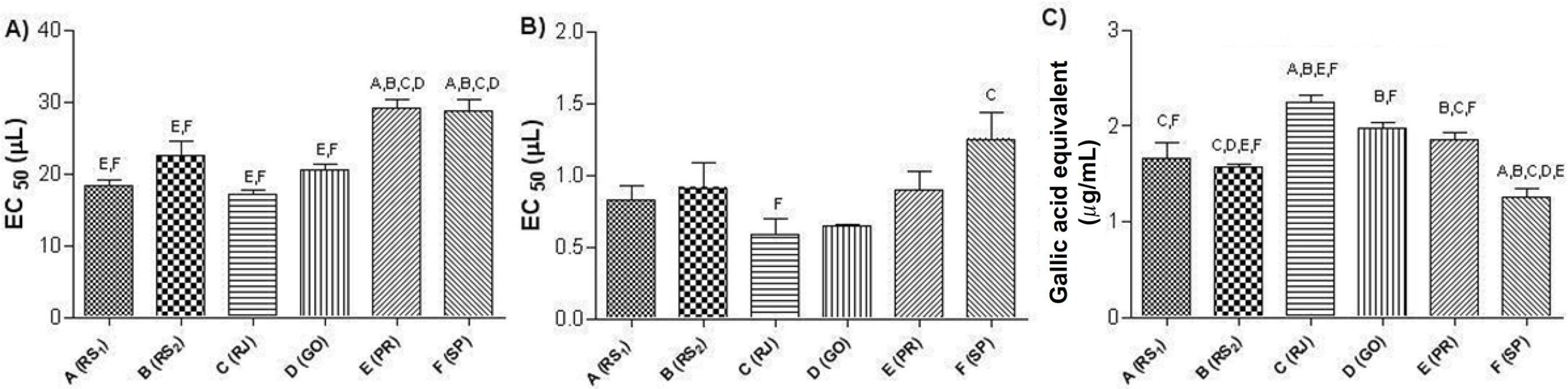
The samples from RJ and SP presented respectively the higher and lower phenolic content and also antioxidant capacity by the methods used (ABTS and DPPH). The results of the electrochemical index corroborate to the other tests, with the best results to RJ (21.69 ± 3.15 µA/V) and worse to the SP sample (11.30 ± 0.52 µA/V). In the vascular reactivity studies, the relaxation induced by each sample presented more distinct differences, following the order: RJ (87.9 ± 4.8%) > RS1 (71.6 ± 8.6%) > GO (56.2 ± 7.2%) > SP (39.9 ± 7.8%) > PR (39.4 ± 9.5%) > RS2 (19.5 ± 6.2%). Inhibition of endothelial NO practically abolished (p < 0.001) the relaxation for all samples, except one.

Conclusion:

The phenolic content and antioxidant capacity vary greatly among samples. The results obtained for the order of antioxidant activity were: RJ > RS1 > GO > RS2 > PR > SP. The juices were able to induce vascular relaxation at quite varied levels, and the RJ sample the most effective. The L-NAME practically blocked all samples except one (RS2).

  • Antioxidants/pharmacology
  • Cardiovascular Diseases/prevention and control
  • Epidemiology
  • Fruit and Vegetable Juices/analysis
  • Neoplasms/prevention and control
  • Sucos
  • Vasodilatador Agents/analysis
  • Vasodilatation
  • Vitis
Read Full Article
Creative Commons Attribution (CC BY) Creative Commons license
21/01/2019 DOI: 10.5935/2359-4802.20180097
ABC
Editorial

Cardioprotective Effects of Melatonin in Reperfusion Injury

Francisco R. M. Laurindo

The possibility of limiting ischemic myocardial injury has been a major focus of cardiovascular research over 4 decades and literally thousands of interventions have been tested in this direction. Unfortunately, this has been a long, unsolved saga, and, apart from reperfusion, most interventions have been largely unsuccessful at the clinical arena. With the advent of clinical forms of reperfusion, the goal of these studies has slightly changed to identify adjuvant therapies that protect the myocardium from reperfusion injury. However, essentially no interventions have yet come to a realistic clinical testing scenario, although cellular therapies and other emerging interventions such as mitochondrial transplantation have concrete possibilities to bring a novel perspective to cardioprotection. The overall worldwide investments in cardioprotection research by funding agencies alone can be estimated to be over US$ 1 billion so far. Thus, it is plausible to ask whether it is reasonable to keep pursuing this type of investigation. To this end, the National Institutes of Health in the USA has created a consortium to perform a rigorous preclinical assessment of cardioprotective therapies (CAESAR). At present, the answer to these questions in the ischemia/reperfusion setting has yet to wait results of ongoing studies., Meanwhile, it is likely that understanding the mechanisms whereby specific interventions afford cardioprotection in reperfusion injury can have additional mechanistic implications in other areas. For example, several abnormalities of calcium handling observed in ischemia/reperfusion can be relevant to understand the pathophysiology of heart failure, and signaling pathways associated with hypoxia responses can modulate several aspects of vascular response to injury. Therefore, the investigation of nontoxic affordable interventions that provide cardiomyocyte protection, and in particular the identification of underlying associated mechanisms, can be relevant in diverse aspects.

The article by Hu S et al., in this issue, brings a contribution to this scenario. The authors show that pharmacological concentrations of the pineal hormone melatonin (N-acetyl-5-metoxytriptamine) support cardioprotection. They first used an in vitro cardiomyocyte culture model submitted to hypoxia/reperfusion and showed that melatonin pretreatment results in decreased cell death and improved organization of the actin cytoskeleton. The authors interrogated whether these protective mechanisms could be associated with improved calcium handling. Indeed, melatonin incubation promoted decrease in cellular calcium overload and prevented the hypoxia/reperfusion-associated increase in the expression of the inositol trisphosphate receptor, as well the associated decrease in the expression of SERCA (sarcoplasmic reticulum calcium ATPase). The latter two alterations were reproduced in a rat model of ischemia/ reperfusion. Together, they indicate that the handling of calcium by the sarcoplasmic reticulum was improved, allowing the inference of a possible mechanism of cardioprotection. Of additional interest, melatonin incubation increased the phosphorylation of ERK1 (i.e., activation of the extracellular signal-regulated kinase 1) and pharmacological inhibition of ERK1 with the compound PD98059 negated the protective effects of melatonin on cell survival, actin organization and calcium handling. Thus, preservation of ERK1 activation is a likely mechanism of the protective effects of melatonin.

[…]
  • Antioxidants/pharmacology
  • Melatonin / pharmacology
  • Myocardial Reperfusion / physiopathology
  • Myocardial Reperfusion / prevention & control
Read Full Article
Creative Commons Attribution (CC BY) Creative Commons license
01/01/2018 DOI: 10.5935/abc.20180011

How to cite this article

EndNote RIS

Electronic Document Format (Vancouver)

Askin L, Tanrıverdi O, Tibilli H, Turkmen S. New Method Improves the Evaluation of Subclinical Left Ventricular Dysfunction in Type 2 Diabetes Mellitus. Arquivos Brasileiros de Cardiologia 2019;113(2):216-7.

Electronic Document Format (ABNT)

Askin, Lutfu; Tanrıverdi, Okan; Tibilli, Hakan; Turkmen, Serdar. New Method Improves the Evaluation of Subclinical Left Ventricular Dysfunction in Type 2 Diabetes Mellitus. Arquivos Brasileiros de Cardiologia, v. 113, n. 2, p. 216-217, Sep. 2019.

Electronic Document Format (APA)

Askin, L., Tanrıverdi, O., Tibilli, H., & Turkmen, S. (2019). New Method Improves the Evaluation of Subclinical Left Ventricular Dysfunction in Type 2 Diabetes Mellitus. Arquivos Brasileiros de Cardiologia, 113(2), 216-217.

Electronic Document Format (ISO)

Askin, Lutfu and Tanrıverdi, Okan and Tibilli, Hakan and Turkmen, Serdar. New Method Improves the Evaluation of Subclinical Left Ventricular Dysfunction in Type 2 Diabetes Mellitus. Arquivos Brasileiros de Cardiologia [online]. 2019, vol. 113, n. 2, [cited 2026-10-14], pp. 216-217. Available from: <https://journals.cardiol.br/en/article/new-method-improves-the-evaluation-of-subclinical-left-ventricular-dysfunction-in-type-2-diabetes-mellitus/>. ISSN 0066-782X

EndNote RIS

Electronic Document Format (Vancouver)

Britto Junior J, Leite KCS, Gil ES, Rocha ML. Antioxidant and Vasodilatory Action of Grape Juices Produced in Different Regions of Brazil. International Journal of Cardiovascular Sciences 2019;32(3):238-46.

Electronic Document Format (ABNT)

Britto Junior, José; Leite, Karla Carneiro Siqueira; Gil, Eric de Souza; Rocha, Matheus Lavorenti. Antioxidant and Vasodilatory Action of Grape Juices Produced in Different Regions of Brazil. International Journal of Cardiovascular Sciences, v. 32, n. 3, p. 238-246, Jan. 2019.

Electronic Document Format (APA)

Britto Junior, J., Leite, K. C. S., Gil, E. S., & Rocha, M. L. (2019). Antioxidant and Vasodilatory Action of Grape Juices Produced in Different Regions of Brazil. International Journal of Cardiovascular Sciences, 32(3), 238-246.

Electronic Document Format (ISO)

Britto Junior, José and Leite, Karla Carneiro Siqueira and Gil, Eric de Souza and Rocha, Matheus Lavorenti. Antioxidant and Vasodilatory Action of Grape Juices Produced in Different Regions of Brazil. International Journal of Cardiovascular Sciences [online]. 2019, vol. 32, n. 3, [cited 2026-10-14], pp. 238-246. Available from: <https://journals.cardiol.br/en/article/antioxidant-and-vasodilatory-action-of-grape-juices-produced-in-different-regions-of-brazil/>. ISSN 2359-4802

EndNote RIS

Electronic Document Format (Vancouver)

Laurindo FRM. Cardioprotective Effects of Melatonin in Reperfusion Injury. Arquivos Brasileiros de Cardiologia 2018;110(1):5-6.

Electronic Document Format (ABNT)

Laurindo, Francisco R. M.. Cardioprotective Effects of Melatonin in Reperfusion Injury. Arquivos Brasileiros de Cardiologia, v. 110, n. 1, p. 5-6, Dec. 2017.

Electronic Document Format (APA)

Laurindo, F. R. M. (2018). Cardioprotective Effects of Melatonin in Reperfusion Injury. Arquivos Brasileiros de Cardiologia, 110(1), 5-6.

Electronic Document Format (ISO)

Laurindo, Francisco R. M.. Cardioprotective Effects of Melatonin in Reperfusion Injury. Arquivos Brasileiros de Cardiologia [online]. 2018, vol. 110, n. 1, [cited 2026-10-14], pp. 5-6. Available from: <https://journals.cardiol.br/en/article/cardioprotective-effects-of-melatonin-in-reperfusion-injury/>. ISSN 0066-782X

  • About ABC Family
  • Internal Regulation
  • Editorial Board
  • Brazilian Society of Cardiology (SBC)

Issues

SBC Guidelines

  • Videos
  • Podcasts
  • News