ABC Family Arquivos Brasileiros de Cardiologia International Journal of Cardiovascular Sciences ABC Heart Failure & Cardiomyopathy ABC Imagem Cardiovascular
Português English
ABC Family
Português English
  • About
    • About ABC Family
    • Internal Regulation
    • Editorial Board
    • Brazilian Society of Cardiology (SBC)
  • Issues
  • SBC Guidelines
  • Content
    • Videos
    • Podcasts
    • News
  • About
    • About ABC Family
    • Internal Regulation
    • Editorial Board
    • Brazilian Society of Cardiology (SBC)
  • Issues
  • SBC Guidelines
  • Content
    • Videos
    • Podcasts
    • News

ABC Family

  • ABC Family
  • Arquivos Brasileiros de Cardiologia
  • International Journal of Cardiovascular Sciences
  • ABC Heart Failure & Cardiomyopathy
  • ABC Imagem Cardiovascular
Search in

No content found.

Journals
Ordering
Article types
Others

  1. Home
  2. Keyword: radiofrequency catheter ablation
Figure 1
ABC
Research Letter

Treating Brugada Syndrome: A Case of Successful Radiofrequency Catheter Ablation

Mirella Esmanhotto Facin et al. Cristiano Faria Pisani Luciana Sacilotto Francisco Carlos da Costa Darrieux … Nelson Samesima Maurício Ibrahim Scanavacca

Introduction

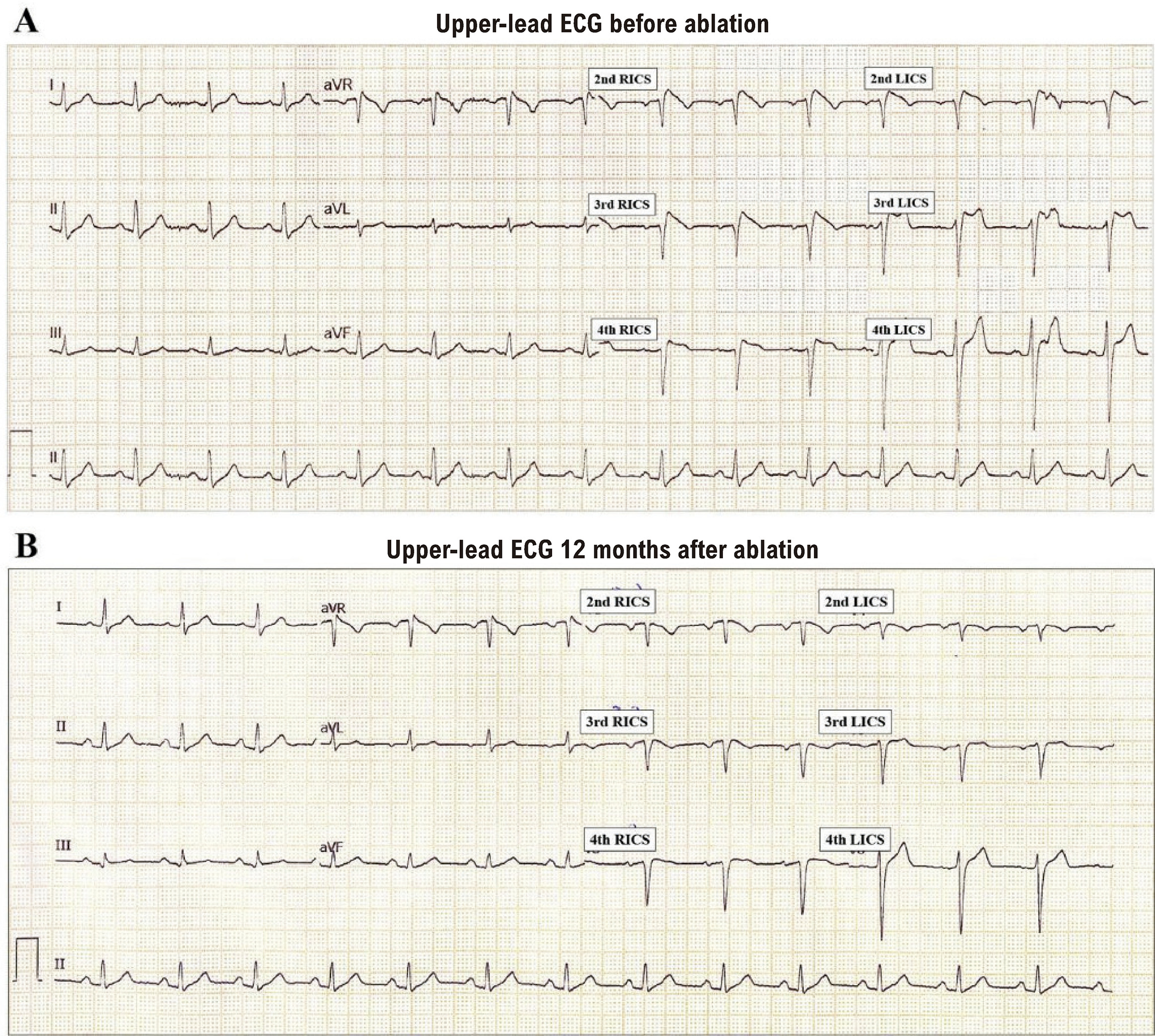
Brugada syndrome (BrS) is a severe health condition characterized by a distinctive electrocardiographic pattern and an increased risk of life-threatening cardiac arrhythmias. Traditional therapy has been limited to implantable cardioverter defibrillators (ICD). In the past two decades, however, radiofrequency catheter ablation (RFCA) has emerged as a valuable treatment option, especially for those ineligible for ICD implantation or who have already undergone appropriate device therapy., Nevertheless, reports on medium to long-term success of this procedure are still scarce. We reported herein the case of a symptomatic patient with BrS who underwent RFCA after experiencing an appropriate ICD shock.

[…]
  • Brugada Syndrome
  • implantable cardioverter-defibrillator
  • Life-threatening Arrhythmic Events
  • radiofrequency catheter ablation
Read Full Article
Creative Commons Attribution (CC BY) Creative Commons license
28/02/2025 DOI: 10.36660/abc.20240501i Views 1
Treatment of atrial fibrillation with radiofrequency ablation and simultaneous multipolar mapping of the pulmonary veins
ABC
Original Article

Treatment of atrial fibrillation with radiofrequency ablation and simultaneous multipolar mapping of the pulmonary veins

Almino C. Rocha Neto et al. Roberto Lima Farias Angelo A. V. de Paola

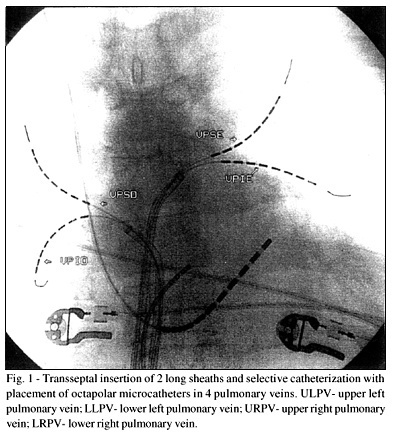
OBJECTIVE: To demonstrate the feasibility and safety of simultaneous catheterization and mapping of the 4 pulmonary veins for ablation of atrial fibrillation. METHODS: Ten patients, 8 with paroxysmal atrial fibrillation and 2 with persistent atrial fibrillation, refractory to at least 2 antiarrhythmic drugs and without structural cardiopathy, were consecutively studied. Through the transseptal insertion of 2 long sheaths, 4 pulmonary veins were simultaneously catheterized with octapolar microcatheters. After identification of arrhythmogenic foci radiofrequency was applied under angiographic or ultrasonographic control. RESULTS: During 17 procedures, 40 pulmonary veins were mapped, 16 of which had local ectopic activity, related or not with the triggering of atrial fibrillation paroxysms. At the end of each procedure, suppression of arrhythmias was obtained in 8 patients, and elimination of pulmonary vein potentials was accomplished in 4. During the clinical follow-up of 9.6±3 months, 7 patients remained in sinus rhythm, 5 of whom were using antiarrhythmic drugs that had previously been ineffective. None of the patients had pulmonary hypertension or evidence of stenosis in the pulmonary veins. CONCLUSION: Selective and simultaneous catheterization of the 4 pulmonary veins with microcatheters for simultaneous recording of their electrical activity is a feasible and safe procedure that may help ablation of atrial fibrillation.

  • Atrial Fibrillation
  • Pulmonary Veins
  • radiofrequency catheter ablation
Read Full Article
Creative Commons Attribution (CC BY) Creative Commons license
31/01/2007 DOI: 10.1590/S0066-782X2001001100003 Views 1
ABC
Artigo Original

Type I atrial flutter radiofrequency ablation. Importance of bidirectional line of block in the inferior vena cava tricuspide annulus isthmus

Mauricio Scanavacca et al. Eduardo Sosa José Luis Velarde André D'Ávila … Denise Hachul Basileu Reolão Osvaldo Sanches Márcio Silva Francisco Darrieux

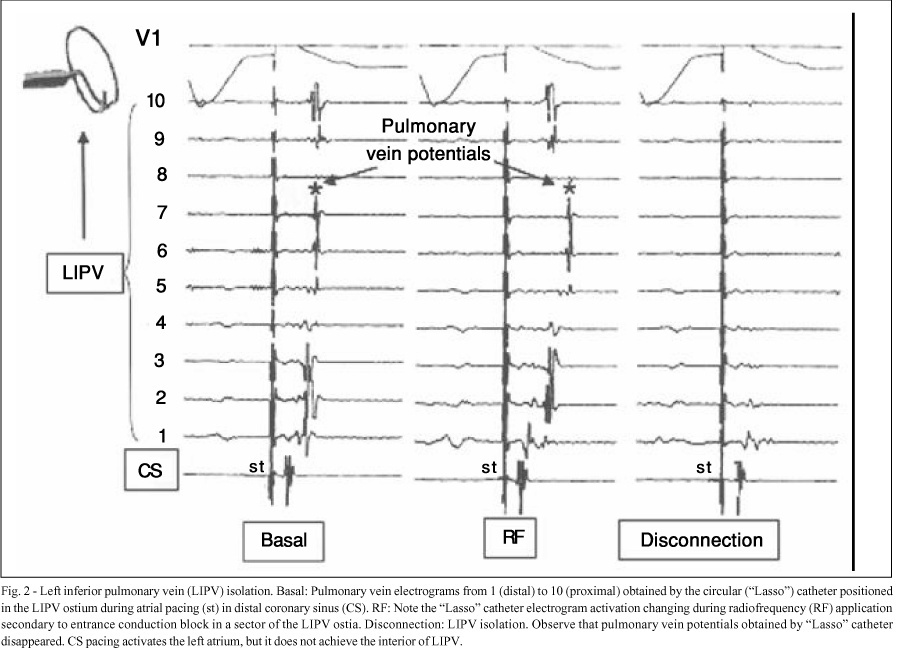
PURPOSE: To determine the clinical importance of a bi-directional line of block demonstration in the inferior vena cava-tricuspid annulus isthmus as an end-point for radiofrequency (RF) atrial flutter (FL) ablation. METHODS: Forty consecutive patients (51±11 years) with type I FL were divided in 2 groups: GI (30 patients) anatomic, non-electrophysiologic isthmus ablation technique (interruption and non-induction FL criteria); and GII (10 patients) anatomic with electrophysiologic evaluation of bi-directional isthmus conduction. The isthmus activation was analyzed before and after anatomic RF ablation with a cateter exploring each side of the line of block, depending on the conduction evaluation (anterograde or retrograde). RESULTS: FL was interrupted and not reinduced in 26/30 (86.6%) GI patients and in 10 (100%) GII patients (p= 0.5558). During follow-up FL recurred in 30% of the patients in both groups. In GII, 6 patients with bi-directional block remained assymptomatic, whereas 3 patients with unidirectional block presented recurrence (p= 0.012). CONCLUSION: Electrophysiologic demonstration of bi-directional line of block in the isthmus is related to long-term success and should be the criterion for interruption of type I atrial FL RF ablation.

  • Atrial flutter
  • radiofrequency catheter ablation
  • Supraventricular Tachycardia
Read Full Article
Creative Commons Attribution (CC BY) Creative Commons license
31/01/2007 DOI: 10.1590/S0066-782X1998001100011 Views 1
Pulmonary veins isolation to treat patients with refractory paroxysmal atrial fibrillation: clinical results after a single procedure
ABC
Artigo Original

Pulmonary veins isolation to treat patients with refractory paroxysmal atrial fibrillation: clinical results after a single procedure

Mauricio Scanavacca et al. Raul Sartini Fernando Tondato André d'Ávila … Denise Hachul Francisco Darrieux Sissy Lara Eduardo Sosa

OBJECTIVE: The purpose of this study was to access the clinical outcome of patients submitted to a single procedure of radiofrequency pulmonary veins (PV) isolation to treat refractory paroxysmal atrial fibrillation (AF). METHODS: This study included 49 consecutive patients (36 male; mean age 54±10 years old) who had frequent symptomatic paroxysmal AF refractory to at least three antiarrhythmic drugs. We used a circular decapolar catheter for mapping PVs – left atrial connections and a 4-mm distal tip catheter for ablation (30 W and 50 C), aiming to achieve electrical isolation of 3 -4 PVs. RESULTS: Twenty-five patients (51%) did not present any AF recurrence in a mean follow-up of 12±5 months. Twenty-four (49%) had at least one recurrence during outcome; twenty (83%) of them within the first month after the procedure and four after two to nine months. After introducing antiarrhythmic drugs 15 (63%) patients were under control, 10 were asymptomatic and five complained of sporadic short duration AF episodes. Nine (37%) patients remained very symptomatic despite the use of antiarrhythmic drugs and were referred to a new procedure of PV isolation. No patient presented major complications. At the end of the follow-up, 35 (71%) patients remained in stable sinus rhythm with no AF recurrences after a single procedure, 50% of them without antiarrhythmic drugs. CONCLUSION: Most patients who present symptomatic paroxysmal AF refractory to antiarrhythmic drugs obtain a good clinical control after a single PV isolation procedure.

  • Atrial Fibrillation
  • Pulmonary Veins
  • radiofrequency catheter ablation
Read Full Article
Creative Commons Attribution (CC BY) Creative Commons license
16/03/2004 DOI: 10.1590/S0066-782X2004000200007
Useful clinical features for the selection of ideal patients with strial fibrillation for mapping and catheter ablation
ABC
Original Article

Useful clinical features for the selection of ideal patients with strial fibrillation for mapping and catheter ablation

Niraj Mehta et al. Maria Zildany Pinheiro Távora Noriaki Takeschita Edilberto Figueiredo … Ricardo M. Lourenço Hélio Germiniani Dalton Précoma

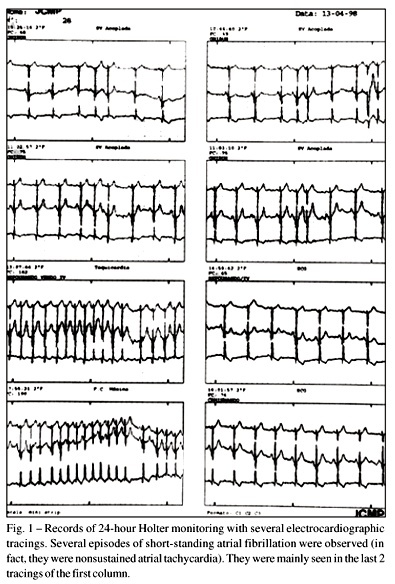
OBJECTIVE: To identify useful clinical characteristics for selecting patients eligible for mapping and ablation of atrial fibrillation. METHODS: We studied 9 patients with atrial fibrillation, without structural heart disease, associated with: 1) antiarrhythmic drugs, 2) symptoms of low cardiac output, and 3) intention to treat. Seven patients had paroxysmal atrial fibrillation and 2 had recurrent atrial fibrillation. RESULTS: In the 6 patients who underwent mapping (all had paroxysmal atrial fibrillation), catheter ablation was successfully carried out in superior pulmonary veins in 5 patients (the first 3 in the left superior pulmonary vein and the last 2 in the right superior pulmonary vein). One patient experienced a recurrence of atrial fibrillation after 10 days. We observed that patients who had short episodes of atrial fibrillation on 24-hour Holter monitoring before the procedure were those in whom mapping the focus of tachycardia was possible. Tachycardia was successfully suppressed in 4 of 6 patients. The cause of failure was due to the impossibility of maintaining sinus rhythm long enough for efficient mapping. CONCLUSION: Patients experiencing short episodes of atrial fibrillation during 24-hour Holter monitoring were the most eligible for mapping and ablation, with a final success rate of 66%, versus the global success rate of 44%. Patients with persistent atrial fibrillation were not good candidates for focal ablation.

  • Atrial Fibrillation
  • mapping
  • radiofrequency catheter ablation
Read Full Article
Creative Commons Attribution (CC BY) Creative Commons license
19/02/2002 DOI: 10.1590/S0066-782X2002000100001 Views 1

How to cite this article

EndNote RIS

Electronic Document Format (Vancouver)

Facin ME, Pisani CF, Sacilotto L, Darrieux FCC, Samesima N, Scanavacca MI. Treating Brugada Syndrome: A Case of Successful Radiofrequency Catheter Ablation. Arquivos Brasileiros de Cardiologia 2025;122(2):e20240501.

Electronic Document Format (ABNT)

Facin, Mirella Esmanhotto; Pisani, Cristiano Faria; Sacilotto, Luciana; Darrieux, Francisco Carlos da Costa; Samesima, Nelson; Scanavacca, Maurício Ibrahim. Treating Brugada Syndrome: A Case of Successful Radiofrequency Catheter Ablation. Arquivos Brasileiros de Cardiologia, v. 122, n. 2, e20240501, Feb. 2025.

Electronic Document Format (APA)

Facin, M. E., Pisani, C. F., Sacilotto, L., Darrieux, F. C. C., Samesima, N., & Scanavacca, M. I. (2025). Treating Brugada Syndrome: A Case of Successful Radiofrequency Catheter Ablation. Arquivos Brasileiros de Cardiologia, 122(2), e20240501.

Electronic Document Format (ISO)

Facin, Mirella Esmanhotto and Pisani, Cristiano Faria and Sacilotto, Luciana and Darrieux, Francisco Carlos da Costa and Samesima, Nelson and Scanavacca, Maurício Ibrahim. Treating Brugada Syndrome: A Case of Successful Radiofrequency Catheter Ablation. Arquivos Brasileiros de Cardiologia [online]. 2025, vol. 122, n. 2, [cited 2026-10-14], e20240501. Available from: <https://journals.cardiol.br/en/article/treating-brugada-syndrome-a-case-of-successful-radiofrequency-catheter-ablation/>. ISSN 0066-782X

EndNote RIS

Electronic Document Format (Vancouver)

Rocha Neto AC, Farias RL, Paola AAV. Treatment of atrial fibrillation with radiofrequency ablation and simultaneous multipolar mapping of the pulmonary veins. Arquivos Brasileiros de Cardiologia 2007;77(5):418-2.

Electronic Document Format (ABNT)

Rocha Neto, Almino C.; Farias, Roberto Lima; Paola, Angelo A. V. de. Treatment of atrial fibrillation with radiofrequency ablation and simultaneous multipolar mapping of the pulmonary veins. Arquivos Brasileiros de Cardiologia, v. 77, n. 5, p. 418-428, Jan. 2007.

Electronic Document Format (APA)

Rocha Neto, A. C., Farias, R. L., & Paola, A. A. V. (2007). Treatment of atrial fibrillation with radiofrequency ablation and simultaneous multipolar mapping of the pulmonary veins. Arquivos Brasileiros de Cardiologia, 77(5), 418-428.

Electronic Document Format (ISO)

Rocha Neto, Almino C. and Farias, Roberto Lima and Paola, Angelo A. V. de. Treatment of atrial fibrillation with radiofrequency ablation and simultaneous multipolar mapping of the pulmonary veins. Arquivos Brasileiros de Cardiologia [online]. 2007, vol. 77, n. 5, [cited 2026-10-14], pp. 418-428. Available from: <https://journals.cardiol.br/en/article/treatment-of-atrial-fibrillation-with-radiofrequency-ablation-and-simultaneous-multipolar-mapping-of-the-pulmonary-veins/>. ISSN 0066-782X

EndNote RIS

Electronic Document Format (Vancouver)

Scanavacca M, Sosa E, Velarde JL, D’Ávila A, Hachul D, Reolão B, Sanches O, et al. Type I atrial flutter radiofrequency ablation. Importance of bidirectional line of block in the inferior vena cava tricuspide annulus isthmus. Arquivos Brasileiros de Cardiologia 2007;71(5):705-11.

Electronic Document Format (ABNT)

Scanavacca, Mauricio; Sosa, Eduardo; Velarde, José Luis; D’Ávila, André; Hachul, Denise; Reolão, Basileu; Sanches, Osvaldo; Silva, Márcio; Darrieux, Francisco. Type I atrial flutter radiofrequency ablation. Importance of bidirectional line of block in the inferior vena cava tricuspide annulus isthmus. Arquivos Brasileiros de Cardiologia, v. 71, n. 5, p. 705-711, Jan. 2007.

Electronic Document Format (APA)

Scanavacca, M., Sosa, E., Velarde, J. L., D’Ávila, A., Hachul, D., Reolão, B., Sanches, O., Silva, M., & Darrieux, F. (2007). Type I atrial flutter radiofrequency ablation. Importance of bidirectional line of block in the inferior vena cava tricuspide annulus isthmus. Arquivos Brasileiros de Cardiologia, 71(5), 705-711.

Electronic Document Format (ISO)

Scanavacca, Mauricio and Sosa, Eduardo and Velarde, José Luis and D’Ávila, André and Hachul, Denise and Reolão, Basileu and Sanches, Osvaldo and Silva, Márcio and Darrieux, Francisco. Type I atrial flutter radiofrequency ablation. Importance of bidirectional line of block in the inferior vena cava tricuspide annulus isthmus. Arquivos Brasileiros de Cardiologia [online]. 2007, vol. 71, n. 5, [cited 2026-10-14], pp. 705-711. Available from: <https://journals.cardiol.br/en/article/type-i-atrial-flutter-radiofrequency-ablation-importance-of-bidirectional-line-of-block-in-the-inferior-vena-cava-tricuspide-annulus-isthmus/>. ISSN 0066-782X

EndNote RIS

Electronic Document Format (Vancouver)

Scanavacca M, Sartini R, Tondato F, d’Ávila A, Hachul D, Darrieux F, Lara S, et al. Pulmonary veins isolation to treat patients with refractory paroxysmal atrial fibrillation: clinical results after a single procedure. Arquivos Brasileiros de Cardiologia 2004;82(2):155-9.

Electronic Document Format (ABNT)

Scanavacca, Mauricio; Sartini, Raul; Tondato, Fernando; d’Ávila, André; Hachul, Denise; Darrieux, Francisco; Lara, Sissy; Sosa, Eduardo. Pulmonary veins isolation to treat patients with refractory paroxysmal atrial fibrillation: clinical results after a single procedure. Arquivos Brasileiros de Cardiologia, v. 82, n. 2, p. 155-159, Mar. 2004.

Electronic Document Format (APA)

Scanavacca, M., Sartini, R., Tondato, F., d’Ávila, A., Hachul, D., Darrieux, F., Lara, S., & Sosa, E. (2004). Pulmonary veins isolation to treat patients with refractory paroxysmal atrial fibrillation: clinical results after a single procedure. Arquivos Brasileiros de Cardiologia, 82(2), 155-159.

Electronic Document Format (ISO)

Scanavacca, Mauricio and Sartini, Raul and Tondato, Fernando and d’Ávila, André and Hachul, Denise and Darrieux, Francisco and Lara, Sissy and Sosa, Eduardo. Pulmonary veins isolation to treat patients with refractory paroxysmal atrial fibrillation: clinical results after a single procedure. Arquivos Brasileiros de Cardiologia [online]. 2004, vol. 82, n. 2, [cited 2026-10-14], pp. 155-159. Available from: <https://journals.cardiol.br/en/article/pulmonary-veins-isolation-to-treat-patients-with-refractory-paroxysmal-atrial-fibrillation-clinical-results-after-a-single-procedure/>. ISSN 0066-782X

EndNote RIS

Electronic Document Format (Vancouver)

Mehta N, Távora MZP, Takeschita N, Figueiredo E, Lourenço RM, Germiniani H, Précoma D, et al. Useful clinical features for the selection of ideal patients with strial fibrillation for mapping and catheter ablation. Arquivos Brasileiros de Cardiologia 2002;78(1):9-16.

Electronic Document Format (ABNT)

Mehta, Niraj; Távora, Maria Zildany Pinheiro; Takeschita, Noriaki; Figueiredo, Edilberto; Lourenço, Ricardo M.; Germiniani, Hélio; Précoma, Dalton. Useful clinical features for the selection of ideal patients with strial fibrillation for mapping and catheter ablation. Arquivos Brasileiros de Cardiologia, v. 78, n. 1, p. 9-16, Feb. 2002.

Electronic Document Format (APA)

Mehta, N., Távora, M. Z. P., Takeschita, N., Figueiredo, E., Lourenço, R. M., Germiniani, H., & Précoma, D. (2002). Useful clinical features for the selection of ideal patients with strial fibrillation for mapping and catheter ablation. Arquivos Brasileiros de Cardiologia, 78(1), 9-16.

Electronic Document Format (ISO)

Mehta, Niraj and Távora, Maria Zildany Pinheiro and Takeschita, Noriaki and Figueiredo, Edilberto and Lourenço, Ricardo M. and Germiniani, Hélio and Précoma, Dalton. Useful clinical features for the selection of ideal patients with strial fibrillation for mapping and catheter ablation. Arquivos Brasileiros de Cardiologia [online]. 2002, vol. 78, n. 1, [cited 2026-10-14], pp. 9-16. Available from: <https://journals.cardiol.br/en/article/useful-clinical-features-for-the-selection-of-ideal-patients-with-strial-fibrillation-for-mapping-and-catheter-ablation/>. ISSN 0066-782X

  • About ABC Family
  • Internal Regulation
  • Editorial Board
  • Brazilian Society of Cardiology (SBC)

Issues

SBC Guidelines

  • Videos
  • Podcasts
  • News