ABC Family Arquivos Brasileiros de Cardiologia International Journal of Cardiovascular Sciences ABC Heart Failure & Cardiomyopathy ABC Imagem Cardiovascular
Português English
ABC Family
Português English
  • About
    • About ABC Family
    • Internal Regulation
    • Editorial Board
    • Brazilian Society of Cardiology (SBC)
  • Issues
  • SBC Guidelines
  • Content
    • Videos
    • Podcasts
    • News
  • About
    • About ABC Family
    • Internal Regulation
    • Editorial Board
    • Brazilian Society of Cardiology (SBC)
  • Issues
  • SBC Guidelines
  • Content
    • Videos
    • Podcasts
    • News

ABC Family

  • ABC Family
  • Arquivos Brasileiros de Cardiologia
  • International Journal of Cardiovascular Sciences
  • ABC Heart Failure & Cardiomyopathy
  • ABC Imagem Cardiovascular
Search in

No content found.

Journals
Ordering
Article types
Others

  1. Home
  2. Keyword: papillary muscle
ABC
Original Article

The Dysfunctional Scenario of the Major Components Responsible for Myocardial Calcium Balance in Heart Failure Induced by Aortic Stenosis

Vitor Loureiro da Silva et al. Sérgio Luiz Borges de Souza Gustavo Augusto Ferreira Mota Dijon H. S. Campos … Alexandre Barroso Melo Danielle Fernandes Vileigas Paula Grippa Sant’Ana Priscila Murucci Coelho Silméia Garcia Zanati Bazan André Soares Leopoldo Antônio Carlos Cicogna

Abstract

Background

Maladaptive cardiac remodelling is characterized by diastolic and systolic dysfunction, culminating in heart failure. In this context, the dysfunctional scenario of cardiac calcium (Ca2+) handling has been poorly studied. An experimental model of aortic stenosis has been extensively used to improve knowledge about the key mechanisms of cardiac pathologic remodelling.

Objective

To understand the dysfunctional process of the major components responsible for Ca2+ balance and its influence on cardiac function in heart failure induced by aortic stenosis.

Methods

Male 21-day-old Wistar rats were distributed into two groups: control (sham; n= 28) and aortic stenosis (AoS; n= 18). Cardiac function was analysed by echocardiogram, isolated papillary muscle, and isolated cardiomyocytes. In the papillary muscle assay, SERCA2a and L-type Ca2+ channel activity was evaluated. The isolated cardiomyocyte assay evaluated Ca2+ handling. Ca2+ handling protein expression was analysed by western blot. Statistical significance was set at p <0.05.

Results

Papillary muscles and cardiomyocytes from AoS hearts displayed mechanical malfunction. AoS rats presented a slower time to the Ca2+ peak, reduced Ca2+ myofilament sensitivity, impaired sarcoplasmic reticulum Ca2+ influx and reuptake ability, and SERCA2a and L-type calcium channel (LTCC) dysfunction. Moreover, AoS animals presented increased expression of SERCA2a, LTCCs, and the Na+/Ca2+ exchanger.

Conclusion

Systolic and diastolic heart failure due to supravalvular aortic stenosis was paralleled by impairment of cellular Ca2+ influx and inhibition of sarcoplasmic reticulum Ca2+ reuptake due to LTCC and SERCA2a dysfunction, as well as changes in Ca2+ handling and expression of the major proteins responsible for cellular Ca2+ homeostasis.
  • Aortic Stenosis
  • calcium handling proteins
  • Heart Failure
  • isolated cardiomyocytes
  • papillary muscle
Read Full Article
Creative Commons Attribution (CC BY) Creative Commons license
28/02/2022 DOI: 10.36660/abc.20200618
Mechanical function is normal in remanent myocardium during the healing period of myocardial infarction - despite congestive heart failure
ABC
Artigo Original

Mechanical function is normal in remanent myocardium during the healing period of myocardial infarction – despite congestive heart failure

Alessandra P. O. N. Peron et al. Roberto M Saraiva Ednei L. Antonio Paulo José Ferreira Tucci

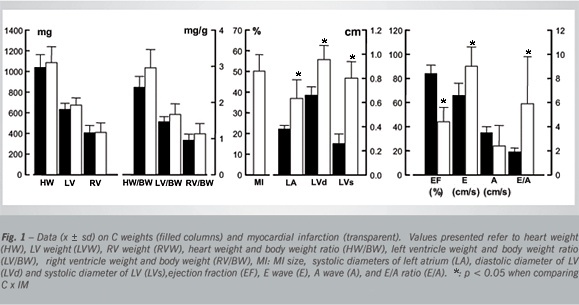
OBJECTIVE: The temporal relation between ventricular dysfunction (VD) after myocardial infarction (MI) and remanent myocardium mechanics is not yet clear. The present work investigated – through Doppler echocardiography (ECHO) – ventricular function in rats with extensive MI, as well as the mechanical function of papillary muscles (PM) at the end of the healing period. METHODS: ECHO and PM of 9 Wistar rats (MI) were studied against 9 controls (C) three weeks after LV myocardial infarction. The following were determined: developed tension (DT) and its first negative and positive derivative, time-to-peak tension (TPT), resting tension (RT), and relaxation time at 50% of DT at 0.5, 1.0, 1.5, 2.0 and 2.5 calcium concentrations (mM). Tetanic contractions were carried out after ryanodine administration at 1.5, 2.5 and 5.0 calcium concentrations. RESULTS: VD was characterized by ECHO, with marked abnormality of diastolic volume and LV and ejection fraction in addition to clear restrictive pattern of blood flow through the mitral valve. No significant difference was found in myocardial mechanics data either for MI or for C rats. CONCLUSION: The heart failure (HF) reported by MI rats with > 40% MI at the end of the healing period is not myocardial function dependent. Chamber structural changes and lower population of myocites should base VD and HF.

  • healing period
  • Myocardial Infarction
  • papillary muscle
  • Rats
  • Ventricular Dysfunction
Read Full Article
Creative Commons Attribution (CC BY) Creative Commons license
20/02/2006 DOI: 10.1590/S0066-782X2006000200005
ABC
Artigo Original

The early administration of growth hormone results in deleterious effects on ventricular remodeling after acute myocardial infarction

José G. Mill et al. Leonardo A. M. Zornoff Marina P. Okoshi Katashi Okoshi … Carlos R. Padovani Mário Sugisaki Cláudia M. Leite Antônio C. Cicogna

OBJECTIVE: To assess the effect of growth hormone (GH) on myocardial remodeling in infarcted rats. METHODS: This study comprised 24 Wistar rats divided into 3 groups as follows: 1) AMI-GH group – comprising 8 rats that underwent infarction and were treated with GH; 2) AMI group – comprising 8 rats that underwent infarction and received only the diluent of the GH solution; and 3) control group (C group) – comprising 8 rats that underwent simulated infarction. After 30 days, the animals underwent functional study through echocardiography, and the changes in myocardial contractility of the isolated left ventricular (LV) papillary muscle were studied. RESULTS:The echocardiography identified an increase in the diastolic (C=7.32±0.49; AMI=8.50±0.73; AMI-GH=9.34±0.73; P<0.05) and systolic (C=3.38±0.47, AMI=5.16±1.24; AMI-GH=5.96±1.54; P<0.05) diameters (mm) in the LV of the infarcted animals. The AMI-GH group animals had a lower ejection fraction (%) (C=0.9±0.03; AMI=0.76±0.12; AMI-GH= 0.72± 0.14; P<0.05 for C vs AMI-GH) compared with those in controls. The study of the isolated left ventricular papillary muscle showed that the AMI-GH group had changes (C= 1.50±0.59; AMI= 1.28±0.38; AMI-GH=1.98±0.41; P<0.05 for C vs AMI-GH) only in the tension at rest (TR – g/mm²) and in the time delta for a 50% decrease in the tension developed (TR50, ms) after stimulation with calcium (C=23.75±9.16; AMI=-16.56±14.82; AMI-GH=-4.69±8.39; P<0.05 for C vs AMI-GH) and in the delta of tension developed (TD, g/mm²) after stimulation with isoproterenol (C=0.99±0.17; AMI=0.54±0.62; AMI-GH=0.08±0.75; P<0.05 for C vs AMI-GH) compared with those in control animals. CONCLUSION: The early administration of GH in the experimental infarction model in rats may result in adverse effects on the process of ventricular remodeling.

  • Echocardiography
  • Hypertrophy
  • papillary muscle
  • Ventricular Function
Read Full Article
Creative Commons Attribution (CC BY) Creative Commons license
08/03/2005 DOI: 10.1590/S0066-782X2005000200005

How to cite this article

EndNote RIS

Electronic Document Format (Vancouver)

Silva VL, Souza SLB, Mota GAF, Campos DHS, Melo AB, Vileigas DF, Sant’Ana PG, et al. The Dysfunctional Scenario of the Major Components Responsible for Myocardial Calcium Balance in Heart Failure Induced by Aortic Stenosis. Arquivos Brasileiros de Cardiologia 2022;118(2):463-75.

Electronic Document Format (ABNT)

Silva, Vitor Loureiro da; Souza, Sérgio Luiz Borges de; Mota, Gustavo Augusto Ferreira; Campos, Dijon H. S.; Melo, Alexandre Barroso; Vileigas, Danielle Fernandes; Sant’Ana, Paula Grippa; Coelho, Priscila Murucci; Bazan, Silméia Garcia Zanati; Leopoldo, André Soares; Cicogna, Antônio Carlos. The Dysfunctional Scenario of the Major Components Responsible for Myocardial Calcium Balance in Heart Failure Induced by Aortic Stenosis. Arquivos Brasileiros de Cardiologia, v. 118, n. 2, p. 463-475, Feb. 2022.

Electronic Document Format (APA)

Silva, V. L. , Souza, S. L. B. , Mota, G. A. F., Campos, D. H. S., Melo, A. B., Vileigas, D. F., Sant’Ana, P. G., Coelho, P. M., Bazan, S. G. Z., Leopoldo, A. S., & Cicogna, A. C. (2022). The Dysfunctional Scenario of the Major Components Responsible for Myocardial Calcium Balance in Heart Failure Induced by Aortic Stenosis. Arquivos Brasileiros de Cardiologia, 118(2), 463-475.

Electronic Document Format (ISO)

Silva, Vitor Loureiro da and Souza, Sérgio Luiz Borges de and Mota, Gustavo Augusto Ferreira and Campos, Dijon H. S. and Melo, Alexandre Barroso and Vileigas, Danielle Fernandes and Sant’Ana, Paula Grippa and Coelho, Priscila Murucci and Bazan, Silméia Garcia Zanati and Leopoldo, André Soares and Cicogna, Antônio Carlos. The Dysfunctional Scenario of the Major Components Responsible for Myocardial Calcium Balance in Heart Failure Induced by Aortic Stenosis. Arquivos Brasileiros de Cardiologia [online]. 2022, vol. 118, n. 2, [cited 2026-10-14], pp. 463-475. Available from: <https://journals.cardiol.br/en/article/the-dysfunctional-scenario-of-the-major-components-responsible-for-myocardial-calcium-balance-in-heart-failure-induced-by-aortic-stenosis/>. ISSN 0066-782X

EndNote RIS

Electronic Document Format (Vancouver)

Peron APON, Saraiva RM, Antonio EL, Tucci PJF. Mechanical function is normal in remanent myocardium during the healing period of myocardial infarction – despite congestive heart failure. Arquivos Brasileiros de Cardiologia 2006;86(2):105-12.

Electronic Document Format (ABNT)

Peron, Alessandra P. O. N.; Saraiva, Roberto M; Antonio, Ednei L.; Tucci, Paulo José Ferreira. Mechanical function is normal in remanent myocardium during the healing period of myocardial infarction – despite congestive heart failure. Arquivos Brasileiros de Cardiologia, v. 86, n. 2, p. 105-112, Feb. 2006.

Electronic Document Format (APA)

Peron, A. P. O. N., Saraiva, R. M., Antonio, E. L., & Tucci, P. J. F. (2006). Mechanical function is normal in remanent myocardium during the healing period of myocardial infarction – despite congestive heart failure. Arquivos Brasileiros de Cardiologia, 86(2), 105-112.

Electronic Document Format (ISO)

Peron, Alessandra P. O. N. and Saraiva, Roberto M and Antonio, Ednei L. and Tucci, Paulo José Ferreira. Mechanical function is normal in remanent myocardium during the healing period of myocardial infarction – despite congestive heart failure. Arquivos Brasileiros de Cardiologia [online]. 2006, vol. 86, n. 2, [cited 2026-10-14], pp. 105-112. Available from: <https://journals.cardiol.br/en/article/mechanical-function-is-normal-in-remanent-myocardium-during-the-healing-period-of-myocardial-infarction-despite-congestive-heart-failure/>. ISSN 0066-782X

EndNote RIS

Electronic Document Format (Vancouver)

Mill JG, Zornoff LAM, Okoshi MP, Okoshi K, Padovani CR, Sugisaki M, Leite CM, et al. The early administration of growth hormone results in deleterious effects on ventricular remodeling after acute myocardial infarction. Arquivos Brasileiros de Cardiologia 2005;84(2):115-21.

Electronic Document Format (ABNT)

Mill, José G.; Zornoff, Leonardo A. M.; Okoshi, Marina P.; Okoshi, Katashi; Padovani, Carlos R.; Sugisaki, Mário; Leite, Cláudia M.; Cicogna, Antônio C.. The early administration of growth hormone results in deleterious effects on ventricular remodeling after acute myocardial infarction. Arquivos Brasileiros de Cardiologia, v. 84, n. 2, p. 115-121, Mar. 2005.

Electronic Document Format (APA)

Mill, J. G., Zornoff, L. A. M., Okoshi, M. P., Okoshi, K., Padovani, C. R., Sugisaki, M., Leite, C. M., & Cicogna, A. C. (2005). The early administration of growth hormone results in deleterious effects on ventricular remodeling after acute myocardial infarction. Arquivos Brasileiros de Cardiologia, 84(2), 115-121.

Electronic Document Format (ISO)

Mill, José G. and Zornoff, Leonardo A. M. and Okoshi, Marina P. and Okoshi, Katashi and Padovani, Carlos R. and Sugisaki, Mário and Leite, Cláudia M. and Cicogna, Antônio C.. The early administration of growth hormone results in deleterious effects on ventricular remodeling after acute myocardial infarction. Arquivos Brasileiros de Cardiologia [online]. 2005, vol. 84, n. 2, [cited 2026-10-14], pp. 115-121. Available from: <https://journals.cardiol.br/en/article/the-early-administration-of-growth-hormone-results-in-deleterious-effects-on-ventricular-remodeling-after-acute-myocardial-infarction/>. ISSN 0066-782X

  • About ABC Family
  • Internal Regulation
  • Editorial Board
  • Brazilian Society of Cardiology (SBC)

Issues

SBC Guidelines

  • Videos
  • Podcasts
  • News