Guy F. A. Prado et al. Stefano Garzon José Mariani Junior Willterson Bandeira … Felipe Mateus Teixeira Bezerra Breno Oliveira Almeida Gustavo Neves de Araujo Ana Claudia Conrado João Silveira Emanuele Barbato Flavio Ribichini Pedro Alves Lemos
Abstract
Background
Intravascular lithotripsy (IVL) has emerged as a groundbreaking technology for treating calcified coronary lesions.
Objective
To assess whether case selection and interventional performance with IVL have evolved over time after its incorporation into daily practice.
Methods
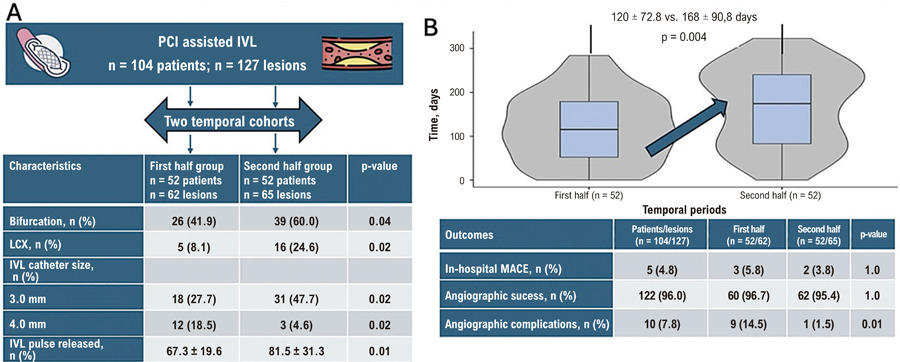
We prospectively included 104 consecutive patients with 127 calcified coronary lesions treated with IVL. The cohort was divided into two temporal groups (52 patients each) based on the order of patient inclusion. Clinical data and procedural performance were compared between the groups. All statistical tests were two-sided, with a significance level of 0.05.
Results
The mean age was 73.2 ± 10.2 years, and 62.5% of patients presented with acute coronary syndromes. Severe calcification and type B2/C lesions were identified in 73.2% and 98.4%, respectively. Upfront IVL was performed in 92.9% of lesions, intravascular imaging was used in 78%, rotational atherectomy in 6.3%, and angiographic success was achieved in 96.0%. Compared with the first cohort, the latter cohort had more bifurcation lesions (60.0% vs. 41.9%; p = 0.04), more interventions in the circumflex artery (24.6% vs. 8.1%; p = 0.02), and a lower use of 4.0-mm diameter balloons (4.6% vs. 18.5%; p = 0.02). The latter cohort spanned a longer inclusion period (168 ± 90.8 vs. 120 ± 72.8 days; p = 0.004) and had fewer angiographic complications (1.5% vs. 14.5%; p = 0.01), whereas in-hospital major adverse cardiac events did not differ (3.8% vs. 5.8%; p = 1.0).
Conclusion
IVL is an effective modality for coronary calcium modification. Temporal changes in case selection and interventional performance may reflect a learning-adaptation curve.